
World News – 2024 – Video Playlist | Video Playlists | Sites: | newsandtimes.org | links-newsandtimes.com | worldwebtimes.com | southcaucasusnews.com | russianworld.net | jossica.com | octobersurprise2016.org | bklyntimes.com | oceanavenuenews.com | fbireform.com | bloggersunite.net | octobersurprise-2024.org | Trump-News.org | Audio-Posts.com | Bklyn-NY.com | Posts Review – newsandtimes.org | Capitol-Riot.com |
The News And Times Review – NewsAndTimes.org

Hadrian in Baiae | Hadrian in Baiae
Epigraph:
Hospes comesque corporis,
Quae nunc abibis? in loca
Pallidula rigida nudula –
Nec ut soles dabis iocos…

1. Canopus
By night the heat relented; in the distance, on the shore,
Canopus flickered with fireflies of torches. The Nile was smooth,
listless, a trireme was barely noticeable, lazily swaying in its
waters. Adrian dictated the letter, Antinous massaged his sore
shoulder and from time to time poured wine into the silver cup.
Two centurions in tunics suddenly jumped up to me, one of
them pointed a sword at my ribs.
“Who are you, and what did you come for?” – Hadrian asked
warily and sternly.
I don’t remember what I answered him, but probably something
that satisfied him. He nodded to the centurions and they
retreated, but remained standing at a distance, readily.
What could I answer him?
“Just a voyeur, Caesar. Observer of people. A wanderer, like you…”
I felt that my appearance somewhat puzzled him, but he did not
show it, continuing to calmly dictate his letter. He watched me
out of the corner of his eye, studied me and, apparently,
calculated, with the automatic habit of a politician, what all this meant and how this situation could be used for his own purposes. From time to time, various people in tunics or loincloths entered the
tent and Adrian gave them orders, after which he returned to
the interrupted phrase in the letter.
Everything around him was saturated with an almost tangible
aura of great, undeniable and absolute power, but behind it was
a living, tense, contradictory and restless person: sensitive,
vulnerable, patient, angry, cruel, defenseless; forever seeking
fame and love.
Antinous was completely natural in everything: movements,
gaze, conversation: it could only be this way and no other. He
was an integral part of nature, the world without him would
have become incomplete, orphaned.
His divine beauty seemed ethereal, non-sexual. It was easy,
simple and good to be with him; his very presence inspired and
enlivened everything around. Some kind of a thread immediately
stretched between us. He came up to me, smiled and handed me
a cup of wine, not at all surprised that I was here. It was as if he
had known and been waiting for me for a very long time and
was glad that I had finally appeared. I realized that we had
become friends.
Hadrian, looking at us, relaxed too and began to pay less
attention to me: apparently, he decided that he had found a proper use
for me. He was completely immersed in his work: he dictated
some letters, looked through and applied his signet ring to
others, received and questioned visitors, thought about
something of his own and continued in the same way, out of the
corner of his eye, unobtrusively and imperceptibly, but clearly
to observe everyone and everything. And the centurions dissolved
somewhere, into the shadows.
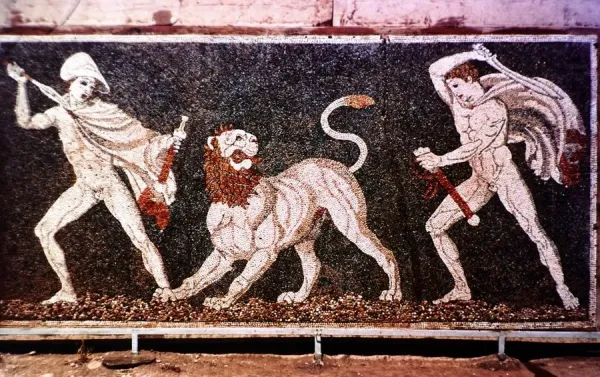
The aging lion was driven out of the pack by his sons. They
returned and drove him out, as soon as their mane began to
show. They returned; matured, stronger, tempered by
wandering male loneliness.
For half a day he and the new young leader stared at each other,
fiercely and menacingly, growling and fanning themselves with
their tails. When finally they started to run at each other and
fight, the young lion bit him on the thigh.
The old lion could have held on for quite some time and, most
likely, in the end, would have outsmarted, outplayed and
defeated the self-confident, but dull and inexperienced
newcomer. But fatigue had grown, and most importantly, he
understood that the pack needed young blood, and they no
longer needed him. And so, after growling and jostling for order,
he finally backed down and left.
Now he could not catch up with even the weakest and slowest
gazelles. And he didn’t have enough strength to look for the new
places. He had no choice but to sit in ambush for hours and wait
for people. Human meat was bitter and tough, but it was easier
to hunt them: their sense of smell was not sharp and they
allowed him to get closer.
A rumor spread through the Libyan villages, west of
Alexandria, that a lion had appeared in their area, devouring
people. They called him Moor – the king of the Moorish lions.
Life stopped, horror hung in the air, carrying, as it seemed to
everyone, the stench of remains and blood; the fields and lands
got empty.
When Hadrian was told about this, his eyes sparkled, his back
straightened, and even the pain in his constantly aching,
long-broken collarbone went away.
“Pater Patrii” will protect his children. He put down the
papyrus and waved the scribe away.
“We’re going hunting tomorrow”, he announced. His movements
now were marked by the elastic young strength, and
an excited smile of anticipation wandered across his face.
Hunting was his sweetest joy and hobby. In it he became himself
again. Most of all he loved to hunt lions. This was the
duel worthy of Caesar.
We left early in the morning. Hadrian, apparently, accepted me
into his retinue, and I was given a tunic, a horse, a sword and
two lances. I was paired with Lucius; Hadrian and Antinous
marched in the front, surrounded by horsemen and a pack of
hungry dogs, squealing impatiently.
The gentle coolness of the night, blown by the north wind from
the sea, was still felt, but the sun was rising higher and higher,
and became brighter, turning unbearably yellow.
Another sultry September Egyptian day was approaching. From
under the hooves of our horses, road dust, drying from the
morning moisture, began to swirl ever thicker. Seeing from afar,
the cavalcade of the Emperor-Pharaoh-God, peasants from
nearby villages prostrated themselves, not daring to raise their
heads until he was out of sight.
“Oh, you don’t know what Rome is”, Lucius muttered to me, carefully straightening his curls, sprinkled with golden glitter,
and wincing in the dust. “Rome is the insatiable whore who is
aroused only by the blood of gladiators flowing in the sufficient
quantities, and it understands only the language of the whip.”
He complained to me about his capricious and hysterical wife,
who did not want to let him go to Egypt with Hadrian, about the
eternal intrigues of senators, about the treacherous unreliability
of slaves, and about the wretchedness of creditors. Not really
understanding who I was and where I came from, he
nevertheless decided, seeing my position in the imperial retinue,
to enlist me as an ally.
When we got to the hunting spot where we saw Moor the Lion
last, the dogs became nervous and began to howl, their tails
between their legs and their noses moving to the wind. The
horsemen cordoned off the thickets in a circle and, banging
swords on their shields and loudly hooting, began to slowly close
in. We waited in an open clearing in the center.
Suddenly, our horses pranced anxiously, flaring their nostrils,
shaking their muzzles, and snorting madly. Jumping out of the
thickets, Moor saw us and stopped for a moment. Letting out a
deafening, piercing roar, he braced himself, preparing to jump,
digging the ground with his front paws and whipping his sides
with his tail, raising pillars of dust.
Antinous, with a spear at the ready, pulled the reins, spurred his
horse and stepped closer to the Moor. They stood against each
other. Antinous could easily pierce the red-singed mane of the
Moor with his spear, but he hesitated and waited for something.
Adrian, swinging, threw his spear, but not at the neck or even at
the heart of the lion, which he could have easily done, but under
the ridge, towards the tail. The spear got stuck between the
bones and was moving around in circles, tearing the wound. The
Moor went mad with pain and rage, and, standing on his hind
legs, aimed at Antinous’s horse. Strung by the reins, the horse
reared up, raising its hooves over the gaping grin of steel fangs,
exuding the heat of animal breath and the roar of the lion’s
mouth. But even now Antinous did not pierce him with his
spear.
Hadrian watched them calmly, absorbedly, confidently. And only
when, having slashed his claws along the silky horse’s neck, the
lion fell over backwards under the horse’s hooves, raising his
paws and waving his stuck spear and, preparing to jump up
again, pointed his outstretched claws at Antinous, Hadrian
struck his blow: quickly, powerfully and accurately; with an
experienced, trained hand, to the very place in the thick of the
mane from which a scarlet fountain stream started to splash.
Moor, stretching out and moving his paws, wheezed and choked
on blood and on the impotent hatred for these
incomprehensible, puny creatures.
He remembered his mother, the sweet taste of her milk, the
warmth of her skin, the crunch of antelope bones under his
teeth, the first days of marriage and the intoxicating moaning of
his lioness, when he convulsively bit into the folds of her neck,
and her stunning scent. And her indifferent look when he was
expelled from the pack; her anxious gaze, trained on their
doomed cubs. Moor wriggled in convulsions and kept trying to
get up, but his mane, stretching in an even velvety wedge along
the bottom of his belly to his hind legs, swelled redder and
thicker, became darker, bristling with wet tufts and dropping
ruby petals onto the sand.
All this happened so quickly that when Lucius and I rode up
from the other end of the clearing, where we were waiting for
the lion, it was already over. Hadrian carefully, holding his
sword at the ready, pushed the lion with the toe of his sandal
and, making sure that his eyes were glazing over, stepped
victoriously onto his mane. Lucius, straightening his curls with
his usual effete touch, stepped on the lion too, as if posing for a
portrait.
Moor suddenly twitched again, uttering his last, dying roar.
Lucius, to Adrian’s satisfied laughter, jumped back in fear, but,
having recovered and came to his senses, bowed in a graceful
courtly gesture: “A king should kill a king…”
Antinous had little interest in the dead lion. He washed the
wounds of his horse: four bloody stripes; two deeper ones – in
the middle, and gently stroked and calmed him. The excitement
of the recent fight was still playing in the eyes of both of them.
Sensing my silent question, he whispered: “Only a king should
kill a king”, and a barely noticeable grin ran across his swollen lips. Or maybe it just seemed this way to me.

After the hunt, Hadrian was in good spirits and agreed to attend
the feast that the Alexandrian nobility had long planned in his
honor. In the Ptolemy’s palace, on a small island northwest of
Alexandria, Hadrian received his guests. His toga stood out
among others with its wide purple imperial edge. He was
cheerful and charming with guests, and joked a lot.

3. Swimmingly
When the waters of his body started to overflow, drown and
suffocate him, Hadrian retired reluctantly and secluded himself
in Baiae. The empire was secure on all frontiers; Egyptian bread
and foreign gladiators in abundance in Rome, senators pacified
and locked in a respectful silence.
He released his physicians in disgust, muttering angrily: “Thy
art is devoid of knowledge…” He studied it himself and knew it
too well.
He also knew who poisoned him: the old Hebrew vagrant with
the empty, frozen eyes. His unusual exotic fruits… They were too
sweet, and too delicious, and caused him the insatiable deep
thirst, which could never be quenched. So they could repeat for
centuries: “May his bones rot!”
Antinous called on him every night; in turbulent muddy waters
of the Nile; his bright, milky-silvery body, covered with streaks
of blood, twisting.
“Throw him to the crocodiles, Lucius cried. Let him learn to
swim with them! Bithynian the pretender! The Empire is mine!”
Many times, in the fits of nostalgia, Hadrian tried to kill himself
but his vigilant servants wrestled the knife out of his hands.
His memories became his lonely walking paths, his thoughts –
his only delight and amusement.
He contemplated the nature of gods, and men, and the fate of
the Empire.
______________________________________

A very short story by Michael Novakhov (Mike Nova),
Links

 Links – The News And Times
Links – The News And Times – links-newsandtimes.com