
President-elect Donald Trump’s “border czar” said Thursday that the use of family detention centers for migrants is “on the table,” raising the possibility t…
Day: December 27, 2024

Images may be subject to copyright. Learn More
The Hypothesis
During the attempted landing in Grozny, the Ukrainian drones flew close to the Azeri plane. (By design?). They were seen as attackers and were shut at by the air defense operators or the system in auto mode. One of the anti-drones hits, producing shrapnel, was close enough to hit the plane’s tail part, and specifically the place were the “Avionics”, electronic communications control centers are located. Thus the plane “lost the controls” and the maneuverability, complicating the landing. The direct damage to the landing gear is also possible. The plane’s conditions and problems became known to the ground operators from the pattern of its movements, and they refused the permission for it to land for the fear of the casualties on the ground and other reasons. Possibly they were inexperienced and scared. Other places refused landing also, and the plane was directed to Aktau.
Images may be subject to copyright. Learn More
The Hypothesis
During the attempted landing in Grozny, the Ukrainian drones flew close to the Azeri plane. (By design?). They were seen as attackers and were shut at by the air defense operators or the system in auto mode. One of the anti-drones hits, producing shrapnel, was close enough to hit the plane’s tail part, and specifically the place were the “Avionics”, electronic communications control centers are located. Thus the plane “lost the controls” and the maneuverability, complicating the landing. The direct damage to the landing gear is also possible. The plane’s conditions and problems became known to the ground operators from the pattern of its movements, and they refused the permission for it to land for the fear of the casualties on the ground and other reasons. Possibly they were inexperienced and scared. Other places refused landing also, and the plane was directed to Aktau.
Images may be subject to copyright. Learn More
The Hypothesis
During the attempted landing in Grozny, the Ukrainian drones flew close to the Azeri plane. (By design?). They were seen as attackers and were shut at by the air defense operators or the system in auto mode. One of the anti-drones hits, producing shrapnel, was close enough to hit the plane’s tail part, and specifically the place were the “Avionics”, electronic communications control centers are located. Thus the plane “lost the controls” and the maneuverability, complicating the landing. The direct damage to the landing gear is also possible. The plane’s conditions and problems became known to the ground operators from the pattern of its movements, and they refused the permission for it to land for the fear of the casualties on the ground and other reasons. Possibly they were inexperienced and scared. Other places refused landing also, and the plane was directed to Aktau.
Eight international coalitions provide military assistance to Ukraine. Each consists of 14 to 21 countries, according to the press service of the Ministry of Defense of Ukraine.
“As part of the work of the Ukraine Defense Contact Group, eight capability coalitions are operating to provide effective assistance in line with the specific needs of Ukraine’s Defense Forces,” the statement reads.
According to the Ministry of Defense, in September 2023, the format of international aid to Ukraine was transformed into the so-called Ramstein 2.0.
This means that Ukraine’s allies are transitioning from primarily bilateral military aid to working within the framework of these coalitions. Their goal is to enhance coordination, systematization, and, as a result, increase the volume of international military assistance.
The needs of Ukraine’s Defense Forces for weapons, military equipment, and personnel training are divided into eight coalition areas:
- Aviation capabilities (14 countries)
- Naval capabilities (18 countries)
- Integrated air and missile defense (14 countries)
- Artillery (14 countries)
- Armored vehicles and maneuverability (14 countries)
- Drones (16 countries)
- Demining (21 countries)
- IT capabilities (17 countries)
It is noted that each coalition is led by a leader country responsible for coordinating its activities. At the same time, some allies have taken on leadership roles in multiple coalitions.
For example, the United States leads the Aviation Capabilities Coalition and the Artillery Coalition, France leads the Integrated Air and Missile Defense Coalition and also the Artillery Coalition, Germany heads the Armored Vehicles and Maneuverability Coalition as well as the Integrated Air and Missile Defense Coalition, the United Kingdom leads the Naval Capabilities Coalition and the Drones Coalition.
Other coalition leaders include Denmark, Estonia, Italy, Iceland, Latvia, Lithuania, Luxembourg, the Netherlands, Norway, and Poland.
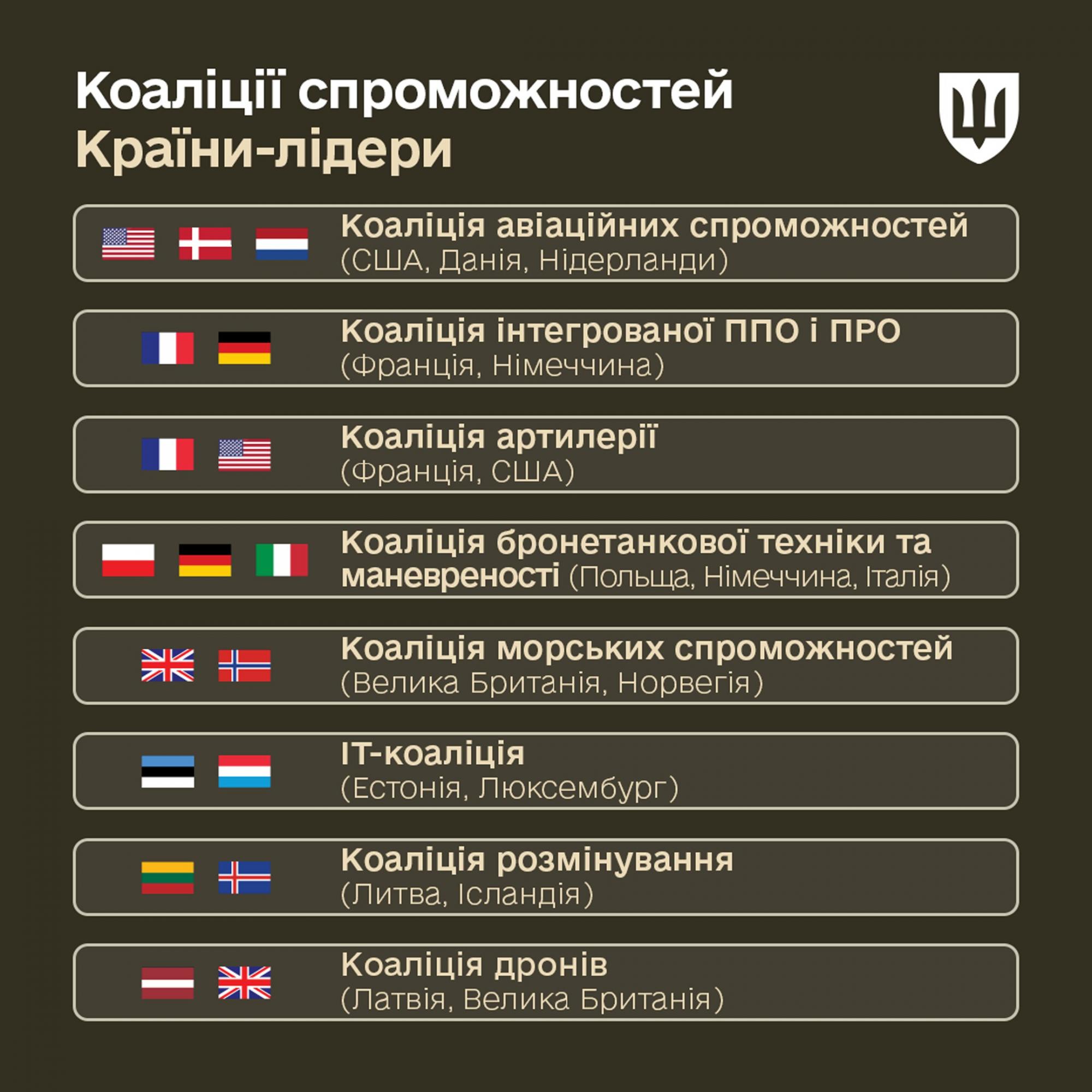
Additionally, efforts are ongoing to involve new countries in the coalitions.
France, aside from leading the aforementioned coalitions, has joined five additional initiatives. Czechia, Spain, Sweden, and Denmark have also become participants in six coalitions, including the Integrated Air and Missile Defense Coalition.
Belgium and Greece have joined five coalitions, including the Aviation Capabilities Coalition.
“The ultimate goal of all coalitions is to contribute to the development of the future structure of the Defense Forces, ensuring the supply of Western equipment and weaponry. Moreover, the coalitions’ work aims to enhance interoperability with NATO, bringing us closer to membership in the Alliance,” the Ministry of Defense stated.
It is worth noting that Ukrainian Defense Minister Rustem Umerov previously assured that Ukraine would continue to receive sufficient military aid in the coming year.
In total, the United States provides 50% of the support, European partners contribute over 40%, with the remainder coming from other countries and Ukraine’s own investments
Eight international coalitions provide military assistance to Ukraine. Each consists of 14 to 21 countries, according to the press service of the Ministry of Defense of Ukraine.
“As part of the work of the Ukraine Defense Contact Group, eight capability coalitions are operating to provide effective assistance in line with the specific needs of Ukraine’s Defense Forces,” the statement reads.
According to the Ministry of Defense, in September 2023, the format of international aid to Ukraine was transformed into the so-called Ramstein 2.0.
This means that Ukraine’s allies are transitioning from primarily bilateral military aid to working within the framework of these coalitions. Their goal is to enhance coordination, systematization, and, as a result, increase the volume of international military assistance.
The needs of Ukraine’s Defense Forces for weapons, military equipment, and personnel training are divided into eight coalition areas:
- Aviation capabilities (14 countries)
- Naval capabilities (18 countries)
- Integrated air and missile defense (14 countries)
- Artillery (14 countries)
- Armored vehicles and maneuverability (14 countries)
- Drones (16 countries)
- Demining (21 countries)
- IT capabilities (17 countries)
It is noted that each coalition is led by a leader country responsible for coordinating its activities. At the same time, some allies have taken on leadership roles in multiple coalitions.
For example, the United States leads the Aviation Capabilities Coalition and the Artillery Coalition, France leads the Integrated Air and Missile Defense Coalition and also the Artillery Coalition, Germany heads the Armored Vehicles and Maneuverability Coalition as well as the Integrated Air and Missile Defense Coalition, the United Kingdom leads the Naval Capabilities Coalition and the Drones Coalition.
Other coalition leaders include Denmark, Estonia, Italy, Iceland, Latvia, Lithuania, Luxembourg, the Netherlands, Norway, and Poland.
Additionally, efforts are ongoing to involve new countries in the coalitions.
France, aside from leading the aforementioned coalitions, has joined five additional initiatives. Czechia, Spain, Sweden, and Denmark have also become participants in six coalitions, including the Integrated Air and Missile Defense Coalition.
Belgium and Greece have joined five coalitions, including the Aviation Capabilities Coalition.
“The ultimate goal of all coalitions is to contribute to the development of the future structure of the Defense Forces, ensuring the supply of Western equipment and weaponry. Moreover, the coalitions’ work aims to enhance interoperability with NATO, bringing us closer to membership in the Alliance,” the Ministry of Defense stated.
It is worth noting that Ukrainian Defense Minister Rustem Umerov previously assured that Ukraine would continue to receive sufficient military aid in the coming year.
In total, the United States provides 50% of the support, European partners contribute over 40%, with the remainder coming from other countries and Ukraine’s own investments
Thailand will implement a global minimum corporate tax of 15% on multinational enterprises from Jan. 1, 2025, the finance ministry said on Friday. https://t.co/D90cLSl5lt pic.twitter.com/YeQZGvX35Z
— Reuters (@Reuters) December 27, 2024


The first Russian-built ice-class liquefied natural gas (LNG) carrier has entered sea trials, LSEG data showed on Friday, as part of Russia’s efforts to raise global LNG market share despite U.S. sanctions. https://t.co/8EON3dKQCE pic.twitter.com/SUsRxdG3qW
— Reuters (@Reuters) December 27, 2024