
BREAKING:
Iran officially withdraws from nuclear talks with the United States. pic.twitter.com/0xu3kdXa3c
— Globe Eye News (@GlobeEyeNews) June 13, 2025
Day: June 13, 2025
The Israel Defense Force has released a graphic showing the uranium enrichment site located beneath the Natanz Nuclear Facility in Central Iran, which was heavily targeted during today’s strikes by the Israeli Air Force. pic.twitter.com/DztB04got6
— OSINTdefender (@sentdefender) June 13, 2025
❗️🇩🇪German Chancellor: We reaffirm 🇮🇱Israel’s right to defend its existence and the security of its citizens. pic.twitter.com/ODpWu5tvp3
— 🪖MilitaryNewsUA🇺🇦 (@front_ukrainian) June 13, 2025
JUST IN:
🇮🇷🇮🇱 At least 20 senior Iranian commanders, including the commander of the Revolutionary Guards’ aerospace force, were killed in the Israeli airstrike – Reuters, citing two sources. pic.twitter.com/pkp9DCUJal
— Megatron (@Megatron_ron) June 13, 2025
Brigadier General Amir Ali Hajizadeh, the Commander of the Islamic Revolutionary Guard Corps’ (IRGC) Aerospace Forces, is confirmed to have been eliminated in an Israeli strike on Western Iran. pic.twitter.com/szSqzFXXM8
— OSINTdefender (@sentdefender) June 13, 2025
israel- iran war – Google Search https://t.co/iI2ZClCnGk
— Michael Novakhov (@mikenov) June 13, 2025
iran strikes back – Google Search https://t.co/PbseLUzsaD
— Michael Novakhov (@mikenov) June 13, 2025
At the present moment, our screens are full of images of rioting and violence, and both parties are straining to craft visual narratives based on those images to build popular support for their partisan policies and worldviews. American political leaders used to cultivate positive messages in public and conduct “oppo research” in secret. Now both parties accentuate the negative, all the time. The opposite party is the enemy: they are fascists, they are possessed by demons. The professed goal of both parties is to stop the other one from destroying the nation. The preferred remedy is to throw members of the “enemy” party in jail or even assassinate them. What is on our screens at present is crafted to promote partisan goals by inflaming negative emotions. Successful “visual arguments” (as Christopher Rufo calls them) help the parties seek power but cause great damage to the country as a whole. Edmund Burke wrote, “To make us love our country, our country ought to be lovely.” But how can we love our country when the streets are full of burning cars, when thugs are looting and attacking public buildings, when law enforcement, backed by military force, is forced to use violence to maintain order?
A recent trip to Italy put some ideas in my head about how this problem might be addressed. Italy is not usually considered a model of political unity, given its history since the Second World War of revolving-door governments. But one thing Italy is very good at is generating a love of country that transcends politics. This is often misunderstood by Americans when they read in the news about the turbulent political cultures of countries like Italy, France, and Greece. What we outsiders often fail to appreciate is that fractiousness in the sphere of politics can be managed in those countries because they are held together by deeper bonds in the sub-political sphere. Bonds of affection and loyalty among citizens remain firm thanks to strong families, private and civil networks, pride in common achievements, and a beloved way of life. Usually, such bonds are invisible to outsiders, but on rare occasions, they come into public view.
On the morning of June 2, 2025, I awoke to find myself trapped. I had rented a serviced apartment near the Roman Forum, thinking to spend the end of a short research trip in Europe in the city that, for me, has always been a spiritual home. Though I have spent altogether more than seven years of my life in Italy, I had somehow forgotten that June 2 was the Festa della Repubblica, the public celebration that commemorates the creation of the Italian Republic in 1946. The apartment I had chosen turned out to be along the principal access lane for VIPs attending the great celebratory parade and had thus become, for a few hours, a high-security zone. Our little half-block had been cordoned off and was being patrolled by state police and army units. There was no entry or exit. In compenso, from the third-floor windows of my apartment, I found myself with a ringside seat for the great parade.
The parade took place between 9 a.m. and noon and began at the Altar of the People on the Vittoriano—the enormous white marble monument to King Vittorio Emanuele II, the first king of Italy, that dominates the center of Rome. A bugle sounded as the president of Italy, Sergio Mattarella, laid a wreath on the grave of the Unknown Soldier. This set a tone of solemn gratitude to those who had fought for Italian liberty. Then nine jets from the Frecce Tricolori, the national aerobatics team, roared over the monument, spewing fumes in the colors of the Italian flag: green, white, and red.
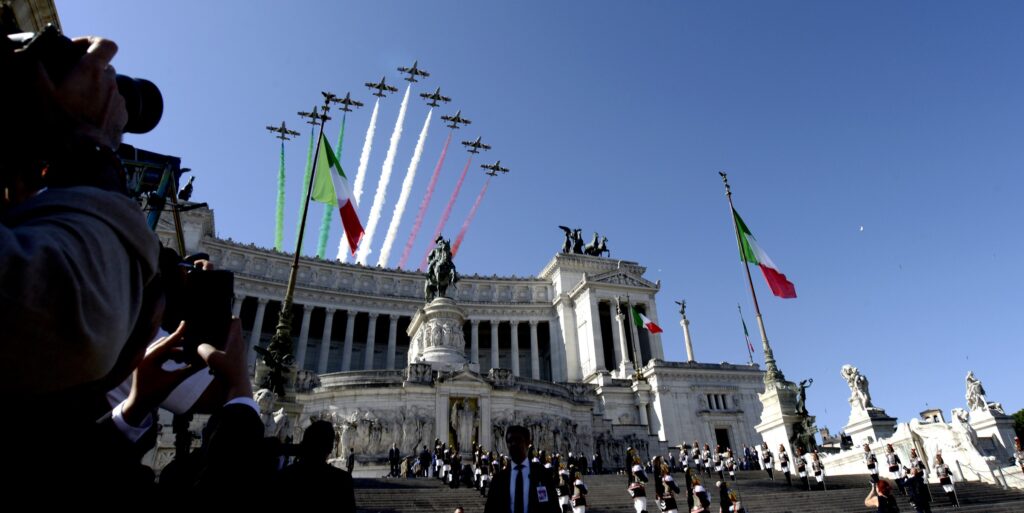
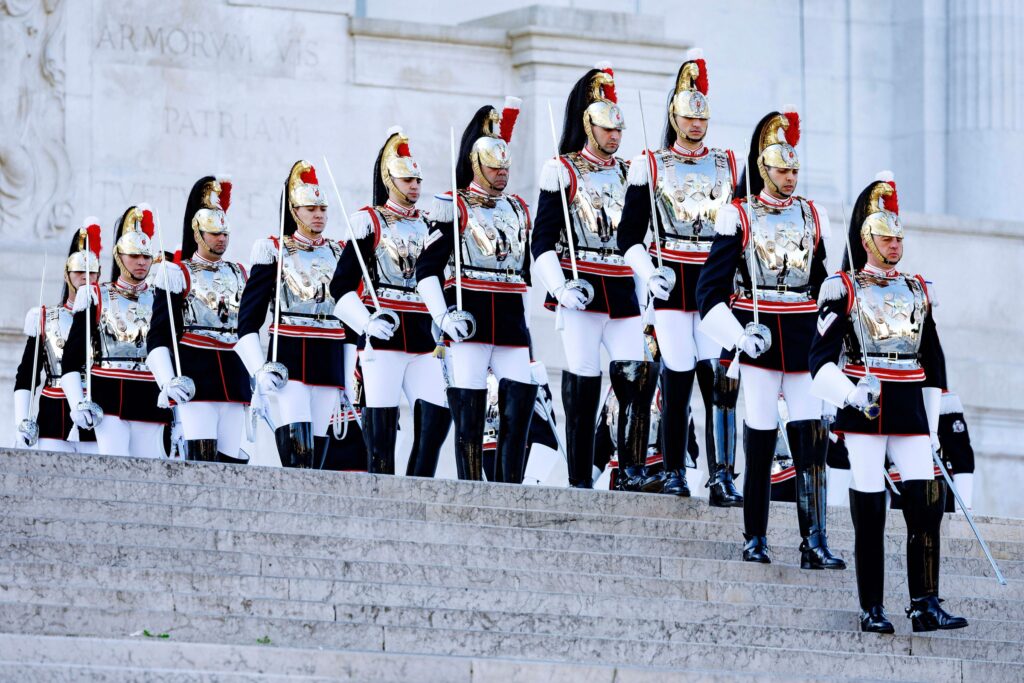
A large crowd had gathered in the Piazza Venezia in the bright sunlight to see the spectacle. The most popular sight, apart from the jet flyover, was the personal guard regiment of the president. These are known as the Reggimento Corazzieri (cuirassiers), all men over 6’4”, magnificently dressed in their ceremonial armor with plumed helmets. “A man is but an ass / who fights in a cuirass” sings the son of King Gama in Gilbert and Sullivan’s operetta Princess Ida, but for public ceremonial, no mere military tunic, no matter how many medals are pinned on it, can match gleaming armor.
After some short speeches by the principal officials of the republic, the presidential group climbed into a motorcade so as to take up its place in the reviewing stand at the center of the processional route—directly opposite my window. The route led from the Vittoriano down the Via dei Fori Imperiali, which had been cleared of traffic and lined with bleachers, to the Colosseum. That famous ruin was draped for the occasion in an enormous, 2000-square-foot flag of Italy. The parade, beginning with several dozen marching units, was to process from the Vittoriano slowly down the Via, then reverse direction and parade back from the Colosseum with a different set of parade units. On either side of the parade route lay the ruins of the imperial forums that long ago had been at the center of ancient Roman public life. Ancient Rome was a silent witness to the parade, with its own message: momento mori.
The whole spectacle was elaborately choreographed to include not just the numerous units of the Italian armed forces, which all seem to have their own marching bands, but representatives of all the various organs of state and Rome’s public services. No one, clearly, wanted to be left out. Also present in the procession were representatives of the European Union, NATO, the diplomatic corps of various nations, and Cardinal Archbishop Baldassare Reina, the vicar general of the Diocese of Rome. Each of the twenty provinces of Italy had units present. Every major Italian department of state had formations in the march, but there were also many private associations meant to embody the best of Italy. Italian Olympic medalists marched, but the Gruppo Sportivo dei Paralitici, Italy’s participants in the Paralympic Games, also rolled by in their wheelchairs. There were units from Italy’s various police forces as well as fire and rescue workers. Hospital nurses, wearing grim faces in response to recent budget cuts, formed a distinct body. The Roman police rode by in their blue-and-white vehicles, led by the chief of the Roman police, driving a Ferrari painted with police colors. That was an only-in-Italy moment! A group of students from a liceo classico (a high school for the study of classical languages) who had won awards for essays on ancient Roman history, came up to the reviewing stand and were handed their prizes by the president. Military parade music (another Italian specialty) was continuous, varied, and often exhilarating. The parade stopped only once, so that Rosalba Pippa, the popular singer known as Arisa, could perform before the reviewing stand the national anthem “Fratelli d’Italia” (which also happens to be the name of Italy’s ruling party, led by Giorgia Meloni).
There were a few short speeches by the Republic’s principal office-holders, but these stressed the common values of the patria—liberty, democracy, and peace—and reminded the crowd that the Republic’s legitimacy was based on a popular referendum held 79 years before. Decorum appropriate to the occasion was observed, partisan messaging kept to a minimum. Prime Minister Meloni spoke of the defense of common values, but got in a dig against “professors” who criticized the Bersaglieri, a unit of the Italian army associated with colonialism. The Bersaglieri, as Meloni well knew, are always among the most popular parade units, with their weird head-gear that looks like a small forest animal has been attached to it. The Bersaglieri also get attention by running, not marching, when they are on parade, creating a challenge for the embouchures of their marching band. So Meloni’s “profs” were a well-chosen target. The opposition party leader also kept things positive, contenting himself with a single dark allusion to the dangers of populism. None of this politicking was sharp-edged enough to disturb the good humor of the crowd. The dominant notes expressed were a heart-swelling love of Italy and gratitude to those who had made sacrifices to keep it free.
A positive celebration of our history, political creed, our great achievements, and our heroes could help counteract the effect of the dispiriting scenes we have been witnessing in recent years.
The end of the parade was marked by a spectacular performance by the Acrobatic Parachutists of the Italian army, who, jumping from helicopters, performed stunning aerial maneuvers while emitting smoke trails in the national colors. The three paracadutisti made a perfect landing at the end of the parade route, right in front of the Colosseum. A last attempt at crowd-pleasing was offered by the sanitation workers. They followed the marchers with a squadron of spanking-new garbage trucks, driven in coordinated, curvilinear patterns. They also picked up the trash.
So let me ask this: Why can’t we in the United States hold a parade something like the Italian festa for our upcoming celebrations next year of America’s 250th birthday? During his first presidency, around 2017, Donald Trump proposed holding a “big and beautiful” parade in Washington, DC to honor US military forces. The parade never materialized owing to logistical problems and cost considerations. It was predictably opposed by the usual suspects who complained that it would promote militarism and colonialism. In his second term, however, the president has swept aside any bureaucratic and ideological objections and scheduled, for tomorrow, a military parade in honor of the US Army’s 250th birthday, which just happens to be his own birthday too.
It is too late for tomorrow’s event to amount to more than a celebration of these twin birthdays. I live near Cambridge, Massachusetts, and can hear the grinding of teeth from here. But in the coming year, there will be time to plan an event that could draw broad public support and benefit our public life. A patriotic parade, reconceived more broadly as a positive celebration of who we are as a nation—our history, political creed, and our great achievements, our heroes—could help counteract the effect of the dispiriting scenes we have been witnessing in recent years. It could also be fun, and we could use some good humor in our civic life. Let’s work together, then, putting country ahead of politics, and celebrate next year the goodness that still fills our country and the good that our country can still do for its citizens and the world.
It has been 10 years since AMC’s Mad Men ended. As the show finished its retelling of the upheavals of the 1960s, the real America was entering a decade of similar convulsions over race, sex, demography, and economics. Now, after our own age of rage, we can better appreciate the traditional view of society that lay beneath Mad Men’s whiskey- and cigarette-infused glamour. The fictional experiences of the men and women of ad agency Sterling, Cooper, Draper, Price, not only serve judgment on the excesses of the ‘60s, but also help explain a likely conservative turn in American social and political trends in the decade ahead. A story about the Age of Aquarius may explain the beginning of the end of the Great Awokening.
Mad Men began its story at the end of what many once idealized as the post-World War II Golden Age, with its cultural and social certainty, long-defined genders and gender roles, and a feeling of common national purpose. Those verities were to be flayed, strip by strip, throughout the series’ seven seasons, as it tackled conformity, sexism, and race relations. Mad Men ended its tale in the early 1970s, at the beginning of post-modern America, a country socially freer and more equal, yet also more lost and lacking in identity, community, and confidence. The show exposed traditional values as hypocritical, outdated, and even immoral—until they ultimately were vindicated by the series’ conclusion.
Like most of current American popular culture, Mad Men largely ignored organized religion, and a subplot that could have explored the decline of faith was dropped early in the second season. Also uneven were the show’s attempts to deal directly with prejudice, whether antisemitism or race relations and the civil rights movement, its transient Jewish and Black characters seemingly pushed to the center of the stage for a few moments.
Mad Men’s focus was the WASP world entering its death throes in the 1960s. From that perspective, it is the cinematic counterpart to Charles Murray’s Coming Apart, his classic study of the changes in White America from 1960 to 2010. The show delivered its ostensible message about the hypocrisy of middle-class White American life in the very first episode, “Smoke Gets in Your Eyes.” Urbane, handsome New York advertising executive Don Draper spends his evening drinking with his youthful subordinates and having intimate relations with a young woman. He then quietly enters a suburban home late at night and sits in his sleeping children’s dark bedroom while his wife, her face encased in shadows, stands silently in the lighted doorway, the two of them isolated physically and emotionally from each other.
Mad Men may have been at its most poignant in these early seasons, in its elegiac depiction of late-1950s/early-1960s suburbia. While the series meant to peel away the veneer of false utopia attached post facto to American suburban life—White, privileged, family-centered—at the same time it fed back into every sense of loss, whether actual or imagined, by those who currently live in the real world birthed during the era Mad Men fictionally portrayed.
For that reason, the saddest character in the series was not the hopelessly lost Don Draper, but his picture-perfect first wife, Betty, whose tragic arc in many ways seems truest to the show’s sub rosa message about the world that has passed. Long after their split and the collapse of their supposedly perfect life, the specter of what Don lost when Betty divorced him for his serial infidelities haunts him (and us) throughout the rest of the series.
A child of privilege and a former model, Betty appears to have won life’s lottery. She entertains perfectly and is the envy of her circle of suburban friends and her husband’s co-workers. She lives the life of mid-century leisure that we are to assume most women aspired to, but only a small fraction attained. Yet we come to see that she is emotionally stunted, betrayed by her husband, callous towards her children, and in almost every way unsatisfied. Even her own remarriage, to a man more successful and prominent than Don, seems less a vindication of her worth than a desperate attempt to recapture what she lost when she defended her honor by finally kicking Don out of the house.
Mad Men delivers an unsparing portrait of our modern existential crisis.
If the Drapers’ hometown of Ossining, New York, is cynically portrayed as a suburban Eden hiding serpents and trees of forbidden knowledge, then Don and Betty’s split throws them both out of the Garden. Unlike their Biblical forebears, however, they are condemned to wander separately, alone even when they have found new mates. Don’s pathetic wistfulness, when he visits his children in Betty’s new home late in the series, is a visceral reminder that he chose a path that destroyed the happiness they all could have had. During these scenes, one cannot avoid remembering Don’s piercing speech from the first season, during his ad pitch to Kodak executives for their new Carousel slide projector. As joyous scenes from his own family’s past flash on the projector screen, Don both sells to his clients and relives for himself a hopeful and innocent life that is fast disintegrating in his turbulent present, yearning for a return to “a place where we know we are loved.”
It is that remembrance which makes Don and Betty’s last phone call to each other, near the very end of the series, so heartrending. Few television shows have so starkly portrayed the pain of divorce and its effects on all involved. Unable to get over their disagreements even so many years later, Don and Betty nonetheless seem haunted by the harsh finality that what they had will never be recovered. Both suffer the almost unbearable pain of confronting their past’s aborted future as an alternate reality they let slip out of their hands. In that brief phone conversation, the ghosts of what that life could have been swirl about them both, etched vividly in a piece of acting by both leads that cannot be overpraised.
By then, Betty has been diagnosed with terminal lung cancer, a mordant twist by the show’s writers, who showered us with innumerable smoking scenes throughout the series. Indeed, Betty was rarely seen without a cigarette, her ethereal looks and perfectly coiffed hair often wreathed in smoke. Cancer is the cruelest blow for Betty, a horrid, slow wasting of the beauty that defined her. And her demise is the more brutal, for she has just begun, after so many years wandering in her own personal purgatory, to climb up from the depths of the meaninglessness of her life by enrolling in college. She is fated not to finish the degree that will give her a sense of her own individuality, but she has seen across the river to a land where she knows that life has promise and meaning and is thus in her own way saved.
Betty lives her final days on her own terms. We last see her sitting in her usual poised style at her kitchen table, serenely smoking the cigarettes that have already killed her, while her once-estranged daughter Sally takes up the household chores at the sink. Even the farewell letter she pens to her daughter, giving precise instructions for how her body is to be prepared for her funeral, is at once unbearably heartbreaking and an affirmation of her spirit.
Compared to Betty’s journey, Don’s odyssey is far more ambiguous. The moral questions at the center of Mad Men become clear through the character of Don Draper. As a Madison Avenue man, Draper is possessed of uncommon excellence, a full development of the social “virtue” that brings success in the cutthroat professional world he inhabits. Yet as a private man, Don lacks all real virtue, his life being bereft of any excellence as a husband, father, or friend. An aristocrat at the advertising storyboards, he is spiritually and emotionally a beggar amidst the plenty of post-war upper-middle-class life. He is one of T. S. Eliot’s “hollow men, stuffed men,” between whose idea and reality falls the shadow.
Don’s alienation from those around him grows throughout the series, leading to two failed marriages. We learn early on why Don is so isolated, for he is, above all, alienated from himself. He is a man living a lie at the very core of his being, having taken the name and identity of a fellow soldier who was killed during the Korean War due to Don’s own battlefield carelessness. Yet the adoption of a false identity was the only way for an orphaned child of a drunk and a prostitute to escape the claws of the Depression-era life that held him until he shipped out for Korea. The lie at the center of his life unravels his first family and prevents him from developing true bonds with his children, Sally and Bobby.
The only one who truly understands and loves Don is, ironically, the widow of the man whose identity he stole, Anna Draper. Don has set her up in a home in the idyllic southern California of the early 1960s, and it is only when he visits her, in their platonic love, that he goes by his real name and can be his true self, Dick Whitman. And when Anna dies, Don is left truly alone in the world.
In less-skilled hands, Don’s story would be simple melodrama, but both series creator Matthew Weiner and actor John Hamm breathe despairing life into Don. By bringing together two such lost souls in Don and Betty, Mad Men delivers an unsparing portrait of our modern existential crisis.
Unlike the renewed family man Pete or the dying but certain Betty, Don seems fated to continue his wanderings, unable to grasp the simple yet profound truths that give meaning to life.
As the story arc comes to its close, Weiner and the writers reveal, perhaps unwittingly, the conservative ethos underlying the series. Don’s second marriage, to the winsome, honest, and ambitious Megan, collapses through his jealousy and (again) infidelity. He then believes he has fallen in love with Diane, a waitress who has run away from her family and now him. In chasing after her, Don finds her former husband, living with a new family in a nondescript, middle-class suburb in the Midwest. Diane’s former husband is portrayed as a prickly, repressed, provincial man, all due to his openly expressed and deeply-held religious beliefs. Yet he immediately discerns Don’s lame ruse to find Diane and drives him from the house. Don flees, discovering that this anonymous, unremarkable, unaccomplished Midwesterner is far more real and stable than he, the entirely false Manhattanite. Whereas Don’s interior is nothing but a jumble of untamed lusts, corruption, and lies, this God-fearing man possesses not only a solid core but the insight into human nature that Don so tragically lacks.
That lesson is reinforced in the series finale, when Pete Campbell, Don’s younger colleague, makes a traditional, life-affirming decision. Pete was introduced in the series’ first episode as a wealthy, callow youth willing to do anything to climb the corporate ladder. He follows Don’s path into infidelity and a broken marriage, even moving to California to live a carefree life. Yet Pete matures over time in a way that Don seems desperate to do but cannot. Pete ultimately reconciles with his estranged wife and flees from Manhattan, where his family has lived for generations, to Kansas City, bringing wife and daughter in tow. Pete has learned that he is incomplete without his wife and that both California and New York City are irredeemable, filled with temptation and immorality. When Pete and his family board their private jet (he is the jet company’s new president) for their new life in the Midwest, what could have come across as a brief, hackneyed scene instead exudes optimism that Pete will honor his second chance.
In very different ways, Betty Draper and Pete Campbell have matured and found fulfilment, one through tragedy, the other through rediscovering the permanent things. Other characters, too, grow during the series, like Joan, the sexpot secretary-turned-businesswoman, and Peggy, who starts out as a mousy secretary and finally breaks the advertising world’s glass ceiling.
Don, however, remains a lost soul. It is perhaps no surprise that he finds himself, at the very end of his journey through Mad Men, at the famed Esalen Institute, in California’s Big Sur. Esalen represents the culmination of America’s journey through the 1960s. From the man in the gray flannel suit, Don has become an avatar of the new consciousness, seemingly making his traumatic emotional breakthrough.
The enigmatic final scene of Don, the very last in the whole series, was as controversial as the first. As he sits above the sun-washed cliffs overlooking the Pacific Ocean, blissfully listening with closed eyes to the chime of the morning meditation bell, Don’s face breaks into a wide, satisfied grin. Has he at last found inner peace and the stability that has so long eluded him? Or, has Draper figured out a way to salvage the wreckage of his career and return to the top of the advertising mountain? The immediate transition from the grinning Don to the iconic 1973 Coca-Cola commercial, “I’d Like to Teach the World to Sing,” all but demands the latter interpretation. Yet I had become so invested in, if repelled by his character, that I wanted to believe that Don, too, had found happiness, and that the Coke ad was a brilliant means of playing on the viewing audience’s nostalgia for a seemingly less cynical time when such corny, new age optimism still was fresh. Regardless of whether he has repaired his emotional wounds or simply ensured corporate immortality, the fact remains that we leave Don Draper as we found him at the beginning of the 1960s—alone.
A decade after that last scene, after a similar period of social and political upheaval, an audience in 2025 is likely more attuned than Mad Men’s original viewers to the knowledge that even if Don believes he has found a new, truly worthwhile path, Esalen and all the counter-cultural movements of the 1960s were illusory Edens, and that those who succumbed to their embrace would move on, always dissatisfied and unfulfilled. Unlike the renewed family man Pete or the dying but certain Betty, Don seems fated to continue his wanderings, unable to grasp the simple yet profound truths that give meaning to life and which demand both discipline and sacrifice to something greater than oneself.
One may have hope that Americans have learned this hard lesson. False utopias, radicalized mob violence, and the denial of nature and reality all have darkened our national horizon in recent years. A turning away, back to something more grounded and tested, seems to have started. The morality of Mad Men illuminates this laudable trend and may even help strengthen its fragile roots.
The protesters who flung pumpkin soup at the Mona Lisa in the Louvre in 2024 claimed, as all such protesters do, that they were justified in their action because some higher principle—in this case, unsustainable food production—was at stake.
Like their compatriots in Just for Oil, who threw tomato soup at Van Gogh’s Sunflowers two years earlier, they surely did not doubt their moral righteousness or question that they were following in the honored footsteps of their eco-terrorist predecessors.
In his novel The Monkey Wrench Gang, Edward Abbey tells the story of four disparate eco-warriors who load their Jeep with the tools of destruction and attack billboards, road-building machinery, and bridges in Utah and Arizona. Their ultimate aim—pondered but never planned—is to destroy the Glen Canyon Dam. As their violence increases, the forces of economic development step up their efforts to stop the group, and eventually do, at least for a while. The gang reunites in Abbey’s posthumous sequel, Hayduke Lives!
A misanthropic provocateur, Abbey surely would have scoffed at the indirect action of hurling the contents of a can of Campbell’s at an unoffending picture. Abbey was a proponent of what he euphemistically called “direct-action environmentalism,” by which he meant the violent destruction of the tools of development—bulldozers, surveyor’s stakes, the Glen Canyon Dam.
The soup throwers were practicing anything but direct action. Blowing up dams is just too hard. Let’s spill lunch at the Louvre.
In life, Abbey always had a hard time fitting in with his erstwhile allies in the environmental movement. A half century after the publication of his seminal novel on eco-terrorism and 36 years after his death, he still does.
His writing is suffused with anti-government rhetoric that at first blush might be appealing to some on the right. But his preference for “direct action”—violence—to achieve his political goals is now being wholeheartedly endorsed by sizable factions of the political left.
The Province of the Outlaw
The Monkey Wrench Gang got mixed reviews. Sales grew mostly through word-of-mouth among like-minded activists. The New York Times didn’t get around to reviewing the book until almost a year after publication.
“The book is not a gem of literature,” wrote reviewer Kenneth C. Caldwell in Landscape Architecture Magazine, who also doubted any potential to inspire real-life violence. “I doubt if the book will kindle fires of unquenchable rage in our hearts, causing us to cast down T-squares and take up cases of Dupont dynamite.”
Others saw something else in the book. William Marling, an author and literature professor, credits Abbey, possessor of two degrees in philosophy, with being “set apart from those who toy with the ‘conquest of nature’ paradox from a great philosophic height by his ability to distinguish not only between Camus and Cocteau but between columbine and penstemon as well. When the ingredients coalesce correctly, he is a powerful writer.”
Perhaps too powerful. “This book counsels insurrection and sabotage,” Marling asserts. “It contains explicit descriptions of procedures for dynamiting bridges and destroying earth-moving machinery. Reading it, one cannot help but feel that Abbey intended the information to be of practical use.”
Abbey always tried to maintain a strategic ambiguity on this point. But he once told an interviewer, “I write in a deliberately outrageous or provocative manner because I like to startle people.” In that, at least, he was successful. In his introduction to the 25th anniversary edition, Douglas Brinkley called The Monkey Wrench Gang “revolutionary, anarchic, seditious, and, in the wrong hands, dangerous.”
How, then, did the book become a popular success and a touchstone for the modern environmental movement?
For one thing, it made environmentalists cool, “the province of the outlaw,” in the words of Abbey biographer David Gessner. Abbey put on the page what thousands were thinking but were not yet prepared to do. Reading about it in a comic yet serious novel allowed people who would never in real life set ablaze a billboard or pour sand into a bulldozer crankcase a sense that they, too, were participants in the revolution.
Another Abbey biographer, James Bishop Jr., wrote that while the theme of The Monkey Wrench Gang was “environmental hooliganism,” it nevertheless came “closest to reaching that place of Abbey’s most steadfast convictions: a romantically idealized world in which the Industrial Revolution has been aborted, and society has reached a steady-state equilibrium where man and the land can exist in harmony.”
That, perhaps, explains why Abbey has a deeply devoted cult following, but has not emerged beyond that.
Abbey’s rants against “industrial tourism” and his insistence that we’d all be happier without air conditioning, roads, automobiles, antibiotics, or many other conveniences of modern life amount to a platform that tells voters: all you have to do is agree to be poorer, and we can save these rocks. As much as we all love rocks, that’s a tough sell.
A Direct Descendant of Abbey’s Writings
In a post-9/11 world, Abbey’s dalliance with eco-terrorism has made him an even tougher sell in some quarters, while elevating him to icon in others. During one of his many appearances on college campuses, Abbey was asked if he really wanted to blow up Glen Canyon Dam. “No,” he told the students. “But if someone else wanted to do it, I’d be there holding the flashlight.”
Writer Doug Peacock, a friend of Abbey and the primary inspiration for the novel’s lead character, George Washington Hayduke, does not hem and haw about Abbey’s role in inspiring eco-terrorists. “The radical environmental group Earth First! Was a direct descendant of Abbey’s writings,” he wrote.”
Abbey rejected the notion that he was endorsing terrorism, drawing a distinction between sabotage and terrorism. “If the wilderness is our true home, and if it is threatened with invasion, pillage, and destruction—as it certainly is—then we have the right to defend that home, as we would our private quarters, by whatever means are necessary,” Abbey wrote in the essay, “Eco-Defense.”
If “the tree of liberty must be refreshed from time to time with the blood of patriots and tyrants,” Abbey seemed to be saying, so must the pinions and junipers of Utah’s slickrock country.
“Whatever means are necessary” seems pretty clear, especially when standing next to his invitation to suicide bombers to take a lunge at Glen Canyon Dam.
Abbey’s defenders like to draw a distinction between damaging property and killing people.
In his essay “One Man’s Terrorist,” Michael Branch, a professor of environmental literature, justifies the destruction of earth-moving machinery, billboards, and surveyor’s stakes—prime targets of the Monkey Wrench Gang—as doing no person any harm.
“Using a chainsaw to fell a billboard is no more violent than using a welding machine to construct one,” Branch writes.
The contention that if no human is harmed, then it can’t be terrorism is faulty on its face. If you blow up a synagogue because you hate Jews, it’s an act of terrorism, whether there are any Jews inside or not.
Abbey was not unaware of the way the book could be, and was, perceived. He worried that he would be “accused of rash crimes … every time some Boy Scout sugars a bulldozer, or shellacs an earth-mover.” He was right to worry. A collection of terrorism biographies published two years after 9/11 profiled “twenty-six people who figure prominently in the story and history of terrorism,” including Osama bin Laden, Timothy McVeigh, and Ted Kaczynski. Abbey is right there at the front, his smiling, bearded countenance first alphabetically, followed by Gerry Adams and Yasir Arafat.
Am I a Racist?
Still, it is not his role as mad prophet of eco-terrorism that makes Abbey something of an untouchable among more conventional environmentalists.
Abbey’s friend and fellow environmental icon Wendell Berry summed up the case best in his essay, “A Few Words in Favor of Edward Abbey.” Abbey, writes Berry, is “seen as a problem by people who are, or who think they are, on his side.” These erstwhile defenders “have an uncontrollable itch to apologize for him.”
The central problem, according to Berry, is that many of his critics “assume that Mr. Abbey is an environmentalist—and hence that they, as other environmentalists, have a right to expect him to perform as their tool.” But, Berry writes, “he is not a conservationist or an environmentalist or a boxable ist of any other kind.”
Brinkley compared Abbey to Don Quixote, and “the windmill Abbey wanted to tear down most was the Glen Canyon Dam.” Others have suggested Harriet Beecher Stowe or Upton Sinclair. He is more often compared to Henry David Thoreau, but biographer James Bishop Jr. astutely notes that The Monkey Wrench Gang is “more Orwellian than Thoreauvian.” Abbey’s vision is in many ways bleak—the alternative futures amount to a choice between a darkscape of industrial wasteland or a post-industrial anarchy shorn of every modern convenience.
But in this age of intersectionality, the real challenge is Abbey’s views on non-environmental issues. Abbey opposed immigration, wrote and said untoward things about racial minorities, called welfare “a subsidy for baby production,” was proudly sexist (“To the editors of Ms. Magazine, NY: “‘Dear Sirs …’”), called the Peace Corps “an act of cultural arrogance,” and owned guns (“I load my own ammo”).
Abbey considered his essay “Immigration and Liberal Taboos” among his personal favorites. Solicited and then rejected in 1982 by The New York Times, it was subsequently rejected by Harper’s, Atlantic, The New Republic, Rolling Stone, Newsweek, and Mother Jones. The left’s intolerance for dissenting opinions is not a new thing.
The piece was eventually published in 1983 by Phoenix New Times.
Abbey argued that “it might be wise for us as American citizens to consider calling a halt to the mass influx of even more millions of hungry, ignorant, unskilled, and culturally-morally-generically impoverished people. … How many of us, truthfully, would prefer to be submerged in the Caribbean-Latin version of civilization? … Harsh words: but somebody has to say them.” And Abbey very cheerfully did, while pondering the criticism.
“Am I a racist?” he asked himself in his journal. “I guess I am. I certainly do not wish to live in a society dominated by blacks, or Mexicans, or Orientals. Look at Africa, at Mexico, at Asia.” At the same time, Abbey believed it was never fair “to evaluate the quality of any individual by reason of race. You cannot judge the worth of a man by his skin color, bone structure, I.Q., body chemistry or genetic inheritance. … However, there are significant differences among the various races, both in character and in achievement. It is intellectually dishonest and socially condescending to pretend otherwise.”
As the editor of his published journals wrote, a sanitized, politically correct Abbey “would be—well, no Edward Abbey at all.”
Abbey, Jefferson, and Lincoln
Fifty years on, The Monkey Wrench Gang endures.
A theme running through retrospective essays on Abbey and his work is speculation on his reaction to climate change. All conclude, naturally, that he’d be on their side. But none wonder about his response to the destruction of habitat wrought by acres devoted to the production of “clean” energy.
It’s difficult to imagine the Don Quixote who ranted about paved roads, visitors’ centers, and flushable toilets on public lands would get behind the idea of deploying solar panels or windmills across his beloved desert.
Abbey wrote that “a patriot must always be ready to defend his country against his government,” sounding suspiciously like Thomas Jefferson justifying the need for rebellion every 20 years. If “the tree of liberty must be refreshed from time to time with the blood of patriots and tyrants,” Abbey seemed to be saying, so must the pinions and junipers of Utah’s slickrock country.
It’s a dangerous philosophy. When each man decides for himself how much violence is justified to achieve political ends, the most violent tend to come out on top.
Abraham Lincoln, an admirer of Jefferson, said, “There is no grievance that is a fit object of redress by mob law.”
If, in reading The Monkey Wrench Gang, conservatives are enticed by Abbey’s anti-government rhetoric, they should heed the words of Lincoln and remember that, eventually, like the left turning on Abbey over immigration, the revolution always devours its own.