
Regime change in Iran seems unlikely amid war with Israel https://t.co/oT0mHG4S7X pic.twitter.com/2vCjtHyhE6
— Michael Novakhov (@mikenov) June 22, 2025
Day: June 22, 2025
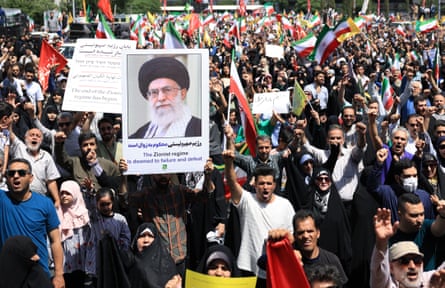
Recent developments suggest that regime change in Iran remains unlikely, even amidst the ongoing conflict with Israel
.
Factors contributing to regime stability:
- Regime Resilience and Control: Despite significant internal discontent, including protests, the Iranian regime has demonstrated a capacity to maintain control, utilizing overwhelming force and suppressing dissent through security and judicial institutions.
- Hardliner Dominance: The hard-line elements within Iran’s governing bodies, such as the Guardian Council, maintain a strong grip on power, limiting the potential for significant political change. The Guardian Council’s role in vetting candidates for elected positions significantly restricts the political choices available to voters.
- Impact of the Conflict: The ongoing conflict with Israel appears to have prompted a degree of national solidarity and a “rally-around-the-flag” effect, at least for the present, which may temporarily strengthen the regime’s position.
Challenges facing the regime:
- Deep Public Disillusionment: There is widespread public dissatisfaction with the regime, fueled by economic hardship, mismanagement, and restrictions on civil liberties.
- Weakened Regional Network: The conflict with Israel has exposed vulnerabilities in Iran’s network of proxies and partners, which were crucial to its regional influence.
- Limited Military Options: Iran’s direct military capabilities have shown limitations, as demonstrated by the limited success of its attacks on Israel.
Overall, while the conflict with Israel adds pressure on the Iranian regime, a change of leadership is not immediately anticipated. However, sustained external pressure and continued internal unrest could potentially weaken the regime’s stability over time.
Regime change in Iran: Analysis and Perspectives – Google Search google.com/search?q=Regime+c…
piped.video/watch?v=sheDgh_F…
AI Mode
Regime change in Iran: Analysis and Perspectives
Recent analyses and perspectives on regime change in Iran highlight the complexities and uncertainties surrounding such a possibility.
Factors contributing to discussions of regime change:
Internal dissent: Iran has witnessed repeated waves of nationwide protests in recent years, including the “Woman, Life, Freedom” movement in 2022 following the death of Mahsa Amini. These protests, which included demands for regime change, were met with severe government crackdowns.
Government repression: The Iranian government has responded to protests with widespread arrests, violence, and even the use of the death penalty against protesters. This intensified repression contributes to the desire for change among certain segments of the population.
Economic hardship: US-led sanctions and economic mismanagement have led to widespread economic hardship, driving further discontent and fueling protest movements.
External pressure: Israel’s recent military actions against Iran, including strikes on nuclear facilities and leadership figures, have intensified discussions around the possibility of regime change.
Challenges and uncertainties surrounding regime change:
Regime strength: Despite internal and external pressures, the Iranian regime remains deeply entrenched and has demonstrated a willingness to use force to suppress dissent.
Divided opposition: Iran’s opposition movement, both inside and outside the country, remains fragmented and lacks a unified leadership or clear strategy for achieving regime change.
Potential for instability: Experts warn that regime change could lead to chaos and instability, potentially impacting regional security.
Unintended consequences: External interventions aimed at regime change have a checkered past, often resulting in prolonged conflict and unintended negative outcomes.
Perspectives on potential outcomes:
Some analyses suggest that the ongoing pressures, especially in the context of recent Israeli actions, could accelerate internal shifts within the regime, potentially leading to a military-dominated state.
Others point to the potential for a popular uprising to overthrow the regime, particularly if economic conditions worsen significantly.
However, many remain cautious, noting that the regime is unlikely to collapse easily and that the future remains uncertain.
Overall, while the prospect of regime change in Iran remains a topic of considerable debate and analysis, it is important to acknowledge the complexities and uncertainties involved. The regime’s resilience, the fractured nature of the opposition, and the potential for regional instability all contribute to a nuanced and dynamic situation.
Regime change in Iran seems unlikely amid war with Israel, Middle East scholar says – YouTube https://t.co/8UYgh9pRZ8
— Michael Novakhov (@mikenov) June 22, 2025
JUST IN:
Israeli airstrikes targeted a power substation and an IRGC base in Yazd, central Iran, with additional strikes reported in the Bushehr region. pic.twitter.com/LuyeMuyi8i
— Current Report (@Currentreport1) June 22, 2025
BREAKING:
🇬🇧🇺🇲🇮🇷 If Iran attacks U.S. personnel we will consider it an attack on a NATO country – United Kingdom pic.twitter.com/GG8GsKAVJT
— Megatron (@Megatron_ron) June 22, 2025
🚨⚡BREAKING AND UNUSUAL
A massive fire and a giant mushroom-shaped smoke cloud following an Israeli attack on Iran now.
Israeli media:
The Israeli Defense Forces are targeting weapons depots in southwestern Iran.Iranian media:
A loud explosion heard in the city of Bushehr… pic.twitter.com/vBYQrPkaIZ— RussiaNews 🇷🇺 (@mog_russEN) June 22, 2025
Regime change in Iran: Analysis and Perspectives – Google Search https://t.co/Ize2oqfMsu https://t.co/8UYgh9pRZ8
— Michael Novakhov (@mikenov) June 22, 2025
JUST IN:
🇷🇺🇮🇷🇺🇲 Dimitry Medvedev on US steikes on Iran:
“What have the Americans accomplished with their nighttime strikes on three nuclear sites in Iran?
1. Critical infrastructure of the nuclear fuel cycle appears to have been unaffected or sustained only minor damage.
2.… pic.twitter.com/olAiMtcY4N
— Megatron (@Megatron_ron) June 22, 2025
BREAKING:
IRGC says it has identified the takeoff locations of the aircraft involved in the nuclear facility attacks and warns the US to expect a regrettable response beyond its calculations. pic.twitter.com/gCID20QyLv
— Current Report (@Currentreport1) June 22, 2025