
Зангезурский коридор как элемент новой трансевразийской архитектуры – Мусабеков и Цукерман на https://t.co/lvR8nq00ta https://t.co/XgyUEEMPfz
— Michael Novakhov (@mikenov) July 17, 2025
Day: July 17, 2025
The Presidents visited the Yukhari Govhar Aga #Mosque today, which was destroyed during the #Armenian occupation and restored by the Heydar Aliyev Foundation after the liberation of Shusha, #Azerbaijan . pic.twitter.com/OtHmbfVZKW
— Vugar Bayramov (@BayramovMP) July 17, 2025
On June 14, protesters gathered in cities across the country under a bold banner: “No Kings.” They marched again under that same cry two weeks later, and rallied again in some cities on July 4. The slogan is intended as a rebuke to what they perceive as a creeping authoritarianism in American politics, particularly directed at President Trump, whose critics accuse him of cultivating a “regal presidency.” Whatever the merits of those charges may be, the imagery accompanying these protests—mannequin heads in French wigs, toy guillotines, and revolutionary theater—evokes not America in 1776, but France in 1793.
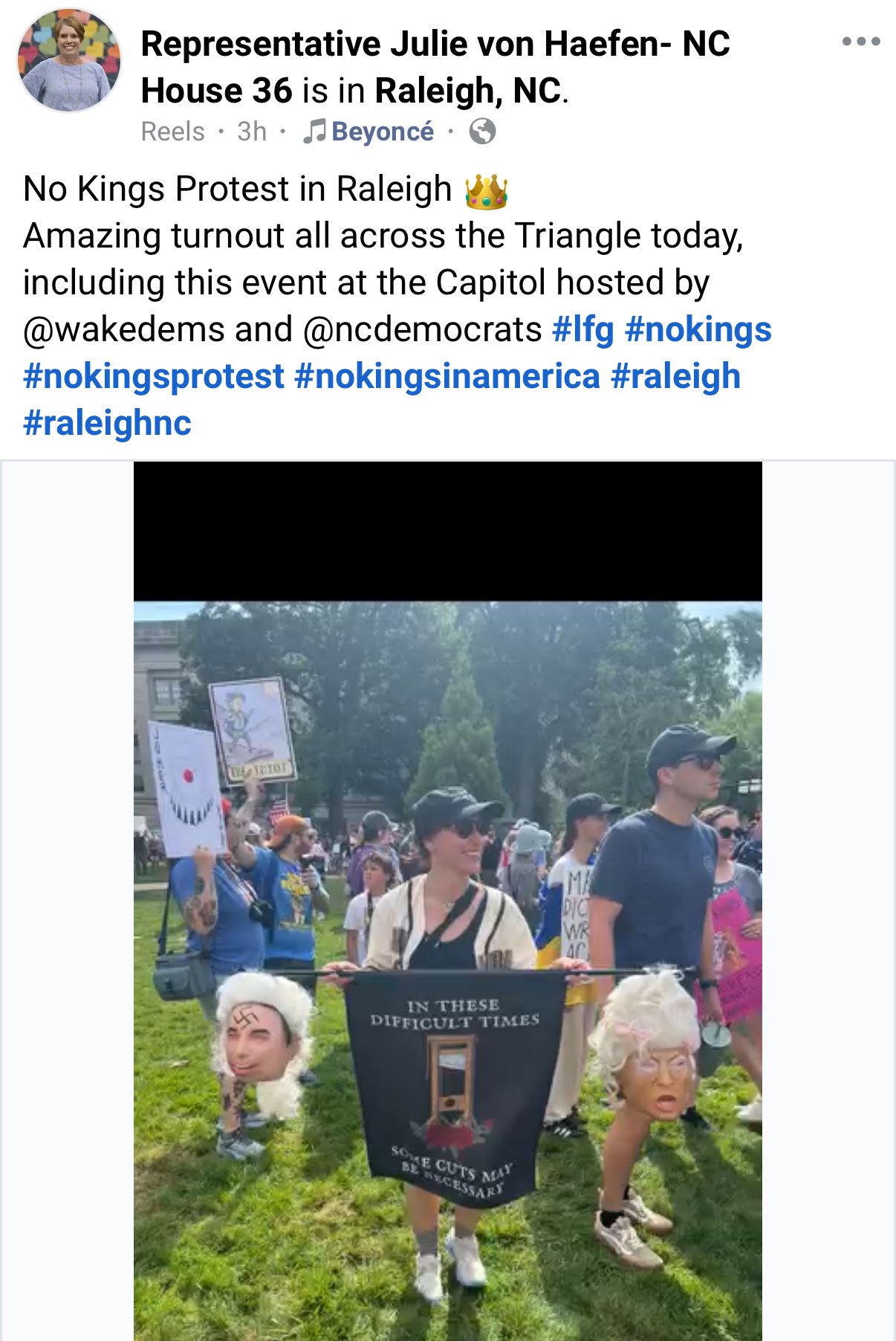
It’s powerful symbolism, but the progressive Left has chosen the wrong revolution to celebrate. On July 4, 1776, America did indeed declare, in effect, “No Kings.” But the revolution that followed lacked the radical aims of the later Jacobins. Our Founders were altogether more restrained and philosophical, and therefore their project has been far more enduring. They may have fought a war to defend their rights, but unlike the French Revolution, they never let loose violence and terror, which upended the social order altogether.
In part, the Founders’ moderation was a consequence of their deep-rootedness in the political thought of John Locke. The Englishman, writing almost a century before the American Revolution, held that the government’s sole purpose is to protect pre-existing natural rights: life, liberty, and property. When the government fails to do so, citizens have not only the right but the duty to withdraw their consent. The Declaration of Independence echoes this logic precisely: governments derive “their just powers from the consent of the governed,” and when they become destructive of those rights, “it is the Right of the People to alter or to abolish it.”
That is a protest against tyranny—but a protest grounded in order and principle, not chaos.
The current “No Kings” movement borrows more heavily from the French model than Anglo-American sources. In their Revolution, sovereignty was not a means of protecting rights, but of redefining them. Jean-Jacques Rousseau’s notion of the “general will” replaced individual conscience with collective conformity. The result, infamously, was not ordered liberty but the Reign of Terror—the new regime devoured its own children in the name of the people. Under Maximilien Robespierre, the “general will” justified mass executions of anyone who disagreed, often without trial.
John Locke and Jean-Jacques Rousseau both began with the premise that government derives its legitimacy from the consent of the governed, but their paths diverged sharply from there. Locke believed that individuals possess natural rights—life, liberty, and property—that exist prior to government and must be protected by it. Rousseau, by contrast, held that rights are shaped and defined by the collective, and that true freedom comes only through submission to the “general will.” Where Locke saw the social contract as a safeguard for individual liberty, Rousseau saw it as a tool to forge civic unity, even at the expense of dissent. The result was two starkly different visions of freedom: one rooted in restraint, the other in control.
We still see echoes of this divergence in American politics today. In a recent interview with Rolling Stone, Congresswoman Alexandria Ocasio-Cortez remarked, “I believe in our collective conscience. So, I don’t have any master plan, but I believe that the people will show me the way.” That sentiment may sound democratic in passing, but it reflects the Rousseauian idea that legitimacy flows not from principle or process, but from the mood of the crowd. Liberty is not secured by intuition or collective conscience—laws, institutions, and limits on power secure it. Unlike Rousseau and his statist heirs, our Founders understood that freedom cannot simply be redefined by a simple majority.
America’s revolution was different because it did not just reject kings—it also rejected mobs. It chose a structure of liberty, not a spectacle of rage.
Today’s protestors may not call for literal guillotines, but their chosen symbols suggest a comfort with revolutionary excess. A movement claiming to resist authoritarianism ought to look more carefully in the mirror. In recent years, many of the same voices decrying executive power as “anti-democratic” had little objection when left-of-center Presidents Obama and Biden stretched that power in service of their own goals. The issue seems less about defending democracy than about discrediting any outcome or leader they happen to dislike. And that’s precisely the kind of arbitrary rule the American founders revolted against.
This is not to say that concern over concentrated executive power is unfounded. Conservatives raised similar alarms during the Obama years, just as progressives now object to Trump’s rhetoric. But what’s missing in today’s movement is consistency and humility.
In his 2014 book The Revolt of the Public, former CIA analyst Martin Gurri describes the rise of “Homo informaticus,” a hyper-connected citizenry whose first reflex is to negate. Armed with smartphones and social platforms, the public now wields a decentralized “no-power” that can topple reputations or derail policy within hours. Yet the angered mob rarely coalesces around durable, constructive programs. “Any untoward event,” Gurri warns, “can draw a networked public into the streets, calling for blood.”
The “No Kings” rallies exemplify that pattern: they film toy guillotines, place guillotines on signs and shirts, and lampoon an imperial presidency but offer no better architecture to replace it. In other words, twenty-first-century mobs achieve Rousseau’s instantaneous unanimity without enduring Rousseau’s committees of public safety; they magnify grievance while remaining institutionally weightless. Unless channeled by structural guardrails—such as the ballots, bicameralism, and federalism prized by our Madisonian system—this digital negation risks repeating the French cycle of demolition without design.
History offers a cautionary preview: two late-eighteenth-century revolutions unleashed popular fury, yet only one translated it into lasting liberty. The American Revolution, though born of conflict, was fundamentally constructive. It produced a written constitution, institutional checks and balances, and a governing structure designed to preserve liberty by limiting power. The French Revolution, by contrast, tore down institutions without building durable replacements. In place of monarchy, it elevated committees, cults, and mobs—all in the name of virtue and the people. The American Founders pledged their lives, fortunes, and sacred honor to establish a republic of laws. The Jacobins demanded blood to purify a society of enemies. One gave rise to ordered liberty. The other ended in the guillotine.
The genius of the American Revolution is that it said “No Kings” and “No Committees of Public Safety.” It distrusted concentrated power of every kind, placing checks and balances between the branches of government, and between the government and the people. That is why July 4 celebrates not just rebellion, but constitutionalism—a nation of laws, not of men.
It is fair, even noble, to oppose executive overreach. But the test of a protest movement is not only what it resists, but what it proposes in its place. The founders did not simply reject monarchy; they established a durable republic founded on natural rights and limited government.
If today’s “No Kings” movement wants to honor that legacy, it might revisit the source. Begin not with Rousseau and Robespierre, but with Locke and Madison—men who knew that liberty depends not on “general will,” but on ordered liberty.
The road of history is fraught with political movements driven by passion, unmoored from principle, that tended to crown tyrants. From Alcibiades, the self-serving populist of Athenian democracy, to Napoleon, to Fidel Castro, the crowd’s will has too often paved the road to centralized, unchecked power. America’s revolution was different because it did not just reject kings—it also rejected mobs. It chose a structure of liberty, not a spectacle of rage.
If we are serious about preventing either thrones or mobs, Congress could begin by reclaiming the authorities it has lazily ceded. Require explicit re-authorization of national emergencies after 90 days; regulate trade through Congressional action; mandate legislative approval for any regulation with a multi-billion-dollar impact; tighten the War Powers Resolution to force an up-or-down vote before extended deployments. Such acts would not suffocate executive energy, but they would re-anchor it to popular consent expressed through deliberation rather than acclamation—a thoroughly Locke-and-Madison remedy for twenty-first-century anxieties. That legacy is worth defending—not with guillotines, but with guardrails on governmental power.
Do people have a moral obligation to obey the law simply because it is the law? If you come to a red light and have a clear view in all directions with no cars in sight, do you have a moral obligation to stop?
Questions like this have long divided philosophers of law. In The Nature of Law: Authority, Obligation, and the Common Good, Daniel Mark defends the traditional natural law position that law’s connection to the common good generates a defeasible moral obligation to obey the law. The book is divided into five chapters. The first two criticize H. L. A. Hart’s rule-based, positivist theory of law. The third criticizes Joseph Raz’s influential positivist account of law’s authority. The fourth chapter is the heart of the book: it presents Mark’s preferred brand of natural law theory, which holds that law is a set of commands oriented to the common good, and explains why this theory implies the existence of a defeasible moral obligation to obey the law. The fifth and final chapter addresses questions about the relationship between Mark’s theory of law and democratic systems of government.
The most interesting and successful parts of the book are where Mark works out the kind of relationship between law and the common good that, assuming it exists, would be capable of generating a moral obligation to obey the law. As Mark points out, if it were the orientation to the common good at the level of the individual law that generated the obligation, then it would be hard to see how this obligation could be an obligation to obey, that is, to comply with the law just because it is the law. The fact that the action required by law is in service of the common good would do all the work in generating the moral obligation to perform the action. The fact that the law requires the action would be redundant.
Mark’s solution is to ground the moral obligation to comply with each individual law in the orientation of the legal system as a whole to the common good. Because the system-level orientation to the common good can remain intact even if some individual laws are unjust, it can generate a moral obligation to obey even those laws, an obligation that would not exist but for the fact that they are laws.
The focus on the system-level orientation to the common good is among the book’s most valuable insights. Not only does it explain how there could be a moral obligation to obey the law just because it is the law, but it also provides Mark with an elegant account of the morality of revolution: generally, revolution becomes morally permissible once injustice has become so pervasive as to compromise the orientation of the system as a whole to the common good. It also provides Mark with an intuitive explanation for why it is generally appropriate for those engaged in civil disobedience to submit to the punishment prescribed by law for their actions. Civil disobedience is morally permissible when the defeasible moral obligation to obey an individual law is defeated by countervailing considerations. Yet even then, it is plausible that the defeasible moral obligation to comply with the law’s provision of punishment for violating the law remains undefeated.
However, we encounter a complication here. It is one thing to work out what kind of relationship between law and the common good would be capable of generating a moral obligation to obey the law. It is another thing to show that law actually has this relationship to the common good. Even if a system’s general orientation to the common good generates a moral obligation to obey its rules, one might still ask whether only systems generally oriented to the common good count as legal systems. If not, then there may not be a moral obligation to obey all laws, only an obligation to obey those that are part of a system generally oriented to the common good.
Despite relying heavily on the work of John Finnis throughout the book, Mark has surprisingly little to say about Finnis’s influential argument that at least all central cases of law have the kind of orientation to the common good that generates a moral obligation to obey. Also conspicuously absent from the book is meaningful engagement with the work on this subject by prominent natural law theorists since Finnis, most notably Mark Murphy.
The closest Mark comes to defending the natural law view that only systems oriented to the common good count as legal systems is in his criticism of Hart’s positivist alternative. Mark reads Hart as (perhaps inconsistently) recognizing that a system does not count as a legal system unless its subjects feel that they ought to follow the system’s rules. But Mark argues that Hart’s theory “gets in the way of any coherent account” of why people feel that way. Hart conceives of law as consisting of “rules based in social practice”—what people do “around here”—and “on a moment’s reflection, any person can see that the fact that we happen to do things a certain way around here … never [generates] an obligation to obey the law just because it is the law.” Absent some basis for thinking that people should obey the law, it is hard to explain people’s feeling that they should obey the law.
I am not sure how much damage this criticism inflicts on Hart’s theory. Hart could, if he liked, help himself to Mark’s account of why there is an obligation to obey all rules of a system oriented to the common good, to explain why the subjects of such a system feel that they ought to obey the law. This is consistent with the claim that a system that was not oriented to the common good but where people, for whatever reason, nonetheless felt that they ought to follow the rules would also constitute a legal system. Hart need not maintain that such a system is probable and thus does not owe us an account of why people might feel that way. Mark never claims that there would be anything counterintuitive about identifying such a system as a legal system and even appears to concede that one’s intuition might align with the positivist on this point.
If Mark wanted to ground the principle of legality in the relationship between law and moral obligation, then he would need to insist on a (defeasible) moral obligation to do whatever the law permits.
Of course, Hart might prefer not to adopt Mark’s account wholesale. Hart does not actually claim that a legal system exists only if all or even most of the system’s subjects feel that they ought to obey the law; all he says is that a legal system exists only if the system’s officials treat its secondary rules of recognition, change, and adjudication as standards of official behavior. And the hypothesis of a moral obligation to obey the law is not the only possible explanation for why a system’s officials treat its secondary rules as standards of official behavior. Alternative explanations include a sense of role morality and social pressure. Hart would likely adopt a liberal attitude toward the range of possible explanations for officials’ attitudes toward the law rather than insist on a single explanation applicable to all legal systems. At any rate, the point is that Hart could, without compromising his positivism, agree that people in legal systems oriented to the common good feel that they ought to obey the law and adopt Mark’s explanation for why. This shows that even if that explanation is correct, it does not follow that we should accept the natural law claim that only systems oriented to the common good are legal systems.
Mark also criticizes Hart’s treatment of trials of Nazi officials in postwar Germany. Hart recognizes that these trials were fraught, even if plausibly justified, because they involved punishing defendants for acts that were legal when they were committed. According to Mark, this makes sense only on the assumption that there is a (defeasible) moral obligation to obey the law, such that the defendants were punished for something that they had a (defeasible) moral obligation to do. Predictably, Mark argues that the problem with the trials is solvable because the defendants’ defeasible moral obligation to obey the law was, in fact, defeated. But Mark maintains that we cannot even understand the problem to be solved unless we recognize a defeasible moral obligation to obey the law.
Mark appears to slide here from legally permitted to legally required. I do not know whether every act for which the defendants in these trials were prosecuted was not only permitted but required by Nazi law, but it is notable that Hart sets up the problem as one of whether “to punish those who did evil things when they were permitted by evil rules then in force” (emphasis added). And Hart seems right to set up the problem this way. As Hart notes, the venerable principle of legality—nulla poena sin lege—prohibits the state from punishing people for acts that were legally permissible when performed. The problem with the trials was that they appeared to violate this principle.
This suggests that it is Mark, not Hart, who “misidentifies the nub of the problem.” The alleged (defeasible) moral obligation to do whatever the law requires has nothing to do with the principle of legality, which prohibits punishment not just for acts that the law required but for any act that the law permitted. If Mark wanted to ground the principle of legality in the relationship between law and moral obligation, then he would need to insist on a (defeasible) moral obligation to do whatever the law permits. And surely Mark would not want to go that far.
Mark’s final major criticism of Hart is that Hart is wrong to reject the model of law as a collection of commands. According to Hart, some legal rules are a poor fit for the command model because they confer powers rather than impose duties. Legal rules defining how a legislature can enact new laws or how parties can form a valid contract are not naturally understood as commands to legislators or to potential parties to a contract. On Hart’s view, such rules confer powers rather than impose duties. But Mark argues that power-conferring rules can generally be understood as conditional commands. On this view, rules defining how a legislature can enact new laws are conditional commands instructing legislators that they must proceed in a certain way if they wish to enact a new law, and rules defining how parties can form a contract are conditional commands instructing parties that they must proceed in a certain way if they wish to form a contract.
Mark’s argument here appears to trade on an ambiguity in the modal force of “must.” The construal of power-conferring rules as tantamount to a conditional requirement of the form, “if you wish to do X, then you must do Y,” is plausible if the modal force of “must” is metaphysical. Given that the relevant legal rule empowers the legislature to create law (only) by means of a certain procedure, it is impossible for the legislature to enact law in any other way: that is the sense in which legislators “must” proceed in a certain way if they wish to enact a new law. So too when parties wish to form a contract. The relevant power-conferring rule specifies the (only) way to do it, making it impossible to form a contract otherwise; that is the sense in which parties “must” proceed in a certain way if they wish to form a contract.
But if Mark is to reduce power-conferring rules to duty-imposing rules, then he needs the modal force of “must” to be normative—more specifically, legal. And the construal of power-conferring rules as conditional requirements of the form “if you wish to do X, then you must do Y” is less plausible if the modal force of “must” is legal. It is not as if Congress could enact a statute without regard to bicameralism or presentment, but is prohibited by law from doing so. Absent bicameralism and presentment, there is no statute. Similarly, it is not as if you and I could form a contract lacking consideration but are prohibited by law from doing so. Absent consideration, there is no contract.
I have focused on Mark’s engagement with Hart because Mark rightly identifies Hart’s theory as the leading positivist competitor to the kind of natural law theory that Mark defends. But even if I am right that Mark’s criticisms of Hart are ultimately unsuccessful, these shortcomings should not overshadow the book’s important contributions to understanding what the grounds of a moral obligation to obey the law must be if indeed such an obligation exists. Nor do they undermine the basis that Mark provides for thinking that in a legal system such as ours in the United States, which does seem to be generally (albeit imperfectly) oriented to the common good, citizens have a defeasible moral obligation to obey the law. In addition, the book features much more of interest than can be covered here, including extended discussions of Raz’s theory of authority and Carl Schmitt’s political theory. Anyone interested in the philosophy of law, especially those interested in questions of political obligation, will enjoy this book and find in it—to quote Mark—plenty of fodder for “discussion and, better yet, disagreement.”