
Categories
Selected Articles

US and UK carry out strikes against Iran-backed Houthis in Yemen

The US and UK militaries launched strikes against Houthi targets in Houthi-controlled areas of Yemen on Thursday, marking a significant response after the Biden administration and its allies warned that the Iran-backed militant group would bear the consequences of its attacks on commercial shipping in the Red Sea.

US President Joe Biden said he ordered the strikes “in direct response to unprecedented Houthi attacks against international maritime vessels in the Red Sea.”

“Today, at my direction, U.S. military forces — together with the United Kingdom and with support from Australia, Bahrain, Canada, and the Netherlands—successfully conducted strikes against a number of targets in Yemen used by Houthi rebels to endanger freedom of navigation in one of the world’s most vital waterways,” the president said in a statement released by the White House.

Biden added that he will “not hesitate to direct further measures to protect our people and the free flow of international commerce as necessary.”

British Prime Minister Rishi Sunak said on Friday the strikes were an act of “self-defense,” adding that the aim was to “de-escalate tensions and to restore stability to the region.”

US and coalition forces struck over 60 targets with more than 100 precision-guided munitions at 16 Iranian-backed Houthi militant locations, US Air Forces Central Commander Lt. Gen. Alex Grynkewich said. The Houthi assets included command and control nodes, munitions, depots, launching systems, production facilities, and air defense radar systems, he added.

The strikes, which have been condemned by several leaders across the Middle East, killed five and wounded six others, according to the rebels’ military spokesperson, Yahya Sare’e, who said the airstrikes would not deter further Houthi attacks on shipping.

The US and UK strikes are a sign of the growing international alarm over the threat to one of the world’s most critical waterways. For weeks, the US had sought to avoid direct strikes on Yemen because of the risk of escalation in a region already simmering with tension as the Israel-Hamas war continues, but the ongoing Houthi attacks on international shipping compelled the coalition to act.

Though the US has carried out strikes against Iranian proxies in Iraq and Syria since the outbreak of the war in Gaza, this marks the first known strike against the Houthis in Yemen.

The strikes were from fighter jets and Tomahawk missiles. More than a dozen Houthi targets were fired on by missiles fired from air, surface, and sub platforms and were chosen for their ability to degrade the Houthis’ continued attacks on vessels in the Red Sea, a US official told CNN.

The USS Florida, a guided missile submarine that crossed into the Red Sea on November 23, was part of the attack on Yemen, according to a second US official.

Four British Typhoon jets departed RAF Akrotiri, a major UK airbase in Cyprus, on Thursday evening local time, according to a British government official.

Two Voyager air-to-air refuelling tankers also comprised the mission, UK junior armed forces minister James Heappey told the BBC on Friday, adding that at least 14 targets were successfully hit.

“They flew south, joined up with their US colleagues, and prosecuted two targets in Houth-controlled Yemen, both of which had been used for the launching of drone and missile attacks,” Heappey added. There are no more UK convoys “immediately planned,” he said.

On Thursday, Rear-Admiral Emmanuel Slaars, joint commander of French forces in the Red Sea region, told journalists in Paris that French naval forces were patroling the waters where the Houthis operated.

Slaars said the French navy forces remain “under national command” and were “not subordinated” to the US. However, they are cooperating and sharing intelligence with the US.

A senior US military official told reporters on Thursday evening that he could not provide an exact percentage of Houthi assets that were destroyed in the strikes but that it was “significant.” He added that precision guided munitions were used to destroy the targets “and also to minimize collateral damage.”

“We were absolutely not targeting civilian population centers. We were going after very specific capabilities, in very specific locations, with precision munitions,” the official said.
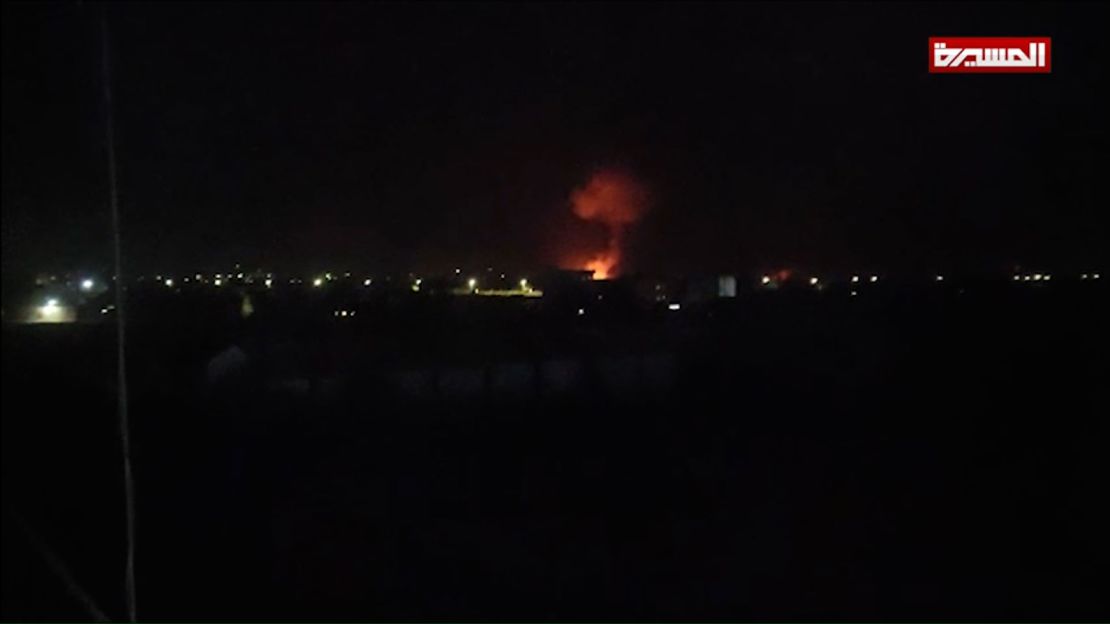
A still from a video released by Houthi-run al-Masira TV allegedly shows the moment of the bombardment in Sanaa, Yemen.

The Houthis — an Iran-backed Shia political and military organization that has been fighting a civil war in Yemen against a coalition backed by Saudi Arabia — have been launching drones and missiles at commercial shipping vessels in the Red Sea for weeks, many of which have been intercepted and shot down by US Navy ships in the area.

The Houthis have said their bombardments are showing solidarity with the Palestinian people, after Israel launched an unrelenting military campaign on Gaza following Hamas’ October 7 terror attacks.

The Houthis have said they will only relent when Israel allows the entry of food and medicine into Gaza; its strikes could be intended to inflict economic pain on Israel’s allies in the hope they will pressure it to cease its military offensive.
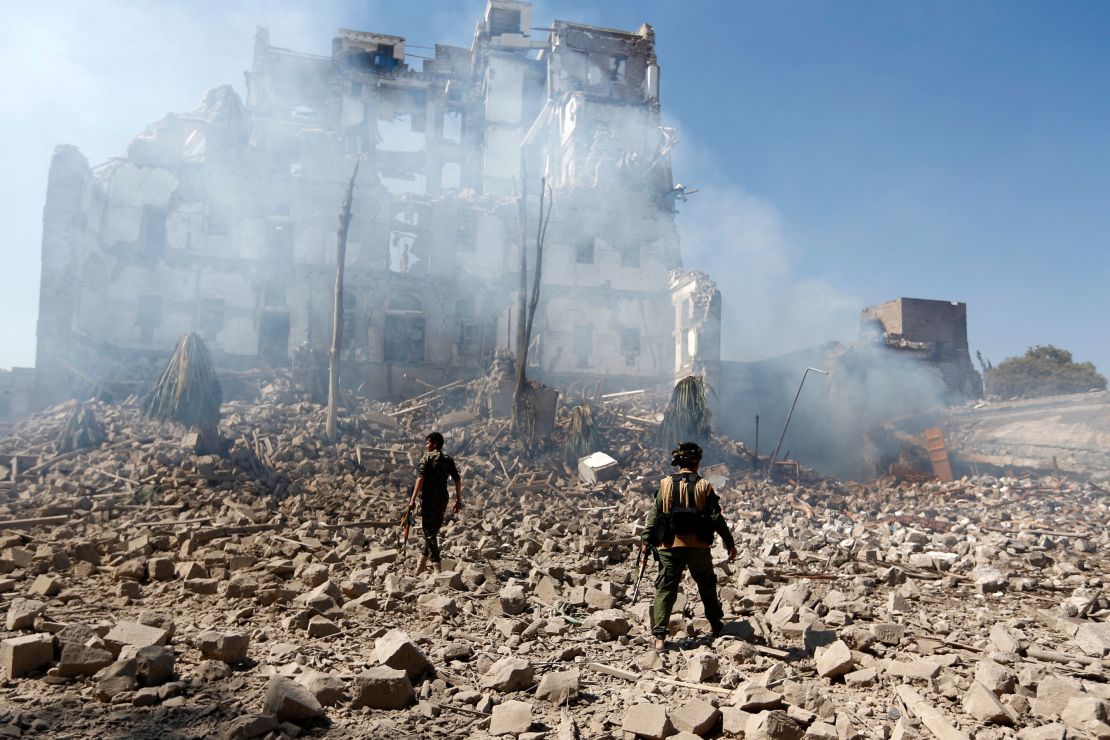
TOPSHOT - Huthi rebel fighters inspect the damage after a reported air strike carried out by the Saudi-led coalition targeted the presidential palace in the Yemeni capital Sanaa on December 5, 2017. Saudi-led warplanes pounded the rebel-held capital before dawn after the rebels killed former president Ali Abdullah Saleh as he fled the city following the collapse of their uneasy alliance, residents said. (Photo by Mohammed HUWAIS / AFP) (Photo by MOHAMMED HUWAIS/AFP via Getty Images)

Within Yemen, a yearslong conflict between Houthi forces and the Saudi-backed coalition has plunged the population into a devastating humanitarian crisis marked by famine, economic turmoil and extreme poverty.

Houthi forces stormed the capital Sanaa in 2014, and toppled the internationally recognized and Saudi-backed government, triggering a civil war. The conflict spiraled into a wider war in 2015 when a Saudi-led coalition intervened in an attempt to beat back the Houthis.

The conflict has killed up to 377,000 people, the United Nations Development Programme (UNDP) reported in 2021. More than half of those died from indirect causes associated with the conflict, such as lack of food, water and healthcare.

Pro-Houthi demonstrators gathered in Sanaa on Friday, protesting against the US and UK airstrikes. Some chanted, “God is great, death to America, death to Israel, curse the Jews, victory to Islam.”
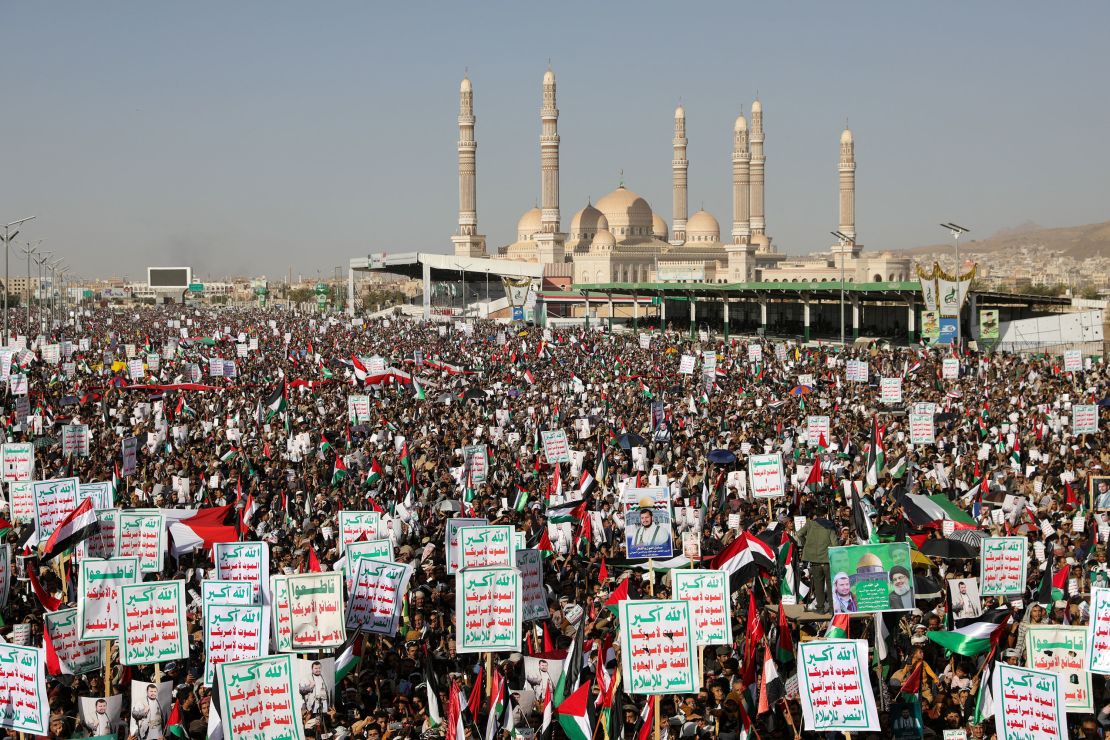
Supporters of the Houthi movement rally to denounce air strikes launched by the U.S. and Britain on Houthi targets, in Sanaa, Yemen January 12, 2024. REUTERS/Khaled Abdullah

The Houthi attacks on Red Sea shipping on Tuesday marked the final straw that culminated in Biden giving the green light for the US to move forward with Thursday’s strikes, though preparations have been ongoing for some time, a senior US official told CNN.

The strikes come as Secretary of Defense Lloyd Austin remains hospitalized following complications from a surgery for prostate cancer. A senior Defense official said Austin ordered and monitored the strikes in in real-time from the hospital “with a full suite of secure communications.”

Over the course of the past several weeks, Biden has weighed potential strikes against Houthi positions in Yemen against the prospect of an escalating crisis in the Middle East. His underlying hesitancy in ordering direct action has been the potential of getting drawn in more directly to an expanding conflict — a scenario US officials believe could ultimately be Iran’s objective.

But the White House had made clear the repeated Houthi attacks on international shipping lanes in the southern Red Sea were intolerable. The attacks have forced some of the world’s largest shipping companies to avoid the waterway, instead adding thousands of miles to international shipping routes by sailing around the continent of Africa.

Hours before the strike on Thursday, Pentagon spokesman Maj. Gen. Pat Ryder said Iran “has a role to play” in getting the Houthis to stop their “reckless, dangerous, and illegal activity.” If they did not, he said, “there will be consequences.”

The Houthi’s deputy foreign minister, Hussein al-Ezzi, claimed that Yemen was targeted in a “massive aggressive assault.”

In a speech Thursday, Houthi leader Abdul Malek Al-Houthi said that any US attack on Yemen ” will not go unanswered,” cryptically warning that the response will be “much more” than attacking US ships in the sea.

Houthi rebels’ military spokesperson Sare’e on Friday said they would continue their aggression against commercial ships in the Red Sea.

In a statement Friday on social media, Mohammed Ali al-Houthi, the head of the group’s Supreme Revolutionary Committee, said the airstrikes “are barbaric, terrorist, and are a deliberate and unjustified aggression that reflects a brutal psychology.”
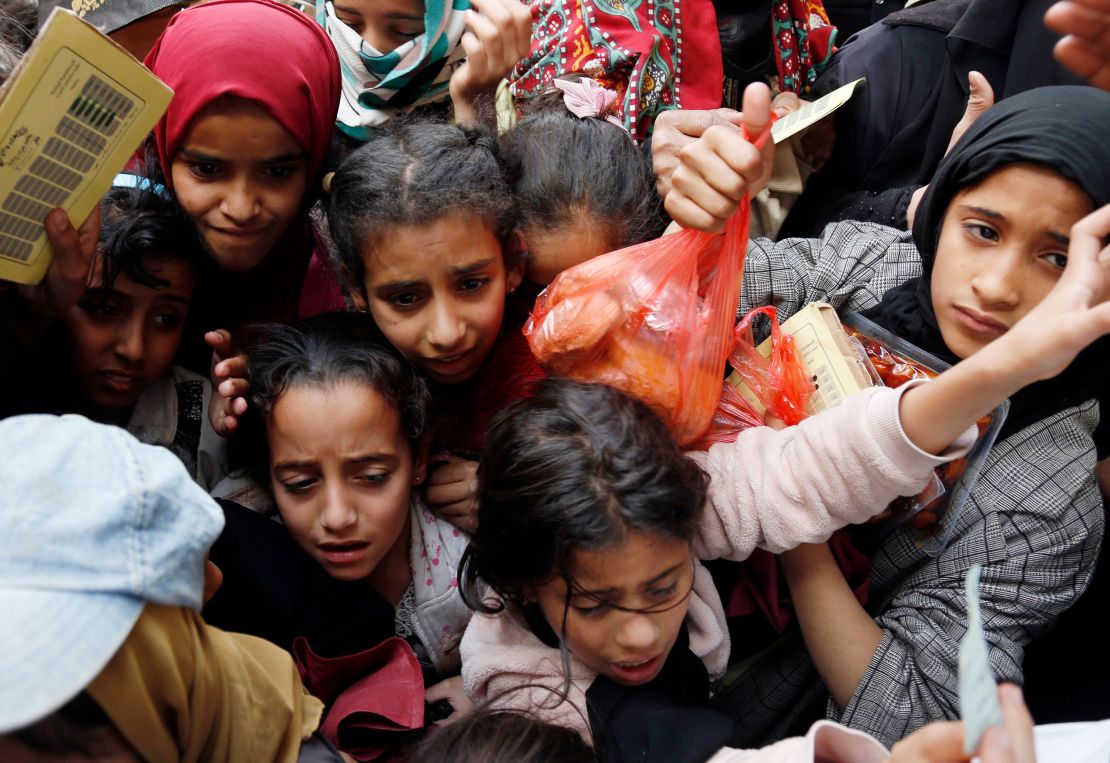
SANA'A, YEMEN - MARCH 23: Girls from families affected by eight years of war and blockade receive free meals provided by a charitable kitchen in the Mseek area on March 23, 2022 in Sana'a, Yemen. March 26th marks the 8th anniversary of the military intervention of the coalition led by Saudi Arabia on Yemen, which left the country to be the largest food security crisis in the world, with two-thirds of the population of Yemen in dire need of humanitarian assistance and protection services. Tens of thousands already live in famine-like conditions, with six million more just a step away from it. The war also displaced over 4 million people, and plunged the Arab country to the brink of collapse. (Photo by Mohammed Hamoud/Getty Images)

The senior military official said the Pentagon has thus far not seen any signs of retaliatory action by the Houthis as of Thursday night.

A senior US administration official signaled that there could be more action to come against the Houthis.

New explosions were heard in Yemen’s western port city of Hodeidah on Friday, a resident told CNN.

The airport in Hodeidah had been hit in the initial round of strikes early Friday morning. The resident provided CNN a video that showed smoke rising from the direction of the airport.

CNN has reached out to the US Department of Defense about the explosions, and whether there are new strikes in Yemen.

On Thursday, US Secretary of State Antony Blinken warned while traveling in the region that “if it doesn’t stop, there will have to be consequences. And unfortunately, it hasn’t stopped.”

Blinken also said he doesn’t believe the war in Gaza is escalating into a regional conflict, even as he warned of “a lot of danger points.” While in the region, Blinken visited Bahrain, home to the US Naval Forces Central Command and the Navy’s Fifth Fleet.

An important aspect of Blinken’s trip to the Middle East was to tell regional leaders that if US takes military action against the Houthis, it should be seen as defensive, not escalatory, according to a senior State Department official.

On Wednesday, the United Nations Security Council passed a US- and Japan-led resolution condemning “in the strongest terms the at least two dozen Houthi attacks on merchant and commercial vessels since November 19, 2023” and demanding “that the Houthis immediately cease all such attacks.” Eleven countries voted in favor of the resolution. Four abstained, including China and Russia. A Western diplomat told CNN that the US accommodated some of China’s requests on the language of the resolution.

US strikes in Yemen are not unprecedented; according to the Council on Foreign Relations, the US has conducted nearly 400 airstrikes in Yemen since 2002.

In Yemen, officials say they are concerned at what a strike against the Houthis would portend for the region. Declassified US intelligence shows that Iran has been deeply involved in coordinating the Houthi attacks on commercial and merchant ships, including providing information about shipping vessels passing through the waterway.

Among the US’ concerns about taking direct action inside Yemen is also the risk of upsetting a carefully brokered truce in the war in Yemen between the Houthis and Saudi Arabia, which a US official previously told CNN the Biden administration considers one of its most significant foreign policy achievements.

Some American officials feared a direct attack on the Houthis in Yemen would be precisely what the group craved: drawing the US into direct engagement with the Iranian proxy group and potentially committing its forces to a more prolonged conflict.
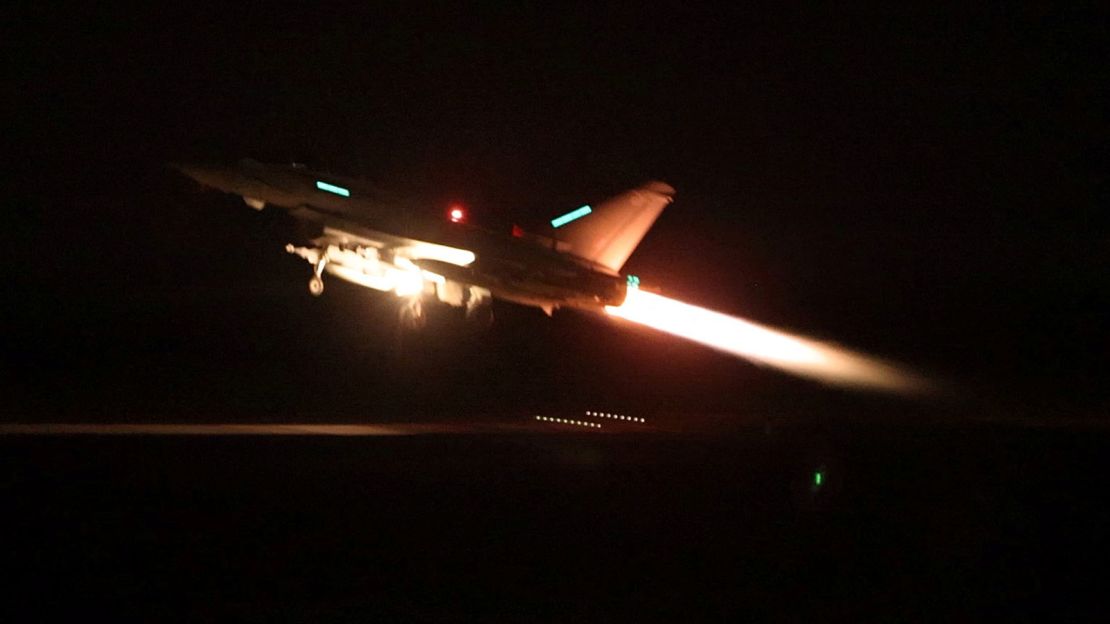
An RAF Typhoon aircraft takes off to join the US-led coalition from RAF Akrotiri to conduct air strikes against military targets in Yemen, aimed at the Iran-backed Houthi militia that has been targeting international shipping in the Red Sea, in Cyprus, in this handout picture released on January 12, 2024, local time.

Still, Biden’s attempts at deterrence had done little to prevent the Houthis from continuing their attacks on commercial and merchant ships transiting the Red Sea.

A significant turning point came around New Year’s, when US Navy helicopters shot and sank three Houthi boats in self-defense, killing those aboard. It was the first direct engagement between the US and Houthis since the start of the conflict, and prompted Biden to convene his national security team for a secure briefing call while he was on vacation in the US Virgin Islands.

That joint statement was issued on January 3, saying that the Houthis “will bear the responsibility of the consequences should they continue to threaten lives, the global economy, and free flow of commerce in the region’s critical waterways.”

While not describing the statement as a red line, Biden and his team recognized the language would essentially bind them to a more forceful response should the Houthi attacks continue, which many officials privately believed they would.

Just on Tuesday, the US Navy to shot down 21 missiles and drones fired by the Houthis; culminating on Thursday the fiercest response from the Biden administration since the salvos began.

There have been at least 27 Houthi attacks since November 19. As the US and its allies have been navigating the Houthis’ ongoing attacks, there have also been at least 131 attacks on US and coalition forces in Iraq and Syria since October 17, leading to several strikes on facilities linked to Iran’s Islamic Revolutionary Guard Corps and other proxy forces.

But many of the commercial vessels have had no connection to Israel. Vice Adm. Bradley Cooper, the commander of US Navy Central Command, said last week that the US assesses 55 nations have “direct connections” to the ships that have come under fire.

CNN’s Samantha Waldenberg, Paul W. Murphy, Jonny Hallam, Amy Cassidy, Dalal Mawad and Catherine Nicholls contributed to this report.

CLARIFICATION: This story has been updated to clarify that the USS Florida is a guided-missile submarine.

This story has been updated with additional developments.

Categories
Saved Web Pages - Audio Posts

US and UK carry out strikes against Iran-backed Houthis in Yemen

The US and UK militaries launched strikes against Houthi targets in Houthi-controlled areas of Yemen on Thursday, marking a significant response after the Biden administration and its allies warned that the Iran-backed militant group would bear the consequences of its attacks on commercial shipping in the Red Sea.

US President Joe Biden said he ordered the strikes “in direct response to unprecedented Houthi attacks against international maritime vessels in the Red Sea.”

“Today, at my direction, U.S. military forces — together with the United Kingdom and with support from Australia, Bahrain, Canada, and the Netherlands—successfully conducted strikes against a number of targets in Yemen used by Houthi rebels to endanger freedom of navigation in one of the world’s most vital waterways,” the president said in a statement released by the White House.

Biden added that he will “not hesitate to direct further measures to protect our people and the free flow of international commerce as necessary.”

British Prime Minister Rishi Sunak said on Friday the strikes were an act of “self-defense,” adding that the aim was to “de-escalate tensions and to restore stability to the region.”

US and coalition forces struck over 60 targets with more than 100 precision-guided munitions at 16 Iranian-backed Houthi militant locations, US Air Forces Central Commander Lt. Gen. Alex Grynkewich said. The Houthi assets included command and control nodes, munitions, depots, launching systems, production facilities, and air defense radar systems, he added.

The strikes, which have been condemned by several leaders across the Middle East, killed five and wounded six others, according to the rebels’ military spokesperson, Yahya Sare’e, who said the airstrikes would not deter further Houthi attacks on shipping.

The US and UK strikes are a sign of the growing international alarm over the threat to one of the world’s most critical waterways. For weeks, the US had sought to avoid direct strikes on Yemen because of the risk of escalation in a region already simmering with tension as the Israel-Hamas war continues, but the ongoing Houthi attacks on international shipping compelled the coalition to act.

Though the US has carried out strikes against Iranian proxies in Iraq and Syria since the outbreak of the war in Gaza, this marks the first known strike against the Houthis in Yemen.

The strikes were from fighter jets and Tomahawk missiles. More than a dozen Houthi targets were fired on by missiles fired from air, surface, and sub platforms and were chosen for their ability to degrade the Houthis’ continued attacks on vessels in the Red Sea, a US official told CNN.

The USS Florida, a guided missile submarine that crossed into the Red Sea on November 23, was part of the attack on Yemen, according to a second US official.

Four British Typhoon jets departed RAF Akrotiri, a major UK airbase in Cyprus, on Thursday evening local time, according to a British government official.

Two Voyager air-to-air refuelling tankers also comprised the mission, UK junior armed forces minister James Heappey told the BBC on Friday, adding that at least 14 targets were successfully hit.

“They flew south, joined up with their US colleagues, and prosecuted two targets in Houth-controlled Yemen, both of which had been used for the launching of drone and missile attacks,” Heappey added. There are no more UK convoys “immediately planned,” he said.

On Thursday, Rear-Admiral Emmanuel Slaars, joint commander of French forces in the Red Sea region, told journalists in Paris that French naval forces were patroling the waters where the Houthis operated.

Slaars said the French navy forces remain “under national command” and were “not subordinated” to the US. However, they are cooperating and sharing intelligence with the US.

A senior US military official told reporters on Thursday evening that he could not provide an exact percentage of Houthi assets that were destroyed in the strikes but that it was “significant.” He added that precision guided munitions were used to destroy the targets “and also to minimize collateral damage.”

“We were absolutely not targeting civilian population centers. We were going after very specific capabilities, in very specific locations, with precision munitions,” the official said.

A still from a video released by Houthi-run al-Masira TV allegedly shows the moment of the bombardment in Sanaa, Yemen.

The Houthis — an Iran-backed Shia political and military organization that has been fighting a civil war in Yemen against a coalition backed by Saudi Arabia — have been launching drones and missiles at commercial shipping vessels in the Red Sea for weeks, many of which have been intercepted and shot down by US Navy ships in the area.

The Houthis have said their bombardments are showing solidarity with the Palestinian people, after Israel launched an unrelenting military campaign on Gaza following Hamas’ October 7 terror attacks.

The Houthis have said they will only relent when Israel allows the entry of food and medicine into Gaza; its strikes could be intended to inflict economic pain on Israel’s allies in the hope they will pressure it to cease its military offensive.

TOPSHOT - Huthi rebel fighters inspect the damage after a reported air strike carried out by the Saudi-led coalition targeted the presidential palace in the Yemeni capital Sanaa on December 5, 2017. Saudi-led warplanes pounded the rebel-held capital before dawn after the rebels killed former president Ali Abdullah Saleh as he fled the city following the collapse of their uneasy alliance, residents said. (Photo by Mohammed HUWAIS / AFP) (Photo by MOHAMMED HUWAIS/AFP via Getty Images)

Within Yemen, a yearslong conflict between Houthi forces and the Saudi-backed coalition has plunged the population into a devastating humanitarian crisis marked by famine, economic turmoil and extreme poverty.

Houthi forces stormed the capital Sanaa in 2014, and toppled the internationally recognized and Saudi-backed government, triggering a civil war. The conflict spiraled into a wider war in 2015 when a Saudi-led coalition intervened in an attempt to beat back the Houthis.

The conflict has killed up to 377,000 people, the United Nations Development Programme (UNDP) reported in 2021. More than half of those died from indirect causes associated with the conflict, such as lack of food, water and healthcare.

Pro-Houthi demonstrators gathered in Sanaa on Friday, protesting against the US and UK airstrikes. Some chanted, “God is great, death to America, death to Israel, curse the Jews, victory to Islam.”

Supporters of the Houthi movement rally to denounce air strikes launched by the U.S. and Britain on Houthi targets, in Sanaa, Yemen January 12, 2024. REUTERS/Khaled Abdullah

The Houthi attacks on Red Sea shipping on Tuesday marked the final straw that culminated in Biden giving the green light for the US to move forward with Thursday’s strikes, though preparations have been ongoing for some time, a senior US official told CNN.

The strikes come as Secretary of Defense Lloyd Austin remains hospitalized following complications from a surgery for prostate cancer. A senior Defense official said Austin ordered and monitored the strikes in in real-time from the hospital “with a full suite of secure communications.”

Over the course of the past several weeks, Biden has weighed potential strikes against Houthi positions in Yemen against the prospect of an escalating crisis in the Middle East. His underlying hesitancy in ordering direct action has been the potential of getting drawn in more directly to an expanding conflict — a scenario US officials believe could ultimately be Iran’s objective.

But the White House had made clear the repeated Houthi attacks on international shipping lanes in the southern Red Sea were intolerable. The attacks have forced some of the world’s largest shipping companies to avoid the waterway, instead adding thousands of miles to international shipping routes by sailing around the continent of Africa.

Hours before the strike on Thursday, Pentagon spokesman Maj. Gen. Pat Ryder said Iran “has a role to play” in getting the Houthis to stop their “reckless, dangerous, and illegal activity.” If they did not, he said, “there will be consequences.”

The Houthi’s deputy foreign minister, Hussein al-Ezzi, claimed that Yemen was targeted in a “massive aggressive assault.”

In a speech Thursday, Houthi leader Abdul Malek Al-Houthi said that any US attack on Yemen ” will not go unanswered,” cryptically warning that the response will be “much more” than attacking US ships in the sea.

Houthi rebels’ military spokesperson Sare’e on Friday said they would continue their aggression against commercial ships in the Red Sea.

In a statement Friday on social media, Mohammed Ali al-Houthi, the head of the group’s Supreme Revolutionary Committee, said the airstrikes “are barbaric, terrorist, and are a deliberate and unjustified aggression that reflects a brutal psychology.”

SANA'A, YEMEN - MARCH 23: Girls from families affected by eight years of war and blockade receive free meals provided by a charitable kitchen in the Mseek area on March 23, 2022 in Sana'a, Yemen. March 26th marks the 8th anniversary of the military intervention of the coalition led by Saudi Arabia on Yemen, which left the country to be the largest food security crisis in the world, with two-thirds of the population of Yemen in dire need of humanitarian assistance and protection services. Tens of thousands already live in famine-like conditions, with six million more just a step away from it. The war also displaced over 4 million people, and plunged the Arab country to the brink of collapse. (Photo by Mohammed Hamoud/Getty Images)

The senior military official said the Pentagon has thus far not seen any signs of retaliatory action by the Houthis as of Thursday night.

A senior US administration official signaled that there could be more action to come against the Houthis.

New explosions were heard in Yemen’s western port city of Hodeidah on Friday, a resident told CNN.

The airport in Hodeidah had been hit in the initial round of strikes early Friday morning. The resident provided CNN a video that showed smoke rising from the direction of the airport.

CNN has reached out to the US Department of Defense about the explosions, and whether there are new strikes in Yemen.

On Thursday, US Secretary of State Antony Blinken warned while traveling in the region that “if it doesn’t stop, there will have to be consequences. And unfortunately, it hasn’t stopped.”

Blinken also said he doesn’t believe the war in Gaza is escalating into a regional conflict, even as he warned of “a lot of danger points.” While in the region, Blinken visited Bahrain, home to the US Naval Forces Central Command and the Navy’s Fifth Fleet.

An important aspect of Blinken’s trip to the Middle East was to tell regional leaders that if US takes military action against the Houthis, it should be seen as defensive, not escalatory, according to a senior State Department official.

On Wednesday, the United Nations Security Council passed a US- and Japan-led resolution condemning “in the strongest terms the at least two dozen Houthi attacks on merchant and commercial vessels since November 19, 2023” and demanding “that the Houthis immediately cease all such attacks.” Eleven countries voted in favor of the resolution. Four abstained, including China and Russia. A Western diplomat told CNN that the US accommodated some of China’s requests on the language of the resolution.

US strikes in Yemen are not unprecedented; according to the Council on Foreign Relations, the US has conducted nearly 400 airstrikes in Yemen since 2002.

In Yemen, officials say they are concerned at what a strike against the Houthis would portend for the region. Declassified US intelligence shows that Iran has been deeply involved in coordinating the Houthi attacks on commercial and merchant ships, including providing information about shipping vessels passing through the waterway.

Among the US’ concerns about taking direct action inside Yemen is also the risk of upsetting a carefully brokered truce in the war in Yemen between the Houthis and Saudi Arabia, which a US official previously told CNN the Biden administration considers one of its most significant foreign policy achievements.

Some American officials feared a direct attack on the Houthis in Yemen would be precisely what the group craved: drawing the US into direct engagement with the Iranian proxy group and potentially committing its forces to a more prolonged conflict.

An RAF Typhoon aircraft takes off to join the US-led coalition from RAF Akrotiri to conduct air strikes against military targets in Yemen, aimed at the Iran-backed Houthi militia that has been targeting international shipping in the Red Sea, in Cyprus, in this handout picture released on January 12, 2024, local time.

Still, Biden’s attempts at deterrence had done little to prevent the Houthis from continuing their attacks on commercial and merchant ships transiting the Red Sea.

A significant turning point came around New Year’s, when US Navy helicopters shot and sank three Houthi boats in self-defense, killing those aboard. It was the first direct engagement between the US and Houthis since the start of the conflict, and prompted Biden to convene his national security team for a secure briefing call while he was on vacation in the US Virgin Islands.

That joint statement was issued on January 3, saying that the Houthis “will bear the responsibility of the consequences should they continue to threaten lives, the global economy, and free flow of commerce in the region’s critical waterways.”

While not describing the statement as a red line, Biden and his team recognized the language would essentially bind them to a more forceful response should the Houthi attacks continue, which many officials privately believed they would.

Just on Tuesday, the US Navy to shot down 21 missiles and drones fired by the Houthis; culminating on Thursday the fiercest response from the Biden administration since the salvos began.

There have been at least 27 Houthi attacks since November 19. As the US and its allies have been navigating the Houthis’ ongoing attacks, there have also been at least 131 attacks on US and coalition forces in Iraq and Syria since October 17, leading to several strikes on facilities linked to Iran’s Islamic Revolutionary Guard Corps and other proxy forces.

But many of the commercial vessels have had no connection to Israel. Vice Adm. Bradley Cooper, the commander of US Navy Central Command, said last week that the US assesses 55 nations have “direct connections” to the ships that have come under fire.

CNN’s Samantha Waldenberg, Paul W. Murphy, Jonny Hallam, Amy Cassidy, Dalal Mawad and Catherine Nicholls contributed to this report.

CLARIFICATION: This story has been updated to clarify that the USS Florida is a guided-missile submarine.

This story has been updated with additional developments.

Categories
Michael Novakhov (@mikenov) / Twitter

@Antiwarcom: RT by @mikenov: US Officials Are Concerned About Split Between Zelensky and Military Chief by Kyle Anzalone @KyleAnzalone_ #Ukraine #Russia…

Categories
Michael Novakhov (@mikenov) / Twitter

@mikenov: #News #Times #NewsAndTimes #NT #TNT #Israel #World #USA #POTUS #DOJ #FBI #CIA #DIA #ODNI #Mossad #Putin #Russia #GRU #Ukraine #SouthCaucasus #NewAbwehr #Bloggers Mr. Wray: I think that the FBI should open the new, formal, (non-partisan, needless to say) and in depth… https://t.co/j3Rsoa8RHs

Categories
Michael Novakhov (@mikenov) / Twitter

@mikenov: #News #Times #NewsAndTimes #NT #TNT #Israel #World #USA #POTUS #DOJ #FBI #CIA #DIA #ODNI #Mossad #Putin #Russia #GRU #Ukraine #SouthCaucasus #NewAbwehr #Bloggers Mr. Wray: I think that the FBI should open the new, formal, (non-partisan, needless to say) and in depth… https://t.co/DmDf947PxT

Categories
Michael Novakhov (@mikenov) / Twitter

@mikenov: Did FBI investigate the October Surprise 2016?

Categories
Michael Novakhov (@mikenov) / Twitter

@mikenov: Trump, Netanyahu, Jared Kushner, and the October Surprise 2016 – GS https://t.co/sdxLTb5KYO The Real News https://t.co/F6TYsFzFw1 › fbi-evidence-israel-netanya… May 7, 2020 — An Israeli minister met with Roger Stone to provide information that may have benefited the Trump… https://t.co/47JA7dxN1y

Categories
Saved Web Pages - Audio Posts

FBI Finds Evidence Of Israeli Intervention In Trump’s 2016 Campaign

YouTube video

An Israeli minister met with Roger Stone to provide information that may have benefited the Trump campaign. The discovery implicates Netanyahu in an attempt to distort the 2016 US election result.

This is a rush transcript and may contain errors. It will be updated.

Kim Brown: Welcome to The Real News. I’m Kim Brown. The US presidential elections of 2016 had such a profound impact on the world. A few did predict some of the things that happened, but many others did not. Now President Donald Trump’s policies seem to clash so clearly with the interests of the citizens of the US that there is no shortage of speculations, reaching from conspiracy theories to proven facts, about what interests have put him in power and for what purpose.

Here at The Real News, we reported about Russiagate, the Russian involvement with the 2016 election campaign, and also about US involvement in the politics of other countries. But new evidence shows that the Israeli government illegally offered and gave Candidate Trump intelligence which may have contributed to his victory. The FBI released new documents showing that an Israeli minister met with Trump advisor, Roger Stone, who has since been convicted of tampering with justice, and offered him information collected by Israeli intelligence services.

Now this information was reported by Politico. Richard Silverstein, in his blog, Tikun Olam, exposed that the Israeli minister involved is most likely Tzachi Hanegbi, Netanyahu’s lapdog. So indeed, when Trump won the presidential election, one man was not surprised.

Speaker 2: President-elect Trump, my friend, congratulations on being elected president of the United States of America. You are a great friend of Israel. Over the years, you have expressed your support consistently, and I deeply appreciate it. I look forward to working with you to advance security, prosperity and peace. Israel is grateful for the broad support it enjoys among the American people, and I am confident that the two of us, working closely together, will bring the great alliance between our two countries to even greater heights. May God bless America. May God bless Israel. May God bless our enduring alliance.

Kim Brown: Richard Silverstein joins us today. He’s an independent journalist who writes the blog, Tikun Olam, which explores Jewish and Muslim relations and the Israeli-Arab conflict. He joins us today from Seattle. Richard, thank you so much for being here.

Richard Silvers…: I’m glad to do it. Thank you.

Kim Brown: So this, to me, is a very fascinating topic. So let’s start with what has been reported. In your opinion, tell us who is Tzachi Hanegbi and what made you think that he was the unnamed minister from the FBI report.

Richard Silvers…: Well, the FBI documents have redacted the name of this contact, but Israeli media have taken sort of the breadcrumbs in the FBI document and figured out, based on what they said about this person, that it was indeed Tzachi Hanegbi, who is a long-time Likud apparatchik who has sort of risen in the ranks over years to be one of Netanyahu’s closest political confidantes. At the time he was a minister without portfolio specializing in military and foreign affairs, which made him a perfect intermediary in this situation with Roger Stone. Because during this period, which was a couple of months before the 2016 election, Hanegbi made regular visits to the United States, and many of those visits were designed to try to create this meeting with Trump through Roger Stone.

In the documents, Hanegbi is portrayed as telling Stone that it looks like Trump’s candidacy is doomed, but that he needs an October surprise to pull things out and that Israel has just the ticket for him. It doesn’t really go into detail about what the particular intelligence information is, but it does mention that, at one of these meetings at least, Hanegbi, with another colleague of Stone named Jerome Corsi, brought an Israeli IDF lieutenant general to the conference, to the meeting.

So there is this element of Israeli intelligence being used and offered to Trump in order to win the election. I’m trying to figure out, find out what exactly the intelligence information was, but you can imagine that that’s not readily available at this point.

Kim Brown: Well, Richard, let’s imagine, shall we? I mean, you just gave us the facts. Now, let’s venture a bit into speculation. I mean, what do you think was involved or contained in the intelligence report that the Trump administration received from the unnamed Israeli minister? The term quid pro quo has floated around and attached itself to Donald Trump since he’s been president. Let’s speculate here. What do you think he got, and what do you think he was expected to give up?

Richard Silvers…: Well, if we look at what the Russians have done, their style is what’s called kompromat, which is usually trying to morally compromise their enemies. So it is possible that there was some kind of information that was meant to embarrass Hillary Clinton. It’s possible that this was more along the lines of some substantive intelligence trove like Israel and Netanyahu constantly try to present Iranian documents proving that Iran is a nuclear power or wants to get nuclear weapons. So it could be something along those lines.

But I want to just go back a little bit also and say that in the midst of the negotiations and the meetings that we’re talking about, it doesn’t seem, until the very last minute, that Hanegbi actually succeeded in meeting Trump. But there is a point in the document where it says that the last correspondence between Stone and Hanegbi was on October 30, 2016, a few days before the election.

There is a message in the document that says that the person, whose name again is redacted, did meet with Trump on October 30th or actually right before October 30th. That would mean if this was Hanegbi, that he did actually have the meeting with Trump. If he did have this meeting, he did transfer the intelligence information. So that really makes this conspiracy with a lot of substance to it rather than just a conspiracy in which they intended to sabotage the election but didn’t necessarily do it.

Now, in terms of your mention of quid pro quos, there are so many possible quid pro quos here. As you know, as your viewers know, Trump has created this deal of the century with his son-in-law, Jared Kushner. It basically presents on a silver platter everything Israel has ever wanted in a peace agreement and deprives the Palestinians of anything that they’ve ever wanted. So that would be one possible way in which he would repay this Israeli gift to him.

Trump also abrogated the nuclear accord with the Iranians and the European powers. So Netanyahu for years has wanted to destroy the nuclear agreement with Iran and has this narrative that Iran is one of the great satans of world nations and an enemy to US interests and to Israel. So those are two plum gifts that that Trump could be giving back to Netanyahu if this intelligence was transferred.

Kim Brown: Richard, in the United States, it’s illegal for candidates to accept help from a foreign country, but in Israel the law is a little different. Donald Trump and Benjamin Netanyahu have this mutually fawning relationship. Trump supported, I believe, now three presidential campaigns of Netanyahu since 2019. Talk to us about how these two men know each other. The nature of their relationship seems not necessarily transparent, though it appears outwardly that they do like each other quite a bit, and they have a lot of overlapping things as it relates to personality and policy. But how did this relationship get forged initially?

Richard Silvers…: Well, Netanyahu, over the 15 years or so that he’s been prime minister, has tilted Israeli policy from being bipartisan in US context to being solely oriented towards Republicans. So he has, as you said, been fawning over all of the Republican candidates. As you recall, during the Obama administration, he did a address to Congress, and he bypassed Obama, and he attacked US policy before the US Congress on Iran. So that’s where the orientation towards the Republican party comes in terms of Netanyahu.

You would think though that these two men wouldn’t have much in common because Trump, if anything, is an anti-Semite. He supports white supremacists, and he is hostile towards Jews who are liberal or Democratic and has even said that Jews who support Democrats are betraying their own interests and their country by doing so. But when it comes to Israel, Trump and Netanyahu have created this sort of relationship of convenience.

As you mentioned, they’re both sort of deeply narcissistic. They both view themselves as sort of, they’re monomaniacs in terms of seeing themselves as the sole savior of their country and wanting to preserve their power at any cost. They both face huge ethical and legal complications from corruption. In Netanyahu’s case, and of course Trump, we know is riddled with corruption. Netanyahu doesn’t have any sexual peccadilloes that Trump does, but they’re very, very similar in their personality. That has created this really odd couple between them and brought them together in this way, even though Netanyahu really is divorcing himself from the American Jewish community, which is very hostile to Donald Trump and also very hostile to Netanyahu’s political views about the Palestinians.

Kim Brown: If you could, Richard, before we let you go, can you update us on what the status is of the Netanyahu administration? There was a lot of news coming out of Israel regarding the elections, and then there was a lot of maneuvering happening. Can you let us know what the latest is?

Richard Silvers…: Yes, very complicated. But we just had our third election in a year in Israel, and now there is an attempt to form a unity government between one of the opposition parties and Netanyahu’s Likud party. However, because Netanyahu is under indictment on three different corruption charges, good government groups have petitioned the Supreme Court and asked it to exclude Netanyahu as prime minister. There never has been a prime minister who has been indicted serving as prime minister, and so this is testing out new law in Israel.

He will, Netanyahu will be tried under these charges, and if he is convicted, which may take some time, he will not be allowed to be prime minister. But the Supreme Court so far has shown a willingness to let this indicted prime minister continue in that role. Many Israelis who are liberal or centrist in their political views are really aghast at this because it betrays this continuing deterioration of moral values in Israeli politics that has been going on for quite some time.

So if, at some point, Netanyahu is convicted or the coalition falls apart, we will have a fourth election. Again, another unprecedented development in Israeli politics and shows that the country’s politics is quite dysregulated and quite dysfunctional, which I guess is nothing new.

Kim Brown: Well, I’m hoping the United States doesn’t follow that pattern of election dysfunctionality as we approach our election in November, though it is looking like it could head in that direction. But this is certainly a fascinating topic about the relationships and the dynamics between Netanyahu people and Donald Trump’s people and whether or not it played a part in the election of Donald Trump as the 45th president of the United States.

We appreciate you joining us today. We’ve been speaking with Richard Silverstein. He is an independent journalist who writes the blog, Tikun Olam. It explores Jewish-Muslim relations and the Israeli-Arab conflict. Richard, as always, we appreciate your reporting today. Thank you so much.

Richard Silvers…: Thanks for having me. It was fun. I enjoyed it. Thank you.

Kim Brown: Thank you for watching The Real News Network.

Production: Genevieve Montinar, Taylor Hebden, Andrew Corkery
Studio: Taylor Hebden

Creative Commons License

Republish our articles for free, online or in print, under a Creative Commons license.

Categories
Michael Novakhov (@mikenov) / Twitter

@jcbehrends: RT by @mikenov: Must read for those who want to understand where #Putin comes from, what shaped him, how we can understand him and his valu…

Categories
Michael Novakhov (@mikenov) / Twitter

@mikenov: RT by @mikenov: FBI Director: More countries interested in 2024 election interference https://t.co/vWDQj2veFJ @TheRecord_Media