
“I utterly reject the Hamas monsters’ capitulation terms,” Netanyahu said. @tovahlazaroff reports:#Gaza | #Netanyahuhttps://t.co/i810Wq98gp
— The Jerusalem Post (@Jerusalem_Post) January 21, 2024
Day: January 22, 2024

CIA Director William Burns … The head of the US Central Intelligence Agency William Burns arrived in East Africa for a crucial meeting with key allies …
The post The Reason Behind US Spy Chief’s Clandestine Visit to Kenya | Mwakilishi.com first appeared on JOSSICA – The Journal of the Open Source Strategic Intelligence and Counterintelligence Analysis.
Grieving mom whose daughter was raped and murdered by an MS-13 gang member files $100MILLION lawsuit against the feds for lax policies: ‘Nobody at the border did their job and checked his background’ https://t.co/J8OHdMqVNm pic.twitter.com/57nLr58esG
— Daily Mail Online (@MailOnline) January 21, 2024
Interpol calls for virtual police stations to be opened in the metaverse to tackle sex offence, child abuse and terrorism crimes committed online https://t.co/SUEp1WlS1J pic.twitter.com/5ohVcE9Kmw
— Daily Mail Online (@MailOnline) January 21, 2024
Revealed: Military chiefs forced to pay out £160m in compensation to thousands of troops after they sued the Ministry of Defence for not providing training to care for their feet in cold weather https://t.co/sgeYSNVh2b pic.twitter.com/4dhg3mYxRY
— Daily Mail Online (@MailOnline) January 21, 2024
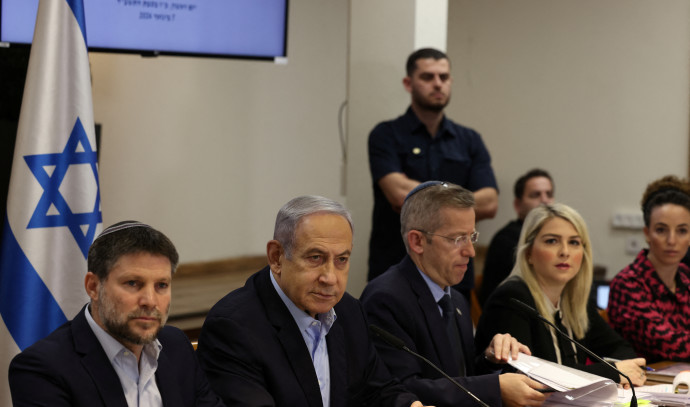
At the beginning of the war, it was as if Prime Minister Benjamin Netanyahu and US President Joe Biden were in sync for the first time since this government was formed.
But as expected, this honeymoon didn’t last very long.
Though Biden has been devoted to Israel and has invested time, funds, and military assistance towards the war effort, the two have reached a point where they haven’t been in direct contact for weeks, according to several sources.
“I will not compromise on full Israeli security control over all the territory west of [the] Jordan [River] – and this runs contrary to a Palestinian state,” Netanyahu wrote in a post on X, formerly Twitter, on Saturday night.
It was the third time he had spoken about the issue in the 48-hour-period.
An issue with communication
Earlier in the day, the Prime Minister’s Office provided further details, stating that in his discussion with Biden, Netanyahu reaffirmed a stance he has maintained for a long time.
US President Joe Biden, Prime Minister Benjamin Netanyahu during the war (credit: HAIM ZACH/GPO)
The PMO explained: “After Hamas is eliminated, Israel must retain full security control of the Gaza Strip to ensure that Gaza won’t pose a threat to Israel, and this conflicts with the demand for Palestinian sovereignty.”
Advertisement
Netanyahu, who is already thinking of the next election, added in a press conference on Saturday night that “those who speak of the day after Netanyahu, are talking about the creation of a Palestinian state led by the Palestinian Authority.”
Ynet reported last week that Netanyahu did not inform IDF Chief of Staff Herzi Halevi, Defense Minister Yoav Gallant, or Shin Bet (Israel Security Agency) director Ronen Bar about the agreement to transport medications into Gaza for the captives. The three found out about this through the media.
A senior official recounted that Mossad head David Barnea verbally updated Netanyahu, and afterward, the PMO released a statement about the agreement. The senior official claimed this resulted in a “delay of three to four days in carrying out the deal.”
Netanyahu must decide what his agenda is. What is the endgame for this brutal war? Is it a one-state solution? A two-state solution? Is Israel’s agenda that the countries in the region absorb millions of Palestinian refugees?
Three months ago, we wouldn’t pressure Netanyahu about focusing on the future, since it was clear to most Israelis that Israel needed to enter this war, defeat Hamas, and release our citizens and soldiers being held captive.
But more than three months later, thousands of our brothers and sisters were killed or severely wounded, and the dead-end junction that we can all see ahead has caused us to speak up.
We urge Prime Minister Netanyahu to decide on a clear and solid agenda for the near and long-term future.As the conflict drags on with its heavy toll, the Israeli public’s patience is wearing down. The ongoing war has not only cost numerous lives, but also raised questions about the long-term strategy of the Netanyahu administration.
Citizens are increasingly demanding clarity on the government’s endgame. Is the aim to completely dismantle Hamas, leading to a prolonged military occupation, or is there a diplomatic solution on the horizon that might bring lasting peace? These questions are not just rhetorical but crucial for shaping the region’s future.
The lack of direct, frequent communication between key Israeli leaders during such a critical period is alarming. It suggests a fragmented approach at the top levels of those involved in the decision-making, which could have severe implications for both the conduct of the war and the post-war scenario.
Moreover, Netanyahu’s strong stance against a Palestinian state, reiterated in his recent statements, has significant implications for Israel’s long-term peace and security. While his commitment to ensuring Israel’s security is clear, the absence of a viable peace plan could lead to perpetual conflict. The Israeli public, having endured the horrors of war, deserves a road map towards sustainable peace.
Netanyahu must articulate a clear vision that goes beyond the immediate military objectives.
This vision should address the region’s political future, the humanitarian needs of all affected populations, and the role of international partners in securing long lasting peace.
Without this, the cycle of violence is likely to continue, with grave consequences for all parties involved.
“Go home! There is nothing left for you to destroy.”
A crowd demands the resignation of Israeli PM #Netanyahu’s government in front of the country’s parliament in #Jerusalem.
Read more: https://t.co/Nk38DN2pTL pic.twitter.com/DnKfLZo00O
— Al Arabiya English (@AlArabiya_Eng) January 16, 2024
“I utterly reject the Hamas monsters’ capitulation terms,” Netanyahu said. @tovahlazaroff reports:#Gaza | #Netanyahuhttps://t.co/i810Wq98gp
— The Jerusalem Post (@Jerusalem_Post) January 21, 2024
Opinion | Israel must make tough strategic choices as hostages suffer – The Washington Post https://t.co/o296SnqXbG
— Michael Novakhov (@mikenov) January 22, 2024
Save
It was probably inevitable: As the war in Gaza passed the 100-day mark, fissures have appeared in the united front between the Biden administration and Israel. Washington appears to have gotten the Israeli war cabinet to allow in humanitarian aid and, more recently, to reduce the intensity of its operations in Gaza. But on the essential issue — defining a strategic endgame for the war — the two are openly at odds. President Biden urges an eventual Palestinian state, and yet on Thursday, Prime Minister Benjamin Netanyahu emphatically ruled it out.
Mr. Biden is articulating a position that is both right on the long-term merits and favorable to his domestic political interests. Mr. Netanyahu is wrong about the issue — but has judged his political self-interest as accurately as Mr. Biden. In the wake of Oct. 7, Israelis have lost faith in peace processes, the country’s president, Isaac Herzog reminded the World Economic Forum at Davos last week. Sixty-five percent oppose a Palestinian state, according to a December Gallup poll.
Follow this authorEditorial Board‘s opinions
The U.S.-Israel impasse makes little practical difference, since a Palestinian state was not imminent anyway, though it does illustrate the already evident need for new leadership in Israel. But developing disagreements within a different formerly united body — Israel’s war cabinet itself — could be consequential in the short run. Also on Thursday, cabinet member Gadi Eisenkot told an Israeli television interviewer that, so far, Israel has failed in its principal war aim — “We didn’t topple Hamas” — and that its other key goal, freeing Hamas’s hostages, is also unattainable without a negotiated deal that might include a humanitarian pause in fighting of as long as four weeks, quadruple the length of the pause that enabled 105 hostage releases in November. Those who contend otherwise, he said, are “trying to sell fantasies to the public.”
Mr. Eisenkot belongs to an erstwhile opposition party, National Unity, that agreed to join the war cabinet after Oct. 7. His words carry authority both because of his past role as the Israel Defense Force’s chief of staff — and because his own son and nephew have been killed fighting in Gaza. He tapped a rising sentiment in Israel that time is running out to free the hostages and that a war that ends without doing so will be a defeat.
This shows, to be sure, the malign tactical acumen of Hamas, which correctly anticipated that abducting men, women and children on Oct. 7 would complicate Israel’s response with a huge moral and military dilemma. After accounting for hostages freed separately from the November pause, and one rescued by Israel, it appears that, out of the 240 originally taken, there are 132 captives still left, a number which includes the remains of 27 believed to have died in captivity. Of those killed, half a dozen were executed by Hamas, according to Israel, and three others died when Israel’s own troops mistakenly shot them. (Six of the hostages are dual U.S.-Israeli citizens.) Hostages range in age from their late 80s to one year — which is how old baby Kfir Bibas is as of Jan. 18. Many are ill and at least one, Hersh Goldberg-Polin, was badly injured when Hamas militants seized him from a music festival on Oct. 7. They are probably being held at sites scattered across Gaza and deep within Hamas’s tunnel network. Mr. Eisenkot acknowledged that, despite the IDF’s best efforts, this makes the idea of large-scale rescues “an illusion.”
These people cannot be forgotten, just as suffering Palestinian civilians cannot be. To speak with the hostages’ family members, as we have done recently, is to understand the limits of human anguish. Nothing justified the kidnapping of their loved ones — or Hamas’s refusal to release them unconditionally. And yet to hold those conversations is also to understand that these families’ desperation has instilled in them a kind of pragmatic clarity. If the Israeli military cannot destroy Hamas soon, and the only way to get the hostages out is a deal with Hamas, brokered by its patron Qatar, then do it, the family members we met with said. But Mr. Netanyahu still doesn’t see it that way, having urged tougher conditions for a possible release in recent cabinet meetings, according to Israeli media.
As the clock ticks for the hostages, and Israeli protests against Mr. Netanyahu’s approach to the issue grow, the country needs a fresh political consensus to enable tough strategic choices. Which brings us to Mr. Eisenkot’s boldest suggestion: new elections, even in wartime. They might bring out the country’s divisions even more starkly, he acknowledged, but are nevertheless needed “to renew trust because right now there is no trust.”