
Live update: Former attorney general Mandelblit lauds High Court judicial overhaul ruling as ‘second legal revolution’ https://t.co/UskM0H77T3 . Click to read ⬇️
— TOI ALERTS (@TOIAlerts) January 2, 2024
Month: January 2024
“We can of course strike the squares in Kyiv, and in any other city. I understand, I’m all boiling inside. But what, should we strike civilians? No, we strike military objects. We’ll keep doing that” – Putin.
Photo below: the aftermath of the strike on “military objects” in… pic.twitter.com/ew3jwKVRLD
— Anton Gerashchenko (@Gerashchenko_en) January 2, 2024
Netanyahu’s coup hasn’t disappeared since October 7, it hides behind a call for unity | Opinionhttps://t.co/3LqQBpmwSl
— Haaretz.com (@haaretzcom) January 2, 2024
When Vladimir Putin spoke by telephone this month to Benjamin Netanyahu, their first conversation in weeks, the two leaders found themselves in an unusual dynamic, engaging not as partners but against the backdrop of historic tensions.
Once touting their friendly relationship – Netanyahu has used billboards showing himself next to Putin during election campaigning in Israel, even last year – the events of 7 October and Russia’s pro-Palestinian stance in the aftermath have brought a decisive schism in their ties.
“The two countries’ ties are absolutely at the lowest point since the fall of the Soviet Union,” said Nikolay Kozhanov, a former Russian diplomat in Tehran and now an associate professor at Qatar University.
The contrasting accounts released by Israel and Russia after the call on 10 December gave insight on the strained relationship, said Dr Vera Michlin-Shapir, of King’s College London and a former official at Israel’s national security council, who specialises in Russian foreign policy.
Netanyahu said in a statement he had spoken to Putin and voiced displeasure with “anti-Israel positions” taken by Moscow’s envoys at the UN, while voicing “robust disapproval” of Russia’s “dangerous” cooperation with its ally Iran.
The Kremlin, meanwhile, highlighted “the catastrophic humanitarian situation in the Gaza Strip”, with Putin saying Israel’s military response to the Hamas terror onslaught should not lead “to such dire consequences for the civilian population”.
“This was not a dialogue. This time around the two leaders just put forward their positions,” said Michlin-Shapir.
A day before their conversation, Moscow backed a UN resolution calling for an immediate ceasefire in the Gaza Strip and said the US was “complicit in Israel’s brutal massacre”, a not-so-subtle reference to the 21,000 people who Gaza health authorities say have been killed since the war began.
The ending of the complex entente between Russia and Israel underscored a larger global shift that had been under way in the Kremlin’s position on the Middle East since Putin launched his war in Ukraine, said Kozhanov. “Russia quickly realised that the ties with the west have been damaged for a long time,” he said.
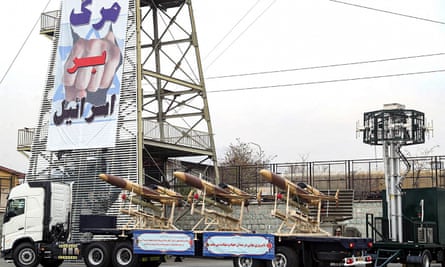
After the start of the war, Kozhanov argued, Moscow started looking into ways to strengthen its economic and military ties with Arab states while also growing closer to Iran, which has been providing artillery shells, drones and missiles for Russia’s war efforts.
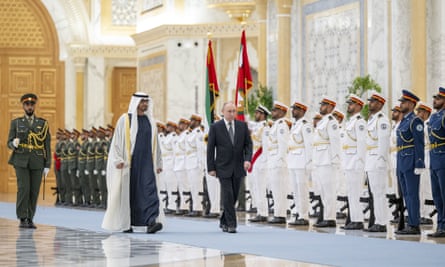
In a rare, one-day trip that underlined his warming relationship with key players in the Middle East, Putin earlier in December visited the United Arab Emirates and Saudi Arabia, where he received a grand welcome, despite his status in the west as a wanted man sought by the international criminal court for war crimes.
“Putin’s visit to the Middle East confirmed the empty noise in the words about the isolation of the Russian Federation,” Izvestia, a pro-Kremlin daily, triumphantly wrote after Putin’s trip.
Kozhanov said the Israel-Hamas war also provided Moscow with a rare opportunity to court the broader global south, which has accused the west’s rules-based order of hypocrisy over Palestinian deaths. In the process, the Kremlin was eager to claim the moral high ground, despite its own devastating record of human rights abuses during wars in Chechnya, Syria and, most recently, Ukraine.
“Putin’s Russia is very pragmatic,” said Kozhanov. “Moscow sensed that the events in Gaza are driving the global south away from the west and could make its attitudes more sympathetic to Moscow.”
For two decades under Putin, Russia and Israel pursued a delicate balance.
While the two countries often found themselves on opposite sides of the geopolitical spectrum, Israel sought contact with Russia in Syria and was careful not to antagonise Moscow, given its ties to Israel’s arch-rival, Iran.
Putin also courted the large Jewish population in Moscow and saw in Israel an ally in keeping the memory of the second world war alive, the monumental historical event around which the Russian leader has sought to build his presidency.
“It was never an alliance, but there was always a strategic understanding. Both countries needed each other,” said Michlin-Shapir.
But Russia’s invasion of Ukraine, which made Putin a pariah in much of the west, placed Israel in a bind.
Many in Israel were left deeply uncomfortable with Russia’s framing of its invasion, with Moscow falsely comparing Ukraine’s government to Nazi Germany to justify its war, said Pinchas Goldschmidt, the former chief rabbi in Moscow.
In spring 2022, these tensions first spilled over into the public when Russian officials accused Israel of supporting the “neo-Nazi regime” in Kyiv. The spat was ignited after Russia’s foreign minister, Sergei Lavrov, recycled an antisemitic conspiracy theory claiming that Adolf Hitler “had Jewish blood” – comments that Israel described as “unforgivable and outrageous”.
“On 7 October, Israel woke up and found Russia on the opposite side of the war. But the foundations for the split were already laid when Putin invaded Ukraine,” said Michlin-Shapir.
skip past newsletter promotion
Sign up to This is Europe
The most pressing stories and debates for Europeans – from identity to economics to the environment
Privacy Notice: Newsletters may contain info about charities, online ads, and content funded by outside parties. For more information see our Privacy Policy. We use Google reCaptcha to protect our website and the Google Privacy Policy and Terms of Service apply.
after newsletter promotion
Alexander Gabuev, the director of the Carnegie Russia Eurasia Center, said it was only logical that Moscow opted to support the Iran-sponsored Hamas, as it was the option most beneficial for its war efforts in Ukraine.
The war in Ukraine has become “the raison d’être for the entire machinery of Putinism”, Gabuev wrote in a recent op-ed, pointing to Iran’s indispensable military support.
“This is why the Kremlin’s muted reaction to the 7 October terrorist attacks by Hamas and ensuing full-throated criticism of Israel’s war in Gaza would once have been unimaginable but is hardly surprising in 2023,” he said.
As the Hamas attack unfolded, Russian officials and state-controlled media quickly took up a pro-Palestinian position, cheering Israeli military and intelligence blunders, which were presented as a testament to western weakness.
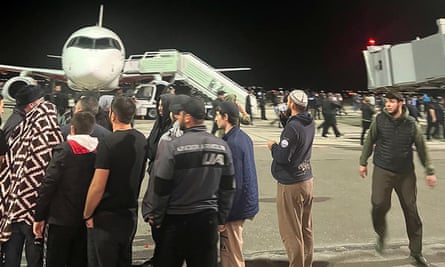
The state rhetoric, which often had nods toward antisemitism, has partly been attributed to the anti-Jewish storming of an airport in the Russian region of Dagestan, during which a violent mob looked for Jewish passengers arriving from Israel.
The Israel-Hamas war has already proved to be a win for Putin by helping take the west’s focus off the war in Ukraine, with the US and the EU struggling to push through two critical aid packages that are deemed vital for Kyiv’s long-term survival.
“Russia now has an interest in prolonging this conflict in the Middle East,” said a senior European diplomat in Moscow, speaking on conditions of anonymity. He said he feared an all-out Israel-Hezbollah war would further derail any help for Ukraine.
The hard pro-Israeli position of the Ukrainian president, Volodymyr Zelenskiy, on the Gaza conflict, in which he sought to compare Hamas to Russia, has in the meantime alienated some of the countries in the global south. This, insiders say, could undo months of diplomatic efforts by the west and Ukraine to paint Moscow as a global pariah in the global south for breaching international law.
“It seemed a bit too easy and too fast for Zelenskiy to go full pro-Israel,” said a senior European official in Kyiv in November. Pointing to countries such as South Africa, Brazil, Indonesia and Turkey, the official said it could now be harder for Ukraine to make inroads after sustained diplomatic progress.
In an interview in Kyiv, Zelenskiy’s adviser Mykhailo Podolyak admitted there would be a “chill in relations” with non-western countries, but said once Ukraine would “be able to explain why this is happening and the role of Russia in it … we will be able to revive all our dialogues”.
For now, Ukraine appears to have little to show in return for supporting Israel. Before 7 October, Netanyahu had announced a nonaligned approach to the war in Ukraine, refusing to provide lethal weapons or much-desired air defence systems to Kyiv, an approach that is unlikely to change with the fighting in Gaza. Netanyahu has also reportedly rejected repeated requests by Zelenskiy to make a solidarity visit to Israel after the Hamas attack.
In contrast, Michlin-Shapir said the Hamas-Israeli war provided Putin with a new opportunity to impose himself on the global order.
The former Israeli official compared the current diplomatic efforts to Russia’s intervention in Syria in 2015, which brought Moscow back to the international table after it annexed Crimea a year before. “They managed to get out of isolation then. The Middle East always provides new opportunities for Russia,” she said.
Shaun Walker contributed from Kyiv
During 2023, at least four clashes on the Armenia-Azerbaijan border took place (combined at least 12 killed, 27 wounded on both sides), leading up to the full capture of Nagorno Karabakh by Azeri forces , 100,000 locals flee to Armenia, over 400 military killed on both sides… pic.twitter.com/pQktUOUb4G
— Nagorno Karabakh Observer (@NKobserver) January 1, 2024
Russian Foreign Ministry: USA intends to open a “second front” in the South Caucasus#PoliticalWar #Russia #SouthCaucasus #USAhttps://t.co/Rcc0UVb0Mu
— Rossa Primavera International News (@NewsFromDonbass) December 30, 2023
#News #Times #NewsAndTimes #NT #TNT #Israel #World #USA #POTUS #DOJ #FBI #CIA #DIA #ODNI #Mossad #Putin #Russia #GRU #Ukraine #SouthCaucasus #NewAbwehr #Bloggers
–
A “second front” in the South Caucasus – GS https://t.co/J1dPzZgxy8 pic.twitter.com/Ov3WtEBuPE— Michael Novakhov (@mikenov) January 1, 2024
The war started by Vladimir Putin should end only with Ukraine strong enough to defeat any future aggression from Moscow, the Institute for the Study of War (ISW) says, with its maps comparing the latest situation on the ground with territory held before Russia’s 2022 invasion.
In an analysis published New Year’s Eve, the Washington, D.C., think tank addressed suggestions that Kyiv should consider ceding territory to end the war, which has killed hundreds of thousands and displaced millions.
The U.S. is the biggest donor of military aid to Ukraine, but further assistance from Washington has been held up by Republican lawmakers who question the ongoing financial commitment that Ukraine wants.

A Ukrainian army scout is pictured on December 23 in Avdiivka, Ukraine. The Institute for the Study of War, a U.S. think tank, says that Ukraine must be given the resources to defeat Russia and prevent future aggression from Moscow.
Kostya Liberov/Getty Images
The GOP-controlled House has not approved President Joe Biden‘s funding request for $106 billion, which includes $61 billion in additional aid for Ukraine and funds for Israel and U.S. border security.
GOP Senator J.D. Vance told CNN‘s State of the Union that it was in the U.S.’s “best interest” to accept that Ukraine would give up some territory to Russia because it was unlikely Kyiv’s forces could force Russian troops back behind the borders in place before they invaded in February 2022.
But the ISW said that the only outcome the U.S. and its allies should accept is a Ukraine that can “deter and defeat” any future aggression by Moscow while maintaining “an economy strong enough to prosper without large amounts of foreign aid.”
Newsweek has emailed the Russian Defense Ministry for comment.
Amid discussions about pressing Ukraine to trade land that the Russians now occupy for a ceasefire or armistice are rumors of the Kremlin’s interest in negotiations of some sort, the ISW said. These discussions largely focus on the supposed intransigence of Ukrainian President Volodymyr Zelensky.
But that argument ignores “the military, economic, and financial consequences that these territorial sacrifices would have for Ukraine’s long-term security and economic viability,” according to the ISW.
It also ignores “the future financial burden they would impose on the supporters of an independent Ukraine.” Furthermore, there are military and economic reasons for Ukraine to try to liberate all of the territory Russia now occupies.
“The current lines cannot be the basis for any settlement remotely acceptable to Ukraine or the West,” the ISW said, adding that “trusting Russian promises of good behavior would be foolish.”
The ISW’s latest maps reveal that Ukraine’s borders, and the line of contact between Ukraine and Russia before the 2022 invasion, were about 2,000 miles and included large defendable areas, especially in the northeast.

This map from the Institute for the Study of War shows Russian-occupied Ukraine before Vladimir Putin’s 2022 invasion.
Institute for the Study of War
Another map, dated December 31, shows how Russia’s territorial gains would become a staging area for a future invasion and that Ukraine must liberate the Kherson and Zaporizhzhia regions to avoid this.

This Institute for the Study of War map, dated December 31, shows what the ISW considers to be the regions that Ukraine must liberate to prevent a future Russian invasion.
Institute for the Study of War
The ISW said that Russia will not abandon its maximalist aims now or in the future and that “the most advantageous lines Ukraine could hold militarily and economically are its internationally recognized 1991 boundaries.”
This means that freezing the war’s gains now “enormously advantages Russia and increases the risks and costs to Ukraine and the West of deterring, let alone defeating, a future Russian attempt to fulfill Putin’s aims by force.”
Newsweek is committed to challenging conventional wisdom and finding connections in the search for common ground.
Newsweek is committed to challenging conventional wisdom and finding connections in the search for common ground.
#News #Times #NewsAndTimes #NT #TNT #Israel #World #USA #POTUS #DOJ #FBI #CIA #DIA #ODNI #Mossad #Putin #Russia #GRU #Ukraine #SouthCaucasus #NewAbwehr #Bloggers
–
Cries of victory in Sweden! Turkey finally made tough decision! Putin di… https://t.co/oI3QZ4GEPj via @YouTube— Michael Novakhov (@mikenov) January 1, 2024