
Egyptian official: Cairo warned Israel, US that Rafah operation puts peace treaty at high risk timesofisrael.com/liveblog_entry… via @TimesofIsrael
Day: May 13, 2024
The Broadway box office numbers for the week of May 5 revealed that Hillary Clinton-produced stage play “Suffs” is on the bottom rung of shows in terms of filling capacity.
Broadway Theatre Industry official site “The Broadway League” shared the weekly grosses from the 35 shows currently playing on Broadway, which include “Suffs,” “Harry Potter and The Cursed Child,” and classics like “Romeo & Juliet,” Sweeney Tod” and “Moulin Rouge! The Musical.”
According to the data, Clinton’s play only reached 81% capacity across eight performances that week, placing it among the bottom eight productions in that category – the bottom 23% of all 35 shows for the week.
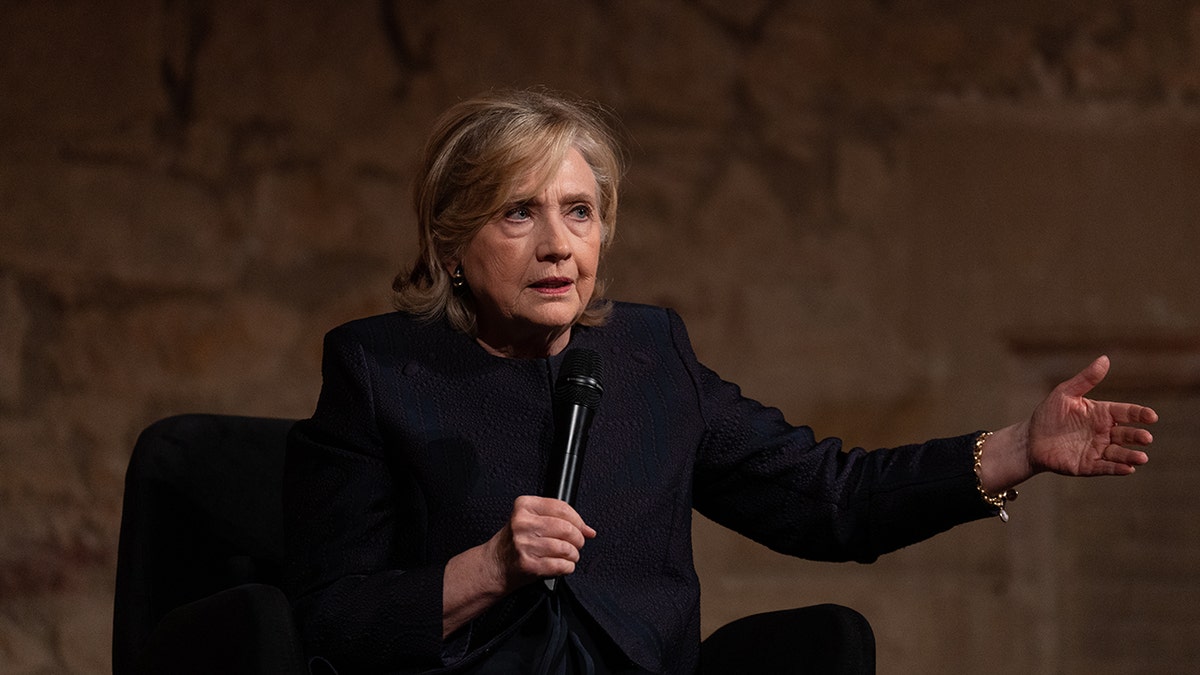
Noting that the play’s lagging numbers look even worse considering it’s a new show, Breitbart News argued the performance “should still be drawing big crowds during Broadway’s peak season – the month before the Tony Awards,” which is right now.
The play first opened on Broadway last month, following an Off-Broadway run that started in 2022 in New York City’s “The Public” theater. The musical was by singer-songwriter Shaina Taub, directed by Leigh Silverman, and produced by lead producers Jill Furman and Rachel Sussman, along with co-producers Hillary Clinton and Malala Yousafzai.
Breitbart also noted that Vice President Harris’s niece, Meena Harris, is another producer on the stage play.
The three-hour-long play brings the women’s suffrage movement of the early 1900s to the stage. According to the show’s website, Suffs “boldly explores the victories and failures of a struggle for equality that’s far from over.”
HILLARY CLINTON: ‘WHAT TRUMP REALLY WANTS’ IS TO ‘KILL HIS OPPOSITION’

The play features an “entirely female and non-binary cast – among them Tony winner Nikki M. James, Jenn Colella, Emily Skinner, and Grace McLean as President Woodrow Wilson,” according to Playbill.com.
Clinton stated she relates to “all of” the characters in the play, telling the Associated Press last month she knows “how hard it is to make change.”
CLICK HERE FOR MORE COVERAGE OF MEDIA AND CULTURE
“I know how important it is to have relationships with the people you’re working for, as you’re taking risks and you’re doing things that have never been done, whether it’s running for president in my case or having a march on Washington in 1913 to try to convince the president and the Congress to adopt the amendment to let women vote,” she said.
The former U.S. Secretary of State added, “But more than that, I see it as relevant today. We have a lot of challenges in our country.”
CLICK HERE TO GET THE FOX NEWS APP
BroadwayLeague.com’s numbers also revealed that last week’s numbers for “Suffs” were even worse, with the show only filling 78% of its 7,784 total seats across performances.

U.S. Sen. Robert Menendez’s criminal corruption trial begins Monday in New York.
Andrew Harnik/Getty Images
Sen. Robert Menendez goes on trial Monday for allegedly accepting hundreds of thousands of dollars in bribes, including bars of gold, in exchange for using his position as a powerful member of Congress to benefit three New Jersey businessmen as well as the governments of Egypt and Qatar.
Menendez, a three-term Democratic senator from New Jersey, faces 16 criminal counts, including bribery, obstruction of justice, acting as a foreign agent and honest services wire fraud. He has pleaded not guilty, and says that he is being targeted because he is a prominent Latino.
He faces trial alongside two co-defendants, Egyptian-American businessman Wael Hana and real estate developer Fred Daibes, while a third businessman, Jose Uribe, pleaded guilty and is cooperating with the government. Menendez’s wife, Nadine, was also charged but will face trial separately.
After he was indicted, Menendez stepped down from his role as chairman of the Senate Foreign Relations Committee, a powerful post that gave him influence over foreign military sales and financing. Despite calls to step down entirely, he has professed his innocence, refused to resign from the U.S. Senate and is still running for re-election this fall — though not as a Democrat.
This is not the first time Menendez has faced legal peril. He was indicted in 2015 on unrelated federal corruption and bribery charges, which he fought and took to trial. That case was declared a mistrial after the jury was unable to reach a unanimous verdict.
Menendez has vowed he will prevail in this prosecution as well. This case will be heard by a federal jury in Manhattan, unlike his previous trial which was in his home state of New Jersey. Jury selection begins Monday, and the trial is expected to last up to two months.
The prosecution’s case
The indictment describes a complex bribery scheme that allegedly ran from 2018 to 2023. Prosecutors say that Menendez and his wife accepted bribes from the three businessmen, including gold bullion, a Mercedes Benz convertible and cash. In exchange, Menendez allegedly agreed to take action to protect and enrich the trio, as well as to secretly benefit Egypt and Qatar.
The alleged scheme contains various threads that were all intertwined.
One revolved around Hana, who prosecutors say had close contacts with Egyptian officials and had been friends with Nadine Menendez for years.
The indictment says Menendez promised to use his power and authority to facilitate military sales and financing to Egypt. In return, Hana promised, among other things, to put Nadine Menendez on the payroll of his company for a “low-or-no-show job.”
Prosecutors say Menendez provided sensitive U.S. government information to Egyptian officials, with Hana acting as a middleman of sorts. Menendez also allegedly edited and ghost-wrote a letter on behalf of Egypt aimed at convincing U.S. senators to lift a hold on $300 million in aid to Egypt. He also signed off on foreign military aid to the country.
Hana, meanwhile, had secured a monopoly from the Egyptian government on certifying U.S. food exported to Egypt as halal. That monopoly, prosecutors say, was highly lucrative for Hana and his business, but it raised the cost of halal certification for U.S. meat suppliers.
The U.S. Department of Agriculture contacted the Egyptian government with concerns about the monopoly.
Gold bars
According to the indictment, Menendez—at Hana’s request—intervened to protect Hana’s business by calling a senior U.S. Department of Agriculture official and demanding the department “stop interfering” with Hana’s monopoly.
The thread related to Qatar revolves around another co-defendant, Fred Daibes.
According to the indictment, Daibes was trying to secure a multimillion-dollar investment from a Qatari investment company, and he enlisted Menendez’s help to do so.
Prosecutors say Menendez made “multiple public statements supporting the Government of Qatar,” and then gave them to Daibes to show the Qatari investor and a Qatari government official. In return for allegedly using his influence as a senator to help Daibes, the indictment says Menendez received gold bars and cash from the businessman.
FBI agents recovered gold bars, as well as $480,000 in cash, during a court-authorized search of Menendez’s home in New Jersey. Some of the gold bars bore serial numbers indicating they’d previously been owned by Daibes.
The indictment says stacks of cash were found in jackets with Menendez’s name stitched on them. Some envelopes of cash found at the home had Daibes’ fingerprints on them, according to court papers.
In addition to those actions, prosecutors allege Menendez also used his influence as a senator to intervene in investigations or prosecutions at the state and federal level.
In one instance, they say he tried to intervene in a New Jersey state criminal prosecution of an associate of one of the businessmen, Jose Uribe, by calling a senior investigator and urging that the matter be resolved.
In another instance, Menendez allegedly took action to intervene in a federal prosecution of Daibes.
Menendez’s defense
Menendez has said that he has worked tirelessly over his career as a public servant, and he’s claimed that he’d being targeted because of his Cuban heritage.
In a news conference after his indictment, Menendez told reporters that “prosecutors get it wrong sometimes.”
On the cash found at his home, Menendez said that he has withdrawn thousands of dollars in cash from his personal savings for potential emergencies. It’s a habit, he said, drawn on “the history of my family facing confiscation in Cuba.” Menendez was born in New York to parents who had immigrated from Cuba.
“I firmly believe that when all the facts are presented, not only will I be exonerated, but I still will be New Jersey’s senior senator.”
Andrei Belousov—a respected economist and former deputy prime minister—will now lead the country’s defense ministry and its prolonged campaign in Ukraine, with President Vladimir Putin having chosen him to replace longtime incumbent and loyalist Sergei Shoigu.
Shoigu will move on to head Russia’s powerful security council, replacing FSB Director Nikolai Patrushev, who has long been considered one of Putin’s most powerful and hawkish officials. It is not yet clear what post Patrushev will be moved to, though his son—Dmitry Patrushev, who has been touted as a possible Putin successor—has been promoted to deputy prime minister.
Russia’s upper house in parliament, the Federation Council, will now need to approve Belousov’s candidacy. His proposed appointment appears to suggest the Kremlin sees victory in Ukraine—and perhaps beyond—as a matter of economics.
“Today on the battlefield, the winner is the one who is more open to innovation,” Kremlin spokesperson Dmitry Peskov said of the reshuffle, as quoted by the state-run Tass news agency.

Incoming Russian Defense Minister Andrei Belousov in Bangkok, Thailand, on November 19, 2022. The economist has long been considered close to Russian President Vladimir Putin.
Incoming Russian Defense Minister Andrei Belousov in Bangkok, Thailand, on November 19, 2022. The economist has long been considered close to Russian President Vladimir Putin.
JACK TAYLOR/POOL/AFP via Getty Images
“Therefore, it is natural that at the current stage, the president decided that the Russian Ministry of Defense should be headed by a civilian.” He added: “It’s very important to put the security economy in line with the economy of the country so that it meets the dynamics of the current moment.”
Belousov, 65, graduated from the Faculty of Economics of the Moscow State University in 1981 with distinction, Reuters reported. Born in Moscow, Belousov is reported to have practiced samba and karate in his youth and did not serve in the armed forces. He has long been considered close to Putin.
By 2000, Belousov had been appointed as a nonstaff adviser to the Russian prime minister. In 2006, he joined the economy ministry as a deputy minister.
Between 2008 and 2012, when Putin was serving one term as prime minister to adhere to constitutional term limits, Belousov served as the director of the government’s department for economics and finance.
Belousov was made the minister for economic development in 2012, before transitioning in 2013 to serve as Putin’s economic adviser. He held that role until 2020, when he became first deputy prime minister. Belousov stepped in as acting prime minister when incumbent Mikhail Mishustin contracted COVID-19 in 2020.
“He’s very professional, he’s a technocrat, and he’s very blunt, very straightforward,” Oleg Ignatov—the nongovernmental organization Crisis Group’s senior analyst for Russia—told Newsweek. “He doesn’t like to hide the truth. He can fix problems.” He added: “From Putin’s point of view, it’s a very good appointment.”
“He has his own vision,” Ignatov said, describing Belousov as “very anti-Western” and believing strongly “that the state should play a crucial role in the Russian economy.” Considered “very hawkish” and not corrupt, Ignatov said, the new minister can be expected to launch a major anti-corruption drive.
“Of course, some people will be upset about this, because the military has been very corrupt in Shoigu’s time,” Ignatov said. Many of Shoigu’s allies can be expected to follow him out of the ministry, likely to be replaced by technocrats more of the Belousov mold.
Unlike Shoigu and other top figures, Belousov does not have his own power base or “clan” of allies and dependents. “Belousov is alone,” Ignatov said. “He’s independent and loyal exclusively to Putin.”
And where Shoigu sought to influence battlefield planning, Beluosov is expected to be more restrained. “He will trust the military and military will do their work,” Ignatov said. “Belousov will care about the defense ministry as a big enterprise, and he will manage it as such.”
The Institute for the Study of War (ISW) wrote that Belousov’s appointment “is a significant development in Putin’s efforts to set full economic conditions for a protracted war,” noting that the economist is known as an advocate for more government involvement in the economy.

Outgoing Russian Defense Minister Sergei Shoigu on May 9, 2024, in Moscow. The long-serving minister will be moved to head Russia’s powerful national security council.
Outgoing Russian Defense Minister Sergei Shoigu on May 9, 2024, in Moscow. The long-serving minister will be moved to head Russia’s powerful national security council.
Contributor/Getty Images
Shoigu’s removal comes after two difficult years for the Putin loyalist, who reportedly enjoyed close access to the president and saw his political stock rise significantly after Moscow’s seizure of Crimea in 2014.
But the full-scale invasion of Ukraine quickly revealed that Shoigu had failed to stamp out systemic incompetence and corruption within the military. Russia’s military casualties have ballooned over more than two years of war, with battlefield success limited. Behind the front, the Wagner Group rebellion was a humiliating demonstration of brewing instability within the Russian military elite.
The arrest of Shoigu’s deputy Timur Ivanov on corruption charges last month appeared to be an effort to undermine the outgoing defense minister and lay the groundwork for a reshuffle.
Russia analyst and economics professor at the University of Chicago, Konstantin Sonin, wrote on Twitter—formerly known as X—that the reshuffle shows the war is “not going according to Putin’s plan, but he will endlessly rotate the same small group of loyalists.”
Michael Kofman, a Russian military expert and a senior fellow at the Carnegie Endowment for International Peace, told the Financial Times the shake-up showed it was “clear that Russian economic elites performed far better than military elites in this war.”
Newsweek is committed to challenging conventional wisdom and finding connections in the search for common ground.
Newsweek is committed to challenging conventional wisdom and finding connections in the search for common ground.
AUDIO POST
Putin replaces Russia’s defense minister with a civilian as Ukraine war rages and defense spending spirals https://t.co/MmWtkERN7m— Michael Novakhov (@mikenov) May 13, 2024

Russian President Vladimir Putin has replaced his defense minister and a long-time close ally Sergei Shoigu with an economist, a major reshuffle of military leadership more than two years after Moscow’s grinding war against Ukraine has sent defense spending soaring.
Andrey Belousov, a civilian who served as former first deputy prime minister and specializes in economics, was appointed to the top defense post, Kremlin spokesperson Dmitry Peskov said on Sunday.
Peskov tried to downplay the move, but the reshuffle comes amid speculation about infighting at the highest echelons of power. Just last month, one of Shoigu’s long-time protégés at the defense ministry was arrested and charged with corruption.
Shoigu was “relieved” of his position by presidential decree, Peskov said, but he will remain an influential part of Putin’s administration as secretary of Russia’s Security Council, replacing Nikolai Patrushev, a former head of the Federal Security Service (FSB), who would “transfer to another job.”
Shoigu will also become the deputy in Russia’s Military-Industrial Commission, Peskov said, as Putin embarks on a fifth term as president.
The timing of Shoigu’s exit is notable, coming off the back of several significant advances by Russian troops in eastern Ukraine.
Russia has launched its most serious cross-border ground assault since Ukraine recaptured the northern Kharkiv region in the late summer of 2022. There have been several months of increased Russian air attacks on the city of Kharkiv amid a grinding advance in Donetsk in the east that has seen incremental but significant progress.
Shoigu had helmed the country’s defense ministry for 12 years and led the full-scale invasion of Ukraine in 2022. Russian troops initially caught Kyiv by surprise but were soon beaten back, exposing the weaknesses of Moscow’s corruption-riddled military and its willingness to send waves of poorly trained and equipped soldiers into what Ukraine and Russian troops have both dubbed a “meat grinder.”
His critics have frequently described Shoigu as remote and out-of-touch with the realities of the conflict. His most forceful critic was the late Wagner chief Yevgeny Prigozhin who accused the Defense Ministry of starving his fighters of resources and bureaucratic incompetence before launching an unsuccessful mutiny last year and dying weeks later in a plane crash.
Despite the criticism, Shoigu has remained a popular politician in Russia. Having spent two decades as the minister of emergency situations, he cultivated an image of a helpful official who brings help when it’s needed.
He is also a rare outsider in Putin’s original inner circle, which consists mostly of the president’s allies from his St. Petersburg political beginnings and his former KGB colleagues. Shoigu was born and grew up in the remote Siberian republic of Tuva and got into politics through his association with the former president Boris Yeltsin.
Belousov’s appointment suggests Russia’s strategy will continue to focus on outgunning Ukraine.
Belousov was selected by Putin because of a need for “innovation,” Peskov said in a press call, during which he highlighted the ministry’s rising budget, saying it was approaching levels last seen during the Cold War.
“Today on the battlefield, the winner is the one who is more open to innovation,” Peskov said. “Therefore, it is natural that at the current stage, the president decided that the Russian Ministry of Defense should be headed by a civilian.”
In a reference to the war in Ukraine, Peskov said that due to “well-known geopolitical circumstances, we are gradually approaching the situation of the mid-80s when the share of expenses for the security bloc in the economy was 7.4%. It’s not critical, but it’s extremely important,” Peskov said.
The budget currently amounts to 6.7% of GDP, he said.
Peskov highlighted Belousov’s previous leadership experience and economic background.
“This is not just a civilian, but a person who very successfully headed the Ministry of Economic Development of Russia, for a long time he was aide to the president on economic issues, and was also the first deputy chairman of the government in the previous cabinet of ministers,” Peskov said.
Much has been made of Belousov’s civilian status, even though Shoigu himself has limited hands-on experience with the military. He holds a rank of a general as a result of his official roles and has never served in active service.
Peskov added that the new appointment did not signal a shift in Russia’s current military system.
“As for the military component, this appointment will in no way change the current coordinate systems. The military component has always been the prerogative of the Chief of the General Staff [Valery Gerasimov], and he will continue his activities. No changes are currently envisaged in this regard,” he said.
In his new role, Shoigu will oversee Russia’s military industrial complex, Peskov said.
“He is deeply immersed in this work, he knows very well the pace of production of military-industrial products at specific enterprises and often visits these enterprises,” he said.
The news follows the arrest last month of one of Shoigu’s close allies, deputy defense minister Timur Ivanov, who was charged with taking a bribe in what was the country’s highest-profile corruption scandal since Putin launched his full invasion of Ukraine more than two years ago.
Ivanov has been accused of accepting a bribe of 1 million rubles (at least $10,800), according to Russian state media TASS.
Former US Secretary of Defense Mark Esper told CNN in an interview Sunday that Putin’s reshuffle is an “important” and “interesting move.”
“The bigger argument coming out of Moscow right now is that Russia is moving toward a war economy,” he said. “They’re on a war footing.”
Esper said that “one of the disappointing things about Shoigu’s tenure is we thought the Russian army, at least during my time at the Pentagon, we thought they were professionalizing, that they were modernizing all their equipment, their doctrine, how they train and fight, and we really haven’t seen that on the battlefield.”
Sergei Shoigu: Putin replaces Russia’s defense minister with a civilian as Ukraine war rages and defense spending spirals | CNN https://t.co/ITSUpHL9QQ pic.twitter.com/KaXMYL5ceY
— Michael Novakhov (@mikenov) May 13, 2024
Андрей Белоусов до прихода в правительство получал деньги от США, выяснило издание “Настоящее время”. До прихода в правительство в 2006 году Белоусов, предложенный президентом на пост министра обороны РФ, управлял московским Центром макроэкономического анализа и краткосрочного… pic.twitter.com/2Cgjft8Td6
— DW на русском (@dw_russian) May 13, 2024
Patrushev Goes All-In. Chemezov Strengthened His Positions. Shoigu is Done.
Dear subscribers and guests of the channel! The “minor” reshuffles in the Russian Government are almost completed, but this is what speaks of a crisis in the country’s governance system. Having… pic.twitter.com/X2rRobKDJA
— generalsvr_en (@generalsvr_en) May 13, 2024