
Categories
Selected Articles

Who is Yahya Sinwar, the Hamas leader Israel has called a ‘dead man walking’

The Israeli prime minister said Wednesday that Israeli forces had surrounded the house of Yahya Sinwar, potentially closing in on the top Hamas official in Gaza – and the man most wanted by Israeli authorities.

The Israel Defense Forces (IDF) said Sinwar was not in the house and was believed to be hiding underground in Gaza, but a senior adviser to Prime Minister Benjamin Netanyahu said Wednesday that it was “only a matter of time before we get him.”

Israel has publicly accused Sinwar of being the “mastermind” behind Hamas’ terror attack against Israel on October 7 – though experts say he is likely one of several – making him one of the key targets of its war in Gaza.

A longtime figure in the Islamist Palestinian group, Sinwar was responsible for building up Hamas’ military wing before forging important new ties with regional Arab powers as the group’s civilian and political leader.

He was elected to Hamas’ main decision-making body, the Politburo, in 2017 as the political leader of Hamas in Gaza branch. However, he has since become the Politburo’s de facto leader, according to research by the European Council on Foreign Relations (ECFR).

He has been designated a global terrorist by the US Department of State since 2015, and has been recently sanctioned by the United Kingdom and France.

Harel Chorev, senior researcher at the Moshe Dayan Center for Middle Eastern and African Studies at Tel Aviv University, said that while Sinwar is a key player within Hamas, he shouldn’t be seen as its sole leader.

“He is perceived as the most senior one because he has a very high public profile, but Hamas doesn’t work this way,” he said. “Hamas is a decentralized organization with several separate power centers and he is one of them.”

Chorev said that while Sinwar is a prominent figure, he is one of a “triumvirate” of Hamas officials responsible for the October 7 attack, along with Mohammed al-Masri, popularly known as Mohammed Deif, the commander of the Al-Qassam Brigades, the military arm of Hamas, and Deif’s deputy, Marwan Issa.

Sinwar, with his silver head of hair and dark eyes set deep under prominent eyebrows, is by far the best known and most recognizable of the three, but it was Deif who announced the October 7 attacks.

But while Sinwar has spent the past few years giving speeches and being photographed, Deif is an extremely secretive, shadowy figure who hasn’t been seen in public in decades.
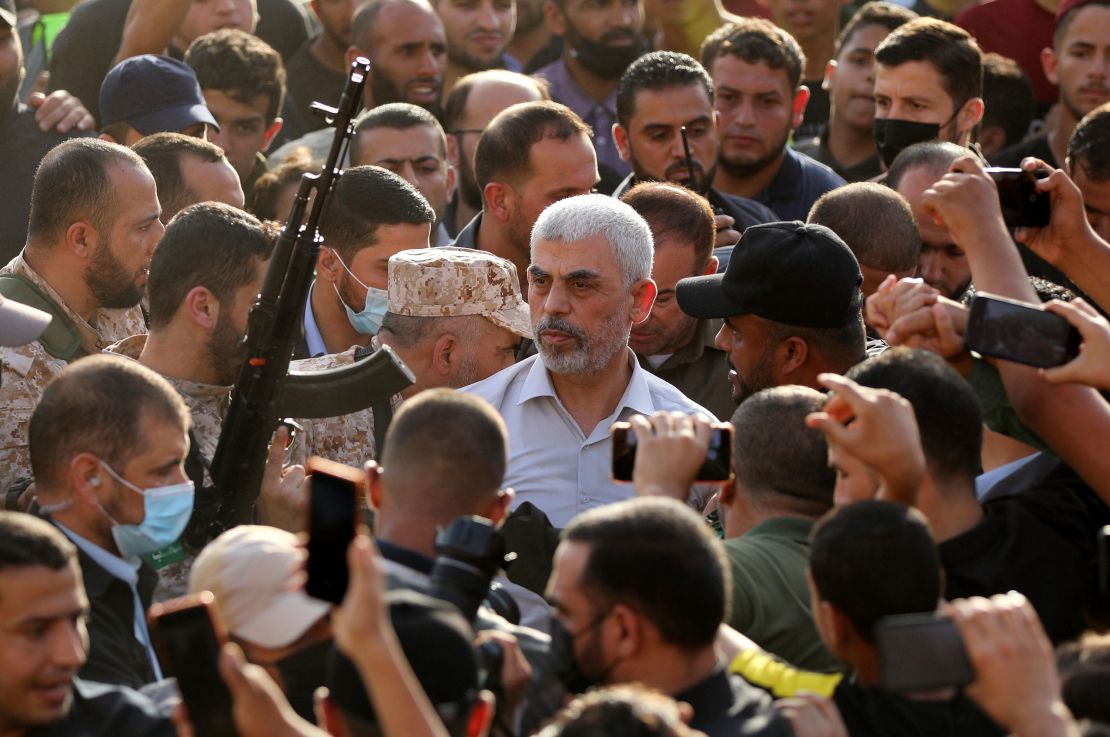
GAZA CITY, GAZA - MAY 30: Hamas' Gaza chief Yahya Sinwar  attends the parade of the Ezzeddin al-Qassam Brigades, the armed wing of Palestinian group Hamas, in Gaza City, Gaza on May 30, 2021. A ceasefire deal between Israel and Hamas was reached following 11 days of clashes between the two sides. (Photo by Ashraf Amra/Anadolu Agency via Getty Images)

Sinwar was born in 1962 in a refugee camp in Khan Younis, southern Gaza. His family was displaced from Al-Majdal, a Palestinian village in modern day Askhelon, during the Arab-Israeli war.

He joined Hamas in the late 1980s and became one of the founders of its feared internal intelligence apparatus, known as the Majd.

He was convicted in 1988 of playing a role in the murder of two Israeli soldiers and four Palestinians suspected of collaboration with Israel, and spent more than two decades in Israeli prison.

Sinwar later said he had spent those years studying his enemy, including learning to speak Hebrew.

He was released in 2011 as part of the deal that saw more than 1,000 Palestinian prisoners exchanged for Gilad Shalit, an IDF soldier who had been captured and taken to Gaza, where he was held for more than five years.

At that time, Sinwar called the exchange “one of the big strategic monuments in the history of our cause.”

Chorev said his release was helped by the fact that his brother was one of Shalit’s kidnappers and insisted on him being included in the deal.

Back in Gaza, Sinwar has risen through the ranks and quickly became a key player within Hamas. Chorev said he became known for his brutality and the violence he inflicts on anyone he suspects of betrayal or collaboration.

“It is well known that while in prison, he tortured people, mostly members of Hamas, using (a) hot plate to cause them burns… his role in the Majd really tells you a lot about his character, his cruelty. But at the same time, Israelis who met him said that he can also be very practical, openly discussing options,” Chorev said.

As the political leader of Hamas, Sinwar focused on the group’s foreign relationships. According to the ECFR, he was responsible for restoring Hamas’ relationship with Egyptian leaders who were wary of the group’s support for political Islam, and for pulling in continued military funding from Iran.

Sinwar was considered a vital decisionmaker and likely the main point of contact within Gaza during the intense negotiations over the return of the more than 240 hostages taken into the enclave by Hamas in the October 7 attacks. The talks involved senior figures from Israel, Hamas, the United States, Qatar and Egypt.

“At the end of the day there are two people” atop the negotiations, said Gershon Baskin, a well-known Israeli peace activist involved in the 2011 release of Shalit, the Israeli soldier. “One is Yahya Sinwar on the Hamas side, and the other is Benjamin Netanyahu on the Israeli side.”

More than 100 Israeli and foreign hostages were released by Hamas and 240 Palestinian prisoners and detainees released by Israel as part of a truce won in those talks, before the temporary ceasefire collapsed on December 1, with Israel and Hamas blaming each other for the failure.

Sinwar has been called many things over the past two months: Israeli military spokesman Lt. Col. Richard Hecht called Sinwar the “face of evil” and declared him a “dead man walking.” Israeli media compared him to Osama bin Laden, while a profile published by the IDF nicknamed him “the Butcher from Khan Younis.”

But Chorev said that despite his position in the spotlight, Sinwar is just one of many commanders Israel needs to remove before it can say it has “destroyed Hamas.”

“To put it simply, if Israel will kill Sinwar, it doesn’t mean necessarily that it will topple down Hamas. However, Hamas can still be toppled down even if Sinwar stays alive … because it’s not (a hierarchical organization). In order for Israel to destroy Hamas, it needs to destroy a critical mass of power centers, not just him,” he said.
Categories
Saved Web Pages - Audio Posts

Who is Yahya Sinwar, the Hamas leader Israel has called a ‘dead man walking’

The Israeli prime minister said Wednesday that Israeli forces had surrounded the house of Yahya Sinwar, potentially closing in on the top Hamas official in Gaza – and the man most wanted by Israeli authorities.

The Israel Defense Forces (IDF) said Sinwar was not in the house and was believed to be hiding underground in Gaza, but a senior adviser to Prime Minister Benjamin Netanyahu said Wednesday that it was “only a matter of time before we get him.”

Israel has publicly accused Sinwar of being the “mastermind” behind Hamas’ terror attack against Israel on October 7 – though experts say he is likely one of several – making him one of the key targets of its war in Gaza.

A longtime figure in the Islamist Palestinian group, Sinwar was responsible for building up Hamas’ military wing before forging important new ties with regional Arab powers as the group’s civilian and political leader.

He was elected to Hamas’ main decision-making body, the Politburo, in 2017 as the political leader of Hamas in Gaza branch. However, he has since become the Politburo’s de facto leader, according to research by the European Council on Foreign Relations (ECFR).

He has been designated a global terrorist by the US Department of State since 2015, and has been recently sanctioned by the United Kingdom and France.

Harel Chorev, senior researcher at the Moshe Dayan Center for Middle Eastern and African Studies at Tel Aviv University, said that while Sinwar is a key player within Hamas, he shouldn’t be seen as its sole leader.

“He is perceived as the most senior one because he has a very high public profile, but Hamas doesn’t work this way,” he said. “Hamas is a decentralized organization with several separate power centers and he is one of them.”

Chorev said that while Sinwar is a prominent figure, he is one of a “triumvirate” of Hamas officials responsible for the October 7 attack, along with Mohammed al-Masri, popularly known as Mohammed Deif, the commander of the Al-Qassam Brigades, the military arm of Hamas, and Deif’s deputy, Marwan Issa.

Sinwar, with his silver head of hair and dark eyes set deep under prominent eyebrows, is by far the best known and most recognizable of the three, but it was Deif who announced the October 7 attacks.

But while Sinwar has spent the past few years giving speeches and being photographed, Deif is an extremely secretive, shadowy figure who hasn’t been seen in public in decades.

GAZA CITY, GAZA - MAY 30: Hamas' Gaza chief Yahya Sinwar  attends the parade of the Ezzeddin al-Qassam Brigades, the armed wing of Palestinian group Hamas, in Gaza City, Gaza on May 30, 2021. A ceasefire deal between Israel and Hamas was reached following 11 days of clashes between the two sides. (Photo by Ashraf Amra/Anadolu Agency via Getty Images)

Sinwar was born in 1962 in a refugee camp in Khan Younis, southern Gaza. His family was displaced from Al-Majdal, a Palestinian village in modern day Askhelon, during the Arab-Israeli war.

He joined Hamas in the late 1980s and became one of the founders of its feared internal intelligence apparatus, known as the Majd.

He was convicted in 1988 of playing a role in the murder of two Israeli soldiers and four Palestinians suspected of collaboration with Israel, and spent more than two decades in Israeli prison.

Sinwar later said he had spent those years studying his enemy, including learning to speak Hebrew.

He was released in 2011 as part of the deal that saw more than 1,000 Palestinian prisoners exchanged for Gilad Shalit, an IDF soldier who had been captured and taken to Gaza, where he was held for more than five years.

At that time, Sinwar called the exchange “one of the big strategic monuments in the history of our cause.”

Chorev said his release was helped by the fact that his brother was one of Shalit’s kidnappers and insisted on him being included in the deal.

Back in Gaza, Sinwar has risen through the ranks and quickly became a key player within Hamas. Chorev said he became known for his brutality and the violence he inflicts on anyone he suspects of betrayal or collaboration.

“It is well known that while in prison, he tortured people, mostly members of Hamas, using (a) hot plate to cause them burns… his role in the Majd really tells you a lot about his character, his cruelty. But at the same time, Israelis who met him said that he can also be very practical, openly discussing options,” Chorev said.

As the political leader of Hamas, Sinwar focused on the group’s foreign relationships. According to the ECFR, he was responsible for restoring Hamas’ relationship with Egyptian leaders who were wary of the group’s support for political Islam, and for pulling in continued military funding from Iran.

Sinwar was considered a vital decisionmaker and likely the main point of contact within Gaza during the intense negotiations over the return of the more than 240 hostages taken into the enclave by Hamas in the October 7 attacks. The talks involved senior figures from Israel, Hamas, the United States, Qatar and Egypt.

“At the end of the day there are two people” atop the negotiations, said Gershon Baskin, a well-known Israeli peace activist involved in the 2011 release of Shalit, the Israeli soldier. “One is Yahya Sinwar on the Hamas side, and the other is Benjamin Netanyahu on the Israeli side.”

More than 100 Israeli and foreign hostages were released by Hamas and 240 Palestinian prisoners and detainees released by Israel as part of a truce won in those talks, before the temporary ceasefire collapsed on December 1, with Israel and Hamas blaming each other for the failure.

Sinwar has been called many things over the past two months: Israeli military spokesman Lt. Col. Richard Hecht called Sinwar the “face of evil” and declared him a “dead man walking.” Israeli media compared him to Osama bin Laden, while a profile published by the IDF nicknamed him “the Butcher from Khan Younis.”

But Chorev said that despite his position in the spotlight, Sinwar is just one of many commanders Israel needs to remove before it can say it has “destroyed Hamas.”

“To put it simply, if Israel will kill Sinwar, it doesn’t mean necessarily that it will topple down Hamas. However, Hamas can still be toppled down even if Sinwar stays alive … because it’s not (a hierarchical organization). In order for Israel to destroy Hamas, it needs to destroy a critical mass of power centers, not just him,” he said.

Categories
Michael Novakhov (@mikenov) / Twitter

@mikenov: RT @shashj: Shame on Austria & Switzerland. “Another intelligence official from a different country estimated that nearly a third of Russia…

Categories
Michael Novakhov (@mikenov) / Twitter

@mikenov: Is yahya sinwar the GRU agent? https://t.co/NHFsrAtm4L

Categories
Michael Novakhov (@mikenov) / Twitter

@mikenov: Is yahya sinwar the GRU agent?

Categories
Michael Novakhov (@mikenov) / Twitter

@mikenov: If this operation was planned since 2014, then it is logical to suppose (as I did earlier) that the Re’im SuperNova Festival was planned (at least 1-2 years prior to attack) as the part of this operation. Hypothetically, it could be done for ideological (anti-Gay), technical… https://t.co/XLvbtr36LM

Categories
Michael Novakhov (@mikenov) / Twitter

@mikenov: RT @Jerusalem_Post: According to Arab Affairs analyst Zvika Yehezkeli, letting Palestinians leave Gaza will help signal Hamas’s defeat. ht…

Categories
Michael Novakhov (@mikenov) / Twitter

@mikenov: How Hamas kept October 7 attack on Israel secret – report – The Jerusalem Post https://t.co/NC4UJ0q7Gy

Categories
Saved Web Pages - Audio Posts

How Hamas kept October 7 attack on Israel secret – report

547717

Only five Hamas leaders knew the full scope of the October 7 invasion plan, and they only made the final decision to attack on that Saturday the day before, according to a new report in Asharq Al-Awsat.  

The report, which said it was based on Palestinian sources closely associated with the leadership of the Al-Qassam Brigades, stated that the decision and timing of the attack were reportedly made by only five individuals: Yahya Sinwar, Hamas leader in Gaza; Muhammed Deif, leader of the Al-Qassam Brigades, Muhammed Sinwar (Yahya’s brother), Rouhi Mushtaha, a Hamas leader close to Sinwar, and Ayman Nofal, a close associate of Deif and former head of Al-Qassam Brigades’ intelligence, assassinated by Israel on October 17.

Surprisingly, the list did not include Hamas leader Ismail Haniyeh, Hamas deputy leader Saleh al-Arouri (recently allegedly assassinated by Israel), or Marwan Issa, considered a key part of Hamas’s internal triumvirate within Gaza currently running its war and hostage efforts.

The surprise attack launched by Hamas resulted in the brutal murders of over 1,200 Israelis, mostly civilians, and the abduction of around 240 Israelis, while Hamas initially took over 22 Israeli villages and the IDF’s forward southern command base at Reim.

According to the report, what it calls “The Al-Aqsa Flood operation” began with just 70 fighters, launching a surprise attack along the entire Gaza Strip border, from north to south.

Homes are destroyed, following the deadly October 7 attack by Hamas terrorists from the Gaza Strip, in Kibbutz Kfar Aza, southern Israel November 2, 2023 (credit: REUTERS/Evelyn Hockstein)

These 70 crossed the Israeli border by strategically exploding prepared explosives to breach the thick walls of the Gaza-Israel barrier.

Next, they used motorized hang gliders and parachutes to position fighters behind, above, and around Israeli sites.

The plan for the attack is dated back to 2014

According to the report, those involved in the operation were selected from Hamas’s elite units across various areas in Gaza, having undergone extensive training over the years – without knowing exactly what they were training for.

In fact, the report claims that the plan to invade Israel is not new but dated back to before the 2014 Gaza conflict and was revisited and updated after the 2021 Gaza conflict.

After receiving confidential training, elite members pledged secrecy about their special training and refrained from discussing plans, while at the same time, they still did not even know the timing or full scope of the plans.

Their training was especially focused on infiltrating Jewish villages in the South.

Further, the report said that even many senior Hamas field commanders’ areas were unaware of attack details or plans, although some had limited information, to the extent that information was relevant to their specific tasks.

All this extreme secrecy was targeted at preventing leaks to Israeli intelligence, said the report.

Although the IDF did discover aspects of the plans, it did not discover the seriousness of the plans and discounted them as a Hamas “pipedream,” and not something which actually needed to be countered.

If the report is correct, part of why Israeli intelligence likely discounted the scenario is because it had existed since 2014 and had never been carried out.

According to the report, the five top leaders informed Al-Qassam Brigades’ unit leaders about the preparations and the attack plan about three days before, signaling something was more likely afoot, but even then, they did not decide or mention their thoughts on the exact timing.

At this point, field commanders started to more carefully prepare their selected forces, though the timing of the attack was still unknown.

Around this time, the report said that Ayman Siyam, the leader of the Gaza rocket unit (also assassinated by the IDF), was finally very belatedly brought into the loop and received instructions to be ready to launch hundreds of rockets simultaneously with the attack.

Ultimately, Hamas fired over 3,000 rockets in the first four hours of the war.

When October 7 was selected by the panel of five, it was based on real-time reports of a sleepy clam descending on the borders, said the report.

Only on October 6, the day before, noted the report, did the panel of five decide on Saturday morning as the time when the IDF’s guard would be at its lowest due to the Simchat Torah holiday.

Carrying out the plan

At midnight that night, they finally gave the order to move into position to take action, the report recounted.

Hamas field commanders and elite forces received instructions and moved into position in the early morning hours, marking the start of the operation.

According to the report, a wider group of Hamas leaders received a briefing just hours before the operation, instructing them to go into hiding in preparation for a likely intense IDF response. This was the first time that Haniyeh and Arouri were given more specific details.

Originally, the report said that Hamas’s plan was just to capture as many soldiers as possible on the border and possibly to get into some villages.

But the report said that Hamas was surprised at how quickly Israeli defenses crumbled and, in real-time, around 90 minutes into the attack, ordered additional waves of forces to take greater advantage of the breach in Israeli security to get into more villages.

Even later, Hamas told Islamic Jihad and other terror groups about the attack and gave them specific tasks to join in at specific villages.

Later, the report said that Hamas also encouraged less trained groups of militia-style fighters to join the fray.

However, the focus of Hamas’s operation remained to kidnap as many Israelis as possible, and the rest of the attacks were designed to give cover for that goal, the report said.

Categories
Michael Novakhov (@mikenov) / Twitter

@mikenov: RT @mikenov: Sinwar made decision to launch Oct. 7 attack, angering Hamas leaders – The Jerusalem Post