
Categories
Michael Novakhov - SharedNewsLinks℠

Environmentalists Lose Their “Perfect Tool”

In a ruling with sweeping implications for environmental law and infrastructure development, the US Supreme Court recently overturned a lower court decision that had halted the Uinta Basin Railway—a proposed rail line linking Utah’s oil-rich Uinta Basin to the national freight network.

The high court’s decision not only revived a major energy project but also corrected a troubling trend: the misuse of the National Environmental Policy Act (NEPA) to obstruct economic development through ever-expanding regulatory demands.

The legal battle was years in the making. In 2021, the US Surface Transportation Board (STB) approved the railway, which would serve an area accounting for 85 percent of Utah’s oil and gas production. But in 2023, the US Court of Appeals for the District of Columbia blocked the project, ruling that its environmental impact statement (EIS) was insufficient. “It is clear that the Board failed to adequately consider the Rail Policies and ‘articulate a satisfactory explanation for its action,’” the court wrote.

The Seven County Infrastructure Coalition—a group of eastern Utah counties backing the railway—vowed to appeal. Meanwhile, environmental activists hailed the ruling, calling the project “a financial boondoggle and a climate bomb.”

Their celebration, however, was short-lived.

Last month, in Seven County Infrastructure Coalition et al v. Eagle County, Colorado, the Supreme Court unanimously overturned the DC appeals court in a ruling that will rein in judicial overreach under NEPA—a law that environmental groups and judicial activists have used not as a constitutional tool for environmental safeguards, but as a means to delay or derail infrastructure and energy projects altogether.

Who Gets to Decide?

Though environmental groups labeled the Uinta Basin Railway project a “climate bomb,” it’s important to note that the project was simply a proposed railway. The proposed project doesn’t involve new drilling permits or additional oil wells, just an 88-mile stretch of railroad through an expanse of desert. But as the Salt Lake Tribune noted, the project stood to triple oil exports from the basin—from 90,000 barrels a day to as much as 350,000.

In other words, the primary sin of the project was that it would result in increased output and transportation of oil and natural gas, which environmental groups argued could harm the environment.

At the center of the legal dispute is NEPA, the 1970 law signed by President Richard Nixon that requires federal agencies to examine the environmental impacts of infrastructure projects.

In the Seven County case, the STB concluded that the economic benefits of the railway project outweighed its environmental costs. The DC court said the STB couldn’t know if this was actually the case, since it did not sufficiently analyze the “upstream” and “downstream” environmental impacts of increased oil and natural gas transportation and production.

The STB, however, said these matters were out of its jurisdiction, stating it had “no authority … over development of oil and gas in the Basin nor any authority to control or mitigate the impacts of any such development.”

“Severe Difficulties” Satisfying Courts

Like many constitutional issues, the Seven County case comes down to a simple question: who gets to decide?

This is not always an easy question to answer. The US constitutional system was designed to be one of checks and balances, and recent history shows every branch of government has been prone to stepping outside of its constitutional authority.

Law professor Mario Loyola last year noted that the Seven County case is in some ways the mirror of the Supreme Court’s 2024 decision to abandon the “Chevron deference” doctrine, which had given agencies leeway in interpreting statutes. “If deciding questions of law is the province of courts under the Administrative Procedure Act (APA),” wrote Loyola, “technical and policy judgments are the competence of administrative agencies—so long as they are acting within their jurisdiction and expertise.”

By overturning the DC Circuit, the high court affirmed that judges cannot impose open-ended environmental mandates beyond their statutory authority.

Loyola makes a good point. Courts should retain primary authority when it comes to interpreting the law, while agencies should be granted leeway in making technical or policy decisions—provided they operate within the bounds of the law. Historically, however, this has not been the way NEPA has been enforced.

Writing at The Atlantic, Nicholas Bagley points out that almost immediately following the passage of NEPA, the US Court of Appeals for the DC Circuit took executive branch officials to task for approving a nuclear plant in Maryland without taking sufficient consideration of potential environmental harms. A flood of court orders followed.

“Within a couple of years, judges blocked construction of a huge oil pipeline in Alaska; delayed highway construction in Arlington, Virginia; and stopped a new dam in Arkansas,” Bagley writes. “Orders halting projects such as nuclear-power plants and forest-timber sales soon became routine.”

In response, federal agencies beefed up bureaucracy. Thousands of experts were hired, environmental reviews became longer, and public review times were extended. Bagley argues these changes were healthy to a certain extent, but came with costs. “Within just a few years,” he writes, “close observers were warning that agencies faced ‘severe difficulties’ in their efforts to satisfy the courts.”

The Uinta Basin Railway is an example of the “severe difficulties” federal agencies face in approving even minor infrastructure projects.

Consider that the STB initiated its environmental impact statement in June of 2019. An initial draft was released in October 2020, which was followed by a four-month public comment period that included half a dozen public meetings. By the time the EIS was completed in August 2021, it was 3,600 pages long and included 1,900 public comments.

The STB spent 26 months on its EIS only to have a federal court say it was “insufficient”—all over an 88-mile railroad through the desert.

A Supreme Reversal

When litigation is included, the environmental and legal process for building Utah’s small rail line will have taken longer than it took the federal government to construct the Hoover Dam.

For decades, scholars have criticized the EPA for overreach—and often with good reason. But activist courts have also played a major role. Indeed, NEPA had become one of the most powerful weapons environmental activists (and judges) possessed for killing infrastructure projects. Bagley notes that for judges “taken with the promise of the nascent environmental movement,” NEPA was “a perfect tool.”

Fortunately, in an 8-0 decision (Justice Neil Gorsuch did not participate), the Supreme Court reminded lower courts of their proper role in a monumental ruling on May 29, emphasizing that it is federal agencies—not judges—that are responsible for evaluating the environmental impacts of projects:

Under NEPA, agencies must consider the environmental impacts for which their decisions would be responsible. Here, the Board correctly determined it would not be responsible for the consequences of oil production upstream or downstream from the Railway, because it could not lawfully consider those consequences as part of the approval process.

Those words came not from Justice Brett Kavanaugh, who authored the majority opinion, but from Justice Sonia Sotomayor—arguably the most liberal member of the Court—writing in a concurring opinion joined by Justices Kagan and Jackson.

Environmental groups that wrongly view fossil fuels as inherently harmful may bristle at Sotomayor’s decision. But the Court rightly held that NEPA was never intended to serve as “a substantive roadblock” to economic development. Yet that’s exactly what NEPA became, as environmental groups turned to the courts to halt projects they opposed under the guise of judicial review.

For years, some federal courts played along, taking “an aggressive role in policing agency compliance” and effectively paralyzing executive agencies. The Court’s majority offered a reset, laying out a more “straightforward” framework for NEPA cases going forward.

“Courts should review an agency’s EIS to check that it addresses the environmental effects of the project at hand. The EIS need not address the effects of separate projects,” Kavanaugh wrote. “In conducting that review, courts should afford substantial deference to the agency as to the scope and contents of the EIS.” 

The Court’s ruling couldn’t come at a more critical time. The US faces an uncertain energy future. To avoid a surge in energy costs, the country must access its resources and rapidly expand its power capacity.

The Supreme Court’s ruling is a step in this direction. At the same time, it restores a measure of constitutional clarity. By overturning the DC Circuit, the high court affirmed that judges cannot impose open-ended environmental mandates beyond their statutory authority.

NEPA may indeed have been “the perfect tool” for environmental groups seeking to thwart infrastructure projects they opposed—but after the court’s ruling, they’ll have to dig deeper into their toolbox.

Categories
Michael Novakhov - SharedNewsLinks℠

Putting the “Executive” in “Unitary Executive”

In “Democratic Efficacy and the Unitary Executive,” James G. Rogers argues that the unitary executive enhances the democratic accountability of the presidency.

Rogers defines unitary executive, however, as only extending to the president’s constitutional right to remove inferior officials. But as a matter of theory, we cannot divorce the independence of the executive branch from its substance. While the Framers wanted to restore unity and independence to the executive branch, they also remained focused on the actual powers to be given to the president. In The Federalist Papers, Alexander Hamilton observed that the president had to be directly elected, for example, rather than chosen by the legislature, and should be one man, rather than multiple leaders, to allow the executive to act with energy and speed. But Hamilton also wrote there that the president would possess well-understood powers, even in—or especially in—the area of foreign affairs and national security. “Of all the cares or concerns of government,” Hamilton wrote in Federalist #74, “the direction of war most peculiarly demands those qualities which distinguish the exercise of power by a single hand.”

The very theory of constitutional interpretation that established the unitary executive did not arise in the context of the removal power. The logic, announced most spectacularly by Justice Scalia in his dissent in Morrison v. Olson, maintains that Article II, § 1’s Vesting Clause grants all of the federal executive power to the president alone, subject only to narrow, explicit exceptions in the text itself. Under the pseudonym of Pacificus, Hamilton advanced the theory in defense of President George Washington’s declaration of neutrality in the wars of the French Revolution. The authority to proclaim neutrality did not depend on the president’s power of removal, but on an implicit executive authority to set and conduct foreign policy on behalf of the nation.

The story of the presidency has not been one of whether the president is really the chief human resources officer of the executive branch. The central element of the presidency has been the growth of its executive powers, not its powers of management. The Framers created the presidency so that a branch of the government would always be “in being” and could exercise substantive powers in times of crisis and emergency. Indeed, the basic theory of the unitary executive was born not out of a debate over removal, but over President Washington’s declaration of American neutrality during the wars of the French Revolution. Our greatest presidents failed because they carefully husbanded the removal power, but because they responded to great challenges using every tool at their disposal, including their substantive powers as chief executive and commander in chief. Authority through the removal and command of subordinates, no doubt, was an element of executive power, but it was secondary to the more important issue—the scope of the president’s constitutional authorities.

It is true that the revolutionaries rebelled against King George III and his perceived oppressions of the colonies, but it does not follow that they opposed the idea of executive power. To most of those who gathered in Philadelphia in the summer of 1787, post-Revolutionary efforts by the states to allow only weak executives with fragmented functions and powers had largely failed. Undermining the integrity of the executive branch had led to unstable, oppressive legislatures. The drafters of the Constitution came to Philadelphia in large part to restore the independence and unity of the executive branch—a republican, not a royal, restoration.

Independence put American theories of governance to the test, and they failed miserably. The Revolutionaries established one national charter, the Articles of Confederation, which soon proved crippled from lack of executive organization and leadership. The revolutionists wrote their state constitutions to undermine the structural integrity of the executive branch, and the results were legislative abuse, special-interest laws, and weak governments. Dissatisfaction with this state of affairs, even in a postwar time of relative peace and prosperity, led American nationalists to draft a new Constitution that would create a stronger, more independent executive branch within a more powerful national form of government. 

Enforcing the law gives the president the right to compel the obedience of private individuals and even states to the Constitution, treaties, and acts of Congress.

Why? As Gordon Wood has argued, the Framers believed that the 1776 constitutions had been the product of excessive revolutionary fervor. Unchecked by independent executives and judiciaries, the state legislatures had passed legislation infringing property rights, cancelling debts, and oppressing minorities. Factions, or special-interest groups, working at the expense of the broader public, had arisen. Unrestrained democracy had produced sharp and abrupt swings in policy that destabilized the newly independent states. The movement to restrain out-of-control legislatures, at both the state and national levels, proved so strong that Wood has likened it to a “Thermidorian” reaction. The object of this constitutional counterrevolution was a restored executive to check the excesses of the legislature, control law enforcement, appoint and manage government personnel, and conduct war and foreign relations.

The revolutionary state constitutions had created obstacles to good government, persuading the Convention delegates that a strong executive and republican government were not incompatible but mutually reinforcing. “A feeble execution is but another phrase for a bad execution,” Hamilton argued in Federalist #70, “and a government ill executed, whatever it may be in theory, must be in practice a bad government.” “Good government” required “energy in the executive,” and a vigorous president was now seen as “essential to the protection of the community against foreign attacks” and “the steady administration of the laws.” 

It would be short-sighted to focus only on unity and independence to the exclusion of one of Hamilton’s other pillars—competent powers. In beginning his discussion of the president’s powers in Federalist #72, Hamilton observed that the “administration of government” falls “peculiarly within the province of the executive department.” It included the conduct of foreign affairs, the preparation of the budget, the expenditure of appropriated funds, the direction of the military, and “the operations of war.” Chief among the president’s enumerated powers was law enforcement. “The execution of the laws and the employment of the common strength, either for this purpose or for the common defense, seem to comprise all the functions of the executive magistrate,” Hamilton observed. The general grant of the executive power and the duty to “take Care that the Laws be faithfully executed” both restrict and empower the president. They make clear that the president cannot suspend the law of the land at his whim, as British kings had, but they also give the president authority both to enforce the law and to interpret it. Enforcing the law gives the president the right to compel the obedience of private individuals and even states to the Constitution, treaties, and acts of Congress.

At the time of the Constitution’s framing, executive power was also understood to include the war, treaty, and other general foreign affairs powers. Political theory developed by thinkers such as John Locke, Baron de Montesquieu, and William Blackstone, as well as Anglo-American constitutional history from the seventeenth century to the time of the framing, established that foreign affairs were the province of the executive branch of government. Hamilton and the other Federalists did not look to the executive to manage war and peace for tradition’s sake. They understood the executive to be functionally best matched in speed, unity, and decisiveness to the high-stakes nature of foreign affairs. Threats to national security led to greater centralization of foreign affairs power in the executive. Article II gave the president the roles of commander in chief and chief executive. “Of all the cares or concerns of government, the direction of war most peculiarly demands those qualities which distinguish the exercise of power by a single hand,” Hamilton wrote in Federalist #74. “The direction of war implies the direction of the common strength,” he continued, “and the power of directing and employing the common strength forms a usual and essential part in the definition of the executive authority.”

Rogers only incompletely advances the idea of a unitary executive. He argues for “unitary,” but not for “executive” in full. “The Executive Power,” as vested in the president by the Constitution, encompasses much more than managing federal employees. Article II vests powers of substance that come to the fore during crises. Some of our greatest presidents have accessed those grants to the great benefit of the nation, such as Washington in declaring neutrality, Jefferson in buying Louisiana, Lincoln in winning the Civil War, and FDR in preparing for World War II. Presidents can err when they misread conditions or turn their powers to purposes not envisioned by the Constitution. But as our nation struggles yet again with unprecedented threats to our national security, the need for the Constitution’s executive power becomes clear.

Categories
Michael Novakhov - SharedNewsLinks℠

A Charity Case

State supreme court justices often must resolve difficult issues in hard cases. No one expects them to get every hard case right. But judges who faithfully adhere to their oaths of office are unlikely to make obvious errors in easy cases whose issues are governed by clear rules and settled precedents. So, what is going on in Wisconsin?

Last week, in Catholic Charities Bureau, Inc. v. Wisconsin Labor & Industry Review Commission, the Supreme Court of the United States reversed a ruling of the Supreme Court of Wisconsin. A unanimous US Supreme Court ruled that Wisconsin’s high court had rationalized religious discrimination by Wisconsin officials in violation of the First Amendment. Writing for the Court, Justice Sotomayor observed that this was not a hard case.

A charitable explanation for the Wisconsin ruling is that a majority of Wisconsin’s justices suffer deep jurisprudential confusion. The court committed three major errors. All three errors are conceptual as well as legal and constitutional. And all three errors matter because they are incompatible with constitutional rule and ordered liberty.

The case arose under a Wisconsin law that requires employers to pay taxes into a scheme of unemployment insurance and exempts religious, nonprofit employers. The Catholic Charities Bureau claimed this tax exemption. But the Supreme Court of Wisconsin decided that Catholic Charities’ charitable ventures are not “operated primarily for religious purposes,” as state law requires. The court acknowledged that Catholic Charities and its subsidiaries are motivated by an explicit Christian mission and are governed by the bishop of a Roman Catholic diocese. But the court asserted that these religious institutions “offer services that would be the same regardless of the motivation of the provider.” The court concluded that Catholic Charities’ “activities are primarily charitable and secular.”

The Wisconsin court held that it did not violate the First Amendment to withhold the exemption from Catholic Charities. A dissenting justice charged that the court’s reasoning “excessively entangles the government in spiritual affairs, requiring courts to determine what religious practices are sufficiently religious under the majority’s unconstitutional test.” But the majority disagreed. “The review we endorse in this case is a neutral and secular inquiry based on objective criteria, examining the activities and motivations of a religious organization.”

The Wisconsin court also insisted that its holding would not infringe Catholic Charities’ free exercise rights. Catholic Charities can afford the tax. To require Catholic Charities to participate in the state’s unemployment compensation scheme, therefore, did not place a “constitutionally significant burden” upon its religious exercise, the court concluded.

Religious liberties are not contingent on sovereign will, Justice Thomas insisted.

In reversing, the justices of the Supreme Court of the United States unanimously held that the Wisconsin ruling was not neutral between different religions, as long-established First Amendment doctrine requires. The Establishment Clause, as the US Supreme Court has interpreted it over several decades, prohibits governments from favoring any religion over any other. This rule of “denominational neutrality,” as the Court calls it, requires strict scrutiny of any law or application of a law that distinguishes between religions, treating one more favorably than another.

Wisconsin violated the neutrality rule. To affirm that violation was the Wisconsin court’s first error. “There may be hard calls to make in policing that rule,” Justice Sotomayor acknowledged, “but this is not one.” Wisconsin officials engaged in a “paradigmatic form of denomina­tional discrimination.”

Wisconsin drew a line between religious charities based on “theo­logical differences in their provision of services.” Wisconsin deemed Catholic Charities and its affiliates ineligible for the tax exemption “be­cause they do not ‘attempt to imbue program participants with the Catholic faith,’ ‘supply any religious materials to program participants or employees,’ or limit their charita­ble services to members of the Catholic Church.” On that reasoning, Catholic Charities “could qual­ify for the exemption while providing their current charita­ble services if they engaged in proselytization or limited their services to fellow Catholics.” But Catholic Charities and its affiliates argued that Catholic doctrine forbids them to use “works of charity for purposes of prose­lytism” and requires them to serve everyone. The burden on religious exercise is obvious.

The implications of this first error for ordered liberty are profound. The problem is not mere favoritism. A state supreme court that arrogates the power to draw the boundary between religious and non-religious activities by religious associations has seized the power in principle to nullify the religious freedom of those associations by defining their free exercise of religion out of legal and constitutional existence.

Writing a separate concurrence, Justice Thomas identified a second error of the Wisconsin court. Catholic Charities Bureau operates through a separate corporation from the Diocese that oversees it. For the Wisconsin majority, this meant that Catholic Charities is a separate “organization” from the Church, and the Church’s religious motivations, therefore, were irrelevant in ascertaining Catholic Charities’ primary purpose.

As Justice Thomas observed, that “hold­ing contravened the church autonomy doctrine,” another well-established constitutional rule. It requires Wisconsin’s courts “to defer to the Bishop of Superior’s religious view that Catholic Charities and its subentities are an arm of the Diocese.” Religious institutions have a First Amendment right to structure their legal affairs in the manner best suited to their own ecclesial governments, theological doctrines, and practical, legal needs. The Supreme Court of Wisconsin has no power to decide which corporate structure is sufficiently religious for a church’s ministries.

The Wisconsin court’s legal error, Thomas explained, was to identify the association of charitable Roman Catholic believers with the legal structures that the association uses to carry on its business. The Roman Catholic Church “is a single worldwide religious insti­tution,” not a legal sub-entity incorporated in the state of Wisconsin. Though the Wisconsin justices acknowledged that the Bishop of the local Diocese directs Catholic Charities and controls its affairs, they nevertheless “viewed Catholic Charities and its subentities as distinct, nonreligious or­ganizations merely because they are separately incorpo­rated.”

The Wisconsin court’s conceptual error was, in Justice Thomas’s words, to think of “religious institutions as nothing more than the cor­porate entities they have formed.” Churches and other religious communities have an existence of their own, which is not reducible to their formal, legal structures and not contingent upon the laws of a state or judgments of secular officials. Whether its rights and obligations are secured by a corporation, a trust, or some other legal fiction, a religious group exists in reality, independent of its recognition in positive laws and legal and equitable judgments.

Justice Thomas pointed out the implications of this conceptual error for civil liberties and the rule of law. Quoting an 1835 decision of the Vermont Supreme Court, Justice Thomas explained, “To conclude that a religious institution has no existence outside its corporate form ‘would be in effect to decide that our religious liberties [are] dependent on the will of the legislature, and not guar­anteed by the constitution.’” Religious liberties are not contingent on sovereign will, Justice Thomas insisted, because “religious institu­tions are a parallel authority to the State, not a creature of state law.”

The majority of justices of the Supreme Court of Wisconsin are not equal to the powers that they arrogated. Secular courts have no legal or constitutional competence to adjudicate questions of canon law, religious or theological doctrine, or ecclesiology. And as the Wisconsin majority opinion illustrates, elite lawyers often lack professional competence to address such questions, as well. Most of the top law schools no longer require law students to learn jurisprudence and legal history, much less canon law. And increasing numbers of lawyers have no meaningful experience of religion.

A society comprised of charitable persons is immeasurably better off than a society whose members only do what they are obligated to do.

Thus, it is not surprising that most of the Wisconsin justices misunderstood religion. Not all religious people proselytize. Though the Christian religion involves evangelization, winning converts is neither the totality of the Christian religion nor its essence. The Christian life consists of acts of obedience. “If you love me, keep my commandments,” Jesus of Nazareth instructed his followers. Among those commandments are several injunctions to perform acts of charity. God will reward those who give food to the hungry, drink to the thirsty, and clothes to the naked. If anyone demands your shirt, give him your coat as well. Above all, love your neighbor as you love yourself.

The Wisconsin justices committed a third conceptual error, which the justices of the US Supreme Court did not correct—indeed, Justice Jackson compounded this error in a separate concurrence. They misunderstood charity. In the minds of the Wisconsin justices, the “religious motivation” for Catholic Charities’ charitable work was “not enough to receive the exemption” because non-religious organizations can provide the same services. The charitable services, therefore, “are secular in nature.”

In this line of reasoning, the justices identified charity according to its outward action and effect, without regard to its motivation. They identified the relevant “activities” as “job training, placement, and coaching, as well as services related to activities of daily living.” Whether these valuable ends are pursued for “religious or secular motivations,” the justices speculated, “the services provided would not differ in any sense.” Therefore, they concluded, the services are activities of a “wholly secular endeavor.”

That conception of charitable action, identifying charity with its effects and consequences, mistakes the character of charity. A charitable intention is what makes an act charitable. To be charitable is to intend to give what one has a right to retain, and to yield up one’s rights with no claim or expectation of reciprocity, for the sole reason that the recipient will benefit. Paying taxes and making payrolls of social services agencies are not acts of charity. Donating time and money that one has no duty to give, so that another may learn or eat, is charity.

Because it is the intention that makes an act charitable, the primary values of charity are moral and spiritual, not pragmatic. As Thomas Aquinas taught centuries ago, acts of charity, such as almsgiving, have an internal effect on the soul of the almsgiver, bearing the “spiritual fruit” of loving another person more than riches. And such acts can also generate gratitude and benevolence in the recipient.

Charity’s moral value is its central aspect. Charitable acts certainly can produce what Aquinas called “a corporal effect, inasmuch as they supply our neighbor’s corporal needs.” But what makes charitable action so valuable, and a chief reason why we extend to charitable actors so many special, legal privileges and immunities, is that charitable actions make charitable persons. And a society comprised of charitable persons is immeasurably better off than a society whose members only do what they are obligated to do.

Is charity religious? In theory, charity can be secular. Every human being has the capacity for charity. But in practice, charity is a religious phenomenon. Viewing the full sweep of human history reveals that charity is a distinctly religious virtue and almost exclusively a religious activity. While many societies throughout history have practiced hospitality and altruism, the Jewish and Christian religions invented charity. And it was Christian societies that placed charity in the mainstream of civic life and gave it a unique place in our fundamental law.

By redefining charitable action according to its material effects, rather than its intention and spiritual value, the Wisconsin majority attempted to make charity commensurable to non-charitable forms of poor relief. This false equivalence opens the door to threats to ordered liberty. If government welfare programs, social engineering projects, or other secular, non-charitable endeavors can produce equal or better results, and if it is the results that matter, then those in power may decide that we can do without charity. If we don’t need to preserve rights to perform charity, then officials may decide they don’t need to respect the autonomy of charitable associations. And we may end up with more rulings like that of the Supreme Court of Wisconsin.

Categories
Michael Novakhov - SharedNewsLinks℠

The Externalities of Postliberalism

The policy argument on the American political right these days between postliberals with (some) populists, on the one hand, and Reaganite and market-oriented fusionist conservatives, on the other hand, is, in essence, an argument over externalities. More particularly, the argument is over what’s included in our set of policy-relevant costs and benefits when we consider policy problems and solutions. The controversy circles around postliberals proposing the inclusion of a set of non-pecuniary costs when identifying policy problems and when considering policy change. Recognizing this means there is enough common ground for constructive debate over policy rather than each side arguing past the other.

To be sure, the philosophical divide between postliberals and market-oriented conservatives (and classical liberals) goes deeper than the policy divide. But Americans, and conservatives in particular, have long had experience with modus vivendi-type policy coalitions constructed out of groups with incompatible philosophical commitments.

“Externalities” are costs or benefits imposed on (or received by) people not party to a market exchange or action. The action or exchange of one set of people imposes costs (or confers benefits) on others who are “external” to a transaction. A canonical example of a negative externality is an increased probability of lung disease as a result of breathing auto emissions from other people’s cars. An example of a positive externality is those spared from contracting an infectious disease because other people got vaccinated and, as a result, did not transmit the infection.

The above are textbook examples of externalities. While rightwing postliberals (and left-wing anti-neoliberals) generally eschew conventional economic jargon, many of their criticisms of markets or market outcomes really only argue for the recognition, and remediation, of un- or underrecognized negative externalities. Postliberal arguments can be accommodated by existing market theory, albeit by that part of market theory that considers market failure.

For example, while the market’s “creative destruction” can expand the economic pie, the process can also impose real costs on people in the form of disrupting lives and communities formed in reliance on settled, if imperfect, expectations of the future. (This is Karl Polanyi’s basic argument in The Great Transformation.) Another example is that increased globalization can attenuate supply chains. This can increase the fragility of domestic markets, thus making economic disruption more likely in response to otherwise remote events across the globe.

While these may seem like novel arguments, careful market theorists have long recognized that the idea of “cost” is broader than often conceived. For example, Harold Demsetz observed in his seminal 1967 article in the American Economic Review, “Toward a Theory of Property Rights,” that externalities can be both “pecuniary as well as nonpecuniary. No harmful or beneficial effect is external to the world.”

Similarly, F. A. Hayek rejected blanket ideological “appeals to the principle of non-interference” in the market economy. He endorsed empirical rather than rationalistic (or a priori) approaches to policy, arguing that government measures to address policy issues like negative externalities “must be examined in each instance” to judge in each case whether “costs will outweigh the advantages.”

That postliberal criticisms of the market can fit within a well-known category of “market failure” does not of course resolve the policy debate.

This does not mean giving a free pass to the mere assertion that the benefits of remediating a negative externality exceed the cost, but it does mean that evidence rather than ideology should be the guide on both sides of the policy argument.

This is not new. Adam Smith proleptically exemplified Hayek’s admonition when discussing a rationale that would justify national restrictions on free trade.

Adam Smith on National Defense and Free Trade

While generally favoring free trade in The Wealth of Nations, Adam Smith nonetheless famously argued that national defense can justify restricting trade with other nations in order to encourage domestic production or conservation of strategic materials needed for defense. Often styled as an argument Smith provided in favor of tariffs, Smith’s argument discussed the possibility that government subsidies (“bounties”) be provided for domestic production of goods critical to defense (rather than tariffs).

While Smith argued in application to a specific policy domain, the form of Smith’s argument is simply a specific example in which the benefit of the trade restriction is greater than the cost; he applies a simple cost/benefit calculus.

Smith provides an argument from an externality. That is, he argues that government intervention would provide a benefit beyond, or external to, the benefits to the parties immediately engaged in international trade of a particular good critically needed for national defense. The loss of the gains of trade to the nation, which occurs with certainty, would be compensated by a probabilistic increase in security.

The value of “increased security” would result from a lower probability of conflict breaking out in the first instance as a result of maintaining domestic production of the critical good, or from an increased probability of winning a conflict or minimizing the magnitude of loss should war actually break out.

The aura of mathematical calculation should not divert attention from the highly subjective elements involved in reasoning through the tradeoffs; the identification or calculation of the underlying parameters—the comparative probabilities that a conflict breaks out with and without the policy intervention, and the cost of a conflict if one does break out—is fraught with subjective judgment calls.

Yet while subjective, the necessity of making the judgment calls is inescapable. As a result, there would likely be policy debate over the magnitude of the foreign threat, the fragility of the international supply of the critical defense good, and over the actual dependence of the nation’s defense on the particular good in dispute. The accuracy of these judgment calls would be known, if ever, only in retrospect. As a result, the policy debate would be entirely appropriate and, again, inescapable.

While Smith limits his argument to national defense (although other externalities make an appearance later in The Wealth of Nations), the form of Smith’s argument is not similarly limited. The policy question is what external benefit or loss we seek to obtain or avoid with a policy intervention relative to the cost of that intervention. (And, to be sure, not all externalities require government intervention to solve. Nonetheless, externalities involving numerous actors unable to easily coordinate their behavior will typically require government intervention. That said, calibrating the appropriate type or level of government intervention in response to an externality can be fraught with practical difficulties.)

While goods like avoiding economic and social disruption of communities, or promoting national solidarity or national greatness, or increasing the availability of meaningful industrial jobs all require the making of highly subjective judgment calls on the nature of the benefit, they’re not really different animals than Smith’s argument justifying policy intervention in international trade to improve a nation’s defense capacity.

Importantly, that does not mean that the assertion of an amorphous, subjective “good” always wins the policy debate, but it does mean that the existence of an amorphous and subjective good does not rule out the need for authentic policy debate. Indeed, careful modern property rights analysis recognizes that identifying what externalities “count” for intervention changes with changing circumstances.

Externalities Change Over Time

Much of the debate today between postliberals and traditional market-oriented Reagan conservatives is, implicitly, an argument over what counts as an externality; that is, what interests we recognize as belonging to people and therefore what counts as a harm when taken away.

Postliberals and (some) populists, for example, advance interests of social solidarity and the dignity of manufacturing work as elements lost with the globalization of US trade. While these may be novel assertions in the context of the sorts of values policymakers (and academics) have typically considered in recent generations, their novelty does not really present a problem for bringing those values within the traditional theoretical structure of policy debates regarding externalities.

Phenomena like social solidarity and dignity doesn’t mean giving postliberals a pass on evidence and proof.

As noted earlier, in his 1967 AER article, Harold Demsetz pointed out that externalities can be “pecuniary as well as nonpecuniary.” While there are issues of identification and measurement, that interests such as solidarity and dignity are “nonpecuniary” does not rule out recognition of their loss as externalities.

Even more piquantly in Demsetz’s discussion is his observation that our concepts of what constitutes an “externality” naturally change over time with the advent of new economic and social circumstances. Demsetz’s argument in his 1967 AER article is dense but important:

Every cost and benefit associated with social interdependencies is a potential externality. …

Changes in knowledge result in changes in production functions, market values, and aspirations. New techniques, new ways of doing the same things, and doing new things-all invoke harmful and beneficial effects to which society has not been accustomed. … The emergence of new property rights takes place in response to the desires of the interacting persons for adjustment to new benefit-cost possibilities.

While interests such as social solidarity and the dignity of manufacturing work aren’t property interests in a narrow sense, the argument nonetheless is that in some identifiable way, these aspects of life and work “belong” to Americans and, as a result, their loss represents a real loss to many Americans. This loss, postliberals and populists argue, deserves to be taken into consideration when weighing policy costs and benefits.

Discussion of social reliance interests related to policy change is a matter of course in other areas. For example, US courts consider the significance of “reliance interests” in current law as one factor judges take into consideration when contemplating changing or overturning legal precedent. While the terminology is borrowed from contract law, no one suggests that overturning a judicial precedent constitutes an actionable breach of promise or an actionable deprivation of a property interest. Nonetheless, as a matter of legal policy, judges consider social reliance on previous decisions, and the cost of confounding settled reliance interests, as a relevant factor when considering whether to overturn precedent.

Identifying and Measuring External Costs

That postliberal criticisms of the market can fit within a well-known category of “market failure” does not, of course, resolve the policy debate. The question, as in all policy debates, is what’s the evidence that a problem exists and what’s the evidence that a proposed policy solution would actually address the problem?

On the one hand, simply asserting that “the pervasive logic of the market system has caused a decrease in social solidarity in the US” isn’t enough to warrant policies with real economic costs. (Nor is de rigueur citation of Karl Polanyi’s 1944 book The Great Transformation.) After all, even in a planned economy in which the means of production are wholly socially owned, changes in the technology of production or in consumer preferences would require planning boards to deploy labor and capital in new and different ways. These changes are no less socially disruptive simply because a planning board instigated them rather than the market. Further, social policies in market economies can cushion the impact of these changes without jettisoning the market in toto. Recall, after all, that Polanyi does not criticize economic change in itself, and he underscores that the system he advocates would make ample use of markets. Rather, Polanyi criticizes market “systems” (let the reader understand!) in which abstract market forces dictate an unduly rapid pace of economic change.

At the same time, the difficulty of empirically accounting for phenomena like social solidarity and dignity does not mean that the phenomena do not exist. In this, as in other policy debates, we must avoid repeating the error of Sir Arthur Eddington’s ichthyologist, who uses a net with a two-inch mesh to catch the fish he studies. When then asked about the study of fish that are less than two inches long, the ichthyologist nods, dismissively waves his hand and responds, “That’s no problem, ‘cuz what my net can’t catch ain’t fish.”

But this also doesn’t mean giving postliberals a pass on evidence and proof. For example, in their book The Politics of Virtue, John Milbank and Adrian Pabst criticize the materialism of modern market economies while also repeatedly (and implausibly) claiming that many of the policies they advocate won’t have any significant negative impact on current living standards. Yet if, in fact, renewed social solidarity and dignity (and other values postliberals identify) are valued by people, then they would be willing to trade away at least some material gain to obtain these greater goods. “Man does not live by bread alone,” after all.

The point, however, is that postliberals and traditional conservatives can have a policy debate on grounds that are recognizable in market theory. Postliberals press the outer boundaries of what we normally consider to be negative externalities. But that’s to be expected, if not actually predicted, as Demsetz observes, given the dramatically changing “social interdependencies” that result from globalization and from the extent that the market penetrates modern life.

To be sure, the possibility of shared areas of policy agreement neither entails nor necessitates philosophical convergence between postliberals and market-oriented conservatives (and classical liberals). Nonetheless, recognizing the possibility of a modus vivendi in some areas of policy would allow these philosophically divergent groups to move ahead together in substantive policy areas.

Categories
Michael Novakhov - SharedNewsLinks℠

The Uniqueness of the EU

One of the “founding fathers” of the European Union, Jean Monnet, famously said, “Europe will be forged in crises, and will be the sum of the solutions adopted for those crises.” The most serious crisis occurred in 2009–10, the eurozone crisis, which put in jeopardy the common currency shared then by 12 EU countries. The euro survived, although no other EU countries have adopted it since, even if they are obligated to do so. Other major challenges have involved terrorism, immigration, the challenge of populism, and now the defense of Europe against Russian aggression without the assurance of American backing. This seems to be the greatest crisis yet. 

The European Union has both boosters and critics, but, given the threats of China, Iran, and Russia, and the failed or failing countries in Africa, it is in everyone’s best interest if the EU succeeds, though that may well take significant “forging,” to quote Monnet. What it will be in ten years’ time is difficult to predict, but the EU is not going anywhere. 

Though the Federalist Papers were ignored during the genesis of the European Union in the 1950s, and in its evolution since then, they are nonetheless useful as a means of analysis of the EU. Hamilton’s introduction to the Essays, in which he ponders the unique American undertaking, speaks to the EU project as well. Hamilton notes, 

It has been frequently remarked that it seems to have been reserved to the people of this country, by their conduct and example, to decide the important question, whether societies of men are really capable or not of establishing good government from reflection and choice, or whether they are forever destined to depend for their political constitutions on accident and force.

Hamilton may have overstated the case, given that the colonies already had well over a century of semi-autonomous self-governance as well as the advantage of the English government model. The EU, however, is arguably sui generis, something new, in a category of only one. Perhaps even more than America, it was created in “reflection and choice,” although some might argue that the “reflection” was insufficient. 

Treaties, Black Pots, and Black Kettles

Even though the US was an early proponent of the EU, hoping for a bulwark against the Soviet Union, the EU is the entity that conservatives love to hate; at times, there are even hints of schadenfreude when the EU finds itself facing challenges or crises. The few progressives who pay attention to the EU are in a sour mood as well, but in their case, it is because they think the project is failing. Both George Soros and the New York Times’ Paul Krugman speak of “the tragedy of the EU” insofar as it is falling short of a United States of Europe, largely governed by a supranational government.

To be sure, there is plenty to criticize, although some critics are apocalyptic. Others maintain that the EU was irreparably flawed from the start. At the least, the EU is finding just how difficult it is to acquire a common culture. At times, though, criticisms of the EU remind one of the proverbial “pot calling the kettle black,” an observation that some admit, even if implicitly. American conservatives criticize the EU for its “democratic deficit,” although the phrase is never well defined. To be sure, every democratic country suffers from a democratic deficit, which we might say is the gap between its political ideals and its governance. On our side of the Atlantic, citizen confidence in US institutions is at a disturbingly low level. A widely circulated poll a few years back found that Congress is less popular than a colonoscopy, a root canal, lice, or telemarketers. In the last several elections, American presidents have been elected, not because of who they are, but of who they are not, namely, their predecessor. Our electoral process is suppressing talent and integrity.

If anything is to unite Europe, and satisfy the quest for a “European identity,” it may be a recovery of its Judeo-Christian heritage.

Criticized as well is the EU’s expectation that the concept of the nation-state will give way over time to a new system of governance. That expectation, though, seems to be dead in the water, to the disappointment of Europhiles: the nation-state is alive and well. In the US, a destructive ideology of “globalism,” perhaps even more radical than the quest for “ever closer union,” has as its effect the non-enforcement of the country’s southwest border, a devastating act of malfeasance that has only recently been addressed. At best, it will take years to manage. Critics charge that the EU has precipitated cultural decline, evident in religious apostasy, declining birthrates, and the social instability brought about by massive immigration. The US, however, has startled even Europe with its freefall into moral anarchy. Who would have thought it would take a British fantasy author to tell Americans that they are embracing gender madness?

The Lisbon Treaty and Sleeping Beauty

The legal basis of the EU is a series of member country treaties; the European Union was born in 1957 with the Treaty of Rome and now numbers 27 countries. Although the idea of a united Europe has been around for centuries, most admit that the impetus for the modern undertaking was to ensure that Germany did not wreak havoc on the continent a third time. In 1992, the Maastricht Treaty formally recognized the “European Union.” The treaty preamble contains the informal motto of the EU: “ever closer union.” In 2004, the EU produced a “constitution,” or a “constitutional treaty.” It failed, however, to secure the required unanimous approval of all 27 countries. Some of its features were copied into the Lisbon Treaty (2007), which expressed more, though still modest, concern for a common defense.

For years, the EU has enjoyed the luxury of talking about a common defense with nothing to show for it, except an annoyed NATO, which found such EU aspirations redundant, and thus competitive. The Lisbon Treaty, moreover, created the position of High Representative for the Union for Foreign Affairs and Security Policy. Although not the first to occupy the position, Italian Frederica Mogherini assumed the office from 2014–19, though the Eastern European EU countries expressed concern, suspicious that she was too sympathetic with Russia after its invasion of the Ukraine. At an EU summit, Mogherini tried to explain, “European defense has sometimes been seen as synonymous for the creation of a European army. This, however, is not the path chosen by the EU and its member states.” She added dubiously, “What we have built is even more ambitious than a European army.” 

On a more hopeful note, Kaja Kallas, former prime minister of Estonia, has just assumed the position that Mogherini occupied; she seems an apt choice for the role as her family suffered grievously from Soviet-occupied Estonia, in which several immediate family members were deported to Siberia. Kallas has expressed strong public support for Ukraine. 

In December of 2017, the EU established PESCO (Permanent Structured Cooperation). Though it fell far short of a common military, its ambitions did include ancillary services: a Medical Command, a Cyber Rapid Response Team, Military Disaster Relief, and improved Maritime Surveillance. In a rather odd tweet about PESCO in 2017, and hopeful it would create an EU military force, then EU Commissioner Jean-Claude Juncker fancifully announced, “She is awake, the Sleeping Beauty of the Lisbon Treaty.” 

Yet, “the mountains heaved, but brought forth a mouse.” The EU’s common military, the European Corps (Eurocorps), is an army corps whose headquarters number all of 1,000 soldiers, stationed in Strasbourg, France. At least the location is symbolic: the Maginot Line runs less than five miles from the city center. Sleeping Beauty still sleeps, and there is no prince in the offing, though there is a new seriousness, both in Brussels and in member countries, of military spending—even if it means deficit spending. Some of the countries that are derelict in meeting their obligations to NATO, and encouraged by the current president of the EU Commission, have pledged to meet NATO’s 3 percent of GDP, or even more. 

The effort, however, will be uneven; for example, the leftist Spanish government, comfortable behind the Pyrenees, explains that responding to climate change will be a major part of its defensive contribution. In addition, the EU is accelerating the process of adding new members; those candidate countries are in the Western Balkans: Albania, Bosnia and Herzegovina, Kosovo, Montenegro, North Macedonia, and Serbia (Bulgaria and Croatia are already EU members). In addition, the EU is looking seriously at Georgia, Moldova, and even Ukraine. A notable success of the EU thus far, has been to offer a safe haven to former Soviet Block countries, and several of them provide a buffer between Russia and Western Europe. 

A Political or Spiritual Crisis?

Unlike Americans, who can point to philosophical antecedents from which the country drew inspiration—even if those sometimes self-contradictory antecedents stimulate debate—the EU has studiously avoided political philosophy, perhaps because of overconfidence in rational design, perhaps because of the devastation wrought by Marxism and Nazism, probably a combination of both. Kant’s hyper-rational “Perpetual Peace: A Philosophical Sketch” (1795) is somewhere in the background, even if it is not recognized. In trying to explain the EU, a prominent Member of the European Parliament (MEP) once told me that it had something to do with Rousseau’s “General Will,” taken from The Social Contract (1792). He did not seem able to elaborate, although he may have been correct. More apropos might be the thought of José Ortega y Gasset, especially his Revolt of the Masses (1930), although his warning of “hyper-democracy” and his promotion of a ruling elite would have been a hard sell. 

If anything is to unite Europe, and satisfy the quest for a “European identity,” it may be a recovery of its Judeo-Christian heritage. This was debated in a peculiar way in the attempt to write the EU constitutional treaty in Brussels in 2003. The question arose, and was debated for weeks, whether the preamble should include a recognition of Europe’s Judeo-Christian roots. The issue bedeviled the assembly, and when all was said and done, no mention was included in the document; some even worried that it would alienate Muslim immigrants. In 2011, the European Commission recommended to the member countries that citizens find a more “inclusive” holiday greeting than “Happy Christmas.” 

Joseph Ratzinger (Benedict XVI), however, asserts that Europe’s religious heritage is not an irrelevant relic. He addresses the question in The True Europe: Its Identity and Mission, (2024), which was sympathetically reviewed on this site by Paul Seaton. Benedict is, as Seaton titles his review, “A European in Full,” yet his warnings about the future are dire: “European rational law is in a crisis, now that it has completely relinquished its religious foundations and de facto runs the risk of turning into a rule of anarchy.” Ratzinger asserts, “There can be no future Europe that would jettison … the heritage of the Christian West.” “History,” he explains, “cannot be turned back.” In saying this, however, Benedict is not advocating a nostalgic return to a bygone era; he fully embraces the continent as it is today, and it is one, he maintains, in which “Christian faith can coexist and make room for different political positions.” Such an environment will offer “binding force,” which “safeguards a maximum of freedom.” If not, he warns, we will witness a “post-European” society.

Conclusion: Federalist #85

As a bookend to essay #1, in Federalist #85, Hamilton draws on Scottish philosopher David Hume to say that a successful constitution needs time. In the last paragraph of #85, Hamilton quotes from Hume’s “The Rise of Arts and Sciences,” in which the Scottish philosopher argues that, at a certain point, nothing can improve a government other than experience, time, and trial and error. 

The zeal for attempts to amend, prior to the establishment of the Constitution, must abate in every man who is ready to accede to the truth of the following observations of a writer equally solid and ingenious: “to balance a large state or society (says he) whether monarchical or republican, on general laws, is a work of so great difficulty, that no human genius, however comprehensive, is able, by the mere dint of reason and reflection, to effect it. The judgments of many must unite in the work; experience must guide their labor; time must bring it to perfection, and the feeling of inconveniences must correct the mistakes which they INEVITABLY fall into in their first trials and experiments.”

What might a “successful EU” look like? The answer is not an easy one. If we look upon the EU as a nation-state, then a Comparative Government perspective is apt, and one could do no worse than consider the Preamble to the US Constitution and judge the EU by those criteria. If the EU, however, is analyzed from an International Relations perspective, that is, as a kind of international organization, then different criteria might apply: We would hope for an entity with a substantial global presence, in a meaningful alliance with the US and other like-minded countries, and a sturdy member of NATO. Since the EU is its own category, it may be that if it at least satisfies the best of both categories, we might then deem the EU successful.

Categories
Michael Novakhov - SharedNewsLinks℠

Save the Libraries

American steel tycoon Andrew Carnegie donated over $40 million to construct 2,509 libraries—1679 in the US and others in the UK, Ireland, Canada, and even distant countries like Serbia, Malaysia, and Fiji. By 1919, nearly half of the 3,500 libraries in the United States were Carnegie libraries. “A library outranks any other one thing a community can do to benefit its people,” said Carnegie. “It is a never failing spring in the desert.”

By contrast, from the fall of Rome to Nazi Germany to Mao’s Cultural Revolution, the dismantling of libraries has been a mark of cultural decline. It demonstrates an indifference, if not hostility, toward the intellectual needs of society.

Yet today, an increasing number of schools are defunding, closing, or repurposing their libraries under the banner of “progress” and “innovation,” and under the false assumption that libraries are just rooms full of books which can be found online or stored in a cheaper or more convenient location. For example, in June, the school board in Elizabethtown, Pennsylvania, eliminated funding for middle and high school library books from next year’s budget. Waiākea High School in Hilo, Hawaii, is now converting its library into a health education center for careers like nursing and physical therapy. Some of its 26,000 books and other materials are being moved to a spare classroom, while the rest are being donated to the community.

In a case that drew the ire of many, even the mayor of Houston, a June 2024 photo from Houston Independent School District (HISD) showed all the furniture in one elementary school library newly rearranged for the coming year. The bookshelves were pushed up against walls and windows, often blocked from reach by other furniture, to make room for row after row of individual desks. It was part of the new superintendent’s “New Education System,” under which HISD school libraries were turned into “team centers” housing disruptive students removed from class for disciplinary reasons.

At an HISD hearing on the issue, one Wheatley High School student protested the change: “I live in Fifth Ward. There’s not a lot there [in the school library], but what is there should not be turned into a [team] center, especially when I am constantly there. I read a lot, and I just feel like that is not what needs to happen.”

The student’s words, “I am constantly there,” speak volumes about the value of libraries. “Constantly” and “there” indicate time and place. A library is a fortress guarding time and space for the exploration of books from intrusions. Libraries are among the real “safe spaces” schools need. Houston ISD says it now allows students to access books on a phone app, as if this were an adequate substitute. But a phone is not a reading space, and it steals time by embedding the act of reading in a world of distractions.

To be sure, many school libraries today are underutilized. In a vicious cycle, as schools allot more funding to digital resources, libraries’ book collections often diminish, which only amplifies the impression that libraries are unnecessary. The answer, however, is not for administrators to shrug their shoulders and give up on school libraries. It is to find creative ways to improve them and attract students to them again, just like successful cities find ways to bring people back to underutilized downtown areas.

The good news is that some schools are doing this. The Laura Bush Foundation for America’s Libraries has awarded 4,000 grants totaling $23 million to expand, update, and diversify the book and print collections of low-income schools across the US. (Bush was an elementary school librarian in Austin, Texas, and has a master’s in library science.)

And many schools are transforming their library spaces. For example, in 2019 New York City Public Schools started the VITAL (Vital Instructional Transformative Accessible Learning) Libraries grant program, funded by the Edith & Frances Mulhall Achilles Memorial Fund, which awards two $50,000 one-time grants each year for schools to develop a sustainable model to make the library an essential resource in the school that is integrated with students’ experience. One long-term goal of the VITAL grants is to create a community of stakeholders who will ensure that the school library program is not dismantled. At one grant recipient, Curtis High School on Staten Island, this stakeholder community includes such diverse members as a parent coordinator, assistant principals, custodians, and the school’s robotics teacher.

In another New York City Public Schools project, in the early 2000s, the Robin Hood Foundation’s Library Initiative helped fund the construction and overhaul of libraries in some of the city’s poorest elementary schools. It enlisted dozens of architects and graphic designers, who turned dilapidated libraries into vibrant central spaces.

Schools are using many strategies to attract students to their libraries, some innovative, others tried-and-true. One is to allow students to have more input. This can include allowing students to make book requests, obtaining the books quickly, and having library “brand ambassadors” who generate ideas for the book collection, selections for the book club, and future events and programs. KC Boyd, the 2022 School Library Journal School Librarian of the Year, keeps the bookshelves dynamic by rearranging them regularly. Librarians can prominently display books connected to current class topics and projects, which requires communication with teachers. The librarians at Fauquier High School in Virginia run “book tastings” in which students rotate from table to table sampling books of different genres using a five-minute timer. And some libraries are hosting events for reading literature or original poetry, or adding podcast recording spaces and makerspaces with supplies.

From a design standpoint, many school libraries have added artwork, like murals and sculptures, and comfortable, all-mobile furniture. Some have put high-traffic offices, like the student activities office, nearby, so students must pass through the library to get there. And many school libraries have seen student use skyrocket after changing to a “learning commons” model, which designates separate zones for classroom space, quiet study, and collaboration with “team tables” and laptop charging stations. Librarian Rebecca Webster of Fauquier High School in Virginia says, “After COVID especially, students forgot how to talk to each other,” so she loves seeing students talking at the team tables. Her fellow librarian, Becca Isaac, says, “Before, [the team areas] might have been the ‘shushing zone,’” but redesigned partitioning allows students seeking conversation and quiet to coexist.

Perhaps the most fundamental way to attract students to school libraries is to have a friendly, helpful librarian who knows students by name. But many are disappearing. For example, in Massachusetts, a recent article reports that the New Bedford School District has 13,000 K-12 students but only one librarian, who works at New Bedford High School. None of the district’s eighteen elementary or middle schools has a librarian, making it a “librarian desert.”

Backward cultures find reasons to dismantle libraries. Wise, flourishing cultures find ways to build and expand them.

Good librarians can change lives. As Leah Gregory of the Illinois Heartland Library System puts it in a 2023 article, “A school librarian can turn a resolute non-reader into a voracious reader by suggesting a magical book that converts them. It’s a miracle that happens regularly in school libraries, but it requires a staff member who has the time to build a connection, a collection to pull from, and the skill to do reader advisory.”

Sometimes, all it takes to get students looking at books in the school library is someone taking them there and pointing out interesting examples of what is available. For example, a decade ago, I was teaching geography at community college, and I had assigned a project to research and design a trip to another part of the world. The instructions required at least ten sources, including three books. “Three?” students said, as if this was way over the top. A few weeks later, one piped up that they had been to the college library and found it contained no books about Mozambique, their destination, nor about Africa in general. Skeptical, after class, I strolled down to the library and found a long bookcase filled with books about Africa, with many sections on Mozambique. It was then that I realized how little experience some students have with finding books in a library, rather than just using it to chat and work on their laptops. So I collaborated with the librarians to set up mini-field trips to the library in which we showed the students where they could find books on every inhabited region of the world. Over the rest of the semester, I found myself bumping into my students in the library, looking for books for their project.

There are also schools that never had a library to dismantle. “I have never worked in a school with a functional school library,” wrote Philadelphia public school English teacher Lydia Kulina-Washburn in her 2022 Education Week article Book Bans? My School Doesn’t Even Have a Library. “In the absence of school libraries, it is not uncommon for teachers to create private classroom libraries from donations. Like mine in Room 250, these usually take the form of clusters of orange Wawa shelving crates.” If book apps on phones were enough, as an increasing number of school districts seem to believe, why would teachers be scrambling to build physical libraries in their classrooms?

A US Department of Education study found that 61 percent of low-income families with kids had zero books for children in the home. This often leaves it to school libraries to introduce students to the world of books. But the current trend of closing, shrinking, and repurposing school libraries robs many students of the opportunity to discover and love books. Moreover, it stands in stark contrast to America’s long history of finding innovative ways to connect people with books and spaces to explore them.

For example, the concept of a bookmobile—a library on wheels—was invented by an American librarian with the mind of a social entrepreneur. In 1902, Mary Lemist Titcomb became head librarian at the Washington County Free Library in Hagerstown, Maryland, which had just opened the year before as only the second county library in the US. It was there that Titcomb started a book outreach service which sent boxes of 30 books each to some 66 “book stations” located in stores, post offices, and other public places. But she realized that the books still were not reaching many rural dwellers. So she enlisted Joshua Thomas, a janitor at her library who lived in a rural area, to drive a horse and buggy full of books out to the countryside. Her instructions were to make sure families have enough time to browse and enjoy the books. “The book goes to the man,” said Titcomb, “not waiting for the man to come to the book.”

During my own early childhood in the DC suburbs, our area’s bookmobile was a library in a truck. It would roll in each week during summer and park for an hour at the entrance to our townhouse development. The driver-librarian would open the doors, and I would step up and scour the shelves from microscopes to baseball fundamentals to the Sioux Indians to Frog and Toad and Encyclopedia Brown. At the end of the hour, I would step back down onto the sidewalk and walk home with a big stack of books in my arms, and the bookmobile would roll on to the next stop.

Long before Mary Lemist Titcomb invented the bookmobile, many of America’s Founders also worked extensively to build and support libraries. For example, in 1731, a 25-year-old Ben Franklin and his philosophy club, the Junto, founded the Library Company of Philadelphia, the first public library in what is now the United States.

Thomas Jefferson allowed friends and the public to use his library at Monticello in Virginia, where he amassed between 9,000 and 10,000 volumes. It was the largest personal book collection in the early United States. Jefferson inherited some of his books, while others he obtained through book dealers in Georgetown, Washington, DC, New York, and Philadelphia. And he procured many books during his five years in Europe as America’s Minister to France. He sailed home to Virginia with trunks full of books from across Europe. In 1814, after the 3,000 volumes in the Library of Congress were lost when the British burned the US Capitol building, Jefferson more than doubled the size of the library by selling the government 6,487 of his own books. They were left in their original bookcases, which were put into ten horse-drawn wagons and hauled 300 miles from Monticello to DC. Jefferson described the collection he sent in a letter to his friend Samuel Harrison Smith, DC’s most prominent journalist and newspaper owner:

I have been 50. years making it, & have spared no pains, opportunity or expence to make it what it is. [W]hile residing in Paris I devoted every afternoon I was disengaged, for a summer or two, in examining all the principal bookstores, turning over every book with my own hands … [and] during the whole time I was in Europe, in it’s principal book-marts, particularly Amsterdam, Frankfort, Madrid and London, [I searched] for such works relating to America as could not be found in Paris. … and after my return to America, I was led to procure also whatever related to the duties of those in the high concerns of the nation.

When the final shipment left Monticello for DC, Jefferson wrote to Smith, “Our 10th and last waggon load of books goes off to-day. … [And] an interesting treasure is added to your city, now become the depository of unquestionably the choicest collection of books in the US. and I hope it will not be without some general effect on the literature of our country.”

What Jefferson, Franklin, Titcomb, and Carnegie all understood was the value of putting books in people’s hands. Too often today, centuries of work are being reversed by misguided initiatives that shrink the distribution of printed books. A 2024 article in Publisher’s Weekly reported that “In 2022 there were 162 million fewer books on US library shelves than in 2010, a roughly 20% decline.”

On the other hand, in 2021, six Congressmen from both houses introduced the Build America’s Library Act, which would provide $5 billion to build and upgrade libraries in underserved communities across the country. And the exploding classical school movement centers on daily reading and discussion of great books. These developments are in step with Americans’ long history of finding innovative ways to connect people with books.

Backward cultures find reasons to dismantle libraries. Wise, flourishing cultures find ways to build and expand them. Rather than using new technology as an excuse to downsize and repurpose libraries, we can better use it to orchestrate funding and logistics to expand school library collections and design and improve library spaces. Anyone donating to schools should recognize that school libraries are often an endangered species and consider stipulating that their donations are for the maintenance and expansion of libraries—especially ones on the brink of extinction. The real progress lies in creatively improving school libraries and educating students about what they have to offer, turning deserts into springs once again.

Categories
Michael Novakhov - SharedNewsLinks℠

The Republic on Parade

At the present moment, our screens are full of images of rioting and violence, and both parties are straining to craft visual narratives based on those images to build popular support for their partisan policies and worldviews. American political leaders used to cultivate positive messages in public and conduct “oppo research” in secret. Now both parties accentuate the negative, all the time. The opposite party is the enemy: they are fascists, they are possessed by demons. The professed goal of both parties is to stop the other one from destroying the nation. The preferred remedy is to throw members of the “enemy” party in jail or even assassinate them. What is on our screens at present is crafted to promote partisan goals by inflaming negative emotions. Successful “visual arguments” (as Christopher Rufo calls them) help the parties seek power but cause great damage to the country as a whole. Edmund Burke wrote, “To make us love our country, our country ought to be lovely.” But how can we love our country when the streets are full of burning cars, when thugs are looting and attacking public buildings, when law enforcement, backed by military force, is forced to use violence to maintain order?

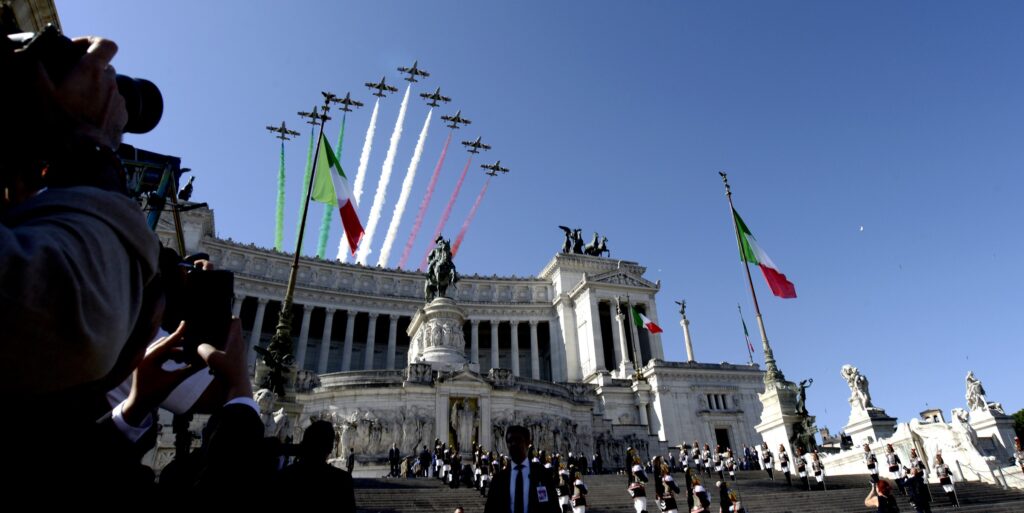
A recent trip to Italy put some ideas in my head about how this problem might be addressed. Italy is not usually considered a model of political unity, given its history since the Second World War of revolving-door governments. But one thing Italy is very good at is generating a love of country that transcends politics. This is often misunderstood by Americans when they read in the news about the turbulent political cultures of countries like Italy, France, and Greece. What we outsiders often fail to appreciate is that fractiousness in the sphere of politics can be managed in those countries because they are held together by deeper bonds in the sub-political sphere. Bonds of affection and loyalty among citizens remain firm thanks to strong families, private and civil networks, pride in common achievements, and a beloved way of life. Usually, such bonds are invisible to outsiders, but on rare occasions, they come into public view.

On the morning of June 2, 2025, I awoke to find myself trapped. I had rented a serviced apartment near the Roman Forum, thinking to spend the end of a short research trip in Europe in the city that, for me, has always been a spiritual home. Though I have spent altogether more than seven years of my life in Italy, I had somehow forgotten that June 2 was the Festa della Repubblica, the public celebration that commemorates the creation of the Italian Republic in 1946. The apartment I had chosen turned out to be along the principal access lane for VIPs attending the great celebratory parade and had thus become, for a few hours, a high-security zone. Our little half-block had been cordoned off and was being patrolled by state police and army units. There was no entry or exit. In compenso, from the third-floor windows of my apartment, I found myself with a ringside seat for the great parade.

The parade took place between 9 a.m. and noon and began at the Altar of the People on the Vittoriano—the enormous white marble monument to King Vittorio Emanuele II, the first king of Italy, that dominates the center of Rome. A bugle sounded as the president of Italy, Sergio Mattarella, laid a wreath on the grave of the Unknown Soldier. This set a tone of solemn gratitude to those who had fought for Italian liberty. Then nine jets from the Frecce Tricolori, the national aerobatics team, roared over the monument, spewing fumes in the colors of the Italian flag: green, white, and red.

Aeroplanes of the Frecce Tricolori aerobatic unit of the Italian Air Force spread smoke with the colors of the Italian flag over the Altare della Patria before the Republic Day parade in Rome, Italy. (Photo by Simona Granati – Corbis/Corbis via Getty Images)

A large crowd had gathered in the Piazza Venezia in the bright sunlight to see the spectacle. The most popular sight, apart from the jet flyover, was the personal guard regiment of the president. These are known as the Reggimento Corazzieri (cuirassiers), all men over 6’4”, magnificently dressed in their ceremonial armor with plumed helmets. “A man is but an ass / who fights in a cuirass” sings the son of King Gama in Gilbert and Sullivan’s operetta Princess Ida, but for public ceremonial, no mere military tunic, no matter how many medals are pinned on it, can match gleaming armor.

Cuirassiers during the celebration of National Unity and the Armed Forces at Altar of the Fatherland in Rome. (Photo by Roberto Monaldo /LaPresse / Alamy Live News)

After some short speeches by the principal officials of the republic, the presidential group climbed into a motorcade so as to take up its place in the reviewing stand at the center of the processional route—directly opposite my window. The route led from the Vittoriano down the Via dei Fori Imperiali, which had been cleared of traffic and lined with bleachers, to the Colosseum. That famous ruin was draped for the occasion in an enormous, 2000-square-foot flag of Italy. The parade, beginning with several dozen marching units, was to process from the Vittoriano slowly down the Via, then reverse direction and parade back from the Colosseum with a different set of parade units. On either side of the parade route lay the ruins of the imperial forums that long ago had been at the center of ancient Roman public life. Ancient Rome was a silent witness to the parade, with its own message: momento mori.

The whole spectacle was elaborately choreographed to include not just the numerous units of the Italian armed forces, which all seem to have their own marching bands, but representatives of all the various organs of state and Rome’s public services. No one, clearly, wanted to be left out. Also present in the procession were representatives of the European Union, NATO, the diplomatic corps of various nations, and Cardinal Archbishop Baldassare Reina, the vicar general of the Diocese of Rome. Each of the twenty provinces of Italy had units present. Every major Italian department of state had formations in the march, but there were also many private associations meant to embody the best of Italy. Italian Olympic medalists marched, but the Gruppo Sportivo dei Paralitici, Italy’s participants in the Paralympic Games, also rolled by in their wheelchairs. There were units from Italy’s various police forces as well as fire and rescue workers. Hospital nurses, wearing grim faces in response to recent budget cuts, formed a distinct body. The Roman police rode by in their blue-and-white vehicles, led by the chief of the Roman police, driving a Ferrari painted with police colors. That was an only-in-Italy moment! A group of students from a liceo classico (a high school for the study of classical languages) who had won awards for essays on ancient Roman history, came up to the reviewing stand and were handed their prizes by the president. Military parade music (another Italian specialty) was continuous, varied, and often exhilarating. The parade stopped only once, so that Rosalba Pippa, the popular singer known as Arisa, could perform before the reviewing stand the national anthem “Fratelli d’Italia” (which also happens to be the name of Italy’s ruling party, led by Giorgia Meloni).

There were a few short speeches by the Republic’s principal office-holders, but these stressed the common values of the patria—liberty, democracy, and peace—and reminded the crowd that the Republic’s legitimacy was based on a popular referendum held 79 years before. Decorum appropriate to the occasion was observed, partisan messaging kept to a minimum. Prime Minister Meloni spoke of the defense of common values, but got in a dig against “professors” who criticized the Bersaglieri, a unit of the Italian army associated with colonialism. The Bersaglieri, as Meloni well knew, are always among the most popular parade units, with their weird head-gear that looks like a small forest animal has been attached to it. The Bersaglieri also get attention by running, not marching, when they are on parade, creating a challenge for the embouchures of their marching band. So Meloni’s “profs” were a well-chosen target. The opposition party leader also kept things positive, contenting himself with a single dark allusion to the dangers of populism. None of this politicking was sharp-edged enough to disturb the good humor of the crowd. The dominant notes expressed were a heart-swelling love of Italy and gratitude to those who had made sacrifices to keep it free.

A positive celebration of our history, political creed, our great achievements, and our heroes could help counteract the effect of the dispiriting scenes we have been witnessing in recent years.

The end of the parade was marked by a spectacular performance by the Acrobatic Parachutists of the Italian army, who, jumping from helicopters, performed stunning aerial maneuvers while emitting smoke trails in the national colors. The three paracadutisti made a perfect landing at the end of the parade route, right in front of the Colosseum. A last attempt at crowd-pleasing was offered by the sanitation workers. They followed the marchers with a squadron of spanking-new garbage trucks, driven in coordinated, curvilinear patterns. They also picked up the trash.

So let me ask this: Why can’t we in the United States hold a parade something like the Italian festa for our upcoming celebrations next year of America’s 250th birthday? During his first presidency, around 2017, Donald Trump proposed holding a “big and beautiful” parade in Washington, DC to honor US military forces. The parade never materialized owing to logistical problems and cost considerations. It was predictably opposed by the usual suspects who complained that it would promote militarism and colonialism. In his second term, however, the president has swept aside any bureaucratic and ideological objections and scheduled, for tomorrow, a military parade in honor of the US Army’s 250th birthday, which just happens to be his own birthday too.

It is too late for tomorrow’s event to amount to more than a celebration of these twin birthdays. I live near Cambridge, Massachusetts, and can hear the grinding of teeth from here. But in the coming year, there will be time to plan an event that could draw broad public support and benefit our public life. A patriotic parade, reconceived more broadly as a positive celebration of who we are as a nation—our history, political creed, and our great achievements, our heroes—could help counteract the effect of the dispiriting scenes we have been witnessing in recent years. It could also be fun, and we could use some good humor in our civic life. Let’s work together, then, putting country ahead of politics, and celebrate next year the goodness that still fills our country and the good that our country can still do for its citizens and the world.

Categories
Michael Novakhov - SharedNewsLinks℠

Eco-Terrorists Aren’t What They Used to Be

The protesters who flung pumpkin soup at the Mona Lisa in the Louvre in 2024 claimed, as all such protesters do, that they were justified in their action because some higher principle—in this case, unsustainable food production—was at stake.

Like their compatriots in Just for Oil, who threw tomato soup at Van Gogh’s Sunflowers two years earlier, they surely did not doubt their moral righteousness or question that they were following in the honored footsteps of their eco-terrorist predecessors.

In his novel The Monkey Wrench Gang, Edward Abbey tells the story of four disparate eco-warriors who load their Jeep with the tools of destruction and attack billboards, road-building machinery, and bridges in Utah and Arizona. Their ultimate aim—pondered but never planned—is to destroy the Glen Canyon Dam. As their violence increases, the forces of economic development step up their efforts to stop the group, and eventually do, at least for a while. The gang reunites in Abbey’s posthumous sequel, Hayduke Lives!

A misanthropic provocateur, Abbey surely would have scoffed at the indirect action of hurling the contents of a can of Campbell’s at an unoffending picture. Abbey was a proponent of what he euphemistically called “direct-action environmentalism,” by which he meant the violent destruction of the tools of development—bulldozers, surveyor’s stakes, the Glen Canyon Dam.

The soup throwers were practicing anything but direct action. Blowing up dams is just too hard. Let’s spill lunch at the Louvre.

In life, Abbey always had a hard time fitting in with his erstwhile allies in the environmental movement. A half century after the publication of his seminal novel on eco-terrorism and 36 years after his death, he still does. 

His writing is suffused with anti-government rhetoric that at first blush might be appealing to some on the right. But his preference for “direct action”—violence—to achieve his political goals is now being wholeheartedly endorsed by sizable factions of the political left.

The Province of the Outlaw

The Monkey Wrench Gang got mixed reviews. Sales grew mostly through word-of-mouth among like-minded activists. The New York Times didn’t get around to reviewing the book until almost a year after publication.

“The book is not a gem of literature,” wrote reviewer Kenneth C. Caldwell in Landscape Architecture Magazine, who also doubted any potential to inspire real-life violence. “I doubt if the book will kindle fires of unquenchable rage in our hearts, causing us to cast down T-squares and take up cases of Dupont dynamite.”

Others saw something else in the book. William Marling, an author and literature professor, credits Abbey, possessor of two degrees in philosophy, with being “set apart from those who toy with the ‘conquest of nature’ paradox from a great philosophic height by his ability to distinguish not only between Camus and Cocteau but between columbine and penstemon as well. When the ingredients coalesce correctly, he is a powerful writer.”

Perhaps too powerful. “This book counsels insurrection and sabotage,” Marling asserts. “It contains explicit descriptions of procedures for dynamiting bridges and destroying earth-moving machinery. Reading it, one cannot help but feel that Abbey intended the information to be of practical use.”

Abbey always tried to maintain a strategic ambiguity on this point. But he once told an interviewer, “I write in a deliberately outrageous or provocative manner because I like to startle people.” In that, at least, he was successful. In his introduction to the 25th anniversary edition, Douglas Brinkley called The Monkey Wrench Gang “revolutionary, anarchic, seditious, and, in the wrong hands, dangerous.”

How, then, did the book become a popular success and a touchstone for the modern environmental movement?

For one thing, it made environmentalists cool, “the province of the outlaw,” in the words of Abbey biographer David Gessner. Abbey put on the page what thousands were thinking but were not yet prepared to do. Reading about it in a comic yet serious novel allowed people who would never in real life set ablaze a billboard or pour sand into a bulldozer crankcase a sense that they, too, were participants in the revolution.

Another Abbey biographer, James Bishop Jr., wrote that while the theme of The Monkey Wrench Gang was “environmental hooliganism,” it nevertheless came “closest to reaching that place of Abbey’s most steadfast convictions: a romantically idealized world in which the Industrial Revolution has been aborted, and society has reached a steady-state equilibrium where man and the land can exist in harmony.”

That, perhaps, explains why Abbey has a deeply devoted cult following, but has not emerged beyond that. 

Abbey’s rants against “industrial tourism” and his insistence that we’d all be happier without air conditioning, roads, automobiles, antibiotics, or many other conveniences of modern life amount to a platform that tells voters: all you have to do is agree to be poorer, and we can save these rocks. As much as we all love rocks, that’s a tough sell.

A Direct Descendant of Abbey’s Writings

In a post-9/11 world, Abbey’s dalliance with eco-terrorism has made him an even tougher sell in some quarters, while elevating him to icon in others. During one of his many appearances on college campuses, Abbey was asked if he really wanted to blow up Glen Canyon Dam. “No,” he told the students. “But if someone else wanted to do it, I’d be there holding the flashlight.”

Writer Doug Peacock, a friend of Abbey and the primary inspiration for the novel’s lead character, George Washington Hayduke, does not hem and haw about Abbey’s role in inspiring eco-terrorists. “The radical environmental group Earth First! Was a direct descendant of Abbey’s writings,” he wrote.”

Abbey rejected the notion that he was endorsing terrorism, drawing a distinction between sabotage and terrorism. “If the wilderness is our true home, and if it is threatened with invasion, pillage, and destruction—as it certainly is—then we have the right to defend that home, as we would our private quarters, by whatever means are necessary,” Abbey wrote in the essay, “Eco-Defense.”

If “the tree of liberty must be refreshed from time to time with the blood of patriots and tyrants,” Abbey seemed to be saying, so must the pinions and junipers of Utah’s slickrock country. 

“Whatever means are necessary” seems pretty clear, especially when standing next to his invitation to suicide bombers to take a lunge at Glen Canyon Dam.

Abbey’s defenders like to draw a distinction between damaging property and killing people. 

In his essay “One Man’s Terrorist,” Michael Branch, a professor of environmental literature, justifies the destruction of earth-moving machinery, billboards, and surveyor’s stakes—prime targets of the Monkey Wrench Gang—as doing no person any harm.

“Using a chainsaw to fell a billboard is no more violent than using a welding machine to construct one,” Branch writes. 

The contention that if no human is harmed, then it can’t be terrorism is faulty on its face. If you blow up a synagogue because you hate Jews, it’s an act of terrorism, whether there are any Jews inside or not.

Abbey was not unaware of the way the book could be, and was, perceived. He worried that he would be “accused of rash crimes … every time some Boy Scout sugars a bulldozer, or shellacs an earth-mover.” He was right to worry. A collection of terrorism biographies published two years after 9/11 profiled “twenty-six people who figure prominently in the story and history of terrorism,” including Osama bin Laden, Timothy McVeigh, and Ted Kaczynski. Abbey is right there at the front, his smiling, bearded countenance first alphabetically, followed by Gerry Adams and Yasir Arafat.

Am I a Racist?

Still, it is not his role as mad prophet of eco-terrorism that makes Abbey something of an untouchable among more conventional environmentalists.

Abbey’s friend and fellow environmental icon Wendell Berry summed up the case best in his essay, “A Few Words in Favor of Edward Abbey.” Abbey, writes Berry, is “seen as a problem by people who are, or who think they are, on his side.” These erstwhile defenders “have an uncontrollable itch to apologize for him.”

The central problem, according to Berry, is that many of his critics “assume that Mr. Abbey is an environmentalist—and hence that they, as other environmentalists, have a right to expect him to perform as their tool.” But, Berry writes, “he is not a conservationist or an environmentalist or a boxable ist of any other kind.” 

Brinkley compared Abbey to Don Quixote, and “the windmill Abbey wanted to tear down most was the Glen Canyon Dam.” Others have suggested Harriet Beecher Stowe or Upton Sinclair. He is more often compared to Henry David Thoreau, but biographer James Bishop Jr. astutely notes that The Monkey Wrench Gang is “more Orwellian than Thoreauvian.” Abbey’s vision is in many ways bleak—the alternative futures amount to a choice between a darkscape of industrial wasteland or a post-industrial anarchy shorn of every modern convenience. 

But in this age of intersectionality, the real challenge is Abbey’s views on non-environmental issues. Abbey opposed immigration, wrote and said untoward things about racial minorities, called welfare “a subsidy for baby production,” was proudly sexist (“To the editors of Ms. Magazine, NY: “‘Dear Sirs …’”), called the Peace Corps “an act of cultural arrogance,” and owned guns (“I load my own ammo”).

Abbey considered his essay “Immigration and Liberal Taboos” among his personal favorites. Solicited and then rejected in 1982 by The New York Times, it was subsequently rejected by Harper’s, Atlantic, The New Republic, Rolling Stone, Newsweek, and Mother Jones. The left’s intolerance for dissenting opinions is not a new thing. 

The piece was eventually published in 1983 by Phoenix New Times

Abbey argued that “it might be wise for us as American citizens to consider calling a halt to the mass influx of even more millions of hungry, ignorant, unskilled, and culturally-morally-generically impoverished people. … How many of us, truthfully, would prefer to be submerged in the Caribbean-Latin version of civilization? … Harsh words: but somebody has to say them.” And Abbey very cheerfully did, while pondering the criticism.

“Am I a racist?” he asked himself in his journal. “I guess I am. I certainly do not wish to live in a society dominated by blacks, or Mexicans, or Orientals. Look at Africa, at Mexico, at Asia.” At the same time, Abbey believed it was never fair “to evaluate the quality of any individual by reason of race. You cannot judge the worth of a man by his skin color, bone structure, I.Q., body chemistry or genetic inheritance. … However, there are significant differences among the various races, both in character and in achievement. It is intellectually dishonest and socially condescending to pretend otherwise.”

As the editor of his published journals wrote, a sanitized, politically correct Abbey “would be—well, no Edward Abbey at all.”

Abbey, Jefferson, and Lincoln

Fifty years on, The Monkey Wrench Gang endures. 

A theme running through retrospective essays on Abbey and his work is speculation on his reaction to climate change. All conclude, naturally, that he’d be on their side. But none wonder about his response to the destruction of habitat wrought by acres devoted to the production of “clean” energy.

It’s difficult to imagine the Don Quixote who ranted about paved roads, visitors’ centers, and flushable toilets on public lands would get behind the idea of deploying solar panels or windmills across his beloved desert.

Abbey wrote that “a patriot must always be ready to defend his country against his government,” sounding suspiciously like Thomas Jefferson justifying the need for rebellion every 20 years. If “the tree of liberty must be refreshed from time to time with the blood of patriots and tyrants,” Abbey seemed to be saying, so must the pinions and junipers of Utah’s slickrock country. 

It’s a dangerous philosophy. When each man decides for himself how much violence is justified to achieve political ends, the most violent tend to come out on top. 

Abraham Lincoln, an admirer of Jefferson, said, “There is no grievance that is a fit object of redress by mob law.”

If, in reading The Monkey Wrench Gang, conservatives are enticed by Abbey’s anti-government rhetoric, they should heed the words of Lincoln and remember that, eventually, like the left turning on Abbey over immigration, the revolution always devours its own.

Categories
Michael Novakhov - SharedNewsLinks℠

The Morality of Mad Men

It has been 10 years since AMC’s Mad Men ended. As the show finished its retelling of the upheavals of the 1960s, the real America was entering a decade of similar convulsions over race, sex, demography, and economics. Now, after our own age of rage, we can better appreciate the traditional view of society that lay beneath Mad Men’s whiskey- and cigarette-infused glamour. The fictional experiences of the men and women of ad agency Sterling, Cooper, Draper, Price, not only serve judgment on the excesses of the ‘60s, but also help explain a likely conservative turn in American social and political trends in the decade ahead. A story about the Age of Aquarius may explain the beginning of the end of the Great Awokening.

Mad Men began its story at the end of what many once idealized as the post-World War II Golden Age, with its cultural and social certainty, long-defined genders and gender roles, and a feeling of common national purpose. Those verities were to be flayed, strip by strip, throughout the series’ seven seasons, as it tackled conformity, sexism, and race relations. Mad Men ended its tale in the early 1970s, at the beginning of post-modern America, a country socially freer and more equal, yet also more lost and lacking in identity, community, and confidence. The show exposed traditional values as hypocritical, outdated, and even immoral—until they ultimately were vindicated by the series’ conclusion.

Like most of current American popular culture, Mad Men largely ignored organized religion, and a subplot that could have explored the decline of faith was dropped early in the second season. Also uneven were the show’s attempts to deal directly with prejudice, whether antisemitism or race relations and the civil rights movement, its transient Jewish and Black characters seemingly pushed to the center of the stage for a few moments.

Mad Men’s focus was the WASP world entering its death throes in the 1960s. From that perspective, it is the cinematic counterpart to Charles Murray’s Coming Apart, his classic study of the changes in White America from 1960 to 2010. The show delivered its ostensible message about the hypocrisy of middle-class White American life in the very first episode, “Smoke Gets in Your Eyes.” Urbane, handsome New York advertising executive Don Draper spends his evening drinking with his youthful subordinates and having intimate relations with a young woman. He then quietly enters a suburban home late at night and sits in his sleeping children’s dark bedroom while his wife, her face encased in shadows, stands silently in the lighted doorway, the two of them isolated physically and emotionally from each other.

Mad Men may have been at its most poignant in these early seasons, in its elegiac depiction of late-1950s/early-1960s suburbia. While the series meant to peel away the veneer of false utopia attached post facto to American suburban life—White, privileged, family-centered—at the same time it fed back into every sense of loss, whether actual or imagined, by those who currently live in the real world birthed during the era Mad Men fictionally portrayed.

For that reason, the saddest character in the series was not the hopelessly lost Don Draper, but his picture-perfect first wife, Betty, whose tragic arc in many ways seems truest to the show’s sub rosa message about the world that has passed. Long after their split and the collapse of their supposedly perfect life, the specter of what Don lost when Betty divorced him for his serial infidelities haunts him (and us) throughout the rest of the series.

A child of privilege and a former model, Betty appears to have won life’s lottery. She entertains perfectly and is the envy of her circle of suburban friends and her husband’s co-workers. She lives the life of mid-century leisure that we are to assume most women aspired to, but only a small fraction attained. Yet we come to see that she is emotionally stunted, betrayed by her husband, callous towards her children, and in almost every way unsatisfied. Even her own remarriage, to a man more successful and prominent than Don, seems less a vindication of her worth than a desperate attempt to recapture what she lost when she defended her honor by finally kicking Don out of the house.

Mad Men delivers an unsparing portrait of our modern existential crisis.

If the Drapers’ hometown of Ossining, New York, is cynically portrayed as a suburban Eden hiding serpents and trees of forbidden knowledge, then Don and Betty’s split throws them both out of the Garden. Unlike their Biblical forebears, however, they are condemned to wander separately, alone even when they have found new mates. Don’s pathetic wistfulness, when he visits his children in Betty’s new home late in the series, is a visceral reminder that he chose a path that destroyed the happiness they all could have had. During these scenes, one cannot avoid remembering Don’s piercing speech from the first season, during his ad pitch to Kodak executives for their new Carousel slide projector. As joyous scenes from his own family’s past flash on the projector screen, Don both sells to his clients and relives for himself a hopeful and innocent life that is fast disintegrating in his turbulent present, yearning for a return to “a place where we know we are loved.” 

It is that remembrance which makes Don and Betty’s last phone call to each other, near the very end of the series, so heartrending. Few television shows have so starkly portrayed the pain of divorce and its effects on all involved. Unable to get over their disagreements even so many years later, Don and Betty nonetheless seem haunted by the harsh finality that what they had will never be recovered. Both suffer the almost unbearable pain of confronting their past’s aborted future as an alternate reality they let slip out of their hands. In that brief phone conversation, the ghosts of what that life could have been swirl about them both, etched vividly in a piece of acting by both leads that cannot be overpraised.

By then, Betty has been diagnosed with terminal lung cancer, a mordant twist by the show’s writers, who showered us with innumerable smoking scenes throughout the series. Indeed, Betty was rarely seen without a cigarette, her ethereal looks and perfectly coiffed hair often wreathed in smoke. Cancer is the cruelest blow for Betty, a horrid, slow wasting of the beauty that defined her. And her demise is the more brutal, for she has just begun, after so many years wandering in her own personal purgatory, to climb up from the depths of the meaninglessness of her life by enrolling in college. She is fated not to finish the degree that will give her a sense of her own individuality, but she has seen across the river to a land where she knows that life has promise and meaning and is thus in her own way saved.

Betty lives her final days on her own terms. We last see her sitting in her usual poised style at her kitchen table, serenely smoking the cigarettes that have already killed her, while her once-estranged daughter Sally takes up the household chores at the sink. Even the farewell letter she pens to her daughter, giving precise instructions for how her body is to be prepared for her funeral, is at once unbearably heartbreaking and an affirmation of her spirit.

Compared to Betty’s journey, Don’s odyssey is far more ambiguous. The moral questions at the center of Mad Men become clear through the character of Don Draper. As a Madison Avenue man, Draper is possessed of uncommon excellence, a full development of the social “virtue” that brings success in the cutthroat professional world he inhabits. Yet as a private man, Don lacks all real virtue, his life being bereft of any excellence as a husband, father, or friend. An aristocrat at the advertising storyboards, he is spiritually and emotionally a beggar amidst the plenty of post-war upper-middle-class life. He is one of T. S. Eliot’s “hollow men, stuffed men,” between whose idea and reality falls the shadow.

Don’s alienation from those around him grows throughout the series, leading to two failed marriages. We learn early on why Don is so isolated, for he is, above all, alienated from himself. He is a man living a lie at the very core of his being, having taken the name and identity of a fellow soldier who was killed during the Korean War due to Don’s own battlefield carelessness. Yet the adoption of a false identity was the only way for an orphaned child of a drunk and a prostitute to escape the claws of the Depression-era life that held him until he shipped out for Korea. The lie at the center of his life unravels his first family and prevents him from developing true bonds with his children, Sally and Bobby.

The only one who truly understands and loves Don is, ironically, the widow of the man whose identity he stole, Anna Draper. Don has set her up in a home in the idyllic southern California of the early 1960s, and it is only when he visits her, in their platonic love, that he goes by his real name and can be his true self, Dick Whitman. And when Anna dies, Don is left truly alone in the world.

In less-skilled hands, Don’s story would be simple melodrama, but both series creator Matthew Weiner and actor John Hamm breathe despairing life into Don. By bringing together two such lost souls in Don and Betty, Mad Men delivers an unsparing portrait of our modern existential crisis.

Unlike the renewed family man Pete or the dying but certain Betty, Don seems fated to continue his wanderings, unable to grasp the simple yet profound truths that give meaning to life.

As the story arc comes to its close, Weiner and the writers reveal, perhaps unwittingly, the conservative ethos underlying the series. Don’s second marriage, to the winsome, honest, and ambitious Megan, collapses through his jealousy and (again) infidelity. He then believes he has fallen in love with Diane, a waitress who has run away from her family and now him. In chasing after her, Don finds her former husband, living with a new family in a nondescript, middle-class suburb in the Midwest. Diane’s former husband is portrayed as a prickly, repressed, provincial man, all due to his openly expressed and deeply-held religious beliefs. Yet he immediately discerns Don’s lame ruse to find Diane and drives him from the house. Don flees, discovering that this anonymous, unremarkable, unaccomplished Midwesterner is far more real and stable than he, the entirely false Manhattanite. Whereas Don’s interior is nothing but a jumble of untamed lusts, corruption, and lies, this God-fearing man possesses not only a solid core but the insight into human nature that Don so tragically lacks.

That lesson is reinforced in the series finale, when Pete Campbell, Don’s younger colleague, makes a traditional, life-affirming decision. Pete was introduced in the series’ first episode as a wealthy, callow youth willing to do anything to climb the corporate ladder. He follows Don’s path into infidelity and a broken marriage, even moving to California to live a carefree life. Yet Pete matures over time in a way that Don seems desperate to do but cannot. Pete ultimately reconciles with his estranged wife and flees from Manhattan, where his family has lived for generations, to Kansas City, bringing wife and daughter in tow. Pete has learned that he is incomplete without his wife and that both California and New York City are irredeemable, filled with temptation and immorality. When Pete and his family board their private jet (he is the jet company’s new president) for their new life in the Midwest, what could have come across as a brief, hackneyed scene instead exudes optimism that Pete will honor his second chance.

In very different ways, Betty Draper and Pete Campbell have matured and found fulfilment, one through tragedy, the other through rediscovering the permanent things. Other characters, too, grow during the series, like Joan, the sexpot secretary-turned-businesswoman, and Peggy, who starts out as a mousy secretary and finally breaks the advertising world’s glass ceiling.

Don, however, remains a lost soul. It is perhaps no surprise that he finds himself, at the very end of his journey through Mad Men, at the famed Esalen Institute, in California’s Big Sur. Esalen represents the culmination of America’s journey through the 1960s. From the man in the gray flannel suit, Don has become an avatar of the new consciousness, seemingly making his traumatic emotional breakthrough.

The enigmatic final scene of Don, the very last in the whole series, was as controversial as the first. As he sits above the sun-washed cliffs overlooking the Pacific Ocean, blissfully listening with closed eyes to the chime of the morning meditation bell, Don’s face breaks into a wide, satisfied grin. Has he at last found inner peace and the stability that has so long eluded him? Or, has Draper figured out a way to salvage the wreckage of his career and return to the top of the advertising mountain? The immediate transition from the grinning Don to the iconic 1973 Coca-Cola commercial, “I’d Like to Teach the World to Sing,” all but demands the latter interpretation. Yet I had become so invested in, if repelled by his character, that I wanted to believe that Don, too, had found happiness, and that the Coke ad was a brilliant means of playing on the viewing audience’s nostalgia for a seemingly less cynical time when such corny, new age optimism still was fresh. Regardless of whether he has repaired his emotional wounds or simply ensured corporate immortality, the fact remains that we leave Don Draper as we found him at the beginning of the 1960s—alone.

A decade after that last scene, after a similar period of social and political upheaval, an audience in 2025 is likely more attuned than Mad Men’s original viewers to the knowledge that even if Don believes he has found a new, truly worthwhile path, Esalen and all the counter-cultural movements of the 1960s were illusory Edens, and that those who succumbed to their embrace would move on, always dissatisfied and unfulfilled. Unlike the renewed family man Pete or the dying but certain Betty, Don seems fated to continue his wanderings, unable to grasp the simple yet profound truths that give meaning to life and which demand both discipline and sacrifice to something greater than oneself. 

One may have hope that Americans have learned this hard lesson. False utopias, radicalized mob violence, and the denial of nature and reality all have darkened our national horizon in recent years. A turning away, back to something more grounded and tested, seems to have started. The morality of Mad Men illuminates this laudable trend and may even help strengthen its fragile roots.

Categories
Michael Novakhov - SharedNewsLinks℠

Politics of the Cradle

Few debates matter more to the West’s future than the widening divide between left and right over the simple act of having children. Inside an April pronatalism conference in Austin, the roster stretched from the more traditionalist Catherine Pakaluk to libertarian Bryan Caplan. Outside, left-wing protesters branded the gathering “neo-Nazi.” The answer to the question of whether children are worth having will shape everything from fiscal policy to cultural identity. The roots of the quarrel are worth tracing.

That even childbirth now falls under the old slogan “the personal is the political” may shock. Yet it follows naturally from each camp’s bundle of larger ideological commitments. For conservatives, increasing fertility in the West is part of the defense of its civilization. Europeans and other groups that were at its heart are no longer reproducing themselves. Across the OECD, the total-fertility rate has slid to 1.5 children per woman; in Italy and Spain, it hovers near 1.2, and even in the United States, the latest CDC release puts the rate at just 1.63—far below the 2.1 replacement benchmark. For many conservatives, every newborn is a vote that the West remains worth inheriting.

The religious right also has theological reasons for favoring procreation. The Abrahamic religions share the injunction to be fruitful and multiply. All greatly value motherhood. The most iconic image in Western art—the Madonna with Jesus—is an encomium to the pairing of woman and child. Bearing children affirms the belief that God made a good world. We may fall short of that promise, but the act itself testifies to the cardinal virtue of hope.

Natalism also gains support from the right’s rawer political calculations. The crisis of fertility among its native populations contributes to the graying of population and the reduction of its workforce. Yet all Western democracies have pay-as-you-go social security systems dependent on a high ratio of workers to retirees. These brute facts create a fiscal dilemma. Across Europe, leaders duck pension reform but recognize that raising already high taxes would strangle growth. In the United States, leaders likewise dodge entitlement reform and propose hiking taxes only for the top 2 percent. Soaking the rich will not put much of a dent in our record peacetime debt. The obvious solution is to increase the worker-to-retiree ratio by making the population younger. Conservatives would rather accomplish that through increasing birth rates rather than massive increases in immigration. The latter is thought to threaten the distinctive national cultures they value and destabilize politics.

The left does not share these positive reasons for supporting fertility. It does not think Western civilization is one that necessarily should be continued, and is generally indifferent to religion. But the left has other reasons of its own to resist natalism.

One is feminism. Many feminists have persistently argued that social structures keep women from being equal to men in achievement—in the arts, in the sciences, and in business. One of the greatest impediments is the family structure where women undertake more unpaid labor than men, particularly in raising children. Increasing child-care subsidies and supporting early education might look like a fix. Yet nations that lavish money on day care still see women falling behind men in pay and prestige. Once they have children, most women still want to spend more time nurturing than men. Thus, the only way to prevent women from becoming parental specialists is not to become parents.

Another reason that some on the left are not enthusiastic about bringing children into the world is the environment. More people create more pollution and burden the Earth’s biosphere. In some more radical views, new generations are likely to be despoilers of the natural wonders of the earth that need preservation.

If low fertility is causing a fiscal and economic crisis, in the West, the left’s solution is to fling open the borders to more migration. The left believes that foreigners have as much right to enjoy the higher living standards in the West as those who already live there. Indeed, among some more radical voices, they may often have a greater moral claim, because their poverty is caused by the West’s colonialism. The left welcomes the multicultural transformation of the West that great inflows will bring. “Diversity is our strength” is its mantra.

To be fair, the left is no monolith; plenty of progressives still toast big families. Yet, as with transgender orthodoxy and erasure of national borders, it is the activist vanguard that writes the party script. Their chill toward procreation flows from faculty lounges to platform planks, then filters down to voters who sense disdain. Elite ideas tug Democrats leftward long before the rank-and-file notices

History shows that creeds hostile to the cradle soon confront their own demographic sunset.

It might be argued that what is really depressing fertility is not ideology but economics. Housing costs, student-debt burdens, and delayed marriage no doubt matter. But citizens of the West, including the young, are far wealthier and live far more comfortably than in past eras, where fertility rates were much higher. Medical assistance, like IVF, increases the effective reproductive span of women. But Sweden and Hungary show that baby bonuses and family leave pad wallets, not bassinets. Values and culture, not subsidies, rock the cradle.

The contest over childbearing carves a deep rift in today’s political landscape. The left-radical position is likely to damage their party’s political standing. The impulse to have children is deeply ingrained; indeed, from an evolutionary perspective, children are the goal of human life. It is true that contraception has cut the close link between sex and reproduction, but human nature prompts the desire for children in ways other than through sexual desire. Children are cute, and there are few other ways most of us can leave an enduring mark on the world. Thus, this latest left position is going against the human grain.

Moreover, the ideological reasons for skepticism about bringing children into the world may be seen by many as the reductio ad absurdum of left positions. If feminism means that women must avoid having children from being beguiled into an unequal relation with men, feminism then demands that women give up a great source of human fulfillment to be true feminists. If environmentalism opposes the propagation of humanity, such environmentalism seems to prefer the rest of the natural world to the one animal that can see it whole. Treating immigration as a stand-in for native births slips into oikophobia—those who, in Gilbert & Sullivan’s jab, “praise, with enthusiastic tone … every country but their own.”

History, however, shows that creeds hostile to the cradle soon confront their own demographic sunset. The Shakers—an eighteenth and nineteenth millenarian sect who enjoined celibacy on their adherents—are unsurprisingly no longer around. While children do not directly inherit their parents’ political beliefs, there is a correlation in the ideology between parent and child. A growing distaste for having children on the left will, other things equal, push the nation toward the right.

In terms of contemporary politics, the stance against children is sure to continue to push the so-called “normies” (this generation’s echo of the “silent majority” of the 1960s) away from the left. The “normies” now shaping American elections are the large, loosely organized bloc of middle-of-the-road voters—disproportionately non-college, suburban or ex-urban, and culturally conventional—who recoil from both progressive identity politics and hard-right theatrics. Their irritation with the left concerning issues such as transgender athletics or “defund the police” policies stems from a mix of practical worries (fairness in sport and public safety), moral intuitions grounded in mainstream religious or communal norms, and a perception that progressive elites impose niche values without democratic consent. Outnumbering the zealots on both flanks, normies now choose who governs in close races.

Few positions will rile normies more than contempt for the desire to have children. Enthusiasm for having children has been a widespread and religious cultural norm for virtually all of human history. Skepticism of having children is the paradigm niche issue pressed by certain elites. A preference for immigrants over native children is an extreme version of open borders that normies also reject.

It is true that some of the pronatalism of the right may also be off-putting. Some celebrity advocates for more children hardly model the stable families most parents envision. Even the very name “natalism” can alienate ordinary people because it appears to create an odd term for something that comes naturally. Even so, the quirks of the famous and a pompous Latinate label will offend less than open hostility to child-baring.

Whatever one thinks of baby bonuses or child tax credits as policy matters, the fertility fight lays bare the deepest fault line in modern politics. The left, increasingly doubtful about the worth of the West, treats birth as a lifestyle choice to sometimes be discouraged. The right regards it as constitutive of human flourishing. The quarrel over the cradle is thus no social-policy sideshow. It is the distilled essence of two rival creeds. Tell me where an ideology stands on the need for babies, and I can tell you where it will stand on much else.