
Category: Michael Novakhov – SharedNewsLinks℠
Category Added in a WPeMatico Campaign
 |
Michael_Novakhov shared this story . |
CNN
—
For the better part of the past year, as Robert F. Kennedy Jr. built and maintained a small but significant base of support for his quixotic White House bid, the two major parties wrestled with an increasingly pressing question: Whose presidential aspirations might be most damaged by an independent aligned with the conspiratorial right but bearing a famous Democratic name?
Now, with Kennedy having suspended his campaign, both parties will be closely watching who his followers gravitate toward in the closing months before Election Day.
Kennedy formally announced Friday that he was suspending his presidential campaign, saying, “I cannot, in good conscience, ask my staff and volunteers to keep working their long hours, or ask my donors to keep giving when I cannot honestly tell them that I have a real path to the White House.”
He then said he would “throw (his) support to President Trump.” Speculation around an endorsement of former President Donald Trump had earlier grown as both candidates were scheduled to appear in Arizona on Friday, and Trump teased a “special guest” at his event.
Though his odds of victory were quickly diminishing – a recent CBS News poll measured his support at just 2% – Kennedy’s decision to bow out 74 days before the election nevertheless presents another twist to a race already unlike any other. And amid a momentum shift that has catapulted the newly installed Democratic nominee, Vice President Kamala Harris, into close contention with Trump, there is hope within the former president’s operation that Kennedy’s exit could prove decisive if certain battlegrounds are decided by thousands of ballots, just as they were in 2020.
It’s hardly certain what Kennedy’s backers will do. Whether many of them ever intended to vote for him or at all is difficult to gauge, and some may choose to sit the election out without an alternative on the ballot.
Still, the Trump campaign has long worried that Kennedy’s campaign, built on conspiracies and anti-vaccine rhetoric, pulled directly from their side, especially in a handful of key states. Trump’s advisers now see an opening to court some of Kennedy’s voters, particularly those Americans who sit at the overlap between supporters of Vermont Sen. Bernie Sanders’ past presidential campaigns and the GOP’s anti-establishment right wing. There is a presumption among Trump’s team and his allies that conservative-leaning mothers – a demographic the Republican nominee has struggled to win over – could also be swayed. Women were more likely to support Kennedy than men, according to a recent Pew Research Center survey, though other polls haven’t shown a meaningful difference.
As it became clear that Kennedy’s days in the race were numbered, several of Trump’s top allies, including his son, Donald Trump Jr., have maneuvered behind the scenes to arrange for an endorsement. Meanwhile, the former president has showered Kennedy in overtures, telling CNN he might find a place for his onetime rival in a future Cabinet.
“If he endorsed me, I would be honored by it,” Trump said Thursday on Fox News. “I would be very honored by it. He really has his heart in the right place.”
The Democratic National Committee and aligned outside groups have aggressively attacked Kennedy since the beginning of this year in an attempt to minimize his impact on the race. In a memo released Friday, Ramsey Reid, the committee’s operative keeping an eye on third-party candidates, argued that Kennedy dropping out wouldn’t affect the race, pointing to recent polls showing his support declining.
“Here’s what RFK Jr.’s endorsement of Donald Trump would change: nothing,” Reid said in the memo. “The little support that remains is soft, split across ideologies, and disproportionately among lower propensity voters.”
Still, amid the uncertainty, the Harris campaign extended an olive branch to Kennedy’s backers.
“If they were looking for somebody who’s actually going to fight for their interests, their values, or they’re looking for somebody who understood as it relates to the personal decisions that they make in their lives, the government should get the hell out of the way,” Harris spokesman Michael Tyler said, “then there’s a home for them in Kamala Harris campaign.”
An alternative to Biden and Trump
Kennedy first entered the race in April 2023 as a Democratic challenger to President Joe Biden. In October, he ended that bid and announced he would instead run as an independent candidate.
Armed with a storied family lineage – he’s the son of the late Attorney General Robert F. Kennedy and the nephew of President John F. Kennedy – and a cult following from his years of environmental activism and as a leading purveyor of debunked vaccine conspiracies, Kennedy quickly found an audience of Americans disenchanted by the two major parties and a rematch between the two oldest presidents to hold the office.
Though his national support peaked in the teens and has lately fallen to low single digits, Kennedy’s campaign generated fears from both parties that he could tip a critical state or two.
At the Republican National Convention last month, Trump co-campaign manager Chris LaCivita told a room full of reporters that their internal polling predicted Kennedy siphoned slightly more votes from Democrats in Michigan and Wisconsin but “much more from us” in Pennsylvania, whose 19 Electoral College votes are one of this year’s top prizes and could determine the election.
Asked why, LaCivita responded, “I don’t know. I haven’t figured it out yet.”
Democrats, meanwhile, have waged an offensive against Kennedy over the past year, seeking to portray him as a spoiler for Trump by highlighting his ties to megadonor Timothy Mellon, who has donated to super PACs backing both Trump and Kennedy.
The DNC and Clear Choice PAC actively fought Kennedy’s efforts to get on the ballot in 11 states, each of them a battleground or a Democratic stronghold. Kennedy had won all of the legal battles he faced against Democrats in various states up until a New York judge blocked him from appearing on the state’s ballot earlier this month.
Kennedy’s campaign and its underdog operation had spent countless hours, not to mention tens of millions of dollars, working to achieve their goal of gaining ballot access nationwide. Kennedy has qualified for the ballot in 21 states, although it’s unclear whether his name will appear on ballots in those states without him in the race. On Thursday, he withdrew from the ballot in Arizona, the office of the state’s secretary of state told CNN.
If Kennedy drops out, he will have spurned several minor parties who nominated him as their presidential candidate to grant him ballot access in select states. The fate of those minor parties, who in some states earn ballot access based on performance in previous elections, could be in jeopardy.
Trump’s campaign went on offense early against Kennedy’s independent bid, labeling him a radical liberal and promoting his more progressive beliefs. The attacks escalated further in the spring of 2024 as more public and internal polling revealed that Kennedy took as much support from Trump as from Biden.
By May, Trump’s advisers and outside allies went from viewing Kennedy as a nuisance to a real problem that needed extinguishing. Trump himself personally weighed in, urging undecided Americans not to cast a “wasted protest vote.”
Frustration mounted as well with the friendly coverage Kennedy enjoyed into the summer from conservative media – not only Fox News and Newsmax but also among conservative influencers.
“That coverage was a major reason Don Jr. began pushing for a way to get (Kennedy) to end his campaign,” a source familiar with the talks said.
Within Trump’s political orbit, an alliance with Kennedy was never far from a possibility.
Roger Stone, the longtime Republican operative close to the former president, suggested in the summer of 2023 that Kennedy could be a contender for a Cabinet post in a second Trump term. In April, a Kennedy campaign official based in New York was fired by the campaign after she repeatedly urged voters to vote for Kennedy to improve Trump’s chances of victory in blue states such as New York. To Democrats, the episode confirmed what they viewed as an uncomfortable coziness between the efforts behind Trump and Kennedy.
Privately, the lines of communication remained open between their extended political orbits. Discussions between Trump allies and advisers and Kennedy’s team began in the lead-up to the Republican convention in July. Kennedy’s son, Bobby Kennedy III, posted video of a friendly phone call between his father and Trump the same month.
During the conversation, the former president appeared to endorse false theories about the safety of vaccines – a longtime focal point of Kennedy’s public advocacy. The elder Kennedy apologized to Trump for the release of the video of their phone call, which was later deleted.
At an event last month, Kennedy acknowledged for the first time that his path to victory was shrinking and asserted that Trump was “highly likely to be the next president.”
Then, on Tuesday, Kennedy’s running mate, Nicole Shanahan, opened the door to “joining forces” with Trump to prevent Harris from winning the election.
Donald Trump Jr. had been pushing his father and the Trump campaign for weeks to encourage Kennedy to end his bid and endorse the former president, according to a source with knowledge of the conversations.
In addition to Trump Jr., former Fox News host Tucker Carlson – who is close to Kennedy – as well as businessman Omeed Malik, a Trump donor who has also given to Kennedy’s campaign, have helped facilitate the talks.
An endorsement, if it happens, could come as soon as Friday night at Trump’s Phoenix-area rally. Trump said Thursday that “no plans have been made.” Kennedy is scheduled to address “the present historical moment and his path forward” at an event not far away just hours earlier. It will be Kennedy’s first public event since July.
Internal conversations within Trump’s operation had for months focused on whether Kennedy’s endorsement would bring any benefit. Kennedy was a mercurial figure long before his run for president, and he has managed to amass more controversies during his 16-month-long quest for the White House.
In May, Kennedy disclosed for the first time that a parasitic worm once entered his brain and died, a period that led to “brain fog” and “having trouble with word retrieval and short-term memory,” he said. Later in the campaign, he sidestepped accusations published in Vanity Fair that he sexually assaulted a former nanny, telling a podcast he had “many skeletons in my closet.”
“I’m not a church boy,” Kennedy said when asked about the allegations.
The same Vanity Fair article also published an image of Kennedy, sent by him to a friend, which appeared to depict Kennedy pantomiming eating a dog carcass. Kennedy has denied the photo showed him eating a dog.
Earlier this month, Kennedy admitted that a decade ago he placed in New York City’s Central Park a bear cub carcass he found on the road upstate, an incident that appears tied to a 2014 episode that drew national attention.
However, any hesitance inside Trump’s campaign about a Kennedy endorsement eroded when Biden ended his campaign in late July and it became clear that Harris would likely top the Democratic ticket. It was at that point that more people in Trump’s orbit, including several of his most senior advisers, came to believe that Kennedy’s support would be an asset in a race that could be determined by the smallest of margins, two people close to the talks said.
“The team recognized that RFK Jr. could be more hurtful to Trump after that. It quickly became clear that pulling his voters to our side could give us an edge, and the talks happening in the background to secure his endorsement became more serious,” a source familiar with the talks told CNN.
While Trump has long espoused some of the conspiracies around routine inoculations that Kennedy has pushed for years – including the debunked links between certain vaccines and autism – the two were for a time on opposing sides of the coronavirus vaccine. Kennedy had made Trump’s handling of the Covid-19 pandemic and his implementation of Operation Warp Speed, the program to accelerate the manufacturing of Covid-19 vaccines, a major theme of his early campaign.
As Kennedy’s campaign picked up support, Trump labeled the former Democrat a member of the “radical left” and attacked his environmental activism.
But in July, Trump and Kennedy spoke on the phone in the days after the former president survived an assassination attempt at a campaign rally in Pennsylvania. The day after the call, Kennedy and Trump met in person in Milwaukee on the first day of the Republican National Convention.
In those conversations, the candidates first discussed the possibility of Kennedy dropping out of the race and endorsing the former president in exchange for a role in a future Trump administration. Following those conversations, Kennedy said he would not drop out of the race.
Earlier this month, Kennedy’s campaign approached the vice president’s campaign about arranging a meeting to discuss endorsing her in exchange for a potential role in a Harris administration. That meeting never materialized.
Shanahan on Thursday lashed out at Democrats, suggesting they would be to blame if Kennedy’s supporters helped push Trump over the top in November.
Her “old Dem buddies,” she wrote on social media, are “terrified of the idea of our movement joining forces with Donald Trump.”
“Here’s an idea: stop suing us. Let us debate. Quit rigging the media and the polls. It’s a simple formula people – get with it,” Shanahan said.
This headline and story have been updated with additional developments.
CNN’s Kristen Holmes, Kate Sullivan and Ethan Cohen contributed to this report.
|
Michael_Novakhov shared this story from  News | Mail Online. News | Mail Online.
|
Federal law enforcement is doing ‘everything wrong’ in their investigation of the attempted assassination against Donald Trump, claims Sen. Ron Johnson.
The ranking member of the Senate Homeland Security Committee told <a href=”http://DailyMail.com” rel=”nofollow”>DailyMail.com</a> that the actions of the Justice Department are ‘jaw dropping’ and slammed the agency’s law enforcement arm – the FBI – for thinking they are ‘above the law.’
He also said it was suspicious that would be assassin Thomas Matthew Crooks’ body was cremated almost immediately after he was shot and killed at the rally in Butler, Pennsylvania.
Crooks, 20, was gunned down by Secret Service right after one of his bullets grazed the former president’s right ear during the attack on on June 13 that left one supporter dead and two others critically injured.
And amid a still ongoing investigation into the events that transpired that day, Crooks’ body was already released and cremated despite lingering questions from lawmakers.
‘I think the FBI, Department of Justice, Secret Service are doing everything exactly wrong,’ Johnson told <a href=”http://DailyMail.com” rel=”nofollow”>DailyMail.com</a> at Trump Tower in Chicago on Monday. ‘If you want people to have confidence in the investigation, it needs to be transparent.’
Sen. Ron Johnson (right) told <a href=”http://DailyMail.com” rel=”nofollow”>DailyMail.com</a> that ‘the FBI, Department of Justice, Secret Service are doing everything exactly wrong’ in the investigation of the assassination attempt against Donald Trump
‘What we know about the events of July 13 is coming primarily from local law enforcement,’ the furious senator explained.
Multiple congressional committees, including the one Johnson serves on as the top Republican, have questions about the assassination attempt and what could have been done to prevent it.
But Johnson says that they are being stonewalled by the FBI, DOJ and United States Secret Service (USSS).
‘From standpoint of federal law enforcement, they are the law. They believe they’re pretty much above the law, and they’ve never been held accountable,’ the Wisconsin lawmaker said. ‘They don’t believe they really need to be held accountable to the American public. They can avoid scrutiny. So that’s how they’re handling this investigation.’
‘Personally, it’s jaw dropping to me that they would cremate the body before all the autopsy reports were presented to the public,’ he continued.
‘It just boggles your mind how they’re approaching this. They’re doing everything exactly wrong if their goal was to instill confidence in an independent and fair and honest investigation.
‘People are suspicious, and I think justifiably so,’ Johnson lamented after speaking at a press conference for Trump in Chicago on the sidelines of the Democratic National Convention.
Trump took a bullet to his ear during a rally in Butler, Pennsylvania on July 13. With blood streaked across his face, Secret Service agents corralled the former president off the stage
Pennsylvania native Thomas Matthew Crooks, 20, was shot dead by U.S. Secret Service after he opened fire at Trump’s Butler rally and shot the former president in the ear, killing one rally goer and critically injuring two others
Butler cops say they told Secret Service to station guys on roof
Loaded: 0%
Progress: 0%
0:00
LIVE
Crooks was able to get atop a roof little more than a football field’s distance away from where Trump was speaking in Butler, Pennsylvania for a rally days before the Republican National Convention.
The 20-year-old brought an AR-style rifle purchased legally by his father atop a manufacturing building where he took aim at the former president and Republican 2024 nominee.
Crooks’ car was parked nearby the rally with explosives inside, and more bombs were found at his parent’s home, where he lived.
One bullet grazed Trump’s ear on July 13 and was only millimeters from striking his head and potentially resulting in a fatal hit.
Johnson says that his team has requested the agencies probing the attempt turn over interviews they conducted with witnesses and those involved in security the day of the assassination attempt.
His advice for the FBI and USSS: ‘What they could do to provide greater confidence is turn over their transcribed interviews.’
‘We requested them,’ he noted, adding: ‘We haven’t gotten squat.’
‘So again, they’re being almost completely opaque in this thing. And that’s making people suspicious, that’s reducing confidence in their ultimate investigation.’
Johnson said while his committee is investigating the attack against Trump, he fears that the probe is instead turning into an ‘investigation of the investigation.’
|
Michael_Novakhov shared this story . |
OPINION:
Few things could be more embarrassing for the U.S. government than having to ask Poland to release from prison, a former Voice of America (VOA) freelance reporter, Pablo Rubtsov González, an alleged Russian spy.
In February 2022, the Polish security service arrested this dual Russian-Spanish citizen working as a journalist for VOA and other media outlets and accused him of spying for Russia – charges he still denies.
After lengthy detention, he was traded with other Russians to secure the release of a Radio Free Europe/Radio Liberty (RFE/RL) American journalist, Alsu Kurmasheva, and other Westerners imprisoned in Russia on made-up charges and held as hostages by the Russians for precisely this kind of exchange: Russian spies caught in the West for innocent Westerners seized by Russian spy agencies.
VOA and RFE/RL are both under the management oversight of the U.S. Agency for Global Media, now run by Amanda Bennett, who was appointed CEO by President Biden. She previously served as VOA Director selected during the Obama administration. Her job is to protect the agency from foreign influence and keep its employees safe. Mr. Rubtsov González should have never been contracted by VOA, and RFE/RL journalists should have stayed out of Russia. It’s hard to imagine how this debacle could have been allowed to happen. My theory is that partisan hatred was the primary cause.
USAGM bureaucrats and many VOA managers, editors, and reporters hated President Donald Trump with great passion. One senior editor praised and promoted under Amanda Bennett called Trump “f— Cheeto with hair” on his private Facebook page listing his VOA affiliation.
They also hated Michael Pack, who served briefly in 2020-2021 as a Trump-appointed USAGM CEO.
Fearful that Mr. Pack would expose their failure to protect the security of the Voice of America, they focused all their attention on efforts to discredit him. They were more afraid of him than of Mr. Putin and more interested in using VOA to defeat Mr. Trump in 2020 than to support democracy and human rights in Russia or any other foreign country.
Mr. Pack warned that the Voice of America was hiring questionable journalists, but he had to be wrong because he was a conservative Trump appointee. Voice of America editors were so bent on proving Mr. Rubtsov González’s innocence that they failed to notice and mention in several news reports about his detention that his lawyer, whom they frequently quoted, also represented Edward Snowden and separatist nationalists in Spain supported by Russian intelligence services.
Last week, the same group of partisan VOA managers and editors made yet another astonishing move. Without allowing the new Voice of America Director, Michael Abramowitz, to be fully briefed and review Mr. Rubtsov González’s news reports for VOA, they declared them “journalistically sound and balanced.”
In making their mind-boggling statement after Vladimir Putin warmly greeted their former freelance reporter in Moscow, they embarrassed themselves and their new boss, who came to VOA with an impressive record at Freedom House and the Holocaust Museum.
As they were defending the soundness of Mr. Rubtsov Gonzalez’s reporting, independent Russian, Polish, and other European investigative media outlets were presenting new allegations that the VOA freelancer spied on Russian dissident journalists living in exile and expressed support for Putin’s imperial ambitions. Polish media reports suggest that he may have duped his partner, a Polish woman journalist, to assist him in his alleged spying activities. Even though the Polish government released him in the prisoner swap, prosecutors in Warsaw have now formally charged him with spying for Russia.
I had only a few conversations with Michael Pack, whose critics at USAGM and VOA portrayed as a right-wing radical bent on turning the agency into Mr. Trump’s propaganda outlet. He never said a word to me about what should go into RFE/RL programs. The critics also distorted my political background and long experience as a journalist and manager promoted and given multiple awards by Democrats and Republicans in charge of VOA and the agency. I have been registered as an independent voter, which did not bother Mr. Pack, and he approved my plan to hire a prominent anti-Putin Russia expert, who happened to be a Democrat.
I sought an opportunity to publicize this information because the attacks on whom I saw as decent and honorable were undeserved and horribly vicious. In volunteering to take the RFE/RL job, I hoped that even in a brief period, I could initiate steps to protect its journalists by removing them from Mr. Putin’s Russia to neighboring NATO countries and perhaps negotiate the release of a contributor to Radio Liberty programs arrested by the Lukashenko regime in Belarus. I immediately consulted with the State Department and contacted Polish diplomats with experience in Belarus. They were not optimistic, but the Poles said they would try to help. However, the Biden administration did not want me to remain in my job at RFE/RL.
Had I stayed, I would have continued to work for the release of imprisoned reporters and warned others in no uncertain terms not to travel to Russia as long as Vladimir Putin or his allies are in power. I would have also tried to get all of the RFE/RL staff from Afghanistan, which the current USAGM leadership left stranded in great danger when the Taliban captured Kabul. Seeing how his reporting endorsed Vladimir Putin’s empire-building, I would have tried to prevent the Voice of America from hiring Pablo Rubtsov González.
It is disturbing that VOA newsroom editors and reporters have shown much greater willingness to listen and repeat Russia-inspired propaganda about their freelancer than to believe the governments in Poland and Ukraine or independent Russian journalists in exile opposed to Mr. Putin. Knowing that subsequently, some VOA editors and reporters refused to call Hamas “terrorists,” and one posted “death to Israel” memes, I would not be surprised if Pack’s Jewish background also clouded their minds. My advice to them is that they should leave the worrying about who will be the next U.S. president to the American voters and follow the VOA Charter mandate of accurate, balanced, and nonpartisan news reporting.
• Ted Lipien was chief of Voice of America’s Polish Service during Poland’s successful struggle for democracy. He later served as VOA’s acting associate director and Radio Free Europe/Radio Liberty president.
|
Michael_Novakhov shared this story from News | Mail Online.
|
Thomas Matthew Crooks may not have been acting alone when he tried to assassinate Donald Trump, one of the members of Congress investigating the shooting told <a href=”http://Dailymail.com” rel=”nofollow”>Dailymail.com</a>.
Republican Rep. Mike Waltz said the gunman’s motivation is still unknown and he is worried a foreign entity or other third-party could have been involved in the attack.
Waltz questioned how federal law enforcement can confidently say Crooks was a lone wolf if they can’t answer other questions like why he had multiple foreign encrypted messaging accounts.
His comments came after it was revealed that Iran was also plotting an attempt on the former president’s life around the same time that Crooks carried out his attack.
The 20-year-old was also able to create multiple explosives with remote detonators, another thing that raised Waltz’s eyebrows and makes him question whether Crooks had help.
As the FBI, U.S. Secret Service (USSS) and Department of Homeland Security conduct their investigations into the massive security failure, Waltz and 12 other lawmakers on a House task force are also looking into the attempted assassination of Trump.
Rep. Mike Waltz is on the House Task Force on the Attempted Assassination of Donald J. Trump and told <a href=”http://DailyMail.com” rel=”nofollow”>DailyMail.com</a> on Wednesday that he isn’t convinced shooter Matthew Thomas Crooks was acting alone
Moment Donald Trump is SHOT and left with blood strewn across face
Loaded: 0%
Progress: 0%
0:00
LIVE
Thomas Matthew Crooks pictured at the Trump rally in Butler, Pennsylvania on July 13 before he opened fire on the crowd and former president
Thomas Crooks walking around Butler site before Trump shooting
Loaded: 0%
Progress: 0%
0:00
LIVE
‘I don’t understand, and I don’t have any answers yet to help me understand how the [Secret] Service and DHS came out so quickly and said – and I think the FBI as well, but I’ll have to check that – and said, he operated alone,’ Waltz said when speaking with <a href=”http://DailyMail.com” rel=”nofollow”>DailyMail.com</a> at Trump Tower in Chicago on Wednesday. ‘How do you know that mere days into your investigation?’
The Florida congressman added: ‘You can’t tell us his motive, but you could tell us he operated alone? You can’t get into these encrypted overseas accounts, but you can tell us he acted alone? So, I don’t buy that yet.’
Crooks was shot and killed by the Secret Service after he launched an attack at Trump’s rally in Butler, Pennsylvania on July 13.
A bullet fired from his AR-style weapon, bought legally by his father, grazed the former president’s right ear.
Crooks killed one rally-goer and critically injured two others before he was taken out.
The FBI also found explosives in Crooks’ car, which was parked near the rally site. And upon raiding his parents’ house, where he lived, they found more bombs.
‘I don’t know of many 19-year-old kids who could make multiple IEDs with a remote detonator on their own,’ Waltz told <a href=”http://DailyMail.com” rel=”nofollow”>DailyMail.com</a>. ‘Why didn’t that get picked up if he’s searching that online or buying literature on how to do that?’
Crooks, 20, was shot dead on site by U.S. Secret Service after he killed a rally goer, critical injured two other supporters and was able to barely graze the side of Trump’s ear at a rally in Butler, Pennsylvania on July 13
New video shows Trump fans pointing at shooter before he opened fire
Loaded: 0%
Progress: 0%
0:00
LIVE
Trump took a bullet to his ear during a rally in Butler, Pennsylvania on July 13. With blood streaked across his face, Secret Service agents corralled the former president off the stage
Waltz said ‘the more we get into it, the more questions I have.’
He also said that he was joining later on Wednesday a briefing by the FBI, where he was hoping more questions would be answered – but he didn’t seem optimistic.
Rep. Waltz says while federal agencies and congressional committees are scrutinizing the USSS over the attempted assassination, there are more concerning details emerging that make the attack even more ominous.
That includes the revelation of an Iranian plot to assassinate Trump around the same time as the Crooks attempt.
‘It’s really what’s coming out around it that is so disturbing,’ Waltz said.
‘And for me, the thing that’s most disturbing is that we have ongoing plots from Iran to take out a former president, leading candidate, and that a Pakistani national was just arrested after making a down payment for hitmen, and it’s barely even being covered in the news.’
Butler cops say they told Secret Service to station guys on roof
Loaded: 0%
Progress: 0%
0:00
LIVE
Crooks had encrypted messaging accounts on platforms based in Germany, Belgium, and New Zealand.
Waltz said: ‘We still haven’t learned a lot, we haven’t learned that much about those overseas accounts.
‘Why does a 19-year-old kid who is a healthcare aide need encrypted platforms not even based in the United States, but based abroad where most terrorist organizations know it is harder for our law enforcement to get into? That’s a question I’ve had since day one.’
He added: ‘They need to be releasing information as they come across it because this wasn’t an isolated incident. The threats are continually Iran’s threats.’
|
Michael_Novakhov shared this story from  The News And Times. The News And Times. |
The FBI should disclose their relationship with TM Crooks, if it was any, in all the details, truthfully. It may hold the key to this investigation. The “FBI whistleblower and former agent Steve Friend tells Glenn Beck that everything about this story – and the Pennsylvania attempt – points to FBI grooming. Is the FBI influencing potential assassins just to arrest them and ask Congress for more money?
My Opinion:
I agree with Steve Friend’s assessment in this interview: “a Pakistani man who was arrested after allegedly plotting with Iran” to assassinate Trump on 7.12.24, just one day prior to Butler Farm Show Shooting, and while trying to board the plane to leave the country, looks like the classic FBI setup and one of their happily and crudely manufactured plots.
What is interesting and more important here is that this case, with its very clear anti-Iranian sentiment, points to the Israeli involvement. Was this “lead” initially manufactured by some of their intelligence services, state or “private”, and was it fed to the FBI for “further processing”, possibly with the help of their, Israeli agents, embedded with the FBI?
The goal would be to highlight the dangers coming from Iran to Trump’s personal safety, and to protect the Netanyahu’s political investment, and the Russian Mob’s financial investment in Trump.
Was TM Crooks involvement also a setup, influenced (on line?), manufactured, and processed by the same people who set up the Pakistani man; namely by the Israelis?
Was this done in cooperation with the Russians?
These issues have to be further investigated. But the very notion that the FBI can be played with and manipulated in this fashion, is troubling, of course. However, it very well might be the truth.
The FBI should disclose their relationship with TM Crooks, if it was any, in all the details, truthfully. It might hold the key to this investigation.
Michael Novakhov
|
Michael_Novakhov shared this story . |
Ukraine has advanced in several spots in Russia’s Kursk region, a new map indicates, as Moscow wrestles with clamping down on Kyiv’s incursion nearly two weeks after it was launched.
Ukrainian forces seized the villages of Apanaskovka and Byakhovo, a Russian source indicated on Saturday, according to the U.S-based think tank, the Institute for the Study of War (ISW). The settlements sit south of Korenovo, a Russian border town around which heavy clashes have been taking place for more than a week and a half.
Geolocated footage also shows Kyiv’s troops to have advanced into the southwest of the settlement of Russkoye Porechnoye, the think tank noted in its latest map of Ukraine’s cross-border offensive.
Newsweek has reached out to the Russian Defense Ministry for comment via email.
Thousands of Ukrainian troops crossed over into Kursk earlier this month, launching the most significant advance into Russian territory since the start of full-scale war nearly two and a half years ago.
Moscow struggled to respond as Kyiv’s fighters quickly advanced, with the areas surrounding the towns of Sudzha and Korenevo among the first targets. Ukrainian President Volodymyr Zelensky said earlier this week that Kyiv had captured Sudzha, adding that Ukraine was gaining territory in the region.
“The operation is unfolding exactly as we expected,” Zelensky then said in his evening address on Saturday. “Now we are reinforcing our positions. The foothold of our presence is getting stronger.”
Russia’s senior officials have repeatedly said its troops, under a “counterterrorism operation” led by the federal security service, the FSB, halted Ukrainian gains. This narrative has been contradicted by a number of Russia’s influential military bloggers, Ukrainian sources and Western analysis, as Moscow transferred reinforcements to the border.
A prominent Russian military blogger said on Sunday that Moscow had “transferred reserves there and brought in some of the most experienced units from other sections of the front.” On Saturday, the account described “fierce fighting” in Kursk, with Ukraine bringing in “new reserves.”
The Belgorod region bordering Kursk also declared a federal state of emergency on Thursday, and Russia’s Emergency Situations Ministry has recently reported thousands of people leaving Kursk each day.
The ISW assessed on Saturday that Kyiv’s forces had reached up to 28 kilometers (17.4 miles) into Kursk, spanning a width of around 56 kilometers. However, the area Ukraine is consolidating is likely smaller than this, the think tank said.
Ukraine has said it does not wish to keep hold of the territory it controls in Kursk, but hopes to cut off Russian logistics propping up the war effort elsewhere along the front line and shield its territory from highly destructive aerial attacks.
Kyiv’s air force said on Sunday it had destroyed a second bridge in Kursk, tightening Ukraine’s grip on Russian logistics.
A Russian Telegram channel chalked up the attack on the bridge in the Kursk village of Zvannoye to U.S.-supplied HIMARS, or High Mobility Artillery Rocket Systems. There “is only one bridge left in the district,” the account wrote on Sunday.
Russia’s Foreign Ministry said on Friday that Ukraine “completely destroyed” another bridge over the Seym River near the Kursk border village of Glushkovo with “Western-made weapons, probably American HIMARS.”
Russian regional authorities gave the order to evacuate the Glushkovo district, southwest of Korenovo, earlier this week. A Russian military blogger said on Saturday that “the logistical situation continues to deteriorate” around Glushkovo, with Ukraine “striking at the remaining bridges across the Seym River, but the Russian army is already building pontoon crossings.”
The offensive into Kursk came after months of slow but steady gains for Russia in eastern Ukraine, after it seized the strategic Donetsk city of Avdiivka and continued pushing westward toward Pokrovsk. The city is a key link in the chain of Ukraine’s eastern defenses, and a vital logistics hub.
The incursion into Kursk appears to have been a boon for Ukrainian morale, staring down Russia’s persistent gains. Zelensky said on Saturday that Russian forces attacked Ukrainian positions near Pokrovsk and Toretsk, another heavily targeted Donetsk city, “dozens” of times in the previous 24 hours.
The surge toward Pokrovsk, while battling Ukraine’s incursion into Kursk, will put “greater strain” on Russia and could stretch Moscow’s ability to keep up the pressure on Ukraine along the hundreds of miles of front lines, the ISW said.
|
Michael_Novakhov shared this story from  You searched for -[jdsupra – Breaking Defense. You searched for -[jdsupra – Breaking Defense.
|

Ukrainians train with handheld drones. (Photo by Sean Gallup/Getty Images)
WASHINGTON — Ukraine is on the march with a motley mix of weapons, from 70-ton Leopard II tanks to two-pound mini-drones. And while the war has been a brutal proving ground for a wide range of technology and tactics, arguably nothing has defined the Ukrainian conflict more than the ubiquity of drones.
Cheap flying robots, like the Chinese DJI Mavic, with even high-end models costing just a couple thousand dollars, can pinpoint targets for artillery, alert troops to lurking ambushes, drop improvised bombs like a flying IED, and even capture video for online propaganda.
These drones are too small, slow, and low for jet fighters or anti-aircraft missiles to take out, but Ukraine is still losing an estimated 5-10,000 a month — over 160 every day. While gunfire from the ground accounts for some, they’re going down in droves to electronic warfare (EW), which can scramble their GPS navigation systems or jam the radio-control links to their distant operators. Without constant human guidance, the drones’ tiny computer brains may crash them into trees, or just hover safely in mid-air, awaiting new commands, until the batteries run out and they fall to the ground.
In place like Bakhmut, which saw some of the fiercest fighting of the war, Russian jamming became so intense that DJI Mavics and similar off-the-shelf drones could only venture a few hundred yards from their operators without losing the link. “In December, we were able to fly three kilometers [1.8 miles],” a Ukrainian drone operator told the Guardian in April. “Now the guys are saying they cannot fly further than 500 meters.”
It might seem that the logical next step in this mini-drone arms race is to harden the drones against electronic warfare attacks — but several experts told Breaking Defense it’s probably not worth it. Instead, the answer is just to buy and fly more.
Once again, in war quantity has a quality all its own. In particular, as an asset gets cheaper and more numerous, you can use it for more and riskier missions, because losing one, or thousands, doesn’t hurt the way losing a more expensive system does.
“You can use them in more aggressive ways because you don’t care if they get lost,” said Zachary Kallenborn, a policy fellow at George Mason University. And, he laid out in an interview, it’s a great return on investment to sacrifice a couple thousand dollars’ worth of drone to save a soldier from walking into an ambush, or even to avoid firing a few dumb artillery shells — worth a couple thousand bucks apiece — at the wrong target.
In Ukraine today, “commercial quadcopter and FPV [First Person View] drones are treated as expendable munitions,” said Samuel Bendett of CNA in an interview with Breaking Defense. “Both sides recognize that the adversary EW is having a massive effect on such drones, but it’s not cost-effective to proof them against EW. It’s just cheaper and easier to get large quantities of COTS [Commercial Off-The-Shelf] UAVs and replace lost drones.”
That’s a lesson the US military has struggled to learn, with its long and unhappy history of “gold-plated” acquisition programs that pile on esoteric but well-intentioned technical requirements until cost, weight, and development time spiral out of control.
‘It’s Got To Be Expendable’
“In this desire for an exquisite capability, we are losing out on the requirement to get these systems into the hands of soldiers at every echelon,” said Patrick Donahoe, who recently retired from the US Army as a two-star general. “It’s got to be expendable, [so] if the link gets broken and it crashes, we don’t have to go look for it.”
“As a young captain in Bosnia, I spent… a day and a half tracking units looking for what became of a Predator,” he told Breaking Defense. “In Iraq, as a battalion commander, I spent two days with guys out looking for a Raven that crashed in the Euphrates river. Why are we doing that?”
Recently, however, even the US Army showed signs of coming round. In May, it released a Broad Agency Announcement [PDF] that asks small businesses to submit proposals by June 27 for dropping bombs from mini-drones. Emphasizing simplicity, the Army mandates use of munitions already in its supply system, asks that they be at least as lethal as a grenade-dropping drone already in development in-house at DEVCOM’s Armaments Center, and says they should be safely attachable (and detachable!) “by soldiers in the field.”
Most importantly, the service requires companies to use drones already approved by the Defense Innovation Unit (DIU) “blue list.” Those are all relatively small and, by US Army standards, inexpensive commercial options, such as the Skydio X2D, starting at about $10,000 retail, about the cost of five Chinese Mavic Pros. The X2D is already in use, though unarmed, by Army platoons as part of the RQ-28A Short-Range Reconnaissance system.
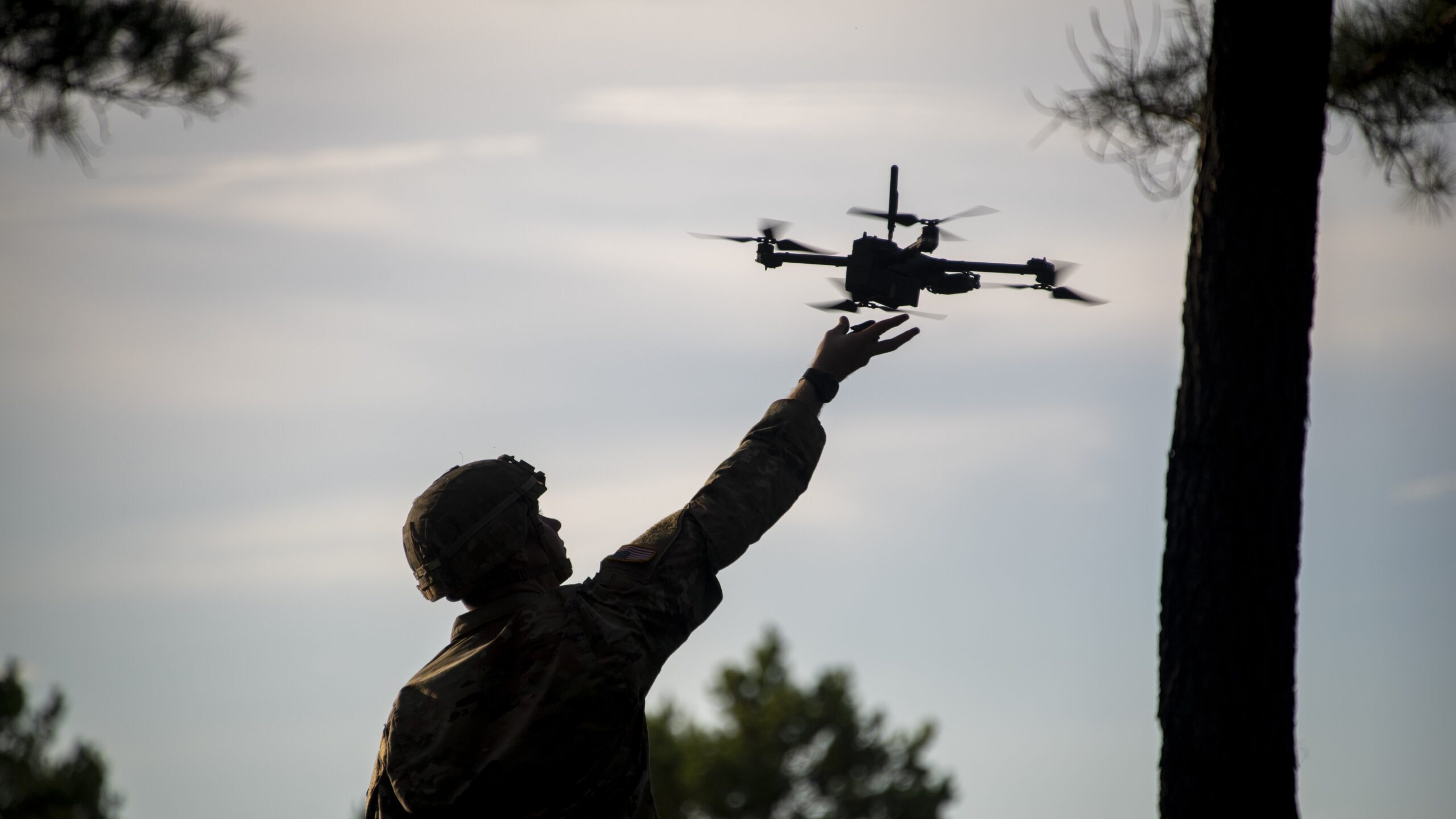
A soldier tests a candidate for the Army’s Short-Range Reconnaissance (SRR) drone in 2020 (photo by Mr. Tad Browning, US Army Operational Test Command)
In fact, many experts and even some Ukrainian combat vets argue that military Medium-Altitude, Long-Endurance (MALE) drones like the famous Predator or the Turkish-built Bayraktar TB2 are just too big and fly too high, making them easy prey for radar-guided anti-aircraft weapons that cannot spot the smaller, lower-flying quadcopters. “Knowing the Russian air defense right now… I’ll give you a 90 percent chance that it will be shot down,” one Ukrainian Air Force officer said last year about the US Army variant of the Predator, the Gray Eagle. “Bayraktar is much cheaper, so it’s okay to lose Bayraktars.”
But even the cheapest model of Bayraktar costs at least $1 million, less than a Predator/Gray Eagle, but about as much as a hundred Skydio X2Ds or 500 Mavic Pros. Of course, these drones have radically different capabilities, with the big MALEs having much longer range and larger payloads. The purpose-built military drones also tend to have some built-in protection against electronic warfare, such as jamming-resistant antennas, alternatives navigation systems for when GPS goes down, or even autonomy software that can fly them without human oversight.
Adding such EW defenses to a much smaller mini-drone, however, runs quickly into limits on weight, power consumption, and cost.
“A DJI drone [is] meant for taking photographs of your pool or filming snowboarders going down the slopes; that’s not meant for fighting sophisticated electronic warfare, [and] at least some of the traditional approaches that you use to overcome jamming, electronic warfare, aren’t going to work very well with these small drones,” said Kallenborn. Better antennas weigh more and take more space, which quadcopters cannot spare; stronger transmitters need more power and drain a quadcopter’s battery faster, reducing already limited flight time.
AI For Drones?
Future advances could let you cram more capability onto a small, cheap platform — especially when it comes to computing power and artificial intelligence. In theory, an AI drone could fly without a live link to a human operator: It could get its instructions before launch, fly itself around the designated area, use object-recognition software to recognize potential targets, and send back brief, compressed and encrypted reports instead of live video.
Even some of today’s DJI drones can already track a designated target, Kallenborn said. But high-end AI currently runs on big, powerful computers — server farms so expensive that ChatGPT loses money with every answer — and wouldn’t fit into a quadcopter-sized digital brain. “Any sophisticated automated intelligence processing would require significant compute that wouldn’t be available on a small drone,” he said, “Autonomy and AI absolutely can help, but given the limits of that capability at the moment, it’s not a silver bullet.”
“AI is unlikely to impact the EW offense vs. drone defense balance in the short term, [and] anything beyond the short term is difficult to speculate on,” agreed Kyle Miller, research analyst at Georgetown University’s Center for Security & Emerging Technologies. “Firstly, the AI, particularly computer vision, models are not at a level of performance… to operate without a constant link to an operator. Secondly, most COTS drones used in Ukraine don’t have enough onboard processing power to effectively run state-of-the-art computer vision models in the first place.”
In fact, while an AI drone would be more resilient against jamming of its control links, it would be just as vulnerable to EW that blinded its sensors — and arguably more vulnerable to hacking, since it would be controlled entirely by complex software. “You would be much more resistant to some types of EW — jamming of [your] datalink — but not necessarily to others,” said Mauro Gilli, a senior research at the Center for Security Studies in Zurich. “As to EW-delivered malicious software… an autonomous system could be more vulnerable than a remotely-controlled one.”
“Definitely, COTS drones are particularly vulnerable to electronic warfare, but any platform that relies on the electromagnetic spectrum for its operation is by definition vulnerable to EW,” Gilli told Breaking Defense. “Effective counter EW is technologically demanding and hence expensive, so it is really a big question as to whether it makes economic sense to make a cheap platform less vulnerable… My sense is that for most COTS drones, the cost is not worth the benefit.”
|
Michael_Novakhov shared this story from |
When it comes to the high-stakes, cloak-and-dagger world of espionage, the CIA isn’t just playing catch-up — they’re leading the charge. If you remember the movie Ant-Man, where Hank Pym whipped up a swarm of tiny, flying ants, you might’ve thought, “Cool, but that’s pure Hollywood.”
Well, not so fast. The tech wizards at the CIA have been busy turning that kind of fantasy into reality, developing some of the tiniest, most sophisticated mini-drones you’ve ever seen. These aren’t just fancy gadgets to show off at spy conventions — they’re game-changers in the world of intelligence gathering.
Picture this: a drone so small it could slip through a crack in your wall or dart down the tightest alleyway, all without anyone giving it a second glance. That’s the kind of innovation we’re talking about. These mini-drones aren’t something you can just pick up at your local electronics store — they’re custom-built for stealth, packed with high-tech cameras, microphones, and sensors that make gathering intel in tight, hard-to-reach places a breeze.
Take the Nano Hummingbird Drone, for example. This little marvel flaps its wings just like a real hummingbird, making it the ultimate undercover spy. It’s small enough to zip through an open window, hover in place, and record everything — all without drawing the slightest bit of attention.
Or think about the Black Hornet Nano, so tiny it fits right in the palm of your hand. Military forces are already using this little wonder to gather critical surveillance in tight urban spaces. Now, just imagine what the CIA could do with something like that — scoping out a high-value target from a distance or mapping out a building’s layout without anyone ever being the wiser. It’s like something straight out of a spy movie, but it’s very real and very effective.
And then there’s the Dragonfly Spy Drone, which is so good at playing nature’s little trickster that it could probably give actual dragonflies a run for their money. This tiny marvel looks just like the real deal, buzzing around without a care in the world — or so it seems. In reality, it’s the perfect urban spy, sneaking up close to a target without raising a single eyebrow.
Now, speaking of undercover agents in the insect world, we can’t forget about the RoboBee. This tiny dynamo is inspired by — you guessed it — bees. And when I say tiny, I mean really tiny. It can fly, hover, and even take a dip if needed, making it a true multitasker in the drone world. Thanks to its minuscule size, the RoboBee can slip into places that would leave even the sneakiest drones scratching their heads. It’s the kind of gadget that would make any spy worth their salt buzz with excitement.
Now, the Piccolissimo proudly holds the title of the world’s smallest self-powered drone. This little guy is so tiny that it can slip through the kind of narrow gaps that would leave bigger drones stuck and frustrated. It’s the perfect spy tool for those tricky situations where a regular-sized drone would stick out like a sore thumb. But don’t let its size fool you — this miniature marvel is packed with enough tech to gather vital reconnaissance data, making it a must-have in any covert ops toolkit.
Picture a high-stakes mission in a crowded urban jungle, where flying anything bigger than a bird would draw too much attention. The target? A suspected terrorist cell holed up in a fortress-like building, right in the middle of a bustling city. Sending in a traditional drone? Not an option — they’d be spotted before they even got close.
But thanks to its ability to navigate through the tightest of spaces, the Piccolissimo managed to slip inside the building through a ventilation duct. Once inside, this pint-sized spy provided live video feeds and gathered crucial intel, helping CIA operatives map out the place and keep tabs on the suspects.
And here’s the kicker: all this real-time data was key in planning a successful raid that took out the bad guys without them ever knowing what hit them. No collateral damage, no alarms raised — just another day at the office for the Piccolissimo.
Another fascinating development is the DelFly Explorer. This little guy looks like a real insect and can also navigate through tight spaces like a pro — perfect for those sneaky indoor surveillance missions. Imagine it zipping around inside a building, gathering all the intel while everyone’s too busy swatting away real bugs to notice!
Now, let’s take a trip down memory lane with the Insectothopter — a vintage CIA creation from the Cold War era. This mechanical dragonfly was one of the agency’s first attempts at building a spy drone. It might’ve flopped in the field due to its unfortunate aversion to windy days (guess even spies have bad weather days), but it’s a quirky bit of history that reminds us that not all top-secret projects are instant hits.
Can you imagine if they’d gotten the Insectothopter right? Every time a dragonfly buzzed by your picnic, you’d wonder if it was after your sandwich… or your secrets!
But wait, there’s more. Enter the Bee-Inspired Drones, currently in development and buzzing with potential. These bad boys are designed to fly in swarms, creating a surveillance network that’s practically unbeatable. They’re like the overachievers of the drone world — small, sneaky, and relentless. So, the next time you see a bug buzzing around, it might be worth giving it a second look. You never know — it could be working overtime to keep the world a little bit safer. Or, you know, it could just be after your sandwich.
These mini-drones are more than just cool gadgets — they’re like the secret agents of the insect world, equipped to do a lot more than just buzz around. In the hands of skilled CIA operatives, they become powerful tools, sneaking into places humans can’t go, gathering crucial intel, and keeping tabs on our enemies in ways that were once pure science fiction.
That dragonfly hovering nearby might just be part of an elite squad on a covert mission, making sure no dark corner of the world is out of reach for the good guys. So, before you swat at that little buzzing intruder, consider this — some of these drones are out there working hard to keep you safe from threats you didn’t even know existed. Who knew the world of espionage could be this tiny, yet mighty?
Robert Morton is a member of the Association of Former Intelligence Officers (AFIO) and authors the ‘Corey Pearson- CIA Spymaster’ series. Check out his latest spy thriller, ‘Mission of Vengeance’.