Categories
Saved Web Pages - Audio Posts

Mueller report sheds new light on how the Russians hacked the DNC and the Clinton campaign

GettyImages-507336192.jpg

The Mueller report contains new information about how the Russian government hacked documents and emails from Hillary Clinton’s presidential campaign and the Democratic National Committee.

At one point, the Russians used servers located in the U.S. to carry out the massive data exfiltration effort, the report confirms.

Much of the information was previously learned from the indictment of Viktor Borisovich Netyksho, the Russian officer in charge of Unit 26165. Netyksho is believed to be still at large in Russia.

But new details in the 488-page redacted report released by the Justice Department on Thursday offered new insight into how the GRU operatives hacked.

The operatives working for the Russian intelligence directorate, the GRU, sent dozens of targeted spearphishing emails in just five days to the work and personal accounts of Clinton Campaign employees and volunteers, as a way to break into the campaign’s computer systems.

The GRU hackers also gained access to the email account of John Podesta, Clinton’s campaign chairman, of which its contents were later published.

Using credentials they stole along the way, the hackers broke into the networks of the Democratic Congressional Campaign Committee days later. By stealing the login details of a system administrator who had “unrestricted access” to the network, the hackers broke into 29 computers in the ensuing weeks, and more than 30 computers on the DNC.

The operatives, known collectively as “Fancy Bear,” comprised several units tasked with specific operations. Mueller formally blamed Unit 26165, a division of the GRU specializing in targeting government and political organizations, for taking on the “primary responsibility for hacking the DCCC and DNC, as well as email accounts of individuals affiliated with the Clinton Campaign,” said the Mueller report.

The hackers used Mimikatz, a hacking tool used once an intruder is already in a target network, to collect credentials, and two other kinds of malware: X-Agent for taking screenshots and logging keystrokes, and X-Tunnel used to exfiltrate massive amounts of data from the network to servers controlled by the GRU. Mueller’s report found that Unit 26165 used several “middle servers” to act as a buffer between the hacked networks and the GRU’s main operations. Those servers, Mueller said, were hosted in Arizona — likely as a way to obfuscate where the attackers were located but also to avoid suspicion or detection.

In all, some 70 gigabytes of data were exfiltrated from Clinton’s campaign servers and some 300 gigabytes of data were obtained from the DNC’s network.

Meanwhile, another GRU hacking unit, Unit 74455, which helped disseminate and publish hacked and stolen documents, pushed the stolen data out through two fictitious personas. DCLeaks was a website that hosted the hacked material, while Guccifer 2.0 was a hacker-like figure who had a social presence and would engage with reporters.

Under pressure from the U.S. government, the two GRU-backed personas were shut down by the social media companies. Later, tens of thousands of hacked files were funneled to and distributed by WikiLeaks.

Mueller’s report also found a cause-and-effect between Trump’s remarks in July 2016 and subsequent cyberattacks.

“I hope you’re able to find the 30,000 emails that are missing,” said then-candidate Trump at a press conference, referring to emails Clinton stored on a personal email server while she headed the State Department. Mueller’s report said “within approximately five hours” of those remarks, GRU officers began targeting for the first time Clinton’s personal office.

More than a dozen staffers were targeted by Unit 26165, including a senior aide. “It is unclear how the GRU was able to identify these email accounts, which were not public,” said Mueller.

Mueller said the Trump campaign made efforts to “find the deleted Clinton emails.” Trump is said to have privately asked would-be national security advisor Michael Flynn, since convicted following inquiries by the Special Counsel’s office, to reach out to associates to obtain the emails. One of those associates was Peter Smith, who died by suicide in May 2017, who claimed to be in contact with Russian hackers — claims which Mueller said were not true.

Does that implicate the Trump campaign in an illegal act? Likely not.

“Under applicable law, publication of these types of materials would not be criminal unless the publisher also participated in the underlying hacking conspiracy,” according to Elie Honig, a CNN legal analyst. “The special counsel’s report did not find that any person associated with the Trump campaign illegally participated in the dissemination of the materials.”

Categories
Saved Web Pages - Audio Posts

2016 Presidential Campaign Hacking Fast Facts

w_800

Here’s a look at hacking incidents during the 2016 presidential race between Donald Trump and Hillary Clinton. For details about investigations into hacking and efforts to interfere with the election, see 2016 Presidential Election Investigation Fast Facts.

September 2015 – The FBI contacts the Democratic National Committee’s help desk, cautioning the IT department that at least one computer has been compromised by Russian hackers. A technician scans the system and does not find anything suspicious.

November 2015 – The FBI reaches out to the DNC again, warning them that one of their computers is transmitting information back to Russia. DNC management later says that IT technicians failed to pass along the message that the system had been breached.

March 19, 2016 – Hillary Clinton’s campaign chairman John Podesta receives a phishing email masked as an alert from Google that another user had tried to access his account. It contains a link to a page where Podesta can change his password. He shares the email with a staffer from the campaign’s help desk. The staffer replies with a typo – instead of typing “This is an illegitimate email,” the staffer types “This is a legitimate email.” Podesta follows the instructions and types a new password, allowing hackers to access his emails.

April 2016 – Hackers create a fake email account and use it to send spear-phishing emails to more than thirty Clinton staffers, according to investigators. In the emails, the hackers embed a link purporting to direct the recipient to a document titled “hillaryclinton-favorable-rating.xlsx.” The link directs the recipients’ computers to a website operated by the hackers. That same month, hackers use stolen credentials to access the Democratic Congressional Campaign Committee computer network, stealing data with malware. They ultimately access 33 DNC computers and anonymously register a website called DC Leaks to publicize the release of documents.

May-June 2016 – The hackers steal thousands of emails from the DNC server and begin to conceal their efforts.

June 12, 2016 – During an interview on British television, WikiLeaks founder Julian Assange says that the website has obtained and will publish a batch of campaign emails.

June 14, 2016 – The Washington Post reports hackers working for the Russian government accessed the DNC’s computer system, stealing oppositional research on Trump and viewing staffers’ emails and chat exchanges. The Kremlin, however, denies that the government was linked to the hack and a US official tells CNN that investigators have not yet concluded that the cyberattack was directed by the Russian government.

June 15, 2016 – Crowdstrike, a cybersecurity firm hired by the DNC, posts a public notice on its website describing an attack on the political committee’s computer network by two groups associated with Russian intelligence. According to the post, two groups called “Cozy Bear” and “Fancy Bear” tunneled into the committee’s computer system. In response, the hackers create a persona called Guccifer 2.0, a self-described Romanian blogger who claims that he alone conducted the theft.

July 22, 2016 – Days before the Democratic National Convention, WikiLeaks publishes nearly 20,000 emails hacked from the DNC server. The documents include notes in which DNC chair Debbie Wasserman Schultz insults staffers from the Bernie Sanders campaign as well as messages that suggest the organization was favoring Clinton rather than remaining neutral. Wasserman Schultz resigns as DNC chair in the aftermath of the leak.

July 25, 2016 – The FBI announces it has launched an investigation into the hack. Officials tell CNN they think the cyberattack is linked to Russia.

July 27, 2016 – During a press conference, Trump talks about Clinton’s use of a private email server while she was secretary of state and calls on hackers to find deleted emails. “Russia, if you’re listening, I hope you’re able to find the 30,000 emails that are missing,” says Trump. Newt Gingrich, a Trump surrogate, defends Trump in a Tweet, dismissing the comment as a “joke.”

August 12, 2016 – Hackers publish cell phone numbers and personal email addresses for Nancy Pelosi and members of the Democratic Congressional Campaign Committee.

September 1, 2016 – During an interview with Bloomberg News, Russian President Vladimir Putin says that he and the Russian government have no ties to the hackers. He says that the identity of the culprit or culprits is not as important as the content of the leaks and ultimately the hackers have revealed important information for voters.

September 22, 2016 – Democrats Dianne Feinstein and Adam Schiff, ranking members of the Senate and House Intelligence Committees, issue a joint statement declaring that based on information they received during congressional briefings, they believe Russian intelligence agencies are carrying out a plan to interfere with the election. They call on Putin to order a halt to the activities.

September 26, 2016 – During a presidential debate, Trump questions whether the DNC cyberattack was carried out by a state-sponsored group or a lone hacker. “It could be Russia, but it could also be China. It could also be lots of other people. It also could be somebody sitting on their bed that weighs 400 pounds.”

October-November 2016 – Over the course of a month, WikiLeaks publishes more than 58,000 messages hacked from Podesta’s account.

October 6, 2016 – DC Leaks publishes a batch of documents stolen from Clinton ally Capricia Marshall.

October 7, 2016 – The Department of Homeland Security and the Office of National Intelligence on Election Security issue a statement declaring that the intelligence community is “confident that the Russian Government directed the recent compromises of emails from US persons and institutions.” According to the statement, document releases on websites WikiLeaks and DCLeaks mirror the methods and motivations of past Russian-directed cyberattacks.

November 29, 2016 – Democratic senators send a letter to President Barack Obama calling on intelligence agencies to declassify information about “the Russian Government and the US election.” Sources later tell CNN that new intelligence has been shared with lawmakers suggesting that Russia’s purpose for meddling in the election was to sway voters towards Trump, rather than broadly undermining confidence in the system.

December 9, 2016 – The Washington Post reports the CIA has determined that Russian hacking was conducted to boost Trump and hurt Clinton. The Trump transition team dismisses the report and criticizes the CIA. Obama asks intelligence agencies to review the hacking incidents and other cyberattacks on political campaigns dating back to 2008. The agencies are asked to deliver their findings before Obama leaves office on January 20. A Russian foreign ministry spokesman expresses skepticism about the review and asks US investigators to share their evidence of government-sponsored cyber espionage.

December 10, 2016 – John McCain, Chuck Schumer, Lindsey Graham and Jack Reed issue a joint statement calling on Congress to work on securing future elections and stopping cyberattacks.

December 11, 2016 – Sources tell CNN that although US intelligence agencies share the belief that Russia played a role in the computer hacks, there is disagreement between the CIA and the FBI about the intent of the meddling. While the CIA assessment shows that the Russians may have sought to damage Clinton and help Trump, the FBI has yet to find proof that the attacks were orchestrated to elect the Republican candidate, according to unnamed officials. Furthermore, some sources say the hackers also infiltrated the Republican National Committee’s computers.

December 12, 2016 – CNN reports that Russian hackers accessed computer accounts of Republican lawmakers and GOP organizations. A source with knowledge of the investigation says that even though hackers breached the GOP computers, they opted not to release documents.

December 13, 2016 – The New York Times publishes a detailed account of the DNC’s delayed response to initial warnings in September of 2015 that its network had been infiltrated by hackers. The report outlines how phishing emails and communication failures led to a sweeping cyberattack. The story also lays out evidence that Guccifer 2.0 and DCLeaks were linked to Russia. A second article in the Times chronicles the hacking of the DCCC. According to the report, Guccifer 2.0 stole tens of thousands of documents and offered them to reporters in districts where Democratic candidates were engaged in competitive races for House seats.

December 29, 2016 – Obama issues an executive order with sanctions against Russia. The order names six Russian individuals who allegedly took part in the hacking. Additionally, 35 Russian diplomats are ordered to leave the United States within 72 hours.

January 3, 2017 – Assange says that the Russian government did not provide him with the hacked DNC emails during an interview with Sean Hannity on the Fox News Channel.

January 3-4, 2017 – In a series of tweets, Trump questions the US intelligence community’s claims that the Russian government interfered with the election. He alleges that intelligence officials have delayed a scheduled meeting with him but sources tell CNN that there has been no change to the schedule. Trump also cites Assange’s interview to back his assertion that a rogue hacker, not the Russian government, may have meddled in the election.

January 5-6, 2017 – Intelligence officials meet separately with Obama and Trump to present the results of their probe into cyber espionage during the presidential campaign. After the president and the president-elect are briefed, the Office of the Director of National Intelligence releases a declassified version of its classified report on Russian meddling. According to the report, hackers did not breach voting machines or computers that tallied election results but Russians meddled in other ways. Putin ordered a multifaceted influence campaign that included spreading pro-Trump propaganda online and hacking the DNC and Podesta, according to the report. Bracing for a possible Clinton win, Russian bloggers were prepared to promote a hashtag #DemocracyRIP on election night. Paid social media users shared stories about Clinton controversies to create a cloud of scandal around her campaign.

January 6-7, 2017 – Trump issues a statement after his meeting with intelligence officials. In the statement, he acknowledges that the Russian government may have been linked to the DNC hacking but declares that cyberattacks did not impact the outcome of the election because voting machines were not breached. In a series of tweets, he repeats that hacking did not affect election results and says that he wants to improve relations with Russia.

March 10, 2017 – In an interview with the Washington Times, Trump ally Roger Stone says that he had limited interactions via Twitter with Guccifer 2.0 during the campaign. He says the exchanges were “completely innocuous.” The following day, the New York Times publishes its own interview with Stone, in which he says that his communication with Guccifer 2.0 took place after the DNC hack, proving there was no collusion with the Trump campaign to arrange the cyberattack.

May 17, 2017 – Deputy Attorney General Rod Rosenstein appoints former FBI Director Robert Mueller as special counsel to lead an investigation into Russian interference and related matters that could result in criminal prosecutions.

June 1, 2017 – In public remarks, Putin says that hacking may have been carried out by patriotic Russian citizens who felt compelled to respond to perceived slights against Russia from America. Putin says, however, that the Russian government played no role in the cyberattacks. During an interview days later, Putin says that a child could have easily committed the hacking.

June 5, 2017 – The Intercept posts a report that the Russian government coordinated a spear-phishing attack on computers at an American voting machine company and compromised at least one email account. The article is based on an NSA memo that was leaked to the Intercept. Hours after the story is published, the source of the leak is identified as a government contractor named Reality Leigh Winner, 25. She is charged with transmitting classified information.

June 21, 2017 – During a Senate hearing, a Department of Homeland Security official says that hackers linked to the Russian government targeted voting systems in up to 21 states.

July 25, 2017- A bipartisan bill limiting Trump’s power to ease sanctions against Russia passes in the House by a 419-3 vote. The measure also imposes new sanctions on North Korea and Iran.

July 27, 2017 – The Russia sanctions bill passes in the Senate 98-2. White House communications director Anthony Scaramucci tells CNN that the president may veto the bill and negotiate a tougher deal.

July 30, 2017 – Putin announces that 755 employees at US diplomatic missions in Russia will be ousted from their posts in response to sanctions.

August 2, 2017 – Trump says the Russia sanctions bill is “seriously flawed” but he signs it anyway.

September 6, 2017 – In a blog post, Facebook announces that more than 3,000 advertisements posted on the social network between June 2015 and May 2017 were linked to Russia. The Washington Post reports that the ads came from a Russian company called the Internet Research Agency.

September 22, 2017 – The DHS notifies select states that hackers targeted their election infrastructure before the vote on November 8, 2016. Although vote-counting systems were not impacted, computer networks containing voter info may have been scanned by Russian hackers. Some states reported attempts to infiltrate their computer systems.

October 3, 2017 – CNN reports that a number of the Russia-linked Facebook ads were geographically targeted to reach residents of Michigan and Wisconsin. Trump defeated Clinton by a narrow margin in both battleground states.

October 12, 2017 – CNN publishes an investigation of Russian trolls who posed as a group of Black Lives Matter activists during the presidential campaign. They used a variety of platforms including Tumblr and Pokemon Go to reach voters.

February 16, 2018 – The Department of Justice announces that Mueller has indicted 13 Russian nationals and three Russian entities for allegedly meddling in the 2016 election, charging them with conspiracy to defraud the United States.

July 3, 2018 – The Senate Intelligence Committee releases a report concluding that the intelligence community’s January 2017 assessment of election meddling was accurate. According to the summary, the intelligence agencies were correct in their finding that the goal of the election interference was to help Trump rather than simply create confusion.

July 13, 2018 – The Justice Department announces indictments against 12 members of the Russian intelligence agency, GRU, as part of Mueller’s ongoing investigation. The indictment accuses the Russians of engaging in a “sustained effort” to hack emails and computer networks associated with the Democratic party during the 2016 presidential campaign.

July 16, 2018 – During a joint press conference with Putin in Helsinki, Trump says that the Russian president was “extremely strong and powerful” in his denial that his country interfered with the 2016 election. Trump says, “I don’t see any reason why it would be Russia.” One day later, he clarifies his remark. “The sentence should have been, ‘I don’t see any reason why it wouldn’t be Russia,’” Trump says. “Sort of a double negative.”

March 22, 2019 – Mueller ends his investigation and delivers his report to Attorney General William Barr. A senior Justice Department official tells CNN that there will be no further indictments.

April 18, 2019 – A redacted version of Mueller’s report is released. The first part of the 448-page document details the evidence gathered by Mueller’s team on coordination and explains his decision not to charge individuals associated with the campaign.

July 25, 2019 – The Senate Intelligence Committee releases the first installment of its report, entitled “Russian Active Measures Campaigns and Interference in the 2016 Election: Volume 1: Russian Efforts Against Election Infrastructure.”

October 8, 2019 – The Senate Intelligence Committee releases the second volume of its report on election interference. The report is critical of the FBI for using a contractor to monitor foreign influence operations. “The apparently outsourced nature of this work is troubling; it suggests FBI either lacked resources or viewed work in this vein as not warranting more institutionalized consideration.”

November 2, 2019 – CNN and Buzzfeed begin receiving interview notes from the Mueller investigation, released by court order. It’s revealed that Trump and other top 2016 Trump campaign officials repeatedly privately discussed how the campaign could get access to stolen Democratic emails WikiLeaks had in 2016.

February 6, 2020 – The Senate Intelligence Committee releases the third volume of its report on election interference. The committee writes that the Obama administration struggled in its reaction to initial reports of Russia’s actions. Several recommendations are directed to President Trump.

April 21, 2020 – The Senate Intelligence Committee releases the fourth volume of its report on election interference. It includes new details on why the committee backs the US intelligence community’s conclusion that Russia interfered in the 2016 presidential election to help then-candidate Trump. It warns that Russia is likely to try to interfere in the 2020 election.

August 18, 2020 – The Senate Intelligence Committee releases the fifth volume of its report on election interference. This report goes beyond the findings Mueller released in 2019, as the Republican-led Senate panel was not limited by questions of criminality that drove the special counsel probe. Among its findings is how Trump and multiple leaders on his campaign spoke with Stone throughout 2016 about reaching out to WikiLeaks and using leaks of Democratic emails to Trump’s advantage.

April 15, 2021 – President Joe Biden’s administration reveals new details about Russia’s extensive interference in the 2016 and 2020 US elections, including disclosing for the first time that a Russian agent who received internal polling data from the Trump campaign in 2016 passed it along to Russia’s intelligence services.

July 28, 2022 – The State Department announces a reward of up to $10 million for knowledge on foreign attempts to interfere in US elections. The department also appeals for information on the Internet Research Agency and other entities and individuals who interfered in the 2016 presidential election.

Categories
Saved Web Pages - Audio Posts

What the Latest Mueller Indictment Reveals About WikiLeaks’ Ties to Russia—and What It Doesn’t

Khatchadourian-Wikileaks-.jpg

When did Russian intelligence give WikiLeaks the e-mails that it hacked from the Democratic National Committee and John Podesta, and how did it transmit them? Shortly after the election, James Clapper, then the director of National Intelligence, testified before Congress that American intelligence officials could not clearly pinpoint these facts. “We don’t have good insight into the sequencing of the releases, or when the data may have been provided,” he said. Today, almost two years later, and after months of investigation, we know a lot more than we once did. But our insight into the timing—at least from publicly available information—remains uncertain.

The latest indictment issued by Robert Mueller, the special counsel, charged twelve members of the G.R.U., Russia’s military-intelligence directorate, with hacking and disseminating Democratic e-mails and other files during the election. It is a highly detailed document, in many ways remarkable. In it, we learn, for instance, that Western intelligence officers had penetrated the G.R.U. so thoroughly that they could track the keystrokes of individual Russian operatives at their desks in a Moscow building. We learn that these G.R.U. staff members essentially Googled vulnerabilities in the Democratic Congressional Campaign Committee before hacking into it. We learn that, from within the D.C.C.C., the G.R.U. hackers moved into the D.N.C. We learn that D.N.C. data were relayed to an American server in Illinois as they were being exfiltrated. We learn that G.R.U. officers used cryptocurrency to pay people around the world to provide things that the operation required—domain names, access to virtual private networks (V.P.N.s). The indictment may only be an accusation, but it hints at the remarkably granular forensic intelligence that has been gathered.

The over-all picture that the indictment offers of the “WikiLeaks connection,” as Clapper once put it, is entirely consistent with previous intelligence assessments, which said that the G.R.U. provided Julian Assange, the editor of WikiLeaks, with the D.N.C. and Podesta archives. But, at the level of evidence, the indictment offers a strange mix: tantalizing, fragmentary new details that suggest the when and how without quite revealing everything that happened.

Indictments are not the same as intelligence reports. They are sometimes intentionally written ambiguously, to give prosecutors flexibility in the way they decide to prove their case—emphasizing the strongest links in an argument while implying a bigger picture. It is likely that the charged G.R.U. officers will never face trial, but Mueller may still want to retain flexibility, given that his investigation is ongoing. It is also conceivable that this document was rushed out before Trump’s summit with the Russian President, Vladimir Putin. Herein lies the complication in using this to advance what we know. We can see only bits.

The “active measures” portion of the chronology in the indictment—including, by implication, the transmission of files to WikiLeaks—emerges for the first time in an early paragraph, under Count One, the charging of G.R.U. officers for conspiring to commit an offense against the United States:

6. Beginning in or around June 2016, the Conspirators staged and released tens of thousands of the stolen emails and documents. They
did so using fictitious online personas, including “DCLeaks” and
“Guccifer 2.0.
”

To make sense of these two sentences, a bit of context is necessary. In 2016, the G.R.U. began a spear-phishing campaign that targeted hundreds of Democratic operatives. People affiliated with Hillary Clinton were targeted as early as March 10th. Podesta, her campaign’s chairman, was targeted nine days later, and his e-mails were stolen on March 21st. The G.R.U. created multiple false online identities to aid its work. By April, it began to set up a mechanism to publish hacked material, a Web site called DCLeaks, purportedly run by American “hacktivists.” The site went live on June 8th, after Clinton became the presumptive Democratic nominee, and published tens of thousands of e-mails from at least seven Clinton-campaign staffers, along with other American officials. Seven days later, the G.R.U. created Guccifer 2.0, which never released e-mails in bulk but published on WordPress, in June, screenshots of a Clinton-related e-mail that were so blurry they were unreadable. By then it is also conceivable that the G.R.U. was releasing material to intermediaries: e-mails that were not yet public but were on their way to becoming so.

How WikiLeaks enters into this behavior is unclear. But, in the following paragraph, the indictment notes that the G.R.U. relayed an apparently different archive to Assange, explicitly through Guccifer 2.0:

7. The Conspirators also used the Guccifer 2.0 persona to release additional stolen documents through a website maintained by an
organization (“Organization 1”)
.

These two sections, together, suggest two separate acts: one, the staging and releasing of tens of thousands of e-mails starting in June; two, using Guccifer 2.0 to release documents to WikiLeaks.

What were those other documents?

It is worth taking a closer look at what happened in the spring and summer of 2016 to understand how the indictment’s sequence of facts and allegations leaves open some intriguing possibilities. On April 18th, the G.R.U. hacked the D.N.C. computers, and began to extract gigabytes’ worth of files, including opposition research, but it did not penetrate the D.N.C.’s Microsoft Exchange Server, to access its e-mails, until later. The indictment argues that the e-mails were stolen at some point between May 25th and June 1st.

What happens next seems significant. By June 1st, the G.R.U. was already in possession of tens of thousands of Clinton-campaign e-mails, including Podesta’s. It had gained access to the D.N.C. e-mails. It had just initiated steps to begin publishing hacked material, on DCLeaks. Then, on June 12th, four days after DCLeaks went live, Assange gave an interview to Britain’s ITV, in which he declared, “We have upcoming leaks in relation to Hillary Clinton, which is great. WikiLeaks has a very big year ahead.” A bit later in the interview, he added, “We have e-mails related to Hillary Clinton which are pending publication.”

At the time, the G.R.U. hacking operation had not been publicly exposed, and Assange had no reason to suspect that this admission would take on any special significance. What he could not have known was that the D.N.C. was quietly trying to address the G.R.U. hack. It had hired a cyber-security firm, CrowdStrike, to purge the Russian operatives from its computers. To manage the story, it had invited in the Washington Post, which published an article on June 14th disclosing the breach. The Mueller indictment describes in detail Moscow’s response to this news: G.R.U. officers “created the online persona Guccifer 2.0,” apparently rushing to mask the hacking operation by promoting the idea that the culprit was a lone Romanian hacker. As they scrambled, they looked up English translations for phrases that could be attributed to their imaginary hacker. Work on the persona, it appears, was finished within hours.

The G.R.U. gave Guccifer 2.0 a WordPress Web page, where, on June 15th, it introduced itself and began posting material that it claimed was hacked from the D.N.C. but which, in fact, appears to be drawn from earlier hacks of Clinton officials. Almost immediately, the Web site, in both its tone and content, attracted skepticism. It looked just like what it was: a hastily built Russian construct. It is still unclear if the many tells were left there out of sloppiness, or by design—an artifact of state-sponsored trolling.

On June 18th, Guccifer 2.0 released twenty documents on WordPress, which it said were from the D.N.C. but which were almost surely not. Two days later, it teased a “dossier on Hillary Clinton from DNC,” which was nothing of the sort. It implied that it was on a mission to release much more. Then, after establishing itself as a hacker with tons of material, Guccifer 2.0 began giving interviews—most notably on Vice’s Motherboard blog—and on June 22nd it invited people to write to it: “I’d like journalists to send me their questions via Twitter Direct Messages.”

That same day, WikiLeaks sent a private message to Guccifer 2.0, presumably over Twitter, saying, “Send any new material here for us to review and it will have a much higher impact than what you are doing.” (Assange later made a nearly identical pitch to Emma Best, a journalist he thought might publish a trove of Guccifer 2.0 material, urging her to route the information to him instead, because the WikiLeaks platform would make it easier to peruse: “Impact is very substantially reduced if the ‘news’ of a release doesn’t coincide with the ability to respond to the news by searching.”) He told Guccifer 2.0 that he hoped to publish before the Democratic National Convention, and he indicated that he had a specific interest—the “conflict between bernie and hillary.”

Throughout late June, the indictment notes, Guccifer 2.0 tried but failed to send an archive of “DNC documents” to WikiLeaks. The reasons for the failures—whether technical, organizational, or personal—are unstated. Coördinating with Assange is not easy. (When I interviewed him last year, he told me, “We had these hiccups that delayed us, and we were given a little more time.”) Finally, on July 14th, Guccifer 2.0 sent WikiLeaks an encrypted attachment that, according to the indictment, contained “instructions on how to access an online archive of stolen DNC documents.” Four days later, WikiLeaks confirmed that it had accessed the archive and claimed that it would release the material that week. Then, on July 22nd, Assange began publishing the D.N.C. “emails and other documents,” as the indictment notes, perhaps a reference to attachments. It also says that WikiLeaks “did not disclose Guccifer 2.0’s role in providing them.” This last statement suggests that WikiLeaks obtained the D.N.C. e-mails from Guccifer 2.0 in the summer, at some point after July 14th—although a legalistic gloss on “role” leaves open the possibility that Guccifer 2.0 provided only some D.N.C. material, such as copies of documents that were also attached to D.N.C. e-mails.

So did the G.R.U. use the Guccifer 2.0 persona to relay e-mails to WikiLeaks in the summer of 2016? Or did it provide them to Assange by some other means much earlier, in the spring?

Let’s look back at the chronology. On June 12th, three days before the creation of Guccifer 2.0, Assange announced that he had a substantial trove of Clinton-related e-mails that were pending publication. Likewise, Guccifer 2.0 proclaimed, on its very first post on the WordPress site, “The main part of the papers, thousands of files and mails, I gave to Wikileaks. They will publish them soon.” Again and again, the G.R.U. officers tried to drive home this point—which, of course, was evidently the main point of creating the persona. “I sent a big part of docs to WikiLeaks,” Guccifer 2.0 told the editor of the Smoking Gun that same day. On June 17th, Guccifer 2.0 said in another e-mail, “I gave WikiLeaks the greater part of the files.” (For e-mail, the G.R.U. gave Guccifer 2.0 another fake identity: Stephan Orphan.)

In other words, both the G.R.U. and Assange appear to have confessed to the transmission and reception of a large trove of Clinton-related e-mails in mid-June, before Guccifer 2.0 was apparently created. The indictment does not address this. There is no way to say precisely what that trove was—if it was the Podesta archive given to WikiLeaks much earlier than is generally presumed, or the D.N.C. e-mails, or both, or something else. (There is also the possibility that both parties were not speaking truthfully.) But, if Assange did have the D.N.C. e-mails before Guccifer 2.0 was created, then the details in the indictment take on new meaning. Some version of the following may be true: it is mid-June, with the convention approaching, and Assange is about to release a bombshell, when he notices the sudden appearance of Guccifer 2.0, a “hacker” edging into his turf, inviting journalists to write in. So he writes in, asking for material that interests him. He has already gone through the D.N.C. e-mails and has recognized that the trove highlights conflict within the Democratic Party. He signals that he wants more on that specific issue. The G.R.U. is happy to comply, through its new cutout. Perhaps some of it overlaps with what the G.R.U. already provided, making Guccifer 2.0’s confessions literally accurate. Perhaps it is the same irrelevant dross that Guccifer 2.0 fed to others.

Last year, I visited Assange several times in the Ecuadorian Embassy in London. He often emphasized to me that the sourcing of his election publications was complex. I usually took this as a dodge. But the sourcing may indeed have been multilayered. There are many conceivable ways that G.R.U. officers could have provided e-mails to WikiLeaks before they created Guccifer 2.0. They could have used the WikiLeaks anonymous-submission system. They could have used a different fictitious online persona. They could have used a human intermediary. Last year, James Clapper told me, “It was done by a cutout, which of course afforded Assange plausible deniability.” In January, 2017, Clapper oversaw a formal intelligence assessment on Russian meddling. At the time, more than one news organization reported that a classified version of the assessment made clear that the intermediaries between the G.R.U. and WikiLeaks were already known. (Certainly, the intelligence community would also have been in possession of Guccifer 2.0’s Twitter D.M.s at that time, too.) One intelligence official, describing the report, indicated to Reuters last year that the e-mails relayed to WikiLeaks had followed a “circuitous route,” by a series of handoffs, on their journey from Moscow. Such a scenario seems to be at odds with the idea that Guccifer 2.0 merely sent WikiLeaks an encrypted link to download it all in one swoop.

If the hacked e-mails had been provided in this way, to Assange in June, one can imagine a nearly slapstick scenario, in which he was receiving G.R.U. material from two different sources: once at the source’s instigation, and once at his own, receiving one tranche that he published and one that he did not. In our chats in the embassy, Assange sometimes offered hints. One evening, I asked him if he had released all of the election-related records that he had received. He looked up at the ceiling, thought for a long while, then spoke extremely slowly, stopping and starting: “We published everything that we received about the election that could be verified before the election—everything that was not already published that we could authenticate.”

I asked, What percentage did you hold back?

“We received quite a lot of submissions, of material that was already published in the rest of the press, and people seemingly submitted the Guccifer archives. We didn’t publish them. They were already published.”

Why not add them to the WikiLeaks library, to insure that they would not be taken down, and also to enrich the exclusive Democratic e-mails that WikiLeaks was putting online—to make the archive more complete?

“We might have done that. But the material from Guccifer 2.0—or on WordPress—we didn’t have the resources to independently verify.”

Assange, cut off from the Internet in the Embassy, has been unable to respond to the latest Mueller indictment. But, whenever Guccifer 2.0 came up in our conversations, he seemed uncomfortable and frustrated. In 2016, with the subject often in the news, he developed a canned P.R. maneuver to questions about the persona. He strove to convey (falsely) that the WikiLeaks publications and the Guccifer 2.0 publications had no overlap, and that therefore it was unfair to conflate the two. “It’s an incredible crunching together of these two archives,” he said. In February, 2017, Assange told me that any purported connection between the D.N.C. hack, Guccifer 2.0, and WikiLeaks was the result of “guesswork.”

Two months later, at the Embassy, I asked Assange what he thought Guccifer 2.0 was. Previously, he had been asked about the persona and its publications, and he had said, “Now, who is behind these, we don’t know. These look very much like they’re from Russians. But in some ways they look very amateur, and almost look too much like the Russians.” Once, he had casually implied to me that he thought Ukrainian operatives might be running the persona; he had also tried to steer people to the view that it was controlled by genuine Eastern European activists. Now I was asking directly what he thought, and he tensed up. “I have to think whether that limits any possibilities,” he told me. “I don’t—I don’t want to comment on the record.” I said that I did not understand why he needed the secrecy: if Guccifer 2.0 had no connection to WikiLeaks, then why not merely speak about it on the record, as an analyst would? Rather than elaborate, he told me, “I think we have already said that Guccifer 2.0 is not our source.”

I looked into it, and I could not find an instance when Assange had said such a thing. What he did say is that he did not receive the e-mails from the Kremlin; as he told Sean Hannity, on Fox News, “Our source is not the Russian government, and it is not a state party.” It is hard to know how he could say such a thing definitively, especially since the G.R.U. frequently worked through fronts, but when I asked him if he knew the full chain of custody of the e-mails he abruptly told me, “I’m not going into sourcing.”

In August of last year, Assange and I returned to the subject. I told him that I could not find his previous denial about Guccifer 2.0, and asked him if he would be willing to make one unambiguously.

“It’s bad form to rule people out,” he told me. Then Assange invoked a strange, transitive argument: because he had already declared that his source was not a state, he was willing to deny that Guccifer 2.0 was his source only in a context in which the persona was being defined as a state-run entity. Clearly, whether or not WikiLeaks received material from Guccifer 2.0’s handlers had nothing to do with how it was defined; he either had obtained the e-mails from the entity or he had not. So I gave him the following menu to choose from:

  1. Julian Assange has no comment on whether the D.N.C. e-mails that
    WikiLeaks published came from Guccifer 2.0.

  2. Julian Assange denies that the D.N.C. e-mails that WikiLeaks
    published came from Guccifer 2.0.

A) Julian Assange has no comment on whether the Podesta e-mails that
WikiLeaks published came from Guccifer 2.0.

B) Julian Assange denies that the Podesta e-mails that WikiLeaks
published came from Guccifer 2.0.

“Please just pick one letter and one number,” I said. He picked none, telling me instead, “I understand the political value to WikiLeaks in a denial. I also understand that if one day someone is arrested for being our source they may want to preserve the Guccifer 2.0 option.” In other words, he did not want to publicly rule out the persona as a source, because he wanted to give a hypothetically accused third party plausible deniability, since Guccifer 2.0 had claimed to be his source. (When he realized that I was ready to publish this, he tried to retroactively pull it off the record.) After kicking around other possible responses, all of them vague, he returned to his original, a denial contingent on how one defined the persona: “If there is a claim that Guccifer 2.0 is a state officer, then it’s easy to give a no answer without giving away more information.”

Categories
Saved Web Pages - Audio Posts

Why didn’t the Obama administration do more about Russian hacks?

161007-obama-putin-mbe-357p.jpg

The Obama administration didn’t respond more forcefully to Russian hacking before the presidential election because they didn’t want to appear to be interfering in the election and they thought that Hillary Clinton was going to win and a potential cyber war with Russia wasn’t worth it, multiple high-level government officials told NBC News.

“They thought she was going to win, so they were willing to kick the can down the road,” said one U.S official familiar with the level of Russian hacking.

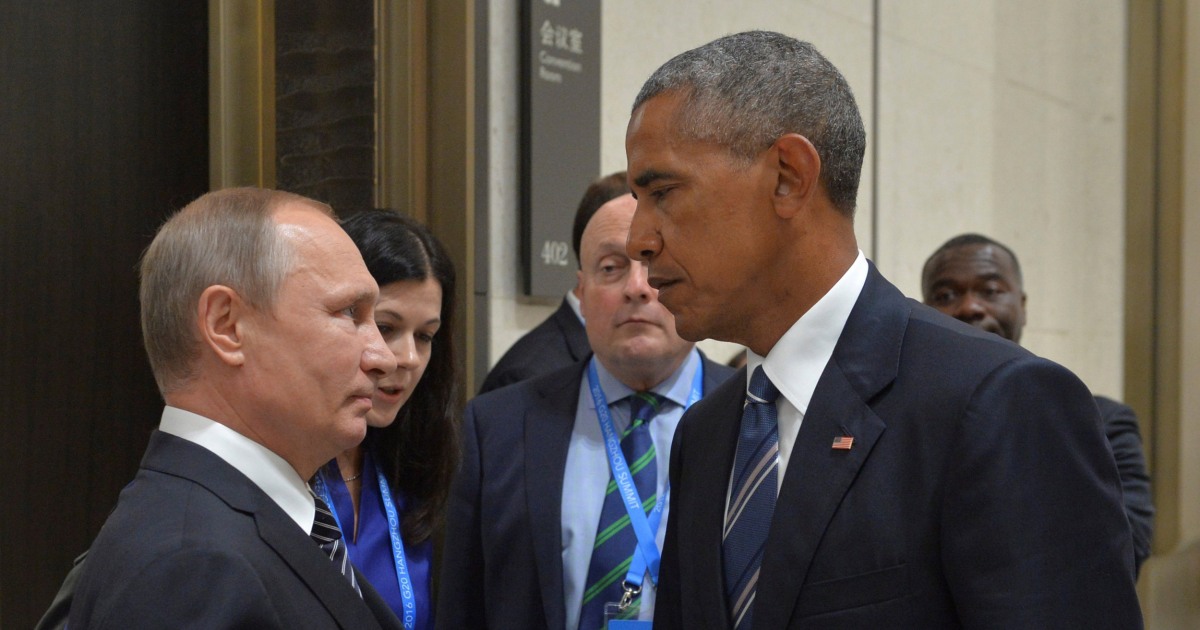
The administration did take action in response to the hack prior to the election. In September, President Obama privately confronted Vladimir Putin about the hacks at the G-20 summit in China. He warned the Russian President of unspecified consequences if the hacks continued.

On Oct. 7, the Department of Homeland Security and the Office of the Director of National Intelligence issued an unprecedented joint statement pointing the finger at Russia, saying hacks of U.S. political groups and individual politicians could only have been done with the authorization of “Russia’s senior most” officials and that its intent was to undermine the integrity of the election.

Democrats and Republicans alike have criticized the Obama administration for not being more forceful.

“I think it is a legitimate question and I think given the stakes at the national level the question deserves an answer,” said retired Adm. James Stavridis when asked by NBC News about the level of the administration’s response. “In retrospect it certainly seems as though it was a mistake not to call the Russians sooner and respond to them in a very forceful way.”

Click Here to Read the Exclusive NBC News Report on Putin’s Involvement in the Hack

An administration official, in turn, criticized the news media for focusing more on the leaked documents than on the Russian covert operation that hacked into political entities to steal the documents.

Administration officials pointed out that the day the intelligence assessment was made public was the same day a tape was leaked revealing Trump’s lewd conversation with Billy Bush. Eleven days later, at an October press conference, Obama was not asked a single question about the Russian hacks.

“We used the same playbook we did with Sony,” an administration official said, referring to the North Korean cyber attack on the Hollywood studio. The difference, he said, was that the media and the public was focused elsewhere.

A Shift in Position?

On Thursday morning, President-elect Trump joined in the criticism of the Obama administration, writing, “If Russia, or some other entity, was hacking , why did the White House wait so long to act? Why did they only complain after Hillary lost?”

Trump was no longer disputing, as he has for months, that Russia was involved. And his top transition aide, Anthony Scaramucci, went even further Wednesday night in an interview with MSNBC’s Brian Williams.

“I don¹t think anybody thinks that you¹re wrong,” he said of the NBC News report. “Our position right now is that we¹re waiting for more information. We reject the notion that people would cyber attack our institutions. We are very upset about it.”

Scaramucci went on to suggest that Trump needed time to digest the intelligence.

“I wonder whether the tweet the president-elect sent out today is the beginning of his pivot, the beginning of his acknowledgement of the intelligence that Russia has been hacking our institutions,” said Rep. Adam Schiff, the ranking Democrat on the House Intelligence Committee.

Putin Did It

In an exclusive report Wednesday, U.S. intelligence officials told NBC News they now believe with “a high level of confidence” that Putin became personally involved in the covert Russian campaign in October.

Two senior officials with direct access to the information say new intelligence shows that Putin personally directed how hacked material from Democrats was leaked and otherwise used. The intelligence came from diplomatic sources and spies working for U.S. allies, the officials said.

Putin’s objectives were multifaceted, a high-level intelligence source told NBC News. What began as a “vendetta” against Hillary Clinton morphed into an effort to show corruption in American politics and to “split off key American allies by creating the image that [other countries] couldn’t depend on the U.S. to be a credible global leader anymore,” the official said.

Ultimately, the CIA has assessed, the Russian government wanted to elect Donald Trump. The FBI and other agencies don’t fully endorse that view, but few officials would dispute that the Russian operation was intended to harm Clinton’s candidacy by leaking embarrassing emails about Democrats.

The latest intelligence said to show Putin’s involvement goes much further than the information the U.S. was relying on in October, when all 17 intelligence agencies signed onto the joint ODNI/DHS statement attributing the Democratic National Committee hack to Russia.

Intelligence sources emphasize to NBC News that there is no evidence that Donald Trump collaborated behind the scenes with Putin or the Russians. A senior intelligence official also said that the possibility of Trump shifting his position on the hacks “will scare the bejesus out of the Kremlin.”

William M. Arkin
Robert Windrem
Categories
Saved Web Pages - Audio Posts

Tracking efforts to remove Trump from the 2024 ballot

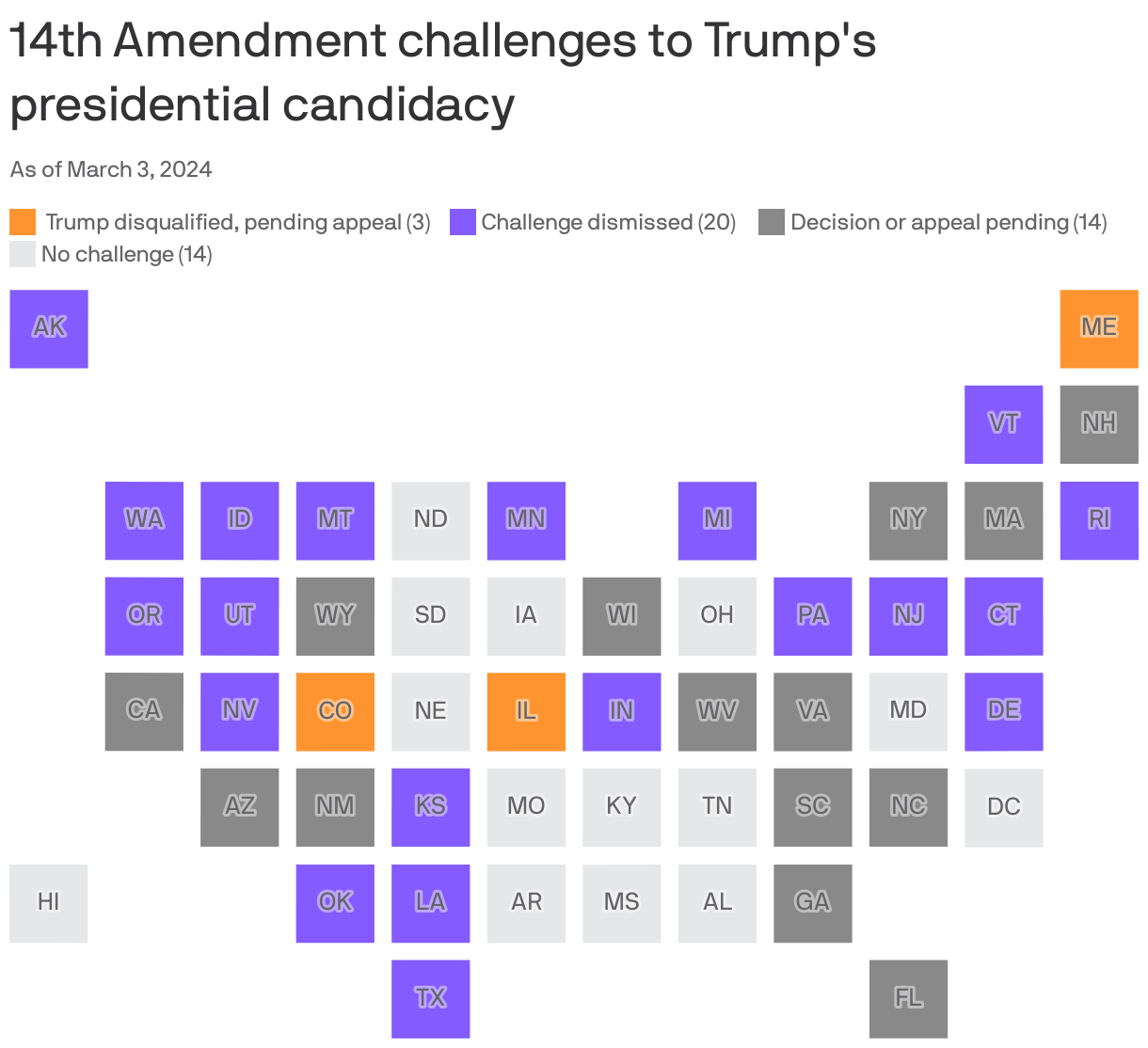
14th Amendment challenges to Trump's presidential candidacyData: Lawfare; Note: “Challenge dismissed” includes challenges that were voluntarily dismissed. New challenges could be brought in states that previously issued dismissals; Map: Erin Davis/Axios Visuals

Time is ticking for more than a dozen states to resolve 14th Amendment challenges to former President Trump’s 2024 candidacy before the Republican primary kicks into high gear.

Why it matters: Colorado and Maine last month disqualified Trump from the ballot over his role in the Jan. 6 Capitol riot, in bombshell decisions that put questions over a largely untested provision before the Supreme Court.

Driving the news: The Supreme Court agreed Friday to take up Trump’s appeal in Colorado and consider whether he can appear on the state’s primary ballot.

  • The high court’s ruling could determine whether the former president and GOP front-runner can be disqualified from the ballot across the country.

Zoom in: Challenges in more than 30 states have been filed citing Section 3 of the 14th Amendment, which holds that nobody should hold office if they “engaged in insurrection” or have “given aid or comfort” to insurrectionists.

  • More than a dozen of the challenges are still awaiting a ruling or a decision on an appeal, according to the nonprofit publication Lawfare.
  • Voters in two other states — Illinois and Massachusetts — filed 14th Amendment challenges to Trump’s candidacy as recently as last week.

Between the lines: Even if a challenge has been rejected in a state, it does not preclude other challenges from being brought in the same state in the future, Lawfare notes.

What they’re saying: Trump’s team has criticized the efforts to challenge his candidacy as election interference and has indicated he plans to appeal any rulings barring him from the ballot.

  • “We have full confidence that the U.S. Supreme Court will quickly rule in our favor and finally put an end to these un-American lawsuits,” Trump spokesperson Steven Cheung said after the Colorado ruling.

What to watch: The Republican primary begins with the Iowa caucuses on Jan. 15. Other states’ deadlines to finalize primary ballots are fast approaching.

  • Oregon could be the next state to weigh in on Trump’s candidacy. The state’s Supreme Court is expected to issue a ruling in the coming weeks before the state’s March 21 deadline to finalize the primary ballot.

Go deeper: Congress erupts after court disqualifies Trump from Colorado ballot

Categories
Saved Web Pages - Audio Posts

The Logic That Will Force Biden to Abandon Israel | National Review

joe-biden-jan-2024.jpg?fit=1200%2C700&ss

Categories
Saved Web Pages - Audio Posts

Biden ‘running out’ of patience with Netanyahu while Israeli civilians are killed by Lebanese missiles on 100th day of Hamas war

newspress-collage-u5ctah89l-170526664702

President Biden’s patience with Israeli Prime Minister Benjamin Netanyahu is extremely close to “running out,’’ it was revealed Sunday — as Israel marked the 100th day of its war with Hamas. 

Despite Biden’s public support of Israel at the cost of political points at home, he is faced with “immense frustration” over the Israeli PM’s handling of the war — with tensions between the pair reaching a boiling point late last month, when Biden abruptly hung up the phone during a conversation with Netanyahu, sources told Axios. 

“This conversation is over!” Biden allegedly yelled at Netanyahu during the pair’s Dec. 23 call, which reportedly grew heated when the prime minister refused to release the Palestinian tax revenues being held by the Israeli government. 

The phone call marked the last conversation between the pair, who had spoken nearly every day since war broke out Oct. 7, the outlet said. 

“The situation sucks, and we are stuck — the president’s patience is running out,” a US official said. 

Another US official added, “There is immense frustration.”

Barak Ayalon
Miri Ayalon

Sen. Chris Van Hollen (D-Md.), who the outlet said has been tight with Biden higher-ups over the war, said, “At every juncture, Netanyahu has given Biden the finger.

“They are pleading with the Netanyahu coalition but getting slapped in the face over and over again.”

The tension had been building over Netanyahu’s refusal to listen to other requests made by the Biden administration, including plans to discuss what post-war Gaza will look like, the sources added. 

Biden and his team have repeatedly pointed to a reformed Palestinian Authority as the best leadership for Gaza once Hamas is out of power, but Netanyahu has rejected such a proposal and insisted that Israel should oversee the demilitarization of the enclave. 

The US has also shown concern over the continued civilian casualties in Gaza that have caused political opposition to America’s support for Israel’s military. 

The deadly strike came on the 100th day of the war between Israel and Hamas. AP

An anti-tank missile fired from Lebanon hit and killed two Israeli citizens. AFP via Getty Images

National Security Council spokesman John Kirby appeared on CBS’s “Face The Nation” on Sunday and said there have been talks with Israel to move on to the next phase of the war that would scale down the fighting and airstrikes in southern gaza. 

“I’m not saying it’s perfect, and we’re certainly not walking away from the need to reduce civilian casualties,” Kirby said of the recent conversations with Israeli leaders. 

Kirby’s claims come as the war between Israel and Hamas has entered its100th day without any sign of slowing down or that the remaining 136 hostages believed to be held in Gaza would be freed. 

Israel declared war on the terror group after its brutal Oct. 7 attack that saw more than 1,200 people murdered in Israel and another 250 kidnapped, the deadliest in the history of the Jewish people since the Holocaust.  

After the slaughter, Israel launched an unrelenting wave of airstrikes across the Gaza Strip before its troops began a ground offensive to destroy Hamas and its military infrastructure. 

Hezbollah said that the group won’t stop fighting until a cease-fire is in place for Gaza. AP

The Israeli offensive has claimed more than 23,000 lives in Gaza, according to the Hamas-run Ministry of Health, which does not differentiate between civilians and terrorists. 

Combined with the deaths Oct. 7, the war has claimed an unprecedented amount of lives in the decades of violence between Israelis and Palestinians.   

The war has also forced nearly all of Gaza’s more than 2 million residents to evacuate their homes, about half of which have been damaged or destroyed by the conflict. 

The destruction and displacement has put shelters and hospitals on the brink of collapse as they struggle with dwindling supplies, with an estimated 576,600 Palestinians facing starvation. 

Although Israel claimed that it would scale down its presence in Gaza after decimating Hamas’ hold on northern Gaza, the fighting remains as intense as ever across the central and southern portions of the Palestinian enclave. 

In Khan Younis, southern Gaza’s largest city where hundreds of thousands of Palestinians have sought refuge, the fighting has ramped up as the IDF seeks to locate Hamas’ top brass and the hostages who have now endured three months in captivity. 

On Sunday, the Kfir Brigade carried out raids in the city and seized a large weapons cache that included rifles, explosives, missile warheads, rockets and other military equipment belonging to the terror group and its elite Nukhba forces, the IDF said. 

The raids came days after Israeli troops discovered a Hamas tunnel system in the city where some of the hostages were being held in “difficult conditions.” 

The safety of the hostages remains among the top concerns for Israelis, with many of the hostages who were freed during the temporary cease-fire in November critical of their government’s response over the urgent issue. 

“We were abandoned by the state of Israel,” freed hostage Hagar Brodutch said during a rally in Tel Aviv on Sunday.  

Brodutch, who was in captivity for 51 days with her three children, was among many who have called on Israel to accept a deal that would see the remaining hostages freed from their nightmare as soon as possible, the Times of Israel reports.  

Israeli soldiers walk past houses destroyed by Hamas terrorists in Kibbutz Be’eri, Israel, Saturday, Oct. 14, 2023. AP

“They need their home now!” Brodutch yelled in the rally.

Meanwhile, with no sign of the conflict in Gaza ending anytime soon, Israel also has seen the chances of a two-front war growing as tensions Sunday continued to heat up along the northern border in Lebanon after a series of missile strikes by Hezbollah terrorists.

One of the strikes in the city of Kfar Yuval killed Miri Ayalon, 76, and her son Barak Ayalon, 45, a member of the Israel Defense Forces serving as a staff sergeant in the reserves and as part of the town’s security team.

Since Oct. 8, the IDF has reported five civilian deaths as a result of the skirmishes with Lebanon’s Hezbollah rebels, with another 10 soldiers and reservists killed in the conflicts. 

Along with Hezbollah, the fellow Iran-backed Houthis rebels have launched attacks in support of Hamas, with the terror group firing at ships in the Red Sea. 

Biden is said to feel “immense frustration” with Netanyahu’s handling of the war. REUTERS

US and UK officials have warned the Houthis rebels of “consequences” if they continue to conduct terror attacks in the region, with the Western allies allegedly unleashing a series of strikes against the group on Sunday. 

Al-Masirah TV, which is operated by the Iran-backed military group, reported the attack against Houthi rebels in Yemen’s war-torn Hodeida. 

It would mark the third day in a row that the Houthi group has been attacked over its aggression in the Red Sea.  US and UK officials have not commented on Sunday’s airstrikes. 

Categories
Saved Web Pages - Audio Posts

Biden Is Angry and Frustrated With Netanyahu. But He Has Realistic Options to Change Course – Middle East News – Haaretz.com

64398-4.jpg?precrop=2400,1395,x0,y208&he

Haaretz | Middle East News

Analysis |

The U.S. president has so far resisted calls to pivot from unequivocal support for Israel’s war in Gaza, now in its third month. Netanyahu’s endless self-interest and obstinacy will make him the loser when Biden acts

Alon Pinkas

Jan 15, 2024 7:46 pm IST

Get email notification for articles from Alon Pinkas Follow

Jan 15, 2024 7:46 pm IST

Get email notification for articles from Alon Pinkas Follow

There are two major Mideast issues currently preoccupying Washington: The obstinacy exhibited by Mr. Benjamin Netanyahu, which has bred annoyance and resentment across the ocean, and the specter of a broader regional conflagration involving the U.S., which would amount to a distraction. The two are entwined, but deserve separate attention.

Paid by Attorney Rakefet Shfaim
Categories
Saved Web Pages - Audio Posts

Surprise: America Is Not in Netanyahu’s Pocket

51385.jpg?precrop=2200,1279,x0,y0&height

Haaretz | Opinion

Opinion |

Get email notification for articles from Itay Rom Follow

Jan 14, 2024

Get email notification for articles from Itay Rom Follow

Imagine for a moment that you are Antony Blinken, the American secretary of state. Following your suspicions that Israel is plotting to encourage the transfer of residents of the Gaza Strip, you ask for an explanation from Prime Minister Benjamin Netanyahu. He reassures you and promises: That is not Israel’s policy.

Paid by Attorney Rakefet Shfaim
Categories
Saved Web Pages - Audio Posts

Op-Ed: Netanyahu wholly embraced Trump — and painted himself into a partisan U.S. corner. Now what?

?url=https%3A%2F%2Fcalifornia-times-brig

Ten days before America’s presidential election, Donald Trump invited journalists into the Oval Office to behold his telephone call with Israeli Prime Minister Benjamin Netanyahu. Ostensibly, the purpose of their discussion was the creation of diplomatic relations between the Jewish state and Sudan, the third Muslim nation to do so with Washington’s midwifing.

But President Trump could not resist demanding a personal favor for his reelection race, as well as a salve to his limitless ego, asking, “Do you think Sleepy Joe [Biden] could have made this deal?” As Trump’s smirk visibly dissolved, the prime minister offered only a bromide about appreciating “the help for peace from anyone in America.”

Those pallid, cautious words from Netanyahu, rather than his usual haughty truculence, offered the first inkling that he may have belatedly glimpsed the price of his strategy of meddling in American politics on the Republican side and fervently embracing Trump — a figure singularly reviled by liberals, Democrats and the vast majority of American Jews.

Now the bill for that reckless policy is going to come due. Stuck with a Democratic president, a Democratic majority in the House and the possibility of Democratic control in the Senate, Netanyahu will have to face the damage he has done to three important elements of Israel’s national interest: bipartisan support in the United States, consensus allegiance from American Jewry and the durability of Zionism itself.

The prime minister’s blows against them did not start with Trump, no matter how effusive their bromance. The deterioration may have begun in 2010, when Netanyahu’s government publicly humiliated Biden by announcing an expansion of settlements opposed by the Obama administration during a visit to Israel by the then-vice president.

In succeeding years, Netanyahu all but formally endorsed Mitt Romney in his race against Obama in 2012. He gave a whitesplaining lecture about the Middle East to America’s first Black president with the media there to record it. He took his campaign against the Iran nuclear deal directly to Congress on the invitation of House Speaker John Boehner, a Republican. Netanyahu spent 90 minutes with Trump in the mogul’s Manhattan tower during the 2016 presidential race, in a chummy contrast to his closed-door session with Hillary Clinton.

And, yes, Netanyahu was rewarded for his partisanship and sycophancy. Trump, the self-proclaimed great dealmaker, turned into just another tourist getting fleeced in the Levantine bazaar. He gave Netanyahu everything — a pullout from the Iran accord, movement of the U.S. Embassy to Jerusalem, support for making separate peace with Sudan, Bahrain and the United Arab Emirates while perpetuating the occupation and de facto annexation of Palestinian land. In return Trump pretty much got zero.

But with Trump headed out of office and Republican power thus greatly reduced, Netanyahu is suddenly having to reckon with American skeptics and foes rather than the most compliant of friends.

Despite his tepid, tardy congratulations to Biden, Netanyahu has spent a full decade undermining even centrist Democrats, including such staples of bipartisan support as Sen. Charles Schumer of New York and Rep. Steny Hoyer of Maryland. As the primary-election season geared up in fall 2019, a range of Democratic candidates, including the progressive hero Bernie Sanders and the Midwest moderate Pete Buttigieg, spoke openly about conditioning U.S. aid to Israel on certain requirements — including not using a cent of it for annexation. Such a stance would have been unthinkable prior to Netanyahu’s alliance with the GOP, when annual assistance to Israel went through both parties as a blank check.

“Jewish presence in both parties, in terms of votes and activism, is what makes a bipartisan relationship,” Steven Bayme, a widely respected analyst of American Jews and Israel, told me last week. He pointedly added that while Netanyahu did not invent tensions with liberals here, he did exacerbate them. As “the prime minister … found increasing criticism of his politics from the left, he found acceptance among evangelicals and conservatives, and that aggravated the situation,” he said.

American Jews, meanwhile, voted overwhelmingly against Trump this year, despite the president’s efforts to cajole them otherwise. Exit polling by the Associated Press gave Trump 30% of the Jewish vote and Biden 68%. (National Public Radio’s findings were almost identical.)

Far from heralding a shift of American Jews toward the Republican Party, the vote for Trump — including 70% of Orthodox Jewish votes — was more of a reversion to past percentages. Republican candidates from the early 1970s through the late 1980s routinely took more than 30% of the Jewish vote.

In other words, the political realignment of American Jews that right-wingers in both America and Israel have longed for, and predicted for decades, remains a mirage. Considering Trump’s extremist stances on many domestic issues dear to American Jews — church-state separation, liberal immigration laws, LGBTQ rights — and his winks and nods to anti-Semitic hate groups, no one should be surprised.

At its essence, Zionism articulated and aspired to reconcile two goals: creating a Jewish nation-state like any other nation-state and serving as a beacon for worldwide Jewry. Through his love affair with Trump, Republicans and the far right, Netanyahu may indeed have shown how Israel can act in as self-interested a manner as any other country. But he has dimmed, if not quite extinguished, the beacon for a great many American Jews.

Samuel G. Freedman is the author of eight books, including “Jew vs. Jew: The Struggle for the Soul of American Jewry.”