Categories
Saved Web Pages - Audio Posts

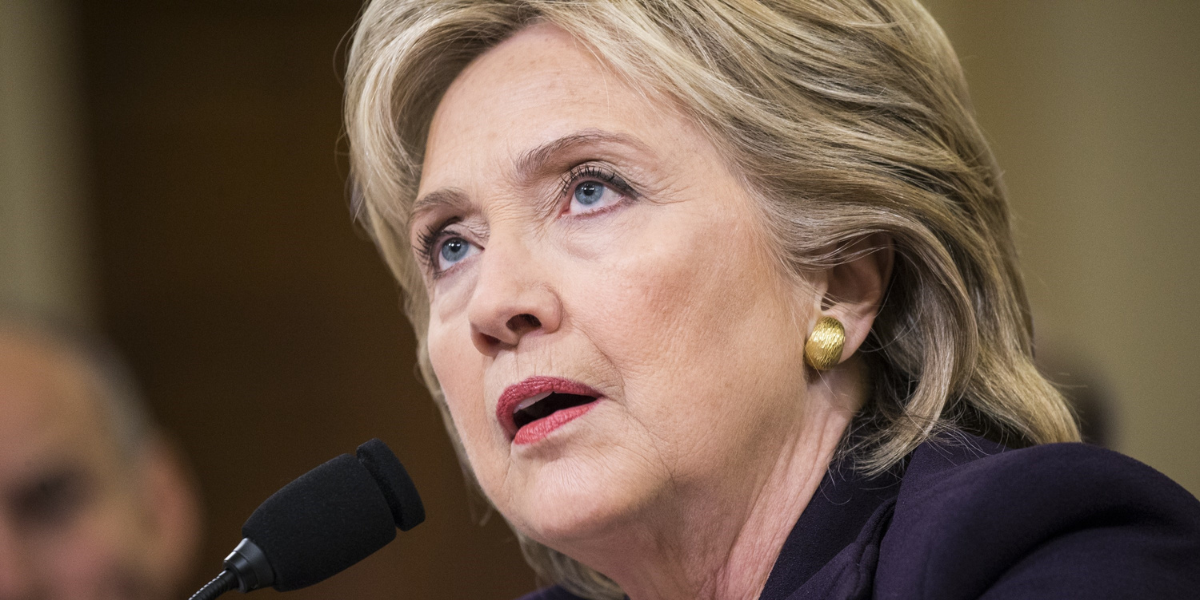
Hillary Clinton Is Probably Shaking Her Damn Head—We’re Right There With Her

img.png?width=1200&height=600&coordinate

If you haven’t heard the name “Charles McGonigal” before, that’s how it’s supposed to be. Top FBI officials in Counterintelligence aren’t supposed to make the news and become household names.

But yesterday, McGonigal was indicted by grand juries in New York and Washington D.C. and arrested for secretly working for Russian oligarch and close Putin ally Oleg Deripaska, and for taking money from an Albanian intelligence agent.

McGonigal is charged with violating economic sanctions, money laundering and conspiracy.

It’s hard to overstate how damaging this arrest is to the already tainted reputation of the FBI. Los Angeles Times legal columnist Harry Litman noted the arrest has left the FBI community “completely stunned” and wondering “if they can get to a guy like McGonigal, whom can’t they get to?”

And as NBC Investigations analyst Tom Winters put it, “Taking a big picture and the totality of all of this, this is somebody whose job was to investigate Oleg Deripaska” and now “he’s a potential foreign agent.”

But beyond the shock of the arrest, things get way murkier when you rewind the clock, especially knowing what we now do about McGonigal’s willingness to do Deripaska’s bidding.

Much as I hate to reopen questions around the 2016 election, McGonigal’s arrest and the revelations about his later ties to the Russian oligarch require it. And I can see how Hillary Clinton might be left with an inescapable “I knew it” feeling.

Let’s dive into why.

McGonigal was in a position to do serious harm to Clinton in 2016.

McGonigal was no run-of-the-mill FBI agent. He was the special agent in charge of the FBI’s New York Field Office’s counterintelligence division—in other words, the official who was supposed to be investigating the Russians, not crawling into bed with them, even if it happened after he left the FBI.

His willingness to accept illegal employment from Deripaska calls his integrity, patriotism, and motives while acting as FBI division head directly into question.

The timing of his initial appointment is also causing raised eyebrows, now that we know what we know. On October 4, 2016, a month before the presidential election between Clinton and Donald Trump, then FBI Director James Comey appointed McGonigal to that key counterintelligence position in the New York office.

It’s important to point out here that around the time of the 2016 election, that particular field office really had it out for Hillary Clinton. Former Attorney General Loretta Lynch spoke candidly about the animosity of that office toward Clinton when she was interviewed by investigators looking into Comey’s actions while FBI director.

Comey had told Lynch that it had become clear that “there is a cadre of senior people in New York who have a deep and visceral hatred of Secretary Clinton,” and that “it was surprising to him or stunning to him.” Comey said that “it was hard to manage because these were agents that were very, very senior.”

Did those “very, very senior” agents include McGonigal? Legal and political observers have taken note of the timing of McGonigal‘s appointment, including historian Michael Beschloss, who observed that Comey made the appointment in late October of 2016, only “[t]hree weeks before his fateful announcement” that he was reopening the criminal case against Hillary Clinton.

Josh Marshall of the influential Talking Points Memo also couldn’t help but notice the timing, tweeting:

“Weird. McGonigal got put in charge of CI [Counterintelligence] at the NYC field office like almost to the day they reopened the Clinton emails case.”

Marshall called these circumstances “ironies,” and that’s the correct term because it’s highly unlikely that the case itself reopened because of McGonigal.

There simply wouldn’t have been time for him to make such an order. But two other major things happened shortly after that appointment that are worth highlighting.

Leaks out of the NY Office forced Comey’s hand.

If Comey had never gone public with the fact that his office had reopened the Clinton email investigation, there would have been no impact on her standing in the national election.

But leaks about the investigation were coming straight out of that New York office, and Comey later admitted that it was the leaks that required him to get ahead of the news.

As The Atlanticreported, Comey told investigators he believed partisan agents in New York might try to put their finger on the political scale:

“My worry was, I have to be careful that people in New York aren’t by virtue of political enthusiasm, trying to take action that will generate noise that will have an impact on the election.”

Former FBI counsel James Baker echoed that fear, specifically about a likely leak of the reopened investigation:

“We were quite confident that … somebody is going to leak this fact. That we have all these emails. That, if we don’t put out a letter, somebody is going to leak it.”

Rudy Giuliani, himself a former federal prosecutor, was openly hinting that he had inside information from the FBI’s New York office, telling Fox News a week before Comey’s disclosure to Congress that there was a “pretty big surprise” coming. (Giuliani later denied he had spoken to any FBI agents.)

In short, Comey felt compelled to get ahead of the leaks driven by partisan pressures from the New York Office. Was McGonigal among those partisans? Was he the source of the leak? And worse still, was he in any way influenced by foreign adversaries?

While there isn’t yet any evidence that McGonigal was compromised by the Russians at the time, his subsequent illegal behavior with Deripaska should raise big concerns.

After all, by the time he started illegally working on Deripaska’s behalf, it was well-established that Deripaska had worked with convicted Russian asset Paul Manafort, the “voluntary” head of the Trump campaign who also provided internal battleground state polling data to Russian intelligence.

McGonigal knew what kind of danger Deripaska presented to America when he accepted a job from him, but he chose money over loyalty to country.

Was McGonigal a source of disinformation?

On October 31, 2016, unnamed sources in FBI counterintelligence led The New York Times to publish a big story with the headline “Investigating Donald Trump, F.B.I. Sees No Clear Link to Russia.”

It reported, rather maddeningly and incorrectly:

“Law enforcement officials say that none of the investigations so far have found any conclusive or direct link between Mr. Trump and the Russian government.”

“And even the hacking into Democratic emails, F.B.I. and intelligence officials now believe, was aimed at disrupting the presidential election rather than electing Mr. Trump.”

The identity of these “law enforcement officials” was left undisclosed, but the damage was done. Voters who had any doubts about Trump and his links to Russia now had nothing less than The New York Times assuring them that the FBI had found nothing despite months of investigation.

Historian Beschloss again took note of the timing of the Times article.

“This was 8 days before the Trump-Clinton election.”

“It was 27 days after Comey named McGonigal to head Counterintelligence for FBI’s New York Field Office.”

Could McGonigal have been one of the Times’ sources for this misleading reporting, and could he have falsely shaped the narrative here? It’s hard to be sure of anything, given what little we still know, and the Times isn’t likely to ever reveal its sources.

But it would be unwise to discount the possibility that the long hand of Russian money and influence may have played some role.

Political commentator Kaivan Shroff captured the cold fury of many upon connecting the dots:

“Just to be clear, when the New York Times reported that the FBI saw ‘no link between Trump and Russia’—a week before the 2016 election—the FBI agent who was just arrested over ties to Russian oligarch Oleg Deripaska was heading up the investigation.”

“Just an absolute scandal.”

When those in charge of our investigations and our security are themselves so readily compromised, public faith in our institutions takes a nosedive, and with good reason.

The arrest of McGonigal is an important step toward restoring integrity to the Department, but to get back there we will need a thorough and honest accounting of what damage McGonigal did while in his position, especially to the electoral chances of Hillary Clinton.

If the answer after a full inquiry is that he was not part of the cabal in the New York field office bent on bringing her down, then we should know that as well.

But right now it is more than understandable why mistrust and anger among Democrats runs deep, given the guy in charge of the Trump-Russia investigation in New York illegally went to work for the Russians and even may have played a significant part in Hillary Clinton’s narrow electoral defeat.

Categories
Saved Web Pages - Audio Posts

Opinion: Did the New York Times help crooked FBI agents elect Trump?

sjm-rump_03854-77222_1059278588_10333375

It was arguably the most consequential “October Surprise” in the history of American presidential elections. In the waning days of the 2016 race, with polls showing Hillary Clinton clinging to a lead over Donald Trump, two last-minute stories broke that rekindled on-the-fence voters’ ethical doubts about Democrat Clinton and quashed a budding scandal around her GOP rival.

Except the “October Surprise” was no surprise to one key player: Rudolph Giuliani, the ex-New York City mayor and Trump insider who later became the 45th president’s attorney. Late that month, Giuliani told Fox News that the trailing Republican nominee had “a surprise or two that you’re going to hear about in the next few days. I mean, I’m talking about some pretty big surprises.”

Just two days later, then-FBI Director James Comey revealed the bureau had reopened its probe into Clinton’s emails, based on the possible discovery of new communications on a laptop belonging to disgraced New York politico Anthony Weiner. The news jolted the campaign with a particularly strong boost from The New York Times, which devoted two-thirds of its front page to the story — and the notion it was a major blow to Clinton’s prospects.

The supposed bombshell — it turned out there was nothing incriminating or particularly new on the laptop — wasn’t the only FBI-related story that boosted Trump in the homestretch of the 2016 campaign. On Oct. 31, citing unnamed “intelligence sources,” The Times reported, “Investigating Donald Trump, F.B.I. Sees No Clear Link to Russia.” That article defused a budding scandal about the GOP White House hopeful — at least until after Trump’s shock election on Nov. 8, 2016.

There are many reasons for Trump’s victory, but experts have argued the FBI disclosures were decisive. In 2017, polling guru Nate Silver argued that the Comey probe disclosure cost Clinton as many as 3-4 percentage points and at least 1 percentage point, which would have flipped Pennsylvania, Michigan and Wisconsin and handed her the Electoral College.

Clearly, the wrong investigation was reopened.

The stunning corruption charges against a top FBI spymaster who assumed a key role in the bureau’s New York office just weeks before 2016′s “October Surprise” — an agent who by 2018 was known to be working for a Vladimir Putin-tied Russian oligarch — should cause America to rethink everything we think we know about the Trump-Russia scandal and how it really happened that Trump won that election.

The government allegations against the former G-man Charles McGonigal (also accused of taking a large foreign payment while still on the FBI payroll) and the outsize American influence of the sanctioned-and-later-indicted Russian billionaire Oleg Deripaska — also tied to U.S. pols from Trump campaign manager Paul Manafort to Senate GOP leader Mitch McConnell — should make us also look again at what was really up with the FBI in 2016.

How coordinated was the effort in that New York field office to pump up the ultimate nothingburger about Clinton’s emails while pooh-poohing the very real evidence of Russian interference on Trump’s behalf, and who were the agents behind it? What was the role, if any, of McGonigal and his international web of intrigue? Was the now-tainted McGonigal a source who told The New York Times that fateful October that Russia was not trying to help Trump win the election — before the U.S. intelligence community determined the exact opposite? If not McGonigal, just who was intentionally misleading America’s most influential news org, and why?

Why does it matter? The seemingly untouchable 45th president was in New Hampshire and South Carolina last weekend, campaigning to become the 47th. The man that critics call “Moscow Mitch” McConnell could return as majority leader in that same election. And Putin’s obsession with Ukraine — always a focus of his U.S. interference and Trump dealings — has become a war with dire global implications.

More importantly, this never-ending scandal has demolished our trust in so many institutions — an FBI that seems to have corrupted an election, a Justice Department that covered up those deeds instead of exposing them, and, yes, a New York Times that enabled several lies instead of exposing them.

Congress and Merrick Garland’s Justice Department can shine a true light on this giant mess, but there’s a reason I’m picking on The New York Times today. The Times can finally apologize for the sins of 2016, expose exactly what went wrong, and then reveal the rest so this kind of disaster never happens again. It owes it to American democracy.

Will Bunch is a Philadelphia Inquirer columnist. (c)2023 The Philadelphia Inquirer. Distributed by Tribune Content Agency.

Categories
Saved Web Pages - Audio Posts

Super spy or paper pusher? How Putin’s KGB years in East Germany helped shape him

DRESDEN, Germany — 

Meticulous. Reticent. Clever, but never showy about it. Ever the watcher.

It was 1989. The young Vladimir Vladimirovich Putin was a KGB officer in the then-East German city of Dresden, and it was one of history’s pivotal moments.

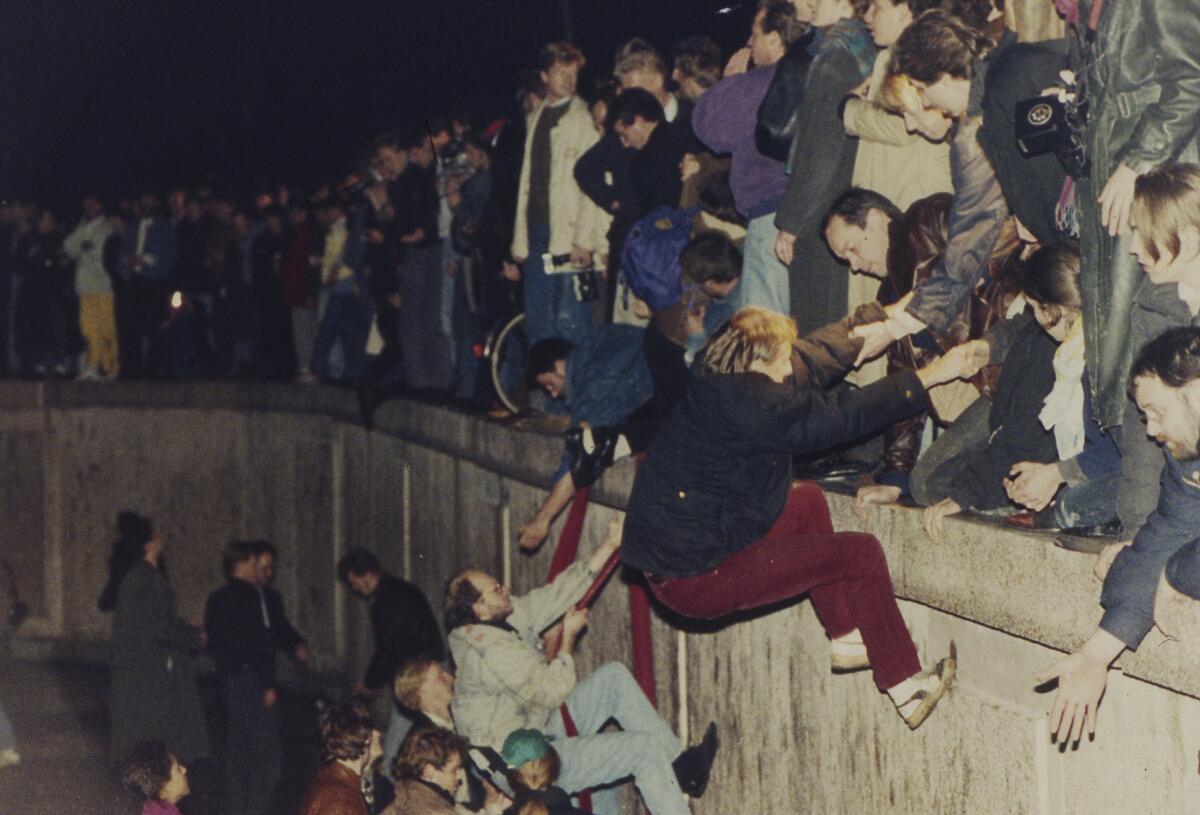
The Berlin Wall had fallen. The repressive government of one of the Soviet Union’s most prized satellite states was collapsing, a prelude to the dissolution of the U.S.S.R. itself. The reunification of East and West Germany was just months away.

East Berliners get helping hands from West Berliners as they climb the Berlin Wall.

East Berliners get help from West Berliners as they climb the Berlin Wall early in the morning Nov. 10, 1989, after people started to dismantle the barrier.

Putin’s five-year sojourn in Dresden, which abruptly ended in 1990, has come under renewed scrutiny as the 70-year-old Russian president prosecutes an increasingly brutal and bloody war in Ukraine — a neighboring sovereign state that for the last 16 months has fiercely resisted a total Russian takeover.

Against that backdrop, analysts point to the lingering legacy of Putin’s Dresden years: His determination never to allow domestic dissent to turn to a tidal surge like the one he witnessed. The realization that even a powerful elite wielding a ruthless police apparatus could suddenly find itself vulnerable. His grievance-laced dreams of a Russian empire greater than the one that slipped away before his eyes.

“It was an important time in his life,” said Douglas Selvage, a historian who works at the main Berlin archive of the Stasi, the onetime East German secret police. “It probably contributed to his sense of how everything could fall apart.”

But Selvage also said the Dresden interlude had been romanticized and mythologized — not least by Russian media, abetted by Putin himself.

“A lot of legends,” Selvage said, “have grown out of that time.”

::

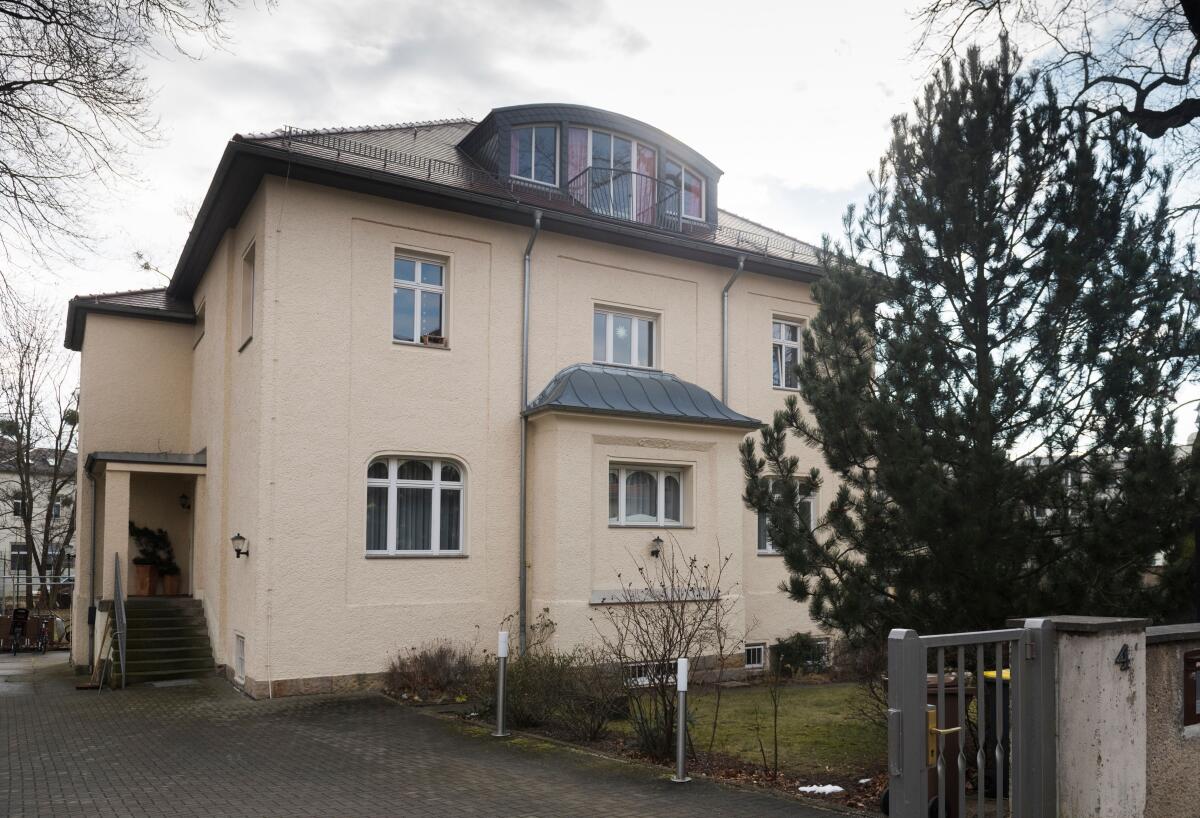
The villa at #4 Angelika Street, in a suburban district overlooking the River Elbe, housed the KGB’s Dresden headquarters. Today, surrounded by a wall and garden, it’s an office building owned by a German foundation; visitors are not welcome.

The former KGB headquarters stands in the eastern German city of Dresden.

The villa that housed the KGB headquarters in the eastern German city of Dresden. Vladimir Putin worked there from 1985 to 1990.

The opposite is true at the former Dresden Stasi headquarters, less than 100 yards away across a busy thoroughfare. The complex is now a museum and memorial to Stasi victims, with dank cellblocks and labyrinthine corridors carefully preserved, together with artifacts like paintings and poetry depicting the suffering of detainees.

“Putin would have been in and out of here all the time,” said Christine Buecher, who organizes events at the museum. “Those kinds of comings and goings were very much normal.”

In addition to attending meetings and ceremonial events, Putin probably would have frequented a Stasi canteen in the building, adjacent to a second-story cellblock. A typewritten menu from the late 1980s, kept by the museum, features comfort food like liverwurst and sauerkraut, or a Russian salad for 77 pfennigs — around 50 cents, if the East German currency had been convertible, which it was not.

In 2018, the discovery of a Stasi identity card issued to Putin caused a media sensation in Germany. It was found in the Dresden archives of the Ministry for State Security, as it was formally known. But there’s no evidence Putin was ever a Stasi operative, said historian Selvage.

Instead, he said, the card was probably issued because Putin and his colleagues were granted routine access to Stasi facilities that honeycombed Dresden. The two agencies had a sometimes-overlapping workload — trying, for example, to recruit international students at Dresden’s Technical University as informants.

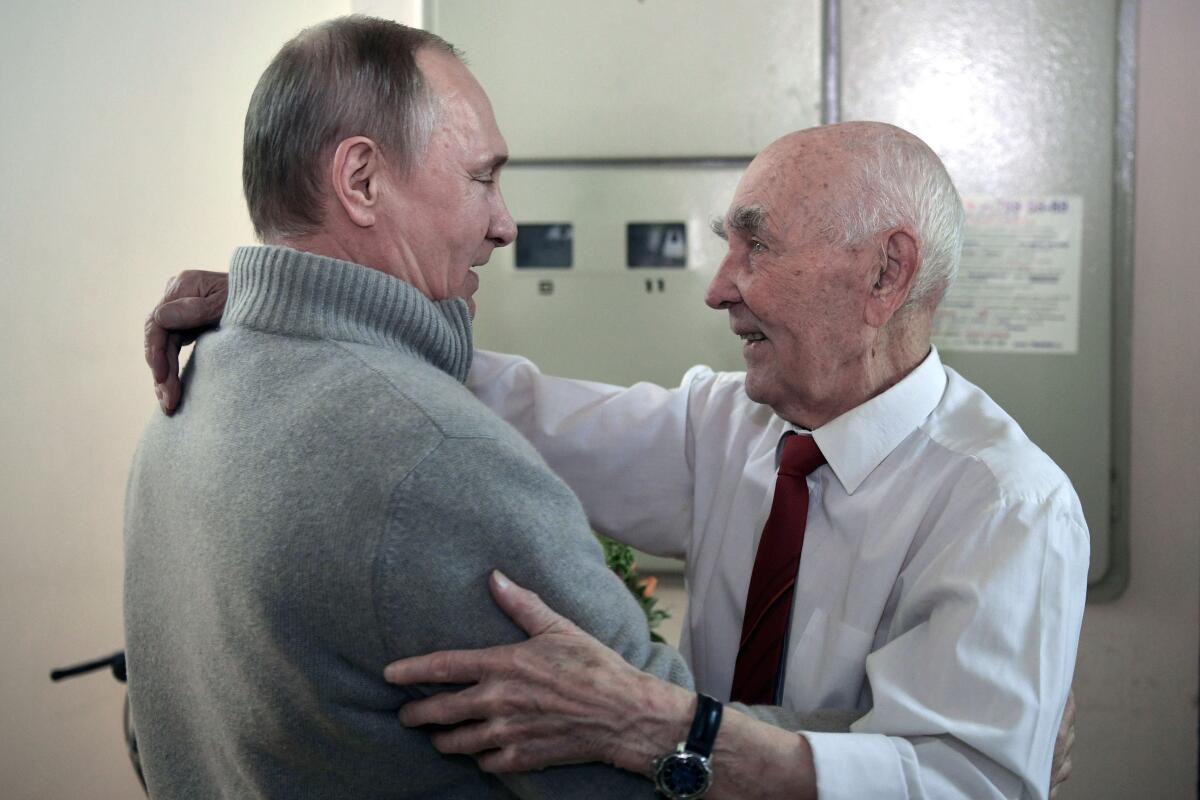
Two men embrace.

Russian President Vladimir Putin, left, greets Lazar Matveev, the former head of the KGB intelligence group in Dresden, on his 90th birthday in 2017 on the outskirts of Moscow.

Like workers everywhere, Putin could appreciate a short commute. He and his family — Lyudmila, the wife he later divorced, and two small daughters, now grown — lived in a large multistory apartment complex a few minutes from the Angelika Street villa, reached via a parkland path.

It was a comfortable lifestyle for the young family, compared with the living standards of ordinary East Germans — though a Russian-language memoir later quoted Lyudmila as observing that Stasi employees, numerous among the neighbors, were usually assigned the bigger and nicer units.

When Putin and his family decamped from Dresden for the last time, they took with them, according to multiple accounts, a symbol of suburban plenty: a used washing machine, given to them by German friends.

In an odd historic echo, invading Russian troops have so often looted washing machines from Ukrainian homes in occupied cities and towns that the household appliance quickly became a wartime meme — an emblem, to Ukrainians, of a foe that was terrifying and destructive, yet also somehow faintly ridiculous.

People living now in Putin’s old apartment complex take in stride the historic connection to a onetime nest of spies, and the notoriety that was to accrue to the onetime tenant.

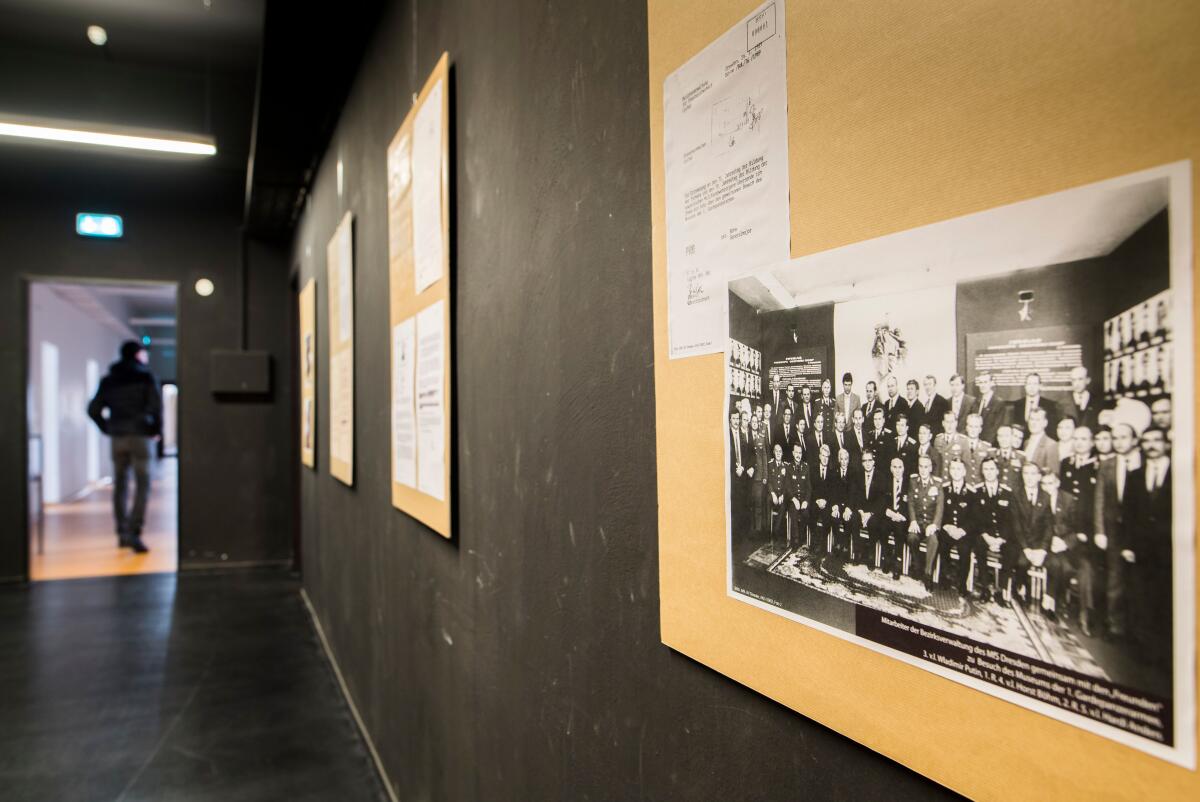
A large black and white photo hanging in a hallway of a group of people

A photo displayed at a former prison and office of the East German Ministry for State Security, or Stasi, in Dresden, shows Vladimir Putin among senior Soviet and East German military and security officers.

“Putin? He was the next block over!” called out a man who was leaning out his second-story window and washing it. Asked his thoughts about the Russian leader, he paused, shook his head and pulled the window firmly shut.

::

Was Putin some kind of super-spy, or more of a paper-pushing bureaucrat?

Over the years, German news reports, and some biographies, attributed various daring feats of espionage to the future Russian president. But some recent depictions are more in line with “The Office” than “The Americans” — tedious, repetitive workplace tasks as opposed to gripping espionage drama.

The German newsmagazine Der Spiegel this month published a deep-dive investigation casting doubt on accounts that Putin was assigned covert activities such as arming and advising the militant Red Army Faction across the border in West Germany.

“The literature is full of speculation about Hollywood-like special missions in which Putin is alleged to have been involved,” the article said. “Even today, there is no convincing evidence for these stories.”

The magazine even undercut one of the most widely repeated stories about Putin’s time in Dresden — his alleged personal confrontation with a small group of demonstrators who approached the villa on Dec. 5, 1989, after a crowd had stormed the Stasi headquarters.

Der Spiegel said there was no proof he was even there that night — but observers often cite the overrunning of the nearby Stasi building in explaining Putin’s visceral response even to peaceful demonstrations, such as Ukrainians’ pro-democracy protests in 2014.

While versions of tumultuous events in Dresden grow more contested with passing years, character studies of Putin drawn from contemporaries’ recollections tend to be more consistent. They paint a portrait of a young officer who was rarely the center of attention, but always kept careful track of those around him: a quick study, but a person who shrouded his capabilities. The one at the edge of the picture frame.

Putin biographer Masha Gessen called Putin “the man without a face,” alluding not only to his resolutely nondescript quality, but his canniness in using it to conceal sharp-edged ambition and deep-seated venality.

Gessen wrote that Putin was disappointed with a humdrum posting in Dresden, considered a backwater, but that then and later, his colorlessness served him well. Years afterward, as he ascended Russia’s political ranks, the lack of a distinctive public persona gave him another key advantage: the ability to craft an image of his own choosing.

Putin’s most prominent domestic critic, the imprisoned Alexei Navalny, said the seeds of cronyism and corruption were planted in Dresden, where Putin rubbed shoulders with figures who were later to become part of the Russian financial elite that propped him up politically. They included Sergei Chemezov, who went on to head Russia’s arms export agency, and Nikolai Tokarev, who would become chief of the Russian pipeline company Transneft.

“Putin failed to get rich or further his career in Dresden,” Navalny, who nearly died in a 2020 poisoning blamed on the Kremlin, said the following year in an investigative video. “But here he met people who became his main ‘wallets.’”

In Dresden, Putin defined his “life principles,” Navalny said: “First, always say one thing and do another — lies and hypocrisy are the most effective methods. Second, corruption is the basis of trust: Your closest friends are those who have been stealing and cheating alongside you for many years. And third, there is no such thing as too much money.”

For long after, Dresden would remain a touchstone. On a 2006 visit described as a homecoming of sorts, Putin dropped into a local cafe and viewed a landmark cathedral that had been wrecked in the Allied bombing of 1945, now newly rebuilt.

Such a visit, of course, would be impossible today. After the Russian president was indicted in March for war crimes by the International Criminal Court, Germany said he would be arrested if he set foot in the country.

::

As a teenage apprentice in Dresden, the Berlin-based artist Markus Draper, now 54, often passed by the house on Angelika Street. The pale-yellow villa came to loom large in his imagination.

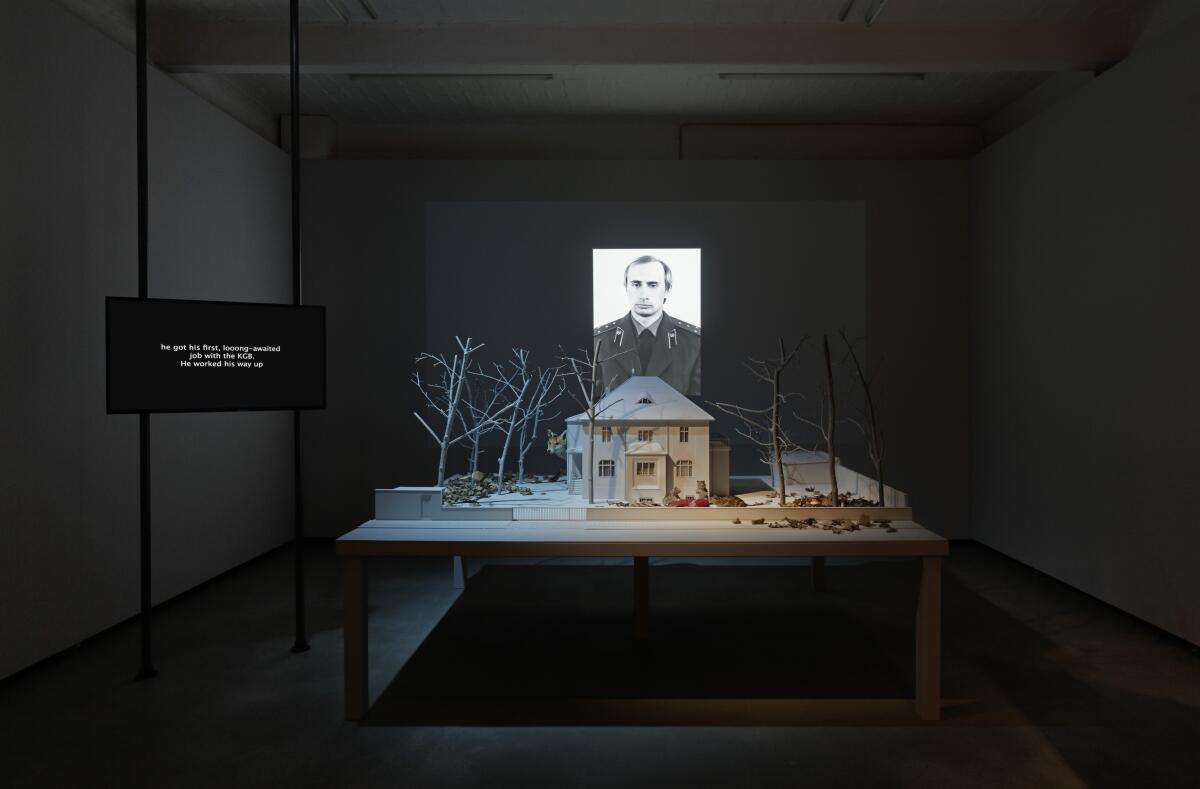
Earlier this year, a well-known Berlin gallery mounted an installation by Draper featuring a hyper-realistic diorama of the historic villa. A filmstrip-style backdrop cycles through images and events of the Cold War, culminating in Putin’s Dresden interlude. The artwork was galvanized by the full-scale invasion of Ukraine, but Draper had toyed for years with the idea of looking at the origins of the Soviet empire’s unraveling, and the lessons Putin drew from it.

An art installation shows the former KGB villa in Dresden in miniature.

German artist Markus Draper’s installation, titled “The House Near a Deep Forest,” shown in a Berlin gallery this year, painstakingly rendered the KGB villa in Dresden in miniature. Russian President Vladimir Putin worked at the villa from 1985 to 1990.

Draper called the KGB building a constant amid the Cold War intrigue that swirled around it and across the Soviet bloc. “To me,” he said, “it’s a kind of hinge, this house.”

Before the Berlin Wall fell in 1989, Draper had good reason to be nervous in the vicinity of Angelika Street. Still a teenager, he had begun to move in clandestine anti-government circles and was well aware of the long arm of the Stasi and the KGB.

“If I had been a little older, or the Wall had fallen later, I would almost certainly have gone to prison,” he said.

Draper’s installation, titled “The House Near a Deep Forest,” painstakingly rendered the KGB villa in miniature, surrounded by bare trees and seemingly snowy ground. Surreal elements encroach: a giant fox peers from behind the house, outsized rodents eye a hunk of raw meat in the yard.

An accompanying audio narrated by a fly on the wall — a nod, the artist said, to Putin likening anti-war Russians to annoying flying midges — is told in the manner of a dark fairy tale. But as with so many allegories, its meaning is many-layered.

Like many Germans who grew up in the former East, Draper expresses a measure of ambivalence about life in reunified Germany. Although happy to have escaped a lifetime in a police state, he is sometimes unsettled now, he said, by the casual cruelties and inequities of Western capitalism.

“Monsters are real, but created,” he said. “And history is a deep forest.”

::

If the future Russian president’s career and character were indelibly marked by his time in Dresden and witnessing East Germany’s fall, its aftermath may have helped foster some fundamental miscalculations on Putin’s part about Germany and the wider West as he prepared, decades later, to try to subdue Ukraine by force.

As his armies embarked on the full-scale invasion of February 2022, Putin seemingly believed that a transactional, pragmatic Germany would not meaningfully challenge him.

“Putin considered Germany too dependent on Russian energy, too weak militarily, and too business-minded to mount any significant resistance to his war,” analysts Liana Fix and Caroline Kapp wrote in a paper for the Council on Foreign Relations marking the war’s first anniversary. “He was wrong.”

And Germany, even more than other Western partners, for years misread the Russian leader, many analysts believe — thinking that his priority lay in reaping the economic benefits of cordial relations and that Putin would not act in a way to threaten those ties.

Putin’s rise to top leadership had come scarcely a decade after he and his family departed Dresden in 1990 for his native Leningrad, which was soon to revert to its pre-Communist name.

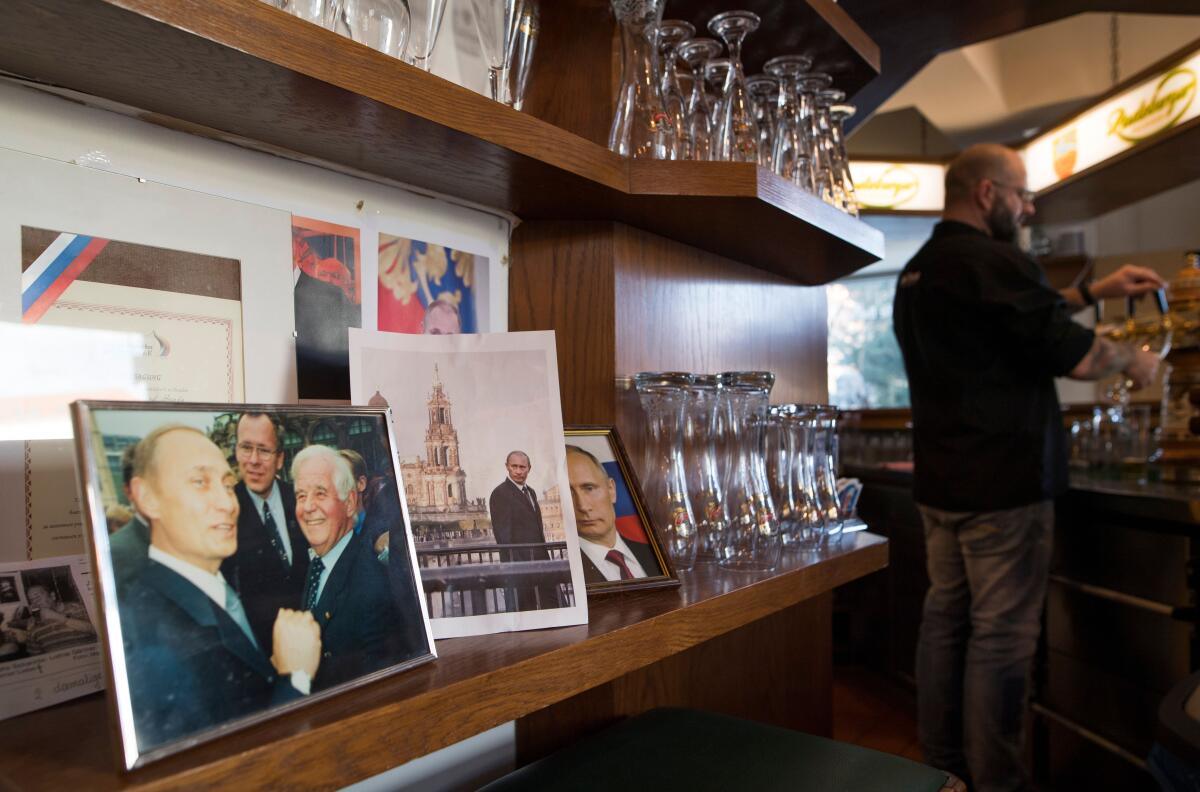
Photos of Vladimir Putin are displayed on a shelf at a German bar.

Photos of Russian President Vladimir Putin are displayed at a Dresden bar, Am Thor, in 2018.

In St. Petersburg — an old royal city like Dresden, and like it a baroque riverside jewel where behind-the-scenes political machinations sometimes rivaled the import of events in a drab capital — his alliances soon set his climb in motion.

He became an advisor to St. Petersburg’s mayor, climbing to the position of deputy mayor and head of a trade panel as billions of dollars were pouring into Russia from overseas. In 1996, he moved to Moscow and up the Kremlin ranks, and in 1998, then-President Boris Yeltsin appointed him head of the KGB’s domestic successor, the FSB. The next year, Yeltsin tapped him as prime minister, a way station to the presidency.

Amid Putin’s seeming desire for rapprochement with the West, though, there were menacing signs.

In 2001, the year after he assumed the Russian presidency, Putin addressed the German Bundestag, or parliament, in proficient German — the first such appearance by a Russian head of state.

Martin Aust, a professor of East European history and culture at the University of Bonn, recalled Putin’s conciliatory language about a common European home — but also a strident defense of the scorched-earth Russian military campaign in the breakaway republic of Chechnya, which now seems like an ominous prelude to the destruction of Ukrainian cities and the targeting of civilians.

“Everybody was so impressed by the Russian president speaking German that nobody wanted to really pay attention to other things he said,” said Aust.

“People heard what they wanted to hear,” he said. “And now we are paying the price.”

Categories
Saved Web Pages - Audio Posts

Was Vladimir Putin a German Agent?

gettyimages-961037694-594x594

Russian President Vladimir Putin visits Sochi, Russia. Putin served as an officer in the KGB, the Soviet-era intelligence services, in the East German city of Dresden until 1990.
Mikhail Svetlov/Getty Images

Russian President Vladimir Putin once owned an ID card for East Germany’s Stasi, the Soviet-era secret police, according to a German publication.

The Stasi identification card, which was first reported on by the German newspaper Bild on Tuesday, was valid until 1989 and bore the name “Major Vladimir Putin.” It also had Putin’s photograph and signature.

The ID was discovered by historical archivists handling Stasi personnel files.

Putin served as an officer of the KGB in the East German city of Dresden until 1990. Fluent in German, he adopted the cover of a translator.

German officials told Bild that the Stasi ID card would have allowed Putin to enter East German government buildings without having to identify himself as a KGB agent. He also would have been able to recruit members of the Stasi to work for the KGB. Kremlin spokesperson Dmitry Peskov noted that the Stasi and the KGB worked closely together and may have exchanged documents.

“My guess is that in the Soviet era, the KGB and the Stasi were partners and for this reason one should not rule out they might have exchanged identification papers and passes,” Peskov told reporters, directing any further questions about the report to Russia’s foreign intelligence services.

gettyimages-961037694-594x594

Russian President Vladimir Putin visits Sochi, Russia. Putin served as an officer in the KGB, the Soviet-era intelligence services, in the East German city of Dresden until 1990.
Mikhail Svetlov/Getty Images

Researchers have noted that the two agencies worked closely together until the collapse of communism and the fall of the Berlin Wall in 1989.

“The East German Ministry for State Security (MfS or Stasi) was established and developed under the strict control of the Soviet secret services (the NKVD, the MGB, and finally the KGB). Up until the very end of its existence, the MfS worked closely together with the KGB,” a report from the Cold War International History Project and the Office of the Federal Commissioner for the Stasi Records said.

“Established in February 1950, the East German Ministry for State Security (MfS) never overcame its subordination to the Soviet secret service. [German communist official Erich] Mielke himself characterized the Stasi as ‘a fighting division of the renowned Soviet Cheka’– a general term for the Soviet secret police,” the report continued.

Putin began working for the KGB in St. Petersburg, Russia, after he finished his law degree in the mid-1970s. East Germany was his first foreign posting. He began his career when then KGB chairman Yuri Andropov was pushing to hire new young recruits. Still, he had a lifelong interest in espionage even before he began his career in the secret service, according to his biographers.

Newsweek is committed to challenging conventional wisdom and finding connections in the search for common ground.

Newsweek is committed to challenging conventional wisdom and finding connections in the search for common ground.


Cristina Maza

Cristina Maza is an award-winning journalist who has reported from countries such as Cambodia, Kyrgyzstan, India, Lithuania, Serbia, and Turkey. She previously worked as a reporter for the Phnom Penh Post in Cambodia, and as a reporting fellow covering energy and cybersecurity for the Christian Science Monitor in Washington D.C. She writes frequently about international affairs, politics, global development, religion, defense, and cybersecurity. 

Cristina Maza is an award-winning journalist who has reported from countries such as Cambodia, Kyrgyzstan, India, Lithuania, Serbia, and Turkey. …
Read more

To read how Newsweek uses AI as a newsroom tool, Click here.

Categories
Saved Web Pages - Audio Posts

Mandiant Unveils Russian GRU’s Cyber Playbook Against Ukraine

Drawing on its tracking of Russia-backed disruptive operations against Ukraine since the country’s invasion of its neighbor in February 2022, Mandiant observed that multiple distinct Russian threat clusters have been persistently using the same, repeatable playbook throughout the war to pursue Russia’s information confrontation objectives.

The cybersecurity firm, now part of Google Cloud, presented its findings in a blog post published on July 12, 2023.

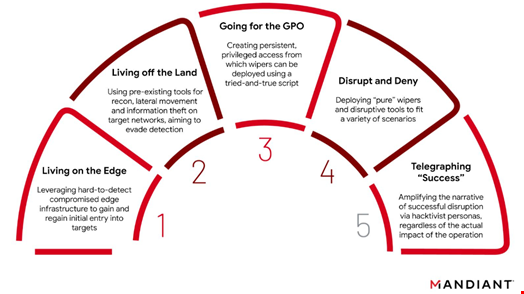
This playbook, crafted by the Russian military intelligence service (GRU), contains the following five operational phases:

  1. Living on the Edge: Leveraging hard-to-detect compromised edge infrastructure such as routers, VPNs, firewalls and email servers to gain and regain initial access into targets
  2. Living off the Land: Using built-in tools such as operating system components or pre-installed software for reconnaissance, lateral movement and information theft on target networks, likely aiming to limit their malware footprint and evade detection
  3. Going for the GPO: Creating persistent, privileged access from which wipers can be deployed via group policy objects (GPO) using a tried-and-true PowerShell script
  4. Disrupt and Deny: Deploying ‘pure’ wipers and other low-equity disruptive tools such as ransomware to fit a variety of contexts and scenarios
  5. Telegraphing ‘Success’: Amplifying the narrative of successful disruption via a series of hacktivist personas on Telegram, regardless of the actual impact of the operation

The GRU’s Disruptive Playbook. Source: MandiantThe GRU’s Disruptive Playbook. Source: Mandiant
Typically, after an initial reconnaissance, Russian cyber operations since the beginning of the war in Ukraine would start compromising systems with the ‘living on the edge’ phase. Then, the adversary would establish a foothold in the system, maintain its presence and escalate privileges with ‘living off the land’ methods. It would then combine these methods with group policy objects to move laterally and conduct further reconnaissance within the internal systems. Finally, it would deploy the malware (wipers, ransomware…) and launch a Telegram campaign to amplify the operation’s success at the same time.

A Deliberate Effort from the GRU to Go Quick and Dirty

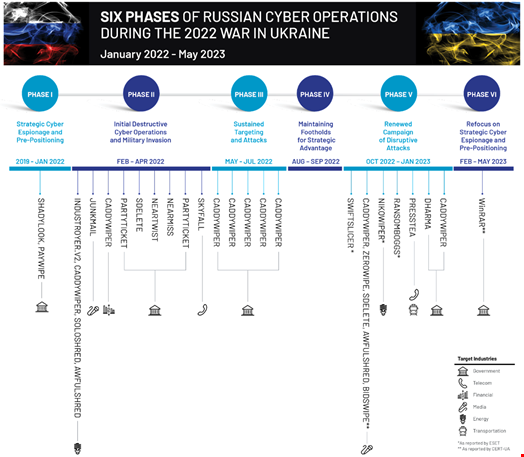
Mandiant has observed that this same playbook has been used by various threat actors throughout the six phases of the war identified by Mandiant researchers – five of which were outlined in Google Threat Analysis Group’s (TAG) February analysis, reported by Infosecurity.

This led Mandiant to confirm the GRU’s “central role in standardizing operations across multiple subteams in an attempt to deliver more repeatable, consistent effects,” the report reads.

Phases of Russian Cyber Operations during the war in Ukraine. Source: MandiantPhases of Russian Cyber Operations during the war in Ukraine. Source: Mandiant
As most phases aim to deploy and execute disruptive malware quickly while avoiding detection, Mandiant noted that the playbook is “notably suited for a fast-paced and highly contested operating environment, indicating that Russia’s wartime goals have likely guided the GRU’s chosen tactical courses of action.”   

The company also assessed “with moderate confidence that this standard concept of operations highly likely represents a deliberate effort to increase the speed, scale and intensity at which the GRU could conduct offensive cyber operations while minimizing the odds of detection.”

A Shift from Previous GRU Methods

Dan Black and Gabby Roncone, the report’s authors, also noted that while the general intent of the GRU is aligned with previous Russia-aligned cyber campaigns – “to irreversibly destroy data and disrupt the ability of target systems to function as intended” – the design of the disruptive malware the GRU has chosen to use during the war is substantively different from what was previously observed.

Read more on Mandiant’s 2023 M-Trends report

First, since the beginning of the war in Ukraine, Russian threat actors have shifted from deploying pure, sometimes pre-packaged, disruptive tools that can be used immediately – but that were usually not reused much – to multifunctional and highly reusable ones.

Second, the GRU has extended its use of “noteworthy political actors and hacktivist identities” in its disruptive playbook. From 2014 to 2018, Mandiant saw the emergence of several ‘personas’ (CyberBerkut, CyberCaliphate, Guccifer 2.0…) that allowed the GRU “to misdirect attribution and generate second-order psychological effects from their cyber operations.”

Since the beginning of the war in Ukraine, some new, self-proclaimed hacktivist groups have started appearing (CyberArmyofRussia_Reborn, XakNet Team,  Infoccentr…). These took a more active role than the previous category of personas: besides supporting the Russian regime, they actively amplified and exaggerated the impact of the cyber-attacks conducted by Russian hackers, and some were even observed to leak data from victims who were also affected by wiper attacks. All this primarily happened on Telegram, “which has emerged as a critical source of sensemaking, war-related information operations, and a key recruitment platform for volunteer cyber “armies” in the conflict,” wrote Mandiant researchers.

UNC3810 and CyberArmyofRussia_Reborn’s Links to the GRU

One notable example highlighted by Mandiant is the deployment of CaddyWiper in October 2022 by a threat group the cybersecurity firm tracks as UNC3810.

The researchers wrote: “In the final stage of the playbook, data from the victim of UNC3810’s wiper attack was staged and advertised on Telegram by ‘CyberArmyofRussia_Reborn,’ […] that claimed responsibility for the wiper attack. However, technical artifacts from the UNC3810’s intrusion indicate that the ‘CyberArmyofRussia_Reborn’ persona severely exaggerated the success of the wiper attack. Due to a series of operator errors, UNC3810 was unable to complete the wiper attack before the Telegram post boasting of the disrupted network. Instead, the Telegram post preceded CADDYWIPER’s execution by 35 minutes, undermining CyberArmyofRussia_Reborn’s repeated claims of independence from the GRU.”

According to Dan Black on Twitter, this operation failure shows the two groups’ “integrated forward planning and the Telegram channel’s high confidence links to the GRU.”

alt pitch: come for the Playbook, stay for the “oopsies” https://t.co/TfEFLV6eay

— Gabby Roncone 🌻 @gabr.bsky.social (@gabby_roncone) July 12, 2023

In its conclusion, Mandiant said it “anticipates that similar operational approaches, or ‘playbooks,’ may be mirrored in future crises and conflict scenarios where requirements to support high volumes of disruptive cyber operations are present.”

Categories
Saved Web Pages - Audio Posts

https://www.nytimes.com/2023/12/14/nyregion/mcgonigal-fbi-sentencing.html

Categories
Saved Web Pages - Audio Posts

Germany was a soft target for Russian spies. That’s changing fast.

In his statement on the case in December, the president of the BND, Bruno Kahl, said the success of the investigation would depend on ensuring as little information as possible became public. 

“Restraint and discretion are very important in this particular case. With Russia, we are dealing with an actor on the other side whose unscrupulousness and willingness to use violence we have to reckon with,” he said. “Every detail of this operation that becomes public means an advantage for this adversary in his intention to harm Germany.”

A former senior BND officer, Gerhard Conrad, said until the precise nature of the suspect’s job at the intelligence service is revealed publicly, it was too soon to assess any potential fallout from the alleged spying. “To have a reliable picture here, we would have to know the specific function of the accused employee,” said Conrad, now a visiting professor in intelligence studies at King’s College London.

Apart from the BND case, a German man was found guilty in November of passing information to Russia while working as a reserve officer in the German military.

German authorities are also examining whether two officials in Germany’s federal ministry of economics were spying for Russia, according to the newspaper Die Zeit. The officials under investigation worked on energy supply issues, possibly placing them at the center of pivotal decisions on the now-suspended Russian Nord Stream 2 natural gas pipeline to Germany. 

Germany’s Federal Office for the Protection of the Constitution, BfV, which is the rough equivalent of the FBI, declined to comment on the case.

The Federal Ministry for Economic Affairs and Climate Action said it could not comment directly on any specific case but said it works in close coordination with federal law enforcement authorities. On energy, the ministry has “completely overhauled the previous government’s Russia-friendly policy” to reduce Germany’s dependence on Russian natural gas, it said.

Angela Merkel, a Christian Democrat considered wary of friction with Russia, had served 16 years as chancellor before leaving office in 2021. Olaf Scholz of the left-leaning Social Democrats succeeded her as Germany’s leader, forming a coalition with the Greens and the Free Democrats.

‘The Russian services are relentless’

For more than two decades, Russia has waged an incessant and often successful campaign of spying and political warfare against Germany, infiltrating the country’s political elites and security services, according to former U.S. intelligence officers, current Western officials and members of Germany’s parliament.

“The Russians have invested massive time and effort into penetrating German institutions at all levels. The Russian services are relentless and have benefited from a weak counterintelligence atmosphere in Germany,” said John Sipher, a former CIA intelligence officer who worked for the agency’s clandestine service for 28 years and had postings in Europe, Asia and elsewhere.

“So, when you have a weak defense combined with a focused and relentless offense, you can expect that there are numerous sources inside the German government and business elite that are doing Moscow’s bidding,” he said.

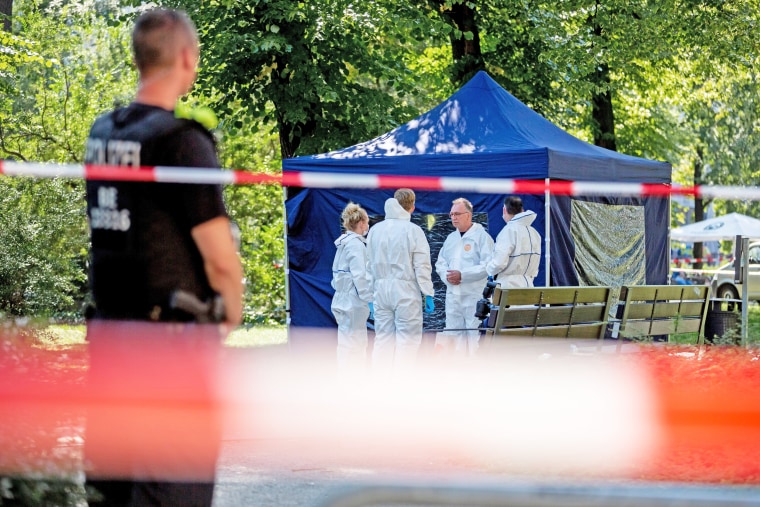
In 2019, a former Chechen separatist fighter was gunned down in Berlin’s Tiergarten park; a German court eventually convicted a Russian national who authorities said was an officer of the Russian FSB domestic intelligence service acting on orders from Moscow.

Forensic experts work at the site of a crime scene of the assassination of Zelimkhan KhangoshviliForensics experts work at the crime scene after the assassination of Zelimkhan Khangoshvili in Berlin in 2019.Christoph Soeder / DPA/AFP via Getty Images

Russia denied the allegations. In his trial, the convicted assassin, Vadim Kraskikov, denied he was acting on Moscow’s orders.

“The murder in the Tiergarten shows that Russia has the impression that Germany is so weak that they can commit a contract killing in broad daylight in the government quarter in Berlin,” said a member of the German parliament. “That tells you something.”

Germany consistently underestimated the Russian threat and gave counterintelligence work a low priority, but that is changing now in the wake of the Russian invasion of Ukraine, experts and Western officials said.

“It is clear that we must also take a completely different approach to counterintelligence than we have in the past,” von Notz said. “We have been drawing attention to this for a long time. In view of the sharp increase in security threats following Russia’s war of aggression in Ukraine, which violated international law, we must act very decisively.”

Conrad, the former BND officer, said decision-makers in Germany failed to heed concerns repeatedly raised by the security services about Berlin’s approach to Russia in the past, including relying on Russian natural gas imports.

“The services have been the unheard admonishers here for years,” Conrad said.

The German government has proposed plans to overhaul the intelligence service to give it more funding and clearer legal authority to carry out its mission.

The BND has been hampered by a lack of resources, with its technology lagging behind many of its partners, and a cumbersome legal framework that makes countering adversaries inside Germany extremely difficult, according to Conrad and other experts.

“The BND law does not meet the current needs,” Krieger said.

German Foreign Minister Annalena BaerbockGerman Foreign Minister Annalena Baerbock.Tobias Schwarz / AFP via Getty Images file

Given the country’s Nazi past and the totalitarian legacy of Soviet-controlled East Germany, politicians have been reluctant to empower German security services and have sought tough safeguards for privacy and civil liberties. German leaders, painfully aware that Germany invaded Russia in World War II, have also tried to avoid confrontation and hoped economic ties could reduce tensions. But the invasion of Ukraine has triggered a political sea change, with Berlin now providing artillery and tanks to Kyiv while backing sanctions on Russia’s economy.

Last April, Berlin expelled 40 Russian Embassy employees for allegedly working for Russian intelligence services. In announcing the move, German Foreign Minister Annalena Baerbock said the employees “have worked every day against our freedom and against the cohesion of our society here in Germany.” 

Western officials and former U.S. intelligence officers called the expulsions and the current investigation of the BND employee a positive sign that shows Berlin’s attitude has shifted. 

“This government is serious about dealing with it,” a Western official familiar with the issue said. 

Germany’s intelligence services failed to anticipate that Russia would invade Ukraine, a failure that has yet to be the subject of any publicly released “lessons learned” review. Such a review would show Germany is serious about altering its approach, the Western official said.

“There’s definitely a change. The question is, how far do they take it?”

Categories
Saved Web Pages - Audio Posts

A German intelligence officer sold classified intelligence data about Ukraine to the FSB for 800,000 euros

Share this article

The trial of 52-year-old Bundeswehr Colonel Karsten L. has begun in the Sixth Senate of the Higher Court of Berlin. He headed the security department of the German Federal Intelligence Service (BND).

He is accused of treason and disclosing classified information to Russian intelligence services. Along with him, the trial includes a diamond trader and a former Bundeswehr soldier, Arthur E. The trial is expected to last until at least the summer, with plans to hold 51 hearings during this time. The case involves 40 volumes of documents, according to BILD.

According to the investigation, the accused individuals sold key intelligence data about the war in Ukraine to the FSB, receiving over 800,000 euros for it. BILD reports that within the BND, this is considered one of the most serious cases of treason in the history of the FRG, and the extent of the damage is immeasurable. Karsten L. was arrested in Berlin on December 21, 2022. The BND had been hunting for him for a week, and crucial information came from the intelligence services of a friendly state.

As reported by Spiegel, Karsten L. initially gained access to a closed chat of the Wagner private military company (PMC), took screenshots, and handed them over to the FSB. He then made 73 pages of screenshots of internal BND chats. Arthur E. took them to Moscow and received money for it.

Karsten L. refuses to testify. According to BILD, he continues to receive a monthly salary of 7,613 euros from the state. Colleagues believe that his act of betrayal was driven by disagreement with the migration and economic policies of the German authorities.

Categories
Saved Web Pages - Audio Posts

Videos show massive lines for eggs in Russia as prices skyrocket

Russian citizens, amid rising inflation and increased import costs, are struggling to get their hands on a household staple: a carton of eggs.

The price for eggs has risen 42.4 percent since the start of the year, according to a report by Reuters, citing Moscow’s federal statistics service. Experts say that the spike in cost is an indirect result of the Western sanctions placed against Moscow since the start of the war in Ukraine, and it comes as support for Russian President Vladimir Putin‘s February 24, 2022, invasion of Ukraine is falling among his citizens.

Videos Show Massive Lines for Eggs inRussia

A customer holds a pack of chicken eggs in a shop in Moscow, Russia, on December 11, 2023. The cost of eggs has risen by more than 40 percent in the last year in Russia.
ALEXANDER NEMENOV/AFP via Getty Images

Videos on social media this week have shown Russians waiting in long lines to buy cartons of eggs from local stands instead of paying the marked-up prices at the supermarket.

In one such clip shared to X, formerly Twitter, which was also used in a Monday report by the Russian-language broadcaster Current Time TV, people stand in line at a small outdoor market amid a lightly snow-covered ground while bundled in winter coats and hats.

An egg crisis is starting to “boil” in Russia and in occupied Crimea.In Belgorod, huge queues lined up for cheap eggs. People began to gather as early as 7am, despite the frost.

Some stores even introduced restrictions on sales: you can buy no more than 20 eggs per customer. pic.twitter.com/FYQPwdpphk

— War_Watcher 🇺🇦🇬🇧 (@war_crimes_uk) December 10, 2023

Another clip shared by the X user Jack Ryan showed people in a long line waiting to buy cartons of eggs from the back of a semi-truck trailer. According to Reuters, prices at Russian supermarkets can sometimes be more than double what the smaller markets are selling cartons of eggs for.

In the southern city of Belgorod, people waited in line at a small market to buy 10 eggs for 65 rubles ($0.72), compared to the supermarket price of 10 for 150 rubles ($1.67), according to the report.

Putin desires to bring back the USSR and russians are getting a taste of the glory days already.

Due to a nationwide egg shortage russians stand in long lines in hopes of getting a few dozen eggs this winter.@Prune602 has some good threads about labor shortages across russia. pic.twitter.com/huzL5KNjOx

— Jack Ryan 🇺🇸🇺🇦 (@jackryan212) December 10, 2023

Moscow resident Yelizaveta Shalayevskaya told Agence France-Presse (AFP) on Monday that she was “horrified” by the rising costs.

“What’s going on with the prices is a nightmare, and not just for eggs, but for everything,” she said.

Ilya Zarubin, a 21-year-old student, told AFP that she “used to buy eggs for 70 rubles at the shop, now it costs around 130-140.”

Marina Petrova, the chief executive officer of the Moscow-based firm Petrova Five Consulting, told Current Time TV that the rise in egg prices was caused by the rise in prices of poultry feed and veterinary products, an impact of the Western sanctions on goods imported into Russia.

The Russian Ministry of Economic Development announced on Wednesday that imports of eggs will be exempt from duty tax for the first six months of 2024 to boost shops that are running low on supplies. Imports are allowed to be sourced only from “friendly countries,” meaning those that have not imposed sanctions on Russia.

“The decision will help in the short term to balance the domestic market of eggs and ensure supply growth,” the ministry said, according to Reuters.

Putin has said that he is “surprised” by his citizens’ economic struggles and has maintained that Moscow’s economic sector is thriving despite being the world’s most sanctioned economy. Last month, however, annual inflation in Russia stood at 7.48 percent. For comparison, inflation is 3.1.

Newsweek reached out to Russia’s Foreign Ministry for comment.

Newsweek is committed to challenging conventional wisdom and finding connections in the search for common ground.

Newsweek is committed to challenging conventional wisdom and finding connections in the search for common ground.


Kaitlin Lewis

Kaitlin Lewis is a Newsweek reporter on the Night Team based in Boston, Massachusetts. Her focus is reporting on national news and politics, where she has covered events such as the 2022 Midterm Election, live campaign rallies and candidate debates for Newsweek. She also covers court and crime stories. Kaitlin joined Newsweek in May 2022 as a Fellow before starting full time in September 2022. She graduated from the University of Dayton and previously worked as a breaking news intern at the Cincinnati Enquirer. You can get in touch with Kaitlin by emailing k.lewis@newsweek.com. Languages: English.

Kaitlin Lewis is a Newsweek reporter on the Night Team based in Boston, Massachusetts. Her focus is reporting on national …
Read more

To read how Newsweek uses AI as a newsroom tool, Click here.

Categories
Saved Web Pages - Audio Posts

Putin insists there will be no peace in Ukraine until his goals are achieved

?url=https%3A%2F%2Fcalifornia-times-brig

MOSCOW — 

Russian President Vladimir Putin vowed Thursday that there would be no peace in Ukraine until his goals are achieved and said those objectives remain unchanged.

Offering rare detail on Moscow’s operation, Putin dismissed the need for a second wave of mobilization of reservists, saying at a year-end news conference that there are some 617,000 Russian troops currently in Ukraine, including around 244,000 soldiers who were called up to fight alongside professional Russian military forces.

The Russian president, who has held power for nearly 24 years and announced recently that he was running for reelection, was greeted with applause as he arrived in the hall in central Moscow.

Putin did not hold his traditional news conference last year after his military failed to take Kyiv and as the Ukrainian army recaptured swaths of territory in the east and south of the country. But with Ukrainian President Volodymyr Zelensky pleading for U.S aid, a stalling counteroffensive and reports of fracturing Western support for Ukraine, Putin decided to face the media once more — though the broadcast remains heavily choreographed and more about spectacle than scrutiny.

This year, ordinary citizens had the chance to phone in questions along with those asked by journalists; Russians also submitted questions over the last two weeks. It was the first time Putin, who has heavily limited his interaction with foreign media, potentially faced multiple questions from Western journalists since before the fighting in Ukraine began.

The news conference opened with questions about the conflict in Ukraine and highlighted concerns some Russians have about fears of another wave of mobilization, which has proved unpopular. In September 2022, Putin ordered a partial military call-up as he tried to boost his forces in Ukraine, sparking protests.

“There is no need,” for mobilization now, Putin said, because 1,500 men are being recruited into the Russian army every day across the country. He said that, as of Wednesday evening, 486,000 soldiers have signed a contract with the Russian military.

Putin reiterated that Moscow’s goals in Ukraine — “de-Nazification, de-militarization and a neutral status” of Ukraine — remain unchanged.

He spelled out those objectives the day he sent troops to the country in February 2022.

“De-Nazification” refers to Russia’s allegations that the Ukrainian government is heavily influenced by radical nationalist and neo-Nazi groups — claims derided by Kyiv and the West. Zelensky, Ukraine’s president, is Jewish.

Putin has also demanded that Ukraine remain neutral — and not join the NATO alliance.

“There will be peace when we will achieve our goals,” Putin said.

The Kremlin has repeatedly said that its “special military operation” in Ukraine would continue until those loosely defined goals were achieved.

In addition to skipping his usual call-in show with ordinary Russians and his traditional session with reporters last year, Putin’s annual state-of-the-nation address was delayed until February of this year. His last news conference was in 2021 amid U.S warnings that Russia was on the brink of sending troops into Ukraine.

Putin’s annual appearance is primarily aimed at a domestic audience and is a chance for him to personally resolve the problems of ordinary Russian citizens and reinforce his grip on power ahead of the March 17 election.

Putin fielded questions Thursday from a group of children in Russian-annexed Crimea concerned about the leaking roof and mold in their gymnasium and a woman who, addressing “my favorite president,” complained about the spiking price of eggs.

“I regret and apologize about that — a glitch in the work of the government,” Putin said, explaining that egg production had not matched demand and blaming the government for not increasing imports quickly enough.

State media said that as of Wednesday, about 2 million questions for Putin had been submitted ahead of the broadcast.