Categories
Saved Web Pages - Audio Posts

Revisiting World War 2 through the Lens of Psychology : World Social Psychiatry

SocialThumb.02251709-202103020-00000.CV.

Bhattacharjee, Debanjan; Agrawal, Adesh Kumar; Gowda, Guru S.

Author Information

Department of Psychiatry, National Institute of Mental Health and Neurosciences, Bengaluru, Karnataka, India

Address for correspondence: Dr. Debanjan Bhattacharjee, Department of Psychiatry, National Institute of Mental Health and Neurosciences, Hosur Road, Bengaluru – 560 029, Karnataka, India. E-mail: [email protected]

Received May 10, 2021

Accepted July 21, 2021

This is an open access journal, and articles are distributed under the terms of the Creative Commons Attribution-NonCommercial-ShareAlike 4.0 License, which allows others to remix, tweak, and build upon the work non-commercially, as long as appropriate credit is given and the new creations are licensed under the identical terms.

World War 2 (WW2) has witnessed the rise of influential personalities such as Hitler, Mussolini, Stalin, Churchill, and Roosevelt. Many causes have been recorded in a history as causes of WW2; however, we argue that there has been complex psychological interaction between the leaders involved in the background of a crisis charged with paranoia and anxiety. Personality factors of the leaders probably helped as a catalyst in setting a cascade of events that resulted in mass causality. We discuss the psychological aspect of WW2 taking examples of few involved personalities.

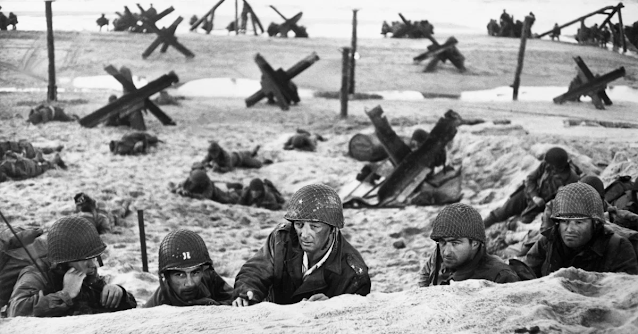
War is an armed conflict between groups having common factors in terms of identity, sense of solidarity between individuals, and personality (high neuroticism, extraversion, and low affability).[1,2,3] Among wars that happened in history, World War 2 (WW2) stood out and was considered the deadliest against the human race and the year 2020 marks the 75th anniversary of the official end of WW2. It began in Europe in 1939, and later included America and Asia, and became a global war. Several possible causes and theories of WW2 have been documented in history such as contemporary dynamic relationships, social, political, and economic problems. Here, we briefly relook into (a) the rise of several famous and powerful personalities such as Adolf Hitler, Joseph Stalin, Winston Churchill, Franklin D Roosevelt, and Benito Mussolini in the sense of an atmosphere of uncertainty and anxiety in European countries; and (b) the perception of complex relationships between leaders through the psychological lens in the setting of a cascade of events in WW2.

PRELUDE

Both Germany and Italy experienced economic downturns after WW1, resulting in low self-esteem, identity, and negative psychological impact.[4,5,6,7] Both of these trends have led to mistrust of civic and political activities and decreased organizational and social operations.[5] Citizens are deprived of meaning and basic needs and have other similarities in terms of what they want to achieve. They can easily be inspired by the charismatic speech and personality of Adolf Hitler in Germany and Benito Mussolini in Italy. Both charismatic personalities raise hope in the countrymen for the crisis of collective self-identity that was lost in the aftermath of the First World War.[8,9] Hence, it was possible for Hitler in Germany and Mussolini in Italy to rise and become a powerful political leader. There can be an additional psychological underpinning basis of rising in power of both Hitler and Mussolini in Europe.

PERSONALITY AND FASCISM

Hitler had an authoritarian father, was more attached to his mother, and frequently witnessed family violence. He had many traumatic experiences with his father who used to become immediately violent and the attachment with his father has been described as an anxious-avoidant one.[10] Retrospectively, using the Coolidge Axis II inventory to understand Hitler’s personality, highest T scores were observed in paranoid, antisocial, narcissistic, and sadistic personality disorders.[11] His aggressive, antisocial, and dominant personality may have evolved from his complex family interactions. Hitler’s entry into political career occurred at the time of his adolescence which Erikson mentions as the period where individuals try to find an identity and his antisemitic ideas and other political ideologies can be conceptualized as a way to resolve the identity crisis by the age of 30 years.[12] According to Erich Fromm, Hitler failed to resolve his oedipal complex and transferred his unconscious desires onto his motherland Germany with a preoccupation of creating lebensraum and the eradication of Jews. Like Hitler, Mussolini has been described as malignant narcissistic.[13] Jung met both Hitler and Mussolini and found Mussolini to be warm and energetic as opposed to Hitler.[11] Mussolini on the other struggled from being a street-corner orator to the head of the government addressing thousands in crowds and emerged as a powerful orator and established fascism. On similar lines, fascism has been described to be based on mass psychology and a personality with a mixture of paranoid, aggressive, and schizoid personality traits.[14,15]

ONSET OF THE WAR

Winston Churchill led Britain whereas Germany and Italy were led by Hitler and Mussolini respectively. There were a hostile and uncertain environment and an increasing sense of paranoia among European leaders before the Second World War.[16] On September 3, 1939, in reaction to Hitler’s invasion of Poland, Britain, and France, both allies declared war on Germany. Churchill has been described as a Type I leader with great charisma and discipline. He had perfectionism and a great drive for power and aggression. Being a great motivational speaker with his famous V sign, he could move masses against the enemies.[17] Furthermore, his belief in his greatness and his tendency to project that view onto his country has been described as adaptive forms of narcissism or healthy narcissism as described by Kohut.[18] The act of war and aggression between Britain and Germany can be seen as a disturbance of the narcissistic equilibrium between Hitler and Churchill. In personality dynamics, projective identification occurs when a subject has an affect or impulse that he or she finds unacceptable and projects onto someone else as if it was really that other person who originated the affect or impulse.[19] Individuals with narcissism have fragile self-esteem and get easily hurt and threatened. They react by going to their grandiose self-image, especially in the background of insecurity and paranoia. Kohut described narcissistic rage in relation to aggression where individuals need to control their environment, go for revenge, and turn from a passive sense of victimization to an active role of giving pain to others when there is a disturbance in the narcissistic equilibrium. The rage is directed to a person who is in a self-object relationship with a narcissistic individual.[20] Later in1940, Mussolini from Italy joined with Hitler facing the threat of losing. In the face of threat, narcissistic individuals face unpleasant arousal which makes them get close to others for protection which can explain Mussolini’s behavior, Both Hitler and Mussolini had similar philosophies in terms of their concern for conquest and personality. Besides, both had a mutual idealization and recognition where both the self and the object admire each other in terms of narcissistic transference.[21]

THE GERMANRUSSIA CONFLICT

The phenomenon of mutual idealization and recognition has also been observed between Hitler of Germany and Stalin of Russia, who evolved as a dictator in Soviet Russia in the mid-1920’s. Both of the countries signed The Molotov–Ribbentrop Pact which was a nonaggression pact. Stalin identified himself with Hitler and had admired each other on several occasions.[22] Stalin had a turbulent childhood where he was often traumatized by the disturbing relationship between his parents and witnessed violence and also faced the same. All these led him to have a negative self-image and an inferiority complex which he used to overcome by inflating self-esteem also described as malignant narcissism.[13,22,23,24] His narcissism was malignant to such an extent that he bluntly ignored the warnings from various sources of impending Nazi invasion of Russia.[13] This also highlights the importance of what mutual idealization has in a narcissistic relationship. However, he was also paranoid about Hitler about his relationships with Britain. Psychodynamically, paranoia originates in the development of an object relationship with the father and needs to maintain personal autonomy and can be activated by any anxiety-producing situations. The affected person identifies himself with the father who is the aggressor. Narcissism and the inner low self-esteem create a conflict in the unconscious mind. This phenomenon was quite common between both Stalin and Hitler.[22] The relationship between Hitler and Stalin started deteriorating following Molotov’s visit to Germany in 1940. Hitler got agitated by Molotov’s approach, who represented Russia and Stalin. Subsequently, Hitler attacked Russia. As in mutual idealization and recognition, if the other stops admiring or supporting then the self feels humiliated and can get expressed as aggression as a psychological phenomenon out of disturbance of narcissistic.[21] This phenomenon can explain the aftermath of Molotov’s visit to Germany.

AMERICA’S INVOLVEMENT

Franklin D Roosevelt, a contemporary of Hitler and Stalin, has been described as a master of public psychology. On personality assessment, he scored low in neuroticism and his focus was predominantly on the individual needs of people.[25] While other European countries adopted an aggressive approach, Roosevelt’s ability in calming fear and anger was one of his important achievements which can be viewed as an existential approach.[26] We see Roosevelt’s delay indirectly involving in the war during the crisis until Pearl Harbor was attacked by Japan which can be attributed to his low neuroticism as it is negatively associated with aggression.

AFTERMATH OF WORLD WAR 2

Post-WW 2 gave rise to a bipolar world with a conflict between America and the Soviet Union commonly referred to as the Cold War, where psychological warfare had a prominent role which was again shaped by the personalities of concerned leaders along with their ideological differences. This was followed by the fall of the Soviet Union and rise of American hegemony and the creation of a unipolar world.[27,28] The fight for predominant polarity has continued since then, and the personalities of the world leaders and ideological differences shape the foreign policies of individual countries. Hence, multilateral diplomacy and major conflicts in the recent past between nations need to be examined on a psychosocial basis.

CONCLUSION

Although there were various economic and political causes which might have resulted in WW2, we argue that there were obvious psychological factors behind WW2. As war is an act of aggression and violence and aggression is a psychological phenomenon which is influenced by personality. Although it will be unwise to determine the personality of anyone without personally meeting them, most of the leaders had deficits in some or other domains of personality functioning. We see how personality functioning can influence interpersonal dynamics and mass psychology. We also highlight Kohut’s theories on self-psychology and narcissistic rage in aggression and Erikson’s views on self-identity. Early-life anxieties and conflicts can lead to dysfunctional personality and aggressive behavior which is important to be identified.[29] WW2 may have been the outcome of these complex dynamics within them and between them, on one side a want to conquer and on the other side a psychological threat from the opponent to protect their state.[22] The contemporary situation in Europe and interpersonal dynamics has been a catalyst in setting the cascade of events in WW2 and hence personality functioning becomes an important aspect of an individual’s life and can have both positive and negative consequences.

Financial support and sponsorship

Nil.

Conflicts of interest

There are no conflicts of interest.

1. Hinde RA. War: Some psychological causes and consequences Interdiscip Sci Rev. 1997;22:229–44
2. Cavalcanti JG, Pimentel CE. Personality and aggression: A contribution of the General Aggression Model Estudos de Psicologia (Campinas). 2016;33:443–451
3. Dam VH, Hjordt LV, Da Cunha-Bang S, Sestoft D, Knudsen GM, Stenbæk DS. Five-factor personality is associated with aggression and mental distress in violent offenders European Neuropsychopharmacology. 2018;28:S35–S36
4. . Economic Collapse and the Rise of Fascism, 1920–33 from A People’s History of Modern Europe on JSTOR n.d.Last accessed on 2020 Oct 30 Available from: https://www.jstor.org/stable/j.ctt1c2crfj0.14?seq=1#metadata_info_tab_contents
5. Mood C, Jonsson JO. The social consequences of poverty: An empirical test on longitudinal data Soc Indic Res. 2016;127:633–52
6. Van Riel A, Schram A. Weimar economic decline, Nazi economic recovery, and the stabilization of political dictatorship The Journal of Economic History. 1993;53:71–105
7. Vetter S, Endrass J, Schweizer I, Teng HM, Rossler W, Gallo WT. The effects of economic deprivation on psychological well-being among the working population of Switzerland BMC Public Health. 2006;6:223.
8. Lindholm C. Charisma, crowd psychology and altered states of consciousness Cult Med Psychiatry. 1992;16:287–310
9. Templeton A, Drury J, Philippides A. From mindless masses to small groups: Conceptualizing collective behavior in crowd modeling Rev Gen Psychol. 2015;19:215–29
10. Hyland P, Boduszek D, Kielkiewicz K. Psycho-historical analysis of Adolf Hitler: The role of personality, psychopathology and development Psychology and Society. 2011;42:58–63
11. Coolidge FL, Davis FL, Segal DL. Understanding madmen: A DSM-IV assessment of Adolf Hitler Individual Differences Research. 2007;5:30–43
12. Cohan AS. Politics and psychoanalysis: The sources of Hitler’s political behavior Br J Int Stud. 1975;1:160–75
13. Glad B. Why tyrants go too far: Malignant narcissism and absolute power Political Psychology. 2002;23:1–2
14. Eckhardt W. The Values of Fascism J Soc Issues. 1968;24:89–104
15. Iezzi F. Benito Mussolini, crowd psychologist Quarterly Journal of Speech. 1959;45:166–170
16. Drabkin IS. “ Hitler’s War” or” Stalin’s War”? Journal of Russian & East European Psychology. 2002;40:5–30
17. Kennedy, Lee Paula. “Some psychological aspects of Winston Spencer-Churchill” Student Work. 1960;391 https://digitalcommons.unomaha.edu/studentwork/391 (last accessed 7 Aug 2021.
18. . Pathological Narcissism and Its Relationship to Empathy and Transcendence on JSTOR n.d.Last accessed on 2020 Oct 30 Available from: https://www.jstor.org/stable/20708878?seq=1
19. Klimstra TA, Hale III WW, Raaijmakers QA, Branje SJ, Meeus WH. A developmental typology of adolescent personality European Journal of Personality: Published for the European Association of Personality Psychology. 2010;24:309–323
20. Robertson J, Robertson J. Young children in brief separation: A fresh look The psychoanalytic study of the child. 1971;26:264–315
21. Dimaggio G, Fiore D, Lysaker PH, Petrilli D, Salvatore G, Semerari A, Nicolo G. Early narcissistic transference patterns: An exploratory single case study from the perspective of dialogical self theory Psychology and psychotherapy: Theory, research and practice. 2006;79:495–516
22. Birt R. Personality and foreign policy: The case of Stalin Political Psychology. 1993;1:607–625
23. Prince C. A Psychological Study of Stalin J Soc Psychol. 1945;22:119–40
24. Luo J, Zheng J. The impact of servant leadership on proactive behaviors: A study based on cognitive evaluation theory Psychology. 2018;9:1228.
25. Lichtenberg BM. American presidents, their personal and psychological characteristics, and their uses of military force (2017) Graduate Theses and Dissertations. 15347. https://lib.dr.iastate.edu/etd/15347 (last accessed 7 Aug 2021).
26. Schwartz RE, Franklin D. Roosevelt’s Psychological Contribution to the United Nations Syracuse J. Int’l L. & Com. 2005;33:213.
27. Greenstein FI. The impact of personality on the end of the cold war: A counterfactual analysis Polit Psychol. 1998;19:1–16
28. Holmes ME. Anglo-American Psychology in the Cold War Oxford Research Encyclopedia of Psychology. 2020 Available from: https://oxfordre.com/psychology/view/10.1093/acrefore/9780190236557.001.0001/acrefore-9780190236557-e-610. [Last acessed on 2021 Jul 09].
29. Shapira M. The Hitler inside War Insid.. 2013 Cambridge Cambridge University Press:87–111
Keywords:

Interpersonal dynamics; mass psychology; personality; World War 2

© 2021 World Social Psychiatry | Published by Wolters Kluwer – Medknow

Categories
Saved Web Pages - Audio Posts

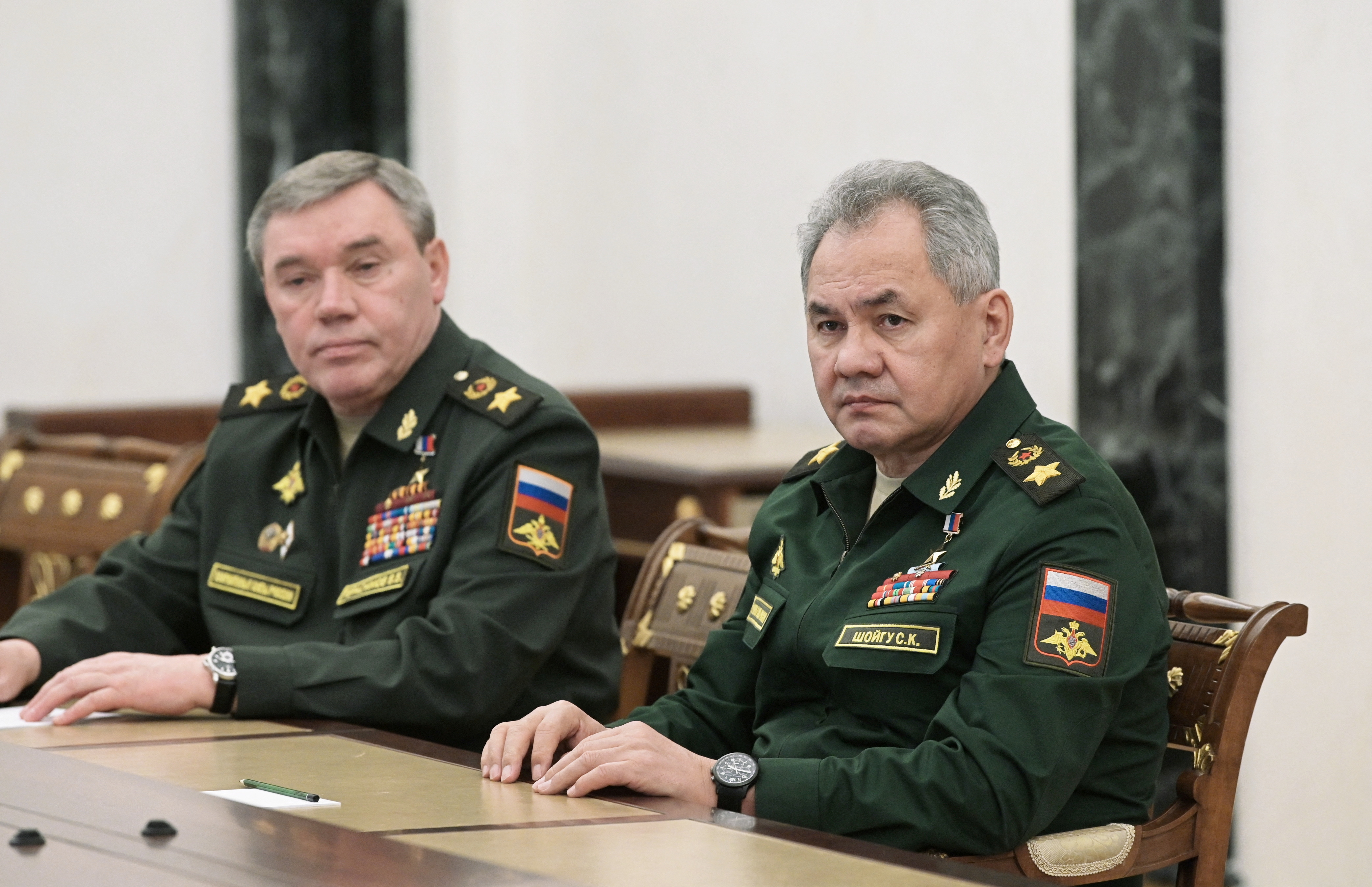
International Criminal Court issues arrest warrants for Russia’s Shoigu and Gerasimov

Russian President Vladimir Putin meets with Defence Minister Sergei Shoigu and Chief of the General Staff of Russian Armed Forces Valery Gerasimov in Moscow
Russian Defence Minister Sergei Shoigu and Chief of the General Staff of Russian Armed Forces Valery Gerasimov attend a meeting with Russian President Vladimir Putin in Moscow, Russia February 27, 2022. Sputnik/Aleksey Nikolskyi/Kremlin via REUTERS/File Photo Purchase Licensing Rights, opens new tab

THE HAGUE, June 25 (Reuters) – The International Criminal Court issued arrest warrants for Sergei Shoigu, the former Russian defence minister, and leading Russian general Valery Gerasimov on Tuesday for alleged crimes committed during Russia’s invasion of Ukraine.

In a press release, the court said judges had found there were “reasonable grounds to believe that the two suspects bear responsibility for missile strikes carried out by the Russian armed forces against the Ukrainian electric infrastructure from at least 10 October 2022 until at least 9 March 2023”.

The Russian officials were suspected of having committed war crimes and crimes against humanity for directing attacks against civilians and civilian objects in Ukraine.

Russia, which like Ukraine is not a member of the ICC, has repeatedly said Ukraine’s energy infrastructure is a legitimate military target and denies targeting civilians or civilian infrastructure.

Sign up here.

Reporting by Benoit Van Overstraeten and Stephanie Van den Berg; Editing by Alison Williams and Alex Richardson

Our Standards: The Thomson Reuters Trust Principles., opens new tab

Categories
Saved Web Pages - Audio Posts

On the New Abwehr Hypothesis | The Russia And Ukraine News – The News And Times

The New Abwehr Hypothesis of Operation Trump by Michael Novakhov: A Psycho-Historical Study - Web Review - 2:09 PM 1/4/2019

More on the New Abwehr Hypothesis

 Investigate the Investigators!

GRU, the Russian Military Intelligence masks as FBI – (?!). Do we know about it? Do we think about it? | Suspect in Capitol car attack posted about fears of FBI and CIA week before ramming officer. | M.N.: FBI: Declassify and disclose all the background information on Noah Green.  His name might also be a “telling name”. Those who are in the know might guess what it means.  Try to unravel the mysteries of the situation by examining closely this person’s life and his connections. 

“The same day, Green uploaded an image of a certificate that appeared to recognize a gift he had made to the Nation of Islam of $1,085.” 

M.N.: This number: $1,085 is odd (not the usual even number, such as $1,000, $2,000, etc.), therefore it might contain the message; I think, most likely it points to a year in the World History: year 1085. The most notable events of that year in history appear to be: 1. Completion of the “Domesday Book“, and 2. The beginning of the introduction of the paper money in China: The output of copper currency for the Chinese Song Dynasty reaches 6 billion coins a year, prompting the Chinese government to adopt the world’s first paper-printed money later in the 1120s.’

Both events can be viewed as the references and allusions to the present day situations and circumstances: “the doomsday scenario” for the Western Civilization and the “America as the global monetary printing press“. 

The allusions to the WW2 may also be present: The Operation Doomsday of the WW2. 

These allusions and references lift the veil (deliberately semitransparent) over the minds, mentality, and the backgrounds of the putative masterminds of these hypothetical intelligence operations. In my opinion, humble or not, they are the leaders and the functionaries of the New Abwehr, the hypothetical construct which I use in the attempts to analyze and to understand these phenomena. This point of view is supported by the the quite visible activization of the Extreme Rightist and the frankly Fascist political and social movements and groups. 

The twist in this concept is that after the WW2 the remnants of the Nazi Abwehr adopted the anti-Hitler and the anti-Nazi stance, outlooks, and “ideologies”, placing them in the Leftist camp. However, the New Abwehr stays high above all the transient political plays and frays, it is concerned mostly with the overcoming the effects of the formal German defeat in the WW2 and their many feelings of guilt, sorrows, recriminations, post mortem analyses, repetition compulsions elements, rationalizations, etc., etc. Their main preoccupations are the German dominance in the World, the new World order (“my way”, anyway),  and the global political and economic matters which are their tools in governing the World. 

This concept of mine may be right or wrong but it has to be considered and explored further, if we really want to get to the Truth. 

Michael Novakhov | 8:42 AM 4/4/2021 – Post Link

Was Noah Green the weaponized target of the GRU (Russian Military Intelligence) which is masked as the FBI Cointelpro? – Google Search 

Just like the scores of others involved in the similar incidents and accidents? 

Does the FBI investigate this hypothesis? 

Post Link

Red Hood and the Bad Gray Wolf – Google Images

Suspect in Capitol car attack posted about fears of FBI and CIA week before ramming officer

Categories
Saved Web Pages - Audio Posts

Russians report 5 killed and over 120 injured after attack on Sevastopol – video

Russians report 5 killed and over 120 injured after attack on Sevastopol – video

A moment of strike on Sevastopol beach. Screenshot: video on social media

The Russian occupation authorities of Crimea and the Ministry of Defence of the Russian Federation have claimed a Ukrainian attack on Sevastopol, which killed five people, including three children, and injured over 120 others.

Source: Mikhail Razvozhayev, the so-called governor of Sevastopol, on Telegram; Russian Defence Ministry on Telegram; Russian state-owned news agencies RIA Novosti, TASS

Advertisement:

Details: The Russian Ministry of Defence reported an alleged attack on “the civilian infrastructure of the city of Sevastopol with US-supplied ATACMS tactical missiles equipped with cluster warheads”.

Russia’s Defence Ministry also acknowledged that civilian casualties had occurred due to Russian air defence operations.

“During the repulsion of the terrorist attack, four US-made ATACMS missiles were shot down by the on-duty air defence units. Another missile deviated from its flight path due to the impact of air defence systems at the final stage, with its warhead exploding in the air above the city,” the ministry said.

Civilians have been injured, Russia’s Ministry of Defence says, “due to the fall of shrapnel from cluster submunitions”.

Mikhail Razvozhayev, the so-called governor of Sevastopol, confirmed three deaths, including two children, and over 100 injuries.

He also lamented that the strike took place on Holy Trinity Day, despite the fact that the Russian Federation attacked Ukraine all the same, specifically Kyiv Oblast and Kharkiv, both day and night.

The assistant to the Russian health minister stated that the attack on Sevastopol injured 124 people, including 27 children.

According to social media, people were killed on Sevastopol’s Uchkuyivka beach.

Yuri Grishan, the mayor of Magadan, stated that the attack killed the daughter of Magadan’s deputy mayor, Oleg Averyanov, who was on holiday with her parents in Sevastopol, according to TASS.

Later, Razvozhaev claimed that the number of people who were injured had risen to five, out of whom three were children. 

In addition, he stated that five children are in intensive care, while the rest of the people affected by the attack received injuries of light and moderate severity.

Background:

This news has been updated since publication.

Support UP or become our patron!

Categories
Saved Web Pages - Audio Posts

Leaks of findings from Oct. 7 IDF probe show: Friendly fire incidents, hesitation to fight

602229

Officially, the IDF probes on October 7 will only be disclosed to the public in mid-July. On Wednesday, Channel 12 reported leaks of some of the key findings; the IDF, notably, did not deny the report.

Although the IDF also did not confirm it, the military has been aggressive in its denials of other leaks about failures related to October 7, so the complete silence in the face of this latest report is telling.

According to the report, the probe will find numerous cases of friendly fire errors leading to tragic deaths, groups of IDF soldiers who were too hesitant to confront Hamas invaders (as still others rushed to fight without being formally summoned), higher-up commanders ordering some groups of soldiers to remain in a reserve second-line capacity – when they should have headed into the front, and not knowing how to handle complex battlefield questions involving a hostage situation in Be’eri.

One of the consequences of the findings to date – some of which are final, while others are interim – could be a freezing of the promotion of Brig.-Gen. Barak Hiram to the post of commander of the Gaza Division.

Barak Hiram (credit: IDF SPOKESPERSON UNIT)

He has been one of the most controversial commanders in this war since he allegedly gave orders to fire on residential units that included both Hamas terrorists and hostages, potentially killing a dozen hostages.

Even this narrative is debated, as his attack order may have been focused on saving his soldiers who were under fire. It is also unclear whether there was any other way to secure the hostages’ release without attacking their Hamas captors.

Some hostage families would raise an outcry if he were posted to the Gaza Division command, while many military personnel would object if he were not, given his overall success rate and record.

On June 5, the IDF announced that it would release its probes on a rolling basis in July and August.

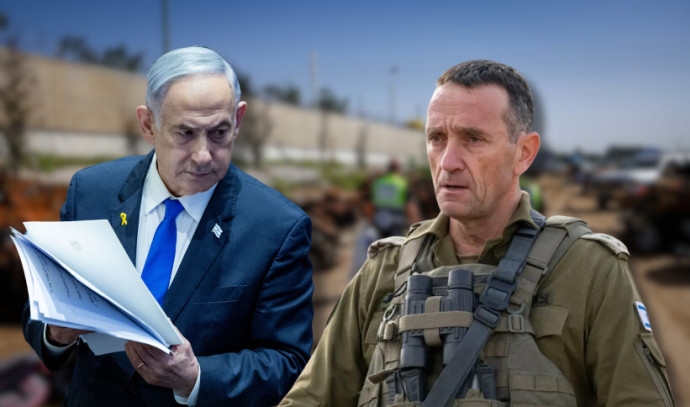
Aspects will be presented by key officers to IDF Chief of Staff Lt.-Gen. Herzi Halevi in early July and will be available to the public late summer after they are integrated with other issues.

Details of the probe 

It will examine everything relating to the Gaza concept and the security establishment’s outlook on it back to 2018.

The IDF has said it expects probes to look even further back in time, as part of a state inquiry and State Comptroller report. If the military itself went back beyond 2018 though, it would mean delaying the publication, which would be increasingly problematic with the passage of time.

The probe of the invasion and the battle for Be’eri could potentially be the first, led by Maj.-Gen. Mickey Edelstein. Some 40 other probes are expected to follow.

A probe focusing on the events of October 6, including specific warnings and operational moves made or not made during that period, will likely be publicized in early August.

Despite the IDF probe, most defense officials are calling for a state inquiry to probe the decisions and actions of the government. Prime Minister Benjamin Netanyahu has opposed any state inquiry, fearing its political consequences for his coalition.

Categories
Saved Web Pages - Audio Posts

Putin Predicts Zelensky’s Ouster: Western Backers to Ditch Ukraine President On This Day…|Oneindia

66758e935c253.image.jpg?crop=640%2C336%2

Categories
Saved Web Pages - Audio Posts

Israel and Ukraine: Visa-Free No More?

Ukrainian envoy to Israel cautioned Jerusalem about the potential consequences of the mistreatment faced by Ukrainian individuals attempting to enter Israel in August warning that Hasidic pilgrims might become the target of Kiev’s retaliatory actions.

In 2010, Israel has entered into a visa-free agreement with Ukraine. But in 2024, Israeli authorities introduced electronic travel authorization (ETA-IL) for citizens of the countries exempt from Israeli visas. These newly-updated requirements will come into force on July 1, 2024.

Ukraine’s ambassador to Israel announced that Ukraine is prepared to reciprocate Israel’s implementation of electronic visas, since Jerusalem’s new policy is making it extremely difficult for many citizens of Ukraine to enter the country.

In the latest Facebook post, Ukrainian embassy stated that Israel’s most recent stipulation effectively brings an end to the visa-free arrangement between two countries, leaving Kyiv with no other option but to reciprocate by implementing comparable pre-approval prerequisites for Israeli citizens, including religious pilgrims.

Tens of thousands of followers of Breslov branch of Hasidic Judaism (Breslover Hasidim) travel to Ukraine every year to observe the Jewish New Year in Ukrainian town of Uman, located to the south of Kiev, and pay homage to the grave of their movement’s originator, Reb Nachman of Bratslav.

Ukrainian envoy to Israel cautioned Jerusalem about the potential consequences of the mistreatment faced by Ukrainian individuals attempting to enter Israel in August warning that Hasidic pilgrims might become the target of Kiev’s retaliatory actions.

According to Ukrainian embassy, Kyiv’s reciprocal actions may affect thousands of religious pilgrims visiting Ukraine annually, but Ukraine is ready and willing to engage in a constructive conversation with Israel in order to address and deliberate upon these alterations in travel policies, with the aim of benefiting both countries.

Last year, Ukrainian officials claimed that approximately 10% of Ukrainian tourists in Israel were deported without any explanation. In response, Israeli officials argued that individuals who are believed to be using their tourist visas for unauthorized work or residency are at risk of being expelled.

WTNJOIN | eTurboNews | eTN

(eTN): Israel and Ukraine: Visa-Free No More? | re-post license | post content

Categories
Saved Web Pages - Audio Posts

The First Three Months

Illustration with profile photo of Fauci looking to right with red dots increasing in number from a few to many

Illustration by The Atlantic. Source: Chip Somodevilla / Getty.

What I saw inside the government’s response to COVID-19

This article was featured in the One Story to Read Today newsletter. Sign up for it here.

On New Year’s Day 2020, I was zipping up my fleece to head outside when the phone in the kitchen rang. I picked it up to find a reporter on the line. “Dr. Fauci,” he said, “there’s something strange going on in Central China. I’m hearing that a bunch of people have some kind of pneumonia. I’m wondering, have you heard anything?” I thought he was probably referring to influenza, or maybe a return of SARS, which in 2002 and 2003 had infected about 8,000 people and killed more than 750. SARS had been bad, particularly in Hong Kong, but it could have been much, much worse.

A reporter calling me at home on a holiday about a possible disease outbreak was concerning, but not that unusual. The press sometimes had better, or at least faster, ground-level sources than I did as director of the National Institute of Allergy and Infectious Diseases, and reporters were often the first to pick up on a new disease or situation. I told the reporter that I hadn’t heard anything, but that we would monitor the situation.

Magazine Cover image

Check out more from this issue and find your next story to read.

View More

Monitoring, however, was not easy. For one thing, we had a hard time finding out what was really going on in China because doctors and scientists there appeared to be afraid to speak openly, for fear of retribution by the Chinese government.

In the first few days of 2020, the word coming out of Wuhan—a city of more than 11 million—suggested that the virus did not spread easily from human to human. Bob Redfield, the director of the Centers for Disease Control and Prevention, was already in contact with George Gao, his counterpart in China. During an early-January phone call, Bob reported that Gao had assured him that the situation was under control. A subsequent phone call was very different. Gao was clearly upset, Bob said, and told him that it was bad—much, much worse than people imagined.

“We don’t know what’s going on with this virus coming out of China right now,” I told the group assembled in a conference room at the National Institutes of Health. This was January 3, just 48 hours after the reporter had called me at home. The scientists sitting around the table, led by Vaccine Research Center Director John Mascola, knew what I was going to say next: “We are going to need a vaccine for whatever this new virus turns out to be.”

Among those present was Barney Graham, a gentle giant of a man at 6 feet 5 inches tall, and one of the world’s foremost vaccinologists. For years, Barney had been leading a group of scientists trying to develop the optimal immunogens for vaccines injected into the body. (An immunogen refers to the crucial part of any vaccine that generates the immune response.) They had been working with Moderna on a vaccine platform called mRNA, the result of groundbreaking research conducted over many years by Katalin Karikó and Drew Weissman, who would win the Nobel Prize in 2023. “Get me the viral genomic sequence,” Barney said, “and we’ll get working on a vaccine in days.”

At this point, an FDA-approved vaccine had never before been made using mRNA technology, and although a lot of skepticism remained, my colleagues and I were very optimistic about it. Compared with other vaccines, the mRNA process is faster and more precise. The team needed the coronavirus’s genomic sequence so that it could pick out the part that codes for the spike protein (the immunogen) and, together with Moderna, use it to make the correct mRNA.

From the January/February 2021 issue: How science beat the virus

Only a week later, on January 10, I received an excited phone call from Barney: Scientists had just uploaded the SARS-CoV-2 sequence to a public database. Barney then immediately contacted a company that produces artificial strings of genetic code. He placed an order for the nucleotide sequence, and this lifesaving product was delivered in a small test tube packaged in a FedEx envelope. The modest charge was put on a credit card.

But soon after, Barney made a sobering point: A full-blown vaccine effort, including clinical trials, was going to cost a lot of money, far beyond what was in the Vaccine Research Center’s budget. I told him not to worry. “If this thing really explodes, I promise you, I will get us more money. You just go and make your vaccine.”

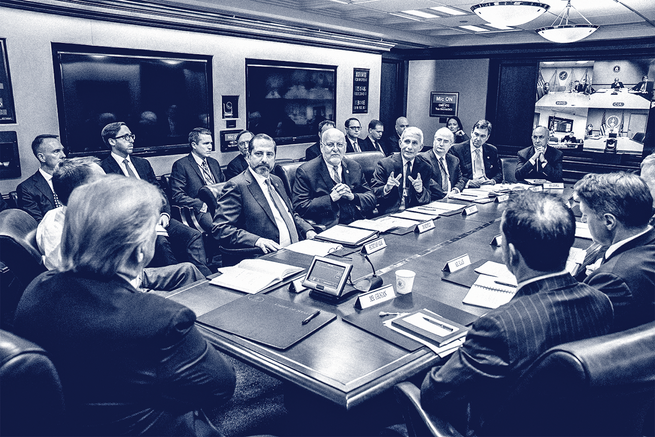
About an hour into a meeting in the White House Situation Room on January 29, concerning how to evacuate U.S. citizens from Wuhan, President Donald Trump walked in. The first thing he did, to my great surprise, was look right at me.

stylized photo of many people sitting at long conference table in suitsAnthony Fauci briefs President Donald Trump in the White House Situation Room,

January 29. (Joyce N. Boghosian / White House)

“Anthony,” he said, “you are really a famous guy. My good friend Lou Dobbs told me that you are one of the smartest, knowledgeable, and outstanding persons he knows.” I gulped. Thus began my first extended conversation with the 45th president of the United States. A big, imposing man, Trump had a New York swagger that I instantly recognized—a self-confident, backslapping charisma that reminded me of my own days in New York. For the next 20 minutes, as we discussed the new virus, the president directed many of his questions my way. I had met Trump only once before. In September 2019, I had been part of a group invited to the Oval Office for the signing of an executive order to manufacture and distribute flu vaccines. Prior to that, I had sometimes wondered what it would be like to interact with him. He had shocked me on day one of his presidency with his disregard of facts, such as the size of the crowd at his inauguration. His apocalyptic inaugural address also had taken me aback, as had his aggressive disrespect for the press. But at that brief signing ceremony, I had found him far more personable than I’d expected. Of course, I had no idea in January 2020 what the months and years ahead would be like.

I had confronted other terrible outbreaks over the course of my career—HIV in the 1980s, SARS in 2002 and 2003, Ebola in 2014, Zika in 2015—but none of them prepared me for the environment I would find myself in during the coronavirus pandemic. The nation was and is extremely polarized, with a large portion of Americans reflexively distrustful of expertise. On social media, anyone can pretend to be an expert, and malicious information is easily amplified. Soon I would come to learn just how dangerous these conditions can be.

I had confronted terrible outbreaks, but none of them prepared me for the environment I would find myself in during the coronavirus pandemic.

A code red went off in my mind during the week of January 23, when I saw photos in a newspaper showing that the Chinese government was quickly erecting a 1,000-bed prefabricated hospital. At that point, the virus had reportedly killed just 25 people and infected about 800, according to data the Chinese had released. Time out, I thought. Why would you need that many hospital beds when fewer than 1,000 people are infected? That was the moment I suspected we could be facing an unprecedented challenge, and my anxiety took a sharp turn upward.

A photograph of a prefabricated hospital in China.Hundreds of construction workers erect a prefabricated hospital in Wuhan, January 28, 2020. (Getty)
By the very end of January, we were hearing that the cases in China were increasing by about 25 percent a day. Reportedly, more than 9,000 people were infected, and 213 people were dead. The number of infections in a single month had surpassed the 2002–03 SARS outbreak. The United States had discovered its first known case of this novel coronavirus on January 20; a 35-year-old man had returned home to Washington State from Wuhan with a severe cough and a fever. The CDC had already begun screening passengers at several U.S. airports, taking their temperature and asking them about symptoms such as a sore throat and a cough. We began to wonder: Should we recommend closing the United States to travelers from China? On January 31, seated in front of the Resolute desk, Health and Human Services Secretary Alex Azar, the CDC’s Bob Redfield, and I explained the details of a proposed travel ban to the president. He posed several questions specifically to me about whether I was fully on board with the ban. “It is an imperfect process with some downsides, Mr. President, but I believe it’s the best choice we have right now,” I told him. Later that day, the Trump administration announced that travel restrictions would go into effect.

The White House communications team began arranging for me to appear on news shows. The entire world was transfixed by this rapidly evolving outbreak, and I became the public face of the country’s battle with the disease. This was useful, in that I could both try to calm the country’s anxieties and provide factual information. But it also led to the gross misperception, which grew exponentially over time, that I was in charge of most or even all of the federal government’s response to the coronavirus. This would eventually make me the target of many people’s frustration and anger.

On February 11, the World Health Organization officially designated the disease caused by the novel coronavirus as COVID-19, which was now spreading relentlessly around the world. And in the midst of this, the CDC, the country’s premier public-health agency, was stumbling badly.

From the September 2020 issue: How the pandemic defeated America

The agency traditionally had a go-it-alone attitude, excluding input from outside sources. Its personnel were talented and deeply committed professionals. I respected them, and many were friends. But the CDC’s approach, which is based on tracking symptoms, was poorly suited to dealing with a swiftly spreading disease in which, it would later turn out, more than a substantial portion of the transmissions come from people who are asymptomatic. The CDC was slow to recognize and act on that.

Another vulnerability was the way the CDC was set up to collect data. Rather than obtaining data firsthand, the agency depended on public-health departments around the country—but those departments did not consistently provide complete, up-to-date data. Some provided information reflecting what had occurred weeks earlier, not the day before. As the disease kept spreading, what was actually happening was always far worse than what the CDC’s data were telling us at the time. Public-health officials had to constantly play catch-up.

The CDC had an outstanding track record for quickly creating tests for diseases like Zika. With COVID, however, instead of immediately partnering with the diagnostic industry, it started from scratch with a test that turned out to be defective. The agency then failed to fix the defect, and wasted even more time in developing adequate testing. February was a lost month as a result.

Although the CDC struggled, there was no mistaking the message delivered on February 25 by its director of immunization and respiratory diseases, Nancy Messonnier. She told reporters that a pandemic in the United States was no longer a matter of if but when, and that we should prepare to close schools and work remotely. “Disruption to everyday life may be severe,” she announced. Nancy did the right thing: She told Americans the truth. But not surprisingly, her statement caused a firestorm. The media erupted, and the stock market plummeted nearly 1,000 points. Trump was furious.

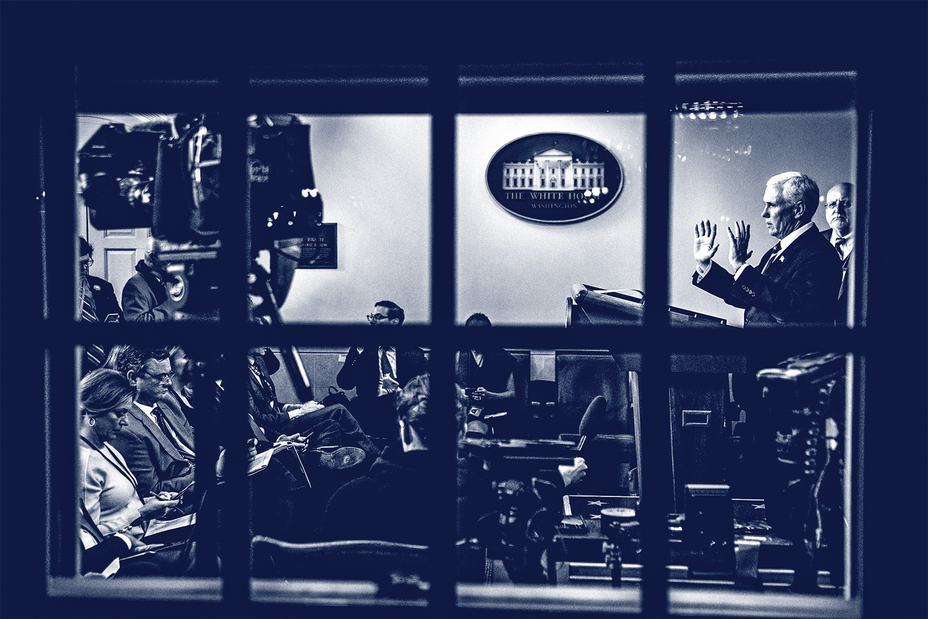
The next day, he announced that Vice President Mike Pence would take over for Alex Azar as the head of the White House coronavirus task force. I met Pence the day he ran his first task-force meeting. He was soft-spoken and always solicited the medical opinions of the physicians on the task force. He listened carefully to our answers, often asking astute follow-up questions and never pretending to understand something if he did not. But I also picked up on little things that indicated how differently this administration operated from previous ones. Vice presidents are always publicly loyal to the president; that is part of the job. But Pence sometimes overdid it. During task-force meetings, he often said some version of “There are a lot of smart people around here, but we all know that the smartest person in the building is upstairs.”

photo looking in through window at press room with man speaking and gesturing at lectern with camera and audienceVice President Mike Pence addresses reporters in the White House briefing room, March 3. (The Washington Post / Getty)
Others joined Pence in heaping praise on Trump. When the task force held teleconferences with governors, most of the Republicans started by saying, “Tell the president what a great job he is doing.” But a couple of days after Nancy’s bombshell announcement, when I got a surprise phone call from Trump at 10:35 p.m., I did not flatter him. What I did do during our 20-minute conversation was lay out the facts. I encouraged him not to underplay the seriousness of the situation. “That almost always comes back to bite you, Mr. President,” I said. “If you are totally honest about what is happening with COVID, the country will respect you for it.” He was courteous to me, and as we hung up, I felt satisfied that he had heard what I’d said.

I was worried about community spread, and I was particularly focused on Seattle. A longtime colleague called me from the city on March 3 and told me that 380 people with flu-like symptoms had been screened in four emergency rooms. Four had tested positive for COVID, a roughly 1 percent infection rate—that may not sound like much, but it was a clear signal that the virus was spreading among those unaware that they had been exposed. That meant the 1 percent was only a tiny fraction of what was actually already happening. When I brought this information to the task-force meeting, neither Pence nor Treasury Secretary Steven Mnuchin seemed to fully appreciate the seriousness of what I was telling them. While I was warning them of the impending disaster, the president was declaring outright to the press that the situation was under control. Without deliberately contradicting him, I kept repeating that things would get worse, and indeed they did.

During task-force meetings, Pence often said some version of “There are a lot of smart people around here, but we all know that the smartest person in the building is upstairs.”

Then, in one Oval Office meeting, I mentioned to Trump that we were in the early stages of developing a COVID vaccine. This got his attention, and he quickly arranged a trip to the NIH. During his visit, Barney Graham told the president that within a couple of weeks, a Phase 1 trial would likely begin. The president asked, “Why can’t we just use the flu vaccine for this virus?” It was not the first or the last time that he seemed to conflate COVID with influenza.

People associate science with immutable absolutes, when in fact science is a process that continually uncovers new information. As new information is uncovered, the process of science allows for self-correction. The biological and health sciences are different from the physical sciences and mathematics. With mathematics, two plus two equals four today, and two plus two will equal four 1,000 years from now. Not so with the biological sciences, where what we know evolves and uncertainty is common.

On March 8, I appeared on a 60 Minutes broadcast in a segment about COVID. At one point, I told the interviewer, “Right now in the United States, people should not be walking around with masks.” I was expressing not just a personal opinion, but the consensus at the time—a view shared by the surgeon general and the CDC.

The supply of masks was already low. One fear was that there would be a stampede, and we would create an even greater shortage of masks needed by the health-care workers taking care of very ill COVID patients. Although there was accumulating evidence that the virus was spread by aerosol, this was not widely accepted, certainly not by the WHO. When additional information became available—including that the virus was readily spread by infected people who had no symptoms—we advised the public to wear masks. But this was how I became the public-health official who, very early in the pandemic, instructed people not to wear a mask. Later, my words would be twisted by extreme elements in an attempt to show that I and other scientists had misled the public, that we could not be trusted, and that we were flip-floppers.

What I came to realize is that our country is more profoundly divided than I’d ever understood. I remember a time when people expected diverse political opinions. You didn’t have to agree, but you respected one another enough to listen. Now the partisanship is so intense that people refuse to even try. They ignore facts in favor of tribal politics. That’s how you wind up with dangerous conspiracy theories. The controversy over masks illustrates a fundamental misperception of how science works. In reality, our understanding of COVID continually evolved, and our medical advice had to change to reflect this.

March 2020 was when COVID became frighteningly real to Americans. This was also around the time I started waking up with a jolt at 4 a.m. to stare at the ceiling with worry. I believe Trump thought that COVID would be temporary: A little time goes by, the outbreak is over, everyone goes back to work, and the election cycle can begin. He could not have imagined that the pandemic would go on for such a long time. I think this explains why he repeatedly asked me and others whether COVID resembled the flu. He desperately wanted the pandemic to disappear, just as flu does at the end of the flu season. Tragically, COVID was not the flu, and it did not vanish. Just the opposite. And so, with the ghastly reality setting in, Trump began to grab for an elixir that would cure this disease. Along came hydroxychloroquine.

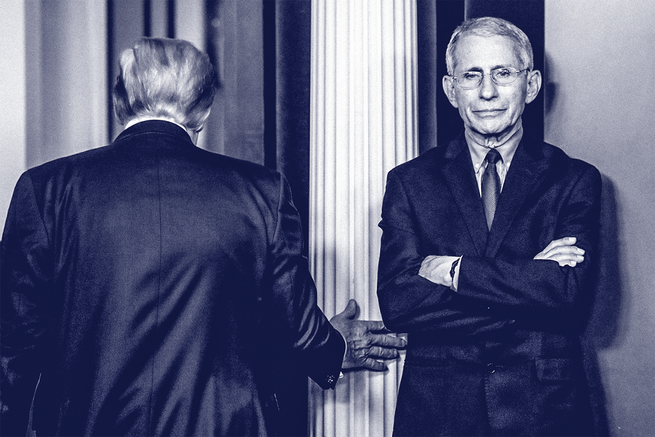
Trump began hearing from the Fox News star Laura Ingraham and others who were promoting the drug as a COVID treatment. People have long taken hydroxychloroquine to prevent or treat malaria. It is also used to treat inflammatory and autoimmune diseases such as lupus and rheumatoid arthritis. Soon Trump began touting it to millions of worried Americans at our now-daily press briefings. But there were no clinical studies proving that this antimalarial drug would alleviate COVID. And it might even hurt people. The president seemed unable to grasp that anecdotes of how hydroxychloroquine might have helped some people with COVID did not translate into solid medical advice. This is when I realized that eventually, I would have to refute him publicly. This was not the White House I had known, and I’d been advising presidents since the Reagan administration. The differences were going to dramatically affect the way I could do my job. “Hydroxychloroquine doesn’t work,” I told reporters. After that, they would inevitably ask me if I agreed with something Trump had said, such as the idea that COVID would disappear “like a miracle.” I would then have to respond with the truth: “Well, that’s not going to happen.”

photo of back of Donald Trump leaving room past Fauci, standing and facing camera with arms crossedTrump departs a daily coronavirus briefing, March 26. (Jonathan Ernst / Reuters / Redux)
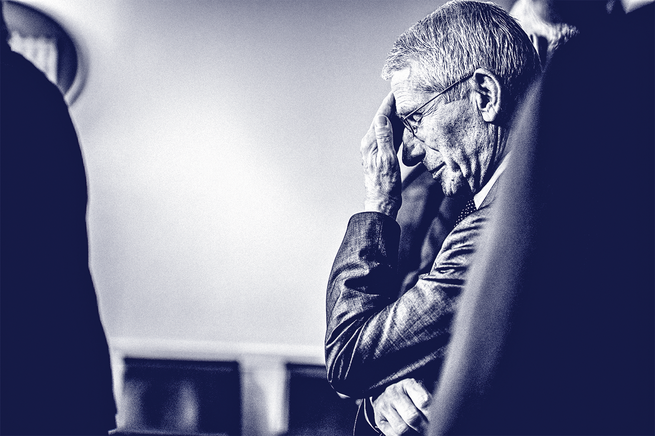
I took no pleasure in contradicting the president of the United States. I have always had a great deal of respect for the Office of the President, and to publicly disagree with the president was unnerving at best and painful at worst. But it needed to be done. I take very seriously a statement in the first chapter of Harrison’s Principles of Internal Medicine, of which I have been an editor for 40 years: “The patient is no mere collection of symptoms, signs, disordered functions, damaged organs, and disturbed emotions. [The patient] is human, fearful, and hopeful, seeking relief, help, and reassurance.” This compels me to always be honest; to be unafraid of saying that I do not know something; to never overpromise; to be comforting, yet realistic. Admitting uncertainty is not fashionable in politics these days, but it is essential in my work. That’s the beauty of science. You make a factual observation. If the facts change, the scientific process self-corrects. You gather new information and data that sometimes require you to change your opinion. This is how we better care for people over time. But too few people understand the self-corrective nature of science. In our daily press conferences, I tried to act as if the American public were my patient, and the principles that guided me through my medical career applied.

There is a widely circulated photo of me from a White House press briefing on March 20, in which I put my hand to my forehead in response to a comment the president had made. That day, Trump was especially flippant. He was standing with Secretary of State Mike Pompeo, making one provocative statement after another. Then he said, “Secretary of State Pompeo is extremely busy, so if you have any questions for him right now could you do that because … I’d like him to go back to the State Department or, as they call it, the ‘Deep State’ Department.” I had a moment of despair mixed with amusement. I put my hand to my forehead to hide my expression. This is when things began to get difficult for my family and me.

In late March, officials monitoring the dark web started to see a considerable amount of hostility and threats directed toward me. The problem was that a hard-core group saw me as a naysaying bureaucrat who was deliberately, even maliciously, undermining Trump. They loved and supported the president and regarded me as the enemy. To them, my hand-to-forehead moment validated what they already believed about me.

photo of Fauci touching his forehead with his hand over face while standingFauci while Trump speaks at the March 20 coronavirus briefing (Erin Schaff / The New York Times / Redux)

As a result, I was assigned a security detail. For years, AIDS had made me a target, but that was largely before social media. Back then, I used to get one or two insulting letters a month, mostly homophobic rants, sent to my office at the NIH. Now my family and I were barraged by emails, texts, and phone calls. I was outraged that my wife, Christine, and our daughters were harassed with foul language and sexually explicit messages, and threatened with violence and even death. I was angry and wanted to lash out. But these direct expressions of hatred did not distract or frighten me. I did not have time for fear. I had a job to do.

My training as a physician in a busy New York City hospital had taught me to push through crises and fatigue, to not feel sorry for myself. During the pandemic, Christine also insisted that I balance the demands of work with taking care of myself. (“You are going to bed at a decent hour, you are going to eat regular meals, and you are going to carry a water bottle,” she said in a way that left no room for argument.) Her advice helped me get through everything that followed.

But in the ensuing years, I also came to realize that addressing the root cause of our country’s division is beyond my capabilities as a scientist, physician, and public servant. That doesn’t mean I’ve given up hope that the country can be healed. I believe scientific education is more crucial now than it has ever been in American history. Children should learn what the scientific process is, how it works, and that it self-corrects. Most of all, I believe we need to reclaim civility. To do so, we need to understand that we’re all more alike than we are different—that we share common goals for ourselves and for our communities. We need to learn to talk to one another again. And we need to figure that out before the next pandemic hits.

This article was adapted from Anthony Fauci’s book On Call: A Doctor’s Journey in Public Service. It appears in the July/August 2024 print edition with the headline “The First Three Months.”

When you buy a book using a link on this page, we receive a commission. Thank you for supporting The Atlantic.

Categories
Saved Web Pages - Audio Posts

Opinion | How to Save a Sad, Lonely, Angry and Mean Society

  • U.S.
  • World
  • Business
  • Arts
  • Lifestyle
  • Opinion
  • Audio
  • Games
  • Cooking
  • Wirecutter
  • The Athletic
a photograph of a marble bust in a museum with a man standing behind it using his hands to explain something

Credit…Matthew Monteith

Recently, while browsing in the Museum of Modern Art store in New York, I came across a tote bag with the inscription, “You are no longer the same after experiencing art.” It’s a nice sentiment, I thought, but is it true? Or to be more specific: Does consuming art, music, literature and the rest of what we call culture make you a better person?

Ages ago, Aristotle thought it did, but these days a lot of people seem to doubt it. Surveys show that Americans are abandoning cultural institutions. Since the early 2000s, fewer and fewer people say that they visit art museums and galleries, go to see plays or attend classical music concerts, opera or ballet. College students are fleeing the humanities for the computer sciences, having apparently decided that a professional leg up is more important than the state of their souls. Many professors seem to have lost faith too. They’ve become race, class and gender political activists. The ensuing curriculum is less “How does George Eliot portray marriage?” and more “Workers of the world, unite!”

And yet I don’t buy it. I confess I still cling to the old faith that culture is vastly more important than politics or some pre-professional training in algorithms and software systems. I’m convinced that consuming culture furnishes your mind with emotional knowledge and wisdom; it helps you take a richer and more meaningful view of your own experiences; it helps you understand, at least a bit, the depths of what’s going on in the people right around you.

The novelist Alice Walker lamented that she lacked models. She wasn’t aware of enough Black female writers who could serve as exemplars and inspirations as she tried to perceive her world and tell her stories. Then she found the novelist and anthropologist Zora Neale Hurston, who, decades before, had pointed the way, shown her how to see and express, enabled her to write about her mother’s life, about voodoo, the structures of authentic Black folklore. Thanks to Hurston she had a new way to see, a deeper way to connect to her own heritage.

I’d argue that we have become so sad, lonely, angry and mean as a society in part because so many people have not been taught or don’t bother practicing to enter sympathetically into the minds of their fellow human beings. We’re overpoliticized while growing increasingly undermoralized, underspiritualized, undercultured.

The alternative is to rediscover the humanist code. It is based on the idea that unless you immerse yourself in the humanities, you may never confront the most important question: How should I live my life?

Ralph Waldo Emerson, for example, argued that we consume culture to enlarge our hearts and minds. We start with the tiny circle of our own experience, but gradually we acquire more expansive ways of seeing the world. Peer pressure and convention may try to hem us in, but the humanistic mind expands outward to wider and wider circles of awareness.

I went to college at a time and in a place where many people believed that the great books, poems, paintings and pieces of music really did hold the keys to the kingdom. If you studied them carefully and thought about them deeply, they would improve your taste, your judgments, your conduct.

Our professors at the University of Chicago had sharpened their minds and renovated their hearts by learning from and arguing against books. They burned with intensity as they tried to convey what past authors and artists were trying to say.

The teachers welcomed us into a great conversation, traditions of dispute stretching back to Aeschylus, Shakespeare, George Bernard Shaw, Clifford Odets. They held up visions of excellence, people who had seen farther and deeper, such as Augustine, Sylvia Plath and Richard Wright. They introduced us to the range of moral ecologies that have been built over the centuries and come down as sets of values by which we can choose to live — stoicism, Buddhism, romanticism, rationalism, Marxism, liberalism, feminism.

The message was that all of us could improve our taste and judgment by becoming familiar with what was best — the greatest art, philosophy, literature and history. And this journey toward wisdom was a lifelong affair.

The hard sciences help us understand the natural world. The social sciences help us measure behavior patterns across populations. But culture and the liberal arts help us enter the subjective experience of particular people: how this unique individual felt; how this other one longed and suffered. We have the chance to move with them, experience the world, a bit, the way they experience it.

We know from studies by the psychologists Raymond Mar and Keith Oatley that reading literature is associated with heightened empathy skills. Deep reading, immersing yourself in novels with complex characters, engaging with stories that explore the complexity of this character’s motivations or that character’s wounds, is a training ground for understanding human variety. It empowers us to see the real people in our lives more accurately and more generously, to better understand their intentions, fears and needs, the hidden kingdom of their unconscious drives. The resulting knowledge is not factual knowledge but emotional knowledge.

The novelist Frederick Buechner once observed that not all the faces Rembrandt painted were remarkable. Some are just average-looking old people. But even the plainest face “is so remarkably seen that it forces you to see it remarkably.” We are jolted into not taking other people for granted but to sense and respect the immense depth of each human soul.

Rembrandt’s “The Return of the Prodigal Son.”Credit…Fine Art Images/Heritage Images, via Getty Images

When I come across a Rembrandt in a museum, I try to train myself to see with even half of Rembrandt’s humanity. Once in St. Petersburg, I had the chance to stand face to face with one of his greatest paintings, “The Return of the Prodigal Son.” He painted this one at the end of his life, when popular taste had left him behind, his finances were in ruins, his wife and four of his five children were in their graves. I have seen other renderings of that parable, but not one in which the rebel son is so broken, fragile, pathetic, almost hairless and cast down. The father envelops the young man with a love that is patient, selfless and forbearing. Close observers note the old man’s hands. One is masculine, and protective. The other is feminine, and tender.

Though this painting is about a parable, it’s not here to teach us some didactic lesson. We are simply witnessing an emotional moment, which is about fracture and redemption, an aging artist painting a scene in which he imagines all his losses are restored. It is a painting about what it is like to finally realize your deepest yearnings — for forgiveness, safety, reconciliation, home. Meanwhile, the son’s older brother is off to the side, his face tensely rippling with a mixture of complex thoughts, which I read as rigid scorn trying to repress semiconscious shoots of fraternal tenderness.

Experiences like this help us understand ourselves in light of others — the way we are like them and the way we are different. As Toni Morrison put it: “Like Frederick Douglass talking about his grandmother, and James Baldwin talking about his father, and Simone de Beauvoir talking about her mother, these people are my access to me; they are my entrance into my own interior life.”

Experiences with great artworks deepen us in ways that are hard to describe. To have visited Chartres Cathedral or finished “The Brothers Karamazov” is not about acquiring new facts but to feel somehow elevated, enlarged, altered. In Rainer Maria Rilke’s novel “The Notebooks of Malte Laurids Brigge,” the protagonist notices that as he ages, he’s able to perceive life on a deeper level: “I am learning to see. I don’t know why it is, but everything penetrates more deeply into me and does not stop at the place where until now it always used to finish.”

Mark Edmundson teaches literature at the University of Virginia and is one of those who still lives by the humanist code. In his book “Why Read?” he describes the potential charge embedded in a great work of art: “Literature is, I believe, our best goad toward new beginnings, our best chance for what we might call secular rebirth. However much society at large despises imaginative writing, however much those supposedly committed to preserve and spread literary art may demean it, the fact remains that in literature there abide major hopes for human renovation.”

Wouldn’t you love to take a course from that guy?

How does it work? How does culture do its thing? The shortest answer is that culture teaches us how to see. “The greatest thing a human soul ever does in this world is to see something, and tell what it saw in a plain way,” the Victorian art critic John Ruskin wrote. “Hundreds of people can talk for one who can think, but thousands can think for one who can see.”

Ruskin intuited something that neuroscience has since confirmed: Perception is not a simple and straightforward act. You don’t open your eyes and ears and record the data that floods in, the way in those old cameras light was recorded on film. Instead, perception is a creative act. You take what you’ve experienced during the whole course of your life, the models you’ve stored up in your head, and you apply them to help you interpret all the ambiguous data your senses pick up, to help you discern what really matters in a situation, what you desire, what you find admirable and what you find contemptible.

Another way to put it is this: Artistic creation is the elemental human act. When they are making pictures or poems or stories, artists are constructing a complex, coherent representation of the world. That’s what all of us are doing every minute as we’re looking around. We’re all artists of a sort. The universe is a silent, colorless place. It’s just waves and particles out there. But by using our imaginations, we construct colors and sounds, tastes and stories, drama, laughter, joy and sorrow.

Works of culture make us better perceivers. We artists learn from other artists. Paintings, poems, novels and music help multiply and refine the models we use to perceive and construct reality. By attending to great perceivers, the Louis Armstrongs, the Jorge Luis Borgeses, the Jane Austens, we can more subtly understand what is going on around us and be better at expressing what we see and feel.

When you go to the Museo Reina Sofía in Madrid, you don’t just see Picasso’s “Guernica”; forever after you see war through that painting’s lenses. You see, or rather feel, the wailing mother, the screaming horse, the chaotic jumble of death and agony, and it becomes less possible to romanticize warfare. We don’t just see paintings; we see according to them.

Picasso’s “Guernica.”Credit…Emilio Parra Doiztua for The New York Times

This process of refining and expanding our internal mental models is not a dry, purely intellectual process. If we’re lucky, and maybe only in rare moments, it can be gut-wrenching and intoxicating, a fusion of the head and the heart. As my friend Arthur Brooks writes, “Think of a time when you heard a piece of music and wanted to cry. Or recall the flutter of your heart as you stared at a delicate, uncannily lifelike sculpture. Or maybe your dizziness as you emerged from a narrow side street in an unfamiliar city and found yourself in a beautiful town square; for me, it was the Piazza San Marco in Venice, with its exquisitely preserved Renaissance architecture. Odds are, you didn’t feel as if the object of beauty was a narcotic, deadening you. Instead, it probably precipitated a visceral awakening, much like the shock from a lungful of pure oxygen after breathing smoggy air.”

In this kind of education, you are lured by beauty and deeply pierced by myths that seem primeval and strange. Once in college, I was reading Nietzsche’s “The Birth of Tragedy” in the library. I don’t know what happened next. The book, with its fevered prose and savage genius, sucked me into a trance. I eventually looked up and it was four hours later. I had traveled in time back into some primeval world of bonfires, dancing and Dionysian frenzy, and it left a residue, which I guess you would call a greater awareness of the metaphysical, the transcendent. Life can be much wilder than it seems growing up on a suburban street.

The philosopher Roger Scruton argued that this kind of education gives us the ability to experience emotions that may never happen to us directly. He wrote: “The reader of Wordsworth’s ‘Prelude’ learns how to animate the natural world with pure hopes of his own; the spectator of Rembrandt’s ‘Night Watch’ learns of the pride of corporations, and the benign sadness of civic life; the listener to Mozart’s ‘Jupiter’ symphony is presented with the open floodgates of human joy and creativity; the reader of Proust is led through the enchanted world of childhood and made to understand the uncanny prophecy of our later griefs which those days of joy contain.”

Your way of perceiving the world becomes your way of being in the world. If your eyes have been trained to see, even just a bit, by the way Leo Tolstoy saw, if your heart can feel as deeply as a K.D. Lang song, if you understand people with as much complexity as Shakespeare did, then you will have enhanced the way you live your life.

Attention is a moral act. The key to becoming a better person, Iris Murdoch wrote, is to be able to cast a “just and loving attention” on others. It’s to shed the self-serving way of looking at the world and to see things as they really are. We can, Murdoch argued, grow by looking. Culture gives us an education in how to attend.

The best of the arts are moral without moralizing. Dostoyevsky’s “Crime and Punishment” is an inquiry into the knowledge of right and wrong, told through the eyes of one who suffers, with all the pity and sorrow that involves.

The best of the arts induce humility. In our normal shopping mall life, the consumer is king. The crucial question is, do I like this or not? But we approach great art in a posture of humility and reverence. What does this have to teach me? What was this other human being truly seeking?

The San Fernando Royal Academy of Fine Arts Museum in Spain.Credit…Emilio Parra Doiztua for The New York Times

One of my heroes is Samuel Johnson, the essayist, playwright, poet, dictionary compiler, one of the greatest critics of all time. He was something of a mess as a young man — lazy, envious, unreliable. Over the decades, he read, wrote and felt his way to greatness. He read with astounding sensitivity. Once at age 9 he was reading “Hamlet” when he came to the ghost scene. He was so terrified he ran to the front door so that he could look out at the people in the street, just to remind himself that he was still in the land of the living.

He wrote biographies of his moral exemplars. He wrote essays, poems and plays about the great works of the Western tradition, and especially about his own sins as if he were trying to beat it out of himself through the scourge of self-examination. (Johnson had a special weakness for envy, and so dozens of his essays in his periodicals mention the sin of envy.) His awareness of human depravity led to humility, self-restraint and redemption. And it worked. By the end of his life he was lavishly generous, a man who had the ability to see the world with absolute honesty and sympathetic perception. Johnson socialized with artists and statesmen, but he invited society’s outcasts to live with him so that he could feed and offer them shelter — a former slave, a doctor who treated the poor, a blind poet. One night he found a woman, most likely a prostitute, lying ill and exhausted on the street. He put her on his back and brought her home to join the others. Johnson was a somewhat tortured Christian. These radical moments of welcome are the essential Gospel-like acts.

When he died, his eulogist observed that he left a chasm in national life that nothing could fill up. He embodied that old humanist ideal. He had become a person of taste, a person of judgment, a person of culture. He died a wonderful man.

David Brooks has been a columnist with The Times since 2003. He is the author, most recently,  of “How to Know a Person: The Art of Seeing Others Deeply and Being Deeply Seen.” @nytdavidbrooks

Categories
Saved Web Pages - Audio Posts

Russian Exceptionalism | Gary Saul Morson

morson_1-022224-900.jpg

When Russian troops seized Crimea in 2014, German chancellor Angela Merkel, reporting on her conversation with Vladimir Putin, told President Obama that the Russian president seemed to dwell “in another world.” In a sense she was right: Russians and Westerners see the world quite differently, and our failure to understand Russia’s perspective made its actions seem surprising in 2014 and still more so when it invaded Ukraine in 2022.

How do Russians think about what their country is doing in Ukraine? If we are to grasp why so many have supported the attack on Georgia in 2008, the seizure of Crimea and eastern Ukraine in 2014, and the present war, we need to recognize that their fundamental assumptions differ from ours. Americans, for example, typically take for granted that the state exists to promote the welfare of its citizens, but Russians often believe the opposite. After all, individuals come and go, but Russia remains. And Russia is not just a nation; it is also an idea.

The “Russian idea,” throughout its many changes, has typically been messianic. It explains the world and gives life purpose; it shapes domestic and foreign policy and, more importantly, gives Russians a sense of their “Russianness”—which includes the ability to save the world. In his famous book The Russian Idea (1946), the philosopher Nikolai Berdyaev argued that Bolshevism owes as much to Russian messianism as to Marx. Medieval Russians, he and many others emphasize, often considered themselves the only true Christians. The Byzantines had, at the Council of Florence in 1439, recognized the pope to secure Western aid against the Turks, thereby betraying the Orthodox faith, which is supposedly why they succumbed to the Ottomans in 1453. From that point on, Moscow, the capital of the only independent Orthodox country until the nineteenth century, became the “Third Rome,” the heir to both Rome and Byzantium as the seat of Christendom. Russians were destined to save the world because, as the monk Philotheus explained, “a fourth Rome there will not be.”

Bolshevism inherited this messianic spirit. The Soviet Union would liberate the workers of the world and create the final utopia. It took Stalin to fuse Marxist internationalism with traditional Russian pride: internationalism would be the work of Russia, the savior nation. Stalin drew on a tradition of Russianness defined as a sort of super-nationality. Every nation manifests a special quality, but Russia, as Dostoevsky argued, displays the unique ability to absorb and perfectly express the qualities of all others. Because of this “receptivity” (ozyvchivost’), Dostoevsky concluded, Russians “may have a greater capacity than other nations to embrace the idea of the universal fellowship of humans, of brotherly love.” As proof, he adduces the Spaniards and Englishmen portrayed in Pushkin’s poems, who, he imagines, differ not a whit from actual Spaniards and Englishmen. I am reminded of the witticism that the linguist Roman Jakobson could speak Russian fluently in six languages.

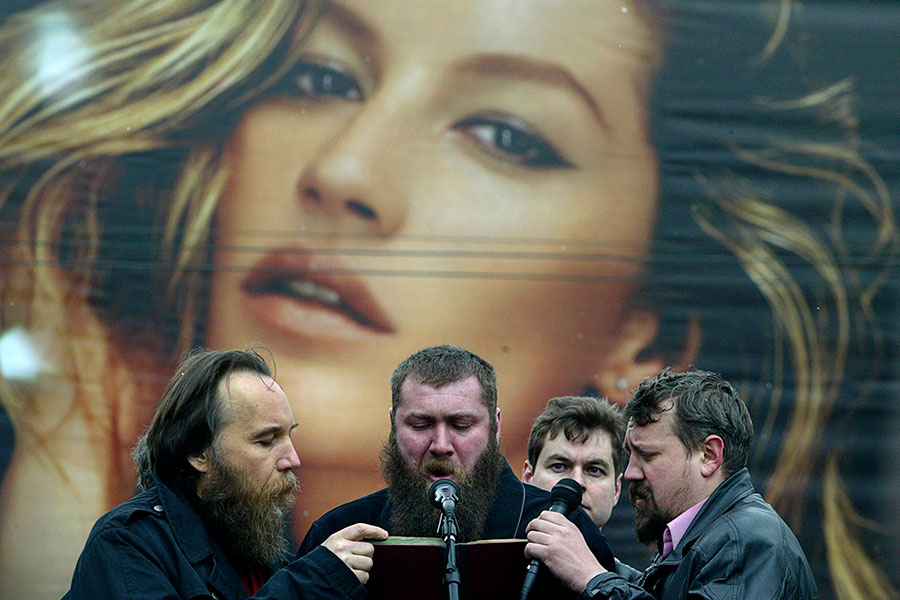
After the fall of the USSR, ideologies competed to replace communism. Liberalism, considered foreign, was overwhelmed by various types of nationalism, one of which, Eurasianism, seems to have achieved the status of a semiofficial ideology. Putin uses Eurasianist phrases, the army’s general staff academy assigns a Eurasianist textbook, and popular culture has embraced its ideas and vocabulary. The better to build an empire, Eurasianism, like Stalinism, carries the banner of anti-imperialism, claiming to unite the world under Russian leadership in order to liberate it from Western cultural colonialism. It could be no other way. As Aleksandr Dugin, the movement’s current leader, explained, “Outside of empire, Russians lose their identity and disappear as a nation.”

Eurasianism began a little over a century ago. Unlike most of its rivals today, it has engaged some truly creative minds. Russian intellectual history, in fact, offers several movements in which powerful thinkers arrive at absurd and often repulsive conclusions. To understand them is to grasp how intelligent people anywhere can accept preposterous beliefs and claim “scientific” certainty for ideas counter to the very spirit of science.

Finding themselves in exile after the revolution and civil war, a group of Russian intellectuals, mostly from the nobility, regarded recent events as a catastrophe unrivaled in history. They experienced profound alienation from both their homeland and the European world in which they found themselves. In his essay “Two Worlds,” Pyotr Savitsky, the movement’s first leader, observed, “Russian exiles are like immigrants ‘from another world,’ like inhabitants of other planets.” Like earlier Russian émigrés, they found a home in the ideology they created.

“Two Worlds” is included in Foundations of Eurasianism, a collection of important texts from the movement, many of which appear in English for the first time. The Bolshevik coup, Savitsky and his fellow émigrés reasoned, simply accelerated the disastrous policy of Westernization pursued by Romanov tsars since Peter the Great. Russia must at last realize that it does not belong to European civilization. It belongs instead to the entirely separate world of “Eurasia.” Culturally, historically, and psychologically, Russians are a steppe people who resemble the Turkic and Mongolian (or “Turanian”) peoples of Central Asia. Far from being a calamity, the Mongol conquest of Russia (roughly 1240–1480) constituted a blessing precisely because it isolated Russia from Europe. It was in this period that the modern Russian character was formed, as a synthesis of the Slavic and the Turanian.

Absolutism, the only rule suitable for steppe peoples dispersed over a vast territory, came to Russia from Genghis Khan and his successors. When the Mongol Empire disintegrated, Russia became its heir. “And hovering over all Russia is the shade of the great Genghis Khan,” wrote the Eurasianist Nikolai Trubetskoy in The Legacy of Genghis Khan (1925). “Whether Russia wants it or not, she remains forever the guardian of this legacy.”

The Eurasianists included two great linguists, Trubetskoy and Jakobson, who discovered the phoneme and are often regarded as the founders of modern structuralism. They devised a theory justifying Eurasianism linguistically. What really matters, they reasoned, is not the common origin of languages, as other linguists and earlier philologists claimed, but their shared destiny. The Pan-Slavists of the nineteenth century had mistakenly proposed that Russians most resembled speakers of other Slavic languages, many of whom had been corrupted by Western culture. Russia’s destiny was to be found elsewhere, in the East. Or as Jakobson observed, “The question ‘to where’ has become more important than ‘from where.’”

Trubetskoy and Jakobson attributed linguistic change to the dynamics of a self-enclosed system. That system is heading somewhere, or, as Trubetskoy explained, “the evolution of a phonemic system at any given moment is directed by the tendency towards a goal.” Balkan languages, they pointed out, were highly diverse in origin. They include not only languages from different branches of Indo-European (Romanian is a Romance language, Serbian is Slavic, Albanian constitutes a branch of its own), but also Turkish, which is not Indo-European at all. And yet the interaction of speakers has led to a number of shared features. In much the same way, they maintained, Russian and Turanian languages form a “language union” bound to draw ever closer. And if that was so, Jakobson and Trubetskoy concluded in a leap of logic, the same must be true of everything else in Russian and Turanian cultures.

Unlike European colonial empire-building, therefore, the Russian conquest of Siberian, Caucasian, and Central Asian peoples was entirely “friendly”—an argument so preposterous it occasioned some of the Eurasianists’ most imaginative historiography. Ukraine proved an obvious sticking point because, from the beginning, Eurasianists had to confront Ukrainian nationalists in the diaspora. From their perspective, all the Eurasianists had demonstrated was that Ukrainians, who share European culture, do not belong with Russians.

What exactly ensured a common destiny for a group of people? The answer was geography, what Savitsky called mestorazvitie—“topogenesis” or, more literally, “place-development.” Geographical environment shapes culture, he argued, so the peoples of the Eurasian Steppe, which extends from Hungary to Manchuria, are bound to display common psychology and therefore to have harmonious relations. By the same token, Savitsky reasoned, an unbridgeable chasm must always divide “oceanic” and “continental” cultures. The former embrace risk, entrepreneurship, and individualism—think of Renaissance Italy or republican Holland or imperial Britain—while the latter prefer tradition, conservatism, and collectivism. The continental world favors centralized authoritarian rule, which is why “geography itself” has preordained Russian rule over the vast territory extending from Poland to the Pacific. “Continentality” dictates isolation from alien influence through economic and social “autarky,” or self-sufficiency.

Above all, this “Russian world” must acknowledge that its greatest enemy is and always will be Western liberalism. The Bolsheviks mistakenly adopted Western, atheistic Marxism, but they correctly established total control over individual lives in the name of a higher ideal. “Modern democracy must give way to ideocracy,” Trubetskoy argued, referring to rule based on abstract ideals. Pluralist democracy entails no all-encompassing and uniform philosophy of life, but ideocracy does. Therefore, “ideocracy presupposes the selection of the ruling echelon according to its faithfulness to a single common governing idea…united in a single ideological state organization” that will “control all aspects of life.” This collectivism ensures that the “last traces of individualism will disappear” and that a common outlook will “become the inalienable ingredient” of everyone’s psyche. From the start, Eurasianism was not an alternative to totalitarianism but a different form of it.

Western liberals, Trubetskoy explained, affirm putatively universal values like human rights, progress, and cosmopolitanism. Viewing people as individuals, they scorn national cultures and consider respect for tradition to be retrograde. The superiority of Western civilization, they presume, lies in its discovery of universals, which are supposedly as free from local prejudice as logic and mathematics. And so Westerners present distinctively European values as objective. Those non-Europeans who accept this claim, as many in Russia and other modernizing cultures have, aspire to become more “civilized” by thoroughly Westernizing, an impossible task necessarily leading to self-contempt.

The book that catalyzed the Eurasianist movement, Trubetskoy’s Europe and Mankind (1920)—selected excerpts of which appear in the first volume of Foundations of Eurasianism—maintains “the equivalence and qualitative incommensurability of all cultures and all peoples of the globe…. There are no higher and lower cultures, there are only similar and dissimilar.” European arguments to the contrary are but “a means of deceiving people and justifying the imperialistic and colonial policies…of the ‘great powers’”—that is, all the great powers but Russia.

Remarkably enough, Trubetskoy’s relativism leads him to the conclusion that because cultures are equal, Europeans, who suppose otherwise, are worse than all others. All are equal, but some are less equal than others. The non-Western world must therefore unite against Europeans, because for relativists “the consequences of Europeanization” are “an absolute evil.” All countries must recognize that “there is only one true confrontation: that between the Romano-Germanics and all other peoples of the world, between Europe and Mankind.”

Lev Gumilev, who corresponded with Savitsky, developed Eurasianist ideas in imaginative and at times ridiculous ways. The son of two great poets, Nikolai Gumilev and Anna Akhmatova, Gumilev boasted a pedigree that commanded attention. In a country where literature enjoyed immense prestige, the persecution of his parents—his father was shot and his mother became the target of nationwide denunciation—only added to Gumilev’s inherited charisma, enhanced still more by two terms in the Gulag. (One “for papa” and one “for mama,” he liked to say.) Born in 1912, Gumilev became a specialist in the Mongols, Turks, and other peoples of Central Asia. His engagingly written books, some of which could be published only during glasnost, challenged traditional accounts of Russian history and developed his own form of ethnology, which he called a new hard science.

As Mark Bassin points out in his illuminating book The Gumilev Mystique, it would be hard to overstate Gumilev’s influence. He eventually enjoyed support at high levels of the Communist Party, the General Staff of the Armed Forces, and the Ministry of Foreign Affairs. In 1995 the State Duma awarded one of his books on Russian history a prestigious prize. Approved by the Ministry of Education of the Russian Federation as a high school textbook, it was reissued in a print run of 100,000. Gumilev’s celebration of Central Asian peoples also made him a hero of Kazakhstan’s former autocratic president Nursultan Nazarbaev. In the Kazakh capital, Astana, students attend Gumilev Eurasian National University. On the hundredth anniversary of Gumilev’s birth, Nazarbaev named a mountain for him (Gumilev Peak). In Russia, Gumilev’s ideas penetrate everywhere, and his central terms—“passionarity,” “complementary,” “chimaera,” and others—have entered common usage.

Gumilev arrived at his core idea in the Gulag, where, without paper, he somehow (the story goes) contrived to write a book on the paper used to wrap food supplies. His theories represent a fantastic excursion into pseudoscience, which thrives in Russia even among serious scholars and scientists. In Gumilev’s view, an ethnic group, which he calls an “ethnos” (“ethnoi” in the plural), is not a social but a biological phenomenon, analogous to a herd or flock among animals. Developing according to biochemical laws, an ethnos constitutes “a biophysical reality…. Ethnic belonging, which manifests itself in the human consciousness, is not a product of…consciousness.”

Gumilev argues that ethnoi, because they are rooted in biology, reflect the human instinct to divide people into “us” and “them.” It followed that, Enlightenment thinkers notwithstanding, the sense of belonging cannot be extended to humanity as a whole, because then there would be no “them” to give “us” meaning. In much the same spirit, Trubetskoy had maintained, by dubious analogy, that just as phonemes are meaningful only by opposition to other phonemes, so “humanity” cannot be a meaningful group, because there would be nothing to which it could be opposed.

Gumilev reasoned that ethnogenesis (the formation of ethnoi) requires enormous

work (in the physical sense)…. And to do that work, energy is needed, very ordinary energy measurable in kilogram-meters or calories…. Let me explain. The stone blocks at the top of a pyramid were not raised by [conscious] ethnic self-awareness but by the muscle power of Egyptian workers on the principle of heave-ho!

That energy must come from somewhere. It cannot come from the consciousness of individuals or their immediate surroundings; such a view, according to Gumilev, “infringes the law of the conservation of energy.” It followed for him that the energy must come from outer space. Otherwise, “entropy…would have smoothed out all ethnic differences and converted the diversity of the human race into a featureless anthroposphere.” The earth receives “more energy from outer space than is needed to maintain equilibrium of the biosphere,” and it is that surplus energy on which ethnogenesis draws.

The process works like this: during some periods of the solar cycle, “the defensive qualities of the ionosphere are reduced, allowing individual quants or bundles of energy to approach near to the earth’s surface.” This energy causes genetic mutations, giving rise to a few people endowed with great “passionarity.” People with passionarity display the ability to absorb large amounts of energy from their surroundings. As lemmings or swarms of locusts sometimes expend great energy in self-destruction, so “passionaries” overcome the survival instinct. They take risks to accomplish great deeds for no reason except to accomplish them. Why did Alexander the Great and his army march all the way to India when they could not hope to bring their booty home to Macedonia? They must have done so out of passionarity. Gumilev regarded passionarity as his greatest discovery, since it explains what no social theory ever could. Heroism, self-sacrifice, supreme devotion to an ideal regardless of the consequence to oneself, loved ones, or friends: these actions, which shape the world in lasting ways, cannot be explained by rational, social-scientific theories because they are not rational, and their origin is biological rather than social.

Using “induction,” passionaries attract others, who attract still others, until an ethnic group forms. Anyone, regardless of race, may be drawn to a passionary, and so ethnoi are rarely homogeneous in origin. (This is how Gumilev refutes accusations of racism.) It is not race that links people into an ethnos; it is “behavioral stereotype.” A certain behavioral repertoire seems natural to members of one ethnos but odd to members of others. Bassin mentions Gumilev’s example of a Russian, a Tatar, a German, and someone from the Caucasus on a train who encounter a drunken youth harassing a woman: “I know, and we all know, that the Russian will say to him, ‘hey you, pal, you’re going to get caught. Look, get off at the next stop’”; the German will use the emergency brake and call the police; the Caucasian will “simply lose control and hit the offender in the face”; and the Tatar will just “turn away in silence.” Behavioral stereotypes develop as responses to the natural environment, and so steppe people are bound to differ from sea people. Gumilev here adapts Savitsky’s idea of topogenesis.

Entropy, Gumilev claims, ensures that passionary energy diminishes at a mathematically calculable rate. That is why all ethnoi pass through a series of precisely defined stages until, after about 1,500 years, they become mere “relicts,” as happened to the ancient Khazars of Central Asia and the Yakuts of Siberia.

If an ethnos lives among other ethnoi, relations may be either friendly or hostile, depending on their behavioral stereotypes and according to natural laws. Groups well adapted to each other enjoy “complementarity.” That, Gumilev says, is emphatically the case with Russians and other steppe peoples.

Most earlier historians considered Russia’s Mongol rulers (“the Golden Horde”) a barbaric and hostile force, an error Gumilev calls the “Black Legend.” It was fabricated, like almost everything else Gumilev needs to explain away, by evil Westerners intent on dividing Slavic and Turkic peoples. To begin with, in Gumilev’s account Russians were not conquered by the Mongols (whose armies destroyed entire cities) but submitted voluntarily. If not for the Mongols, Russia, like Western Slavs, would have succumbed to the domination of Westerners intent on destroying their culture.

Gumilev claims that the Russian ethnos was formed at the Battle of Kulikovo in 1380, traditionally represented as Russia’s first great victory over the Mongols. Gumilev offers an entirely different account of the battle. The Russians fought a mere faction of the Horde, ruled by the “illegitimate” military commander Mamai, who enjoyed support from Genoese merchants. By defeating Mamai, the Russians demonstrated their loyalty to the Horde’s legitimate ruler, Tokhtamysh. To be sure, Tokhtamysh went on to burn Moscow, but Gumilev proves creative enough to explain away this inconvenient fact as well.

If ethnoi are biological phenomena, then it is essential to maintain their gene pool, and so exogamy must be avoided. Sometimes crossbreeding creates a new ethnos, but usually it deforms or destroys an existing one. “But it never happens without a trace,” Gumilev writes. “That is why neglect of ethnology, be it on the scale of state or country, tribal union, or monogamous family, must be qualified as irresponsibility, criminal in regard to the offspring.”

The worst thing that can happen to an ethnos is transformation into a “chimaera,” by which Gumilev meant not a mirage but a monster—“a combination of elements not organically united,” like a beast with lion’s head, goat’s body, and serpent’s tail. “An example of a chimeric relationship in zoology,” he explains,

is that which forms when tapeworms are present inside an animal’s organs…. By necessitating an increased inflow of nutrition and introducing its hormones into the blood and bile of its host organism, the parasite alters its host’s biochemistry.

In much the same way, a parasite ethnos “sucks its sustenance out of the indigenous ethnos.” Jews are Gumilev’s prime example, and his hatred of them amounts to an obsession.

The Babylonian Empire fell, Gumilev supposes, because the king’s advisers were Jews who, divorced from geography, neglected to maintain Babylon’s irrigation networks, which led to crop failures and civilizational collapse. What’s more, Jews married off their women to produce generations of “‘métis’ or ‘bastard’ offspring,” who eventually seized power in the name of the intruder.

Whether Jewish or not, chimeric intruders typically reject the material world, as the various gnostic groups—including Manichaeans, Zoroastrian Mazdaists, and Albigensians—have done. Embracing “vampire concepts that embody a deep and diabolical sense of purpose,” they subscribe to a life-denying worldview detached from the soil, fetishize the written word, adopt lies on principle, and maintain a different morality for themselves than for outsiders. Gumilev claims that the Talmud and Kabbalah, which he evidently knows only from the accounts of Russian antisemites, state that the Jewish God who spoke with Moses was really a demon, Satan’s best friend. He also claims that the Talmud instructs Jews to “kill the best of the goyim.” It is a remarkable feature of Russian thought that creative minds keep inventing new theories demonizing Jews.

During the Yeltsin years, which many called Russia’s “Weimar Era,” the young, bohemian Aleksandr Dugin flirted with occultist and extreme rightist ideas. He seems to have been especially fond of Nazis and adopted the nom de plume Hans Sievers, an allusion to Wolfram Sievers, whom Himmler made director of a group studying the paranormal. Eventually Dugin found his way to Eurasianism, which he synthesized with the work of practitioners of geopolitics from Halford Mackinder on, along with structuralists, postmodernists (Jean-François Lyotard, Gilles Deleuze), French “traditionalists” (René Guénon and Alain de Benoist), and various Nazis or ex-Nazis, including Julius Evola, Carl Schmitt, and, of course, Martin Heidegger.

It is routine to refer to Dugin as “well-read,” but it would be more accurate to say “well-skimmed.” He is one of those pseudoprofound commentators who love to call things “ontological” and “metaphysical” while endlessly dropping the names of thinkers, with many of whom he has a flyleaf acquaintance. If there are fashionable terms to deploy—“rhizome,” “bricolage,” “Dasein”—he is sure to pile them one on another. He speaks of the “hermeneutic circle”—the paradox that we interpret a whole work in reference to the parts and the parts in reference to the whole—as if it meant a worldview. He baffles with what might be called the emperor’s new prose:

The new age of modernity, with its linear vectors of progress and with its postmodern contortions,…are taking us away into the labyrinths of the disintegration of individual reality and to the rhizomatic subject or post-subject.

Real, if wacko, thinkers like Trubetskoy, who identified the phoneme and helped found structuralism, and Gumilev, who was a genuine scholar of the Mongols and peoples of Central Asia, would probably be embarrassed that Dugin is their successor.

Dugin’s most influential book, The Foundations of Geopolitics, began as a lecture series at the General Staff Academy and continues to be assigned at military universities. As the historian John Dunlop observed, “There has probably not been another book published in Russia during the post-Communist period which has exerted a comparable influence on Russian military, police, and statist foreign policy elites.” And not just elites: Dugin’s ideas—cited, recycled, adapted, and plagiarized—fill bookstores and saturate mass media. In the late 1990s the Duma formed a geopolitics committee, and Dugin became an adviser to the Duma’s speaker, Gennady Seleznev.

Dugin stresses Eurasianism’s apocalyptic element. Russians face a final battle of good and evil, a “cultural, philosophical, ontological, and eschatological struggle.” Evil is variously identified as Atlanticism (opposed to Eurasianism “in everything”), modernity (“an absolute evil”), America (“a country of absolute evil”), and above all liberalism, which he says is powerful today because evil is strongest at the end of days. Gumilev imagined he was doing science, but Dugin expresses animus toward “materialistic physics,” Francis Bacon, and “the supremacy of quantitative concepts and secular theories.” In his introduction to Eurasian Mission he also rejects “homogenous space,” “linear time,” and “progress.”

Logic is not his strong point. Progress, he explains, is a form of racism because the assertion that the present is superior to the past constitutes

humiliation of all those who lived in the past, an insult to the honor and dignity of our ancestors…and a violation of the rights of the dead…. The ideology of progress represents the moral genocide of past generations—in other words, real racism.

In Dugin’s view, Eurasianism, suitably adapted, provides the best ideology of resistance to liberalism. Russia must lead not only other steppe peoples but everyone oppressed by the West; in this sense, Eurasia is everywhere. Dugin calls this updated Eurasianism “the fourth political theory,” which he elaborates in his book of that name. Totally rejecting the first theory, liberalism, Eurasianism borrows generously from the other two, communism and fascism. Like Lenin and Stalin, Dugin advocates using any means whatsoever in the struggle against “blood-sucking American, oligarchic, liberal scum.” And we must get over making Hitler into a bogeyman, because apart from its antisemitism, Nazism was no worse, and maybe better, than liberalism.

Like earlier Eurasianists, Dugin argues that all cultures are equal and incommensurable, but he makes an exception for Americans, who possess no “deep identity” because they lack “a pre-modern legacy.” With similar disregard for contradiction, Dugin demands that no country should dominate others while arguing that Russia must wield total power in the fight against America. If Uzbekistan and Turkmenistan don’t want to be united with Russia, that is only “to exploit their recently achieved national sovereignty for their own gain”—which, one might think, is what nations are supposed to do.

Dugin expresses special hostility to independent Ukraine because, despite its cultural and linguistic closeness to Russia, it has treasonously betrayed its proper role as part of the Russian world. In 2014 he called for the conquest of eastern Ukraine months before it happened and even revived the eighteenth-century term for the region, Novorossiya, before the Kremlin started using it. He told one reporter, “Kill! Kill! Kill! There can be no other discussion.” He now demands that Putin wage war more ruthlessly.

Far from distorting earlier Eurasianism, Dugin’s bloodthirstiness represents its predictable development. As has happened so often in its history, Russia demonstrates the consequence of defining oneself with an idea. In the name of justice, one creates an ideocracy and divides the world into absolute good and evil. Immediate neighbors suffer first.

To an extent Westerners have not appreciated, concern with national identity has shaped Russia’s foreign policy over the past decade and accounts for the dramatic shift in its behavior from peaceful concern with economic development to aggressive efforts to dominate its neighbors. Since Putin resumed the presidency in 2012, Eurasianist vocabulary has populated his speeches, newspaper articles, and television appearances. Russia’s elites have embraced Eurasianist concepts defining Russia as a distinct “civilization.” The West has become the liberal “Atlantic” intent on destroying Russian culture, while Russian patriotism is now a matter of “passionarity.”

In Black Wind, White Snow, Charles Clover astutely points out that Putin has been content to let the Baltic states go, even though they have large Russian populations, but not Georgia, Kazakhstan, or especially Ukraine. The dividing line Putin has drawn between “ours” and “not ours,” Clover points out, follows “a strategic and cultural logic strikingly in tune with the theories of the Eurasianists.” The Baltic states are part of European civilization, but Ukraine belongs to Eurasia.

Time and again, Putin has stressed that Eurasian cultures belong together in a single polity under Russian leadership. He has regarded his new “Eurasian Union” with Kazakhstan not just as a trade agreement but also, and more importantly, as the union of peoples who belong together as a single “civilization.” The identity of that civilization, he explained, is based not on ethnicity but on culture—“on the preservation of the Russian cultural dominance, the carriers of which are not only ethnic Russian, but all carriers of such identity regardless of Russian nationality.” This concept of a broader civilizational identity that transcends nationality but still entails Russian dominance is a core idea of Eurasianism.

More often than not, Putin has defined Eurasian civilization negatively, as the opposite of decadent liberalism. In a 2019 interview with the Financial Times, he explained that “the liberal idea” had “outlived its purpose” and “become obsolete.” But it is still dangerous because Western leaders presume that their values are the only rational ones. Expanding NATO to the Russian border and seeking to incorporate traditionally Russian territory, they equate their interests with humanity’s and take for granted that they can “simply dictate anything to anyone just like they have been attempting to do over the recent decades.” On May 9, 2023—Russia’s most important holiday, celebrating the defeat of Nazi Germany—Putin appealed to Russian patriotism in its current fight against liberalism and the West in Ukraine. The West hates Russia, he said, precisely because it represents different civilizational values. “Western globalist elites,” Putin insisted, resent having their supposedly universal values challenged and in response have provoked “bloody conflicts, hatred, Russophobia.”

In 2016 Foreign Minister Sergei Lavrov, in an article citing Gumilev, claimed Russia’s actions in Ukraine were about resisting Western attempts “to deprive Russian lands of their identity.” Contrary to the worldview Merkel and other enlightened Westerners take for granted, existential civilizational conflict, from the Eurasianist perspective, is regarded as inevitable. In that conflict, Russia is the victim of arrogant Westerners seeking to impose their alien, “satanic” values on the rest of humanity. Its struggle, in this view, is not about conquest but the preservation of its very identity. Ultimately, it is also the fight of all non-Western powers who want to maintain their own distinct civilizations. “We will protect the diversity of the world,” Putin explained in a tone that demonstrates that, now as in the remote past, Russian messianism still thrives.