Categories
Saved Web Pages - Audio Posts

Justice Dept. accuses 2 political operatives of hiding foreign lobbying during Trump administration

Attorney General Merrick Garland speaks with reporters during a news conference at the Department of Justice, Wednesday, Dec. 6, 2023, in Washington, as Secretary of Homeland Security Alejandro Mayorkas, left, and FBI Director Christopher Wray, looks on.Mark Schiefelbein/AP

WASHINGTON (AP) — Two well-connected political consultants provided false information about lobbying work on behalf of a wealthy Persian Gulf country during the Trump administration, according to Justice Department court records unsealed Tuesday.

Charging documents filed in federal court in Washington allege that Barry P. Bennett, an adviser to Donald Trump’s 2016 presidential campaign, spearheaded a covert and lucrative lobbying campaign aimed at advancing the interests of a foreign country, including by denigrating a rival nation.

The country for whom the work was done is not named in the documents but it matches the description of Qatar, which in 2017 paid Bennett’s company $2.1 million for lobbying work, and was identified in a 2020 Justice Department subpoena that was earlier obtained by The Associated Press and that sought records related to Bennett’s foreign lobbying.

Advertisement

Article continues below this ad

Federal prosecutors filed two criminal counts against Bennett in a charging document known as an information, which is typically filed only with a defendant’s consent and generally signals that the parties have reached a resolution. Prosecutors said the case will be dismissed after he complies with the terms of a deferred prosecution agreement, including the payment of a $100,000 fine.

The Justice Department also reached a similar agreement with Douglas Watts, a New Jersey political consultant who prosecutors say worked alongside Bennett and failed to register under the Foreign Agents Registration Act.

The law, enacted in 1938 to unmask Nazi propaganda in the United States, requires people to disclose to the Justice Department when they advocate, lobby or perform public relations work in the U.S. on behalf of a foreign government or political entity.

A lawyer for Bennett did not immediately return messages sent to his law firm. Justin Dillon, a lawyer for Watts, declined to comment Tuesday evening. An email to the Qatari embassy was not immediately returned.

Advertisement

Article continues below this ad

According to the Justice Department, Bennett signed a contract in 2017 for his company, Avenue Strategies, to perform lobbying work on behalf of the Qatari embassy. He also registered with the Justice Department that year to lobby for the embassy.

But as part of that strategy, prosecutors said he also covertly operated another company called Yemen Crisis Watch that operated a public relations campaign to denigrate one of Qatar’s unnamed rivals — both Saudi Arabia and the United Arab Emirates were engaged in military operations in Yemen that critics say contributed to a humanitarian crisis — and improve Qatar’s standing with the U.S. government.

That effort included lobbying Congress and Trump, as well as a social media campaign, publishing opinion articles in newspapers and producing a television documentary, according to prosecutors. Yemen Crisis Watch urged the public to contact their lawmakers and urge them to “cease supporting” the intervention in Yemen by Qatar’s unnamed rival, prosecutors said.

Robert Schuller, a prominent televangelist, and former Kansas Gov. Jeff Colyer both helped Yemen Crisis Watch’s efforts, according to earlier reporting from the Wall Street Journal and the Topeka Capital-Journal. Neither man has been charged with any wrongdoing and messages sent to them were not immediately returned.

Advertisement

Article continues below this ad

Prosecutors say Bennett’s consulting company did not disclose in its FARA filings the creation of Yemen Crisis Watch, and that Watts made false statements during interviews with the FBI about his knowledge of the company’s formation and its activities.

The case is among severalprobes by federal law enforcement officials related to Qatar’s aggressive influence campaign during the Trump administration, when it was the target of a blockade by Saudi Arabia and other neighbors.

Suderman reported from Richmond, Virginia.

Categories
Saved Web Pages - Audio Posts

Trump’s Edge? New Poll Shows Public Opinion Shifting Over Ex-President’s Role In Jan. 6 Capitol Riots: ‘They Were Whipped Into A Frenzy By FBI’

Published Jan 03, 2024 07:54
Updated Jan 03, 2024 09:10

Trump's Edge? New Poll Shows Public Opinion Shifting Over Ex-President's Role In Jan. 6 Capitol Riots: 'They Were Whipped Into A Frenzy By FBI'
© Reuters. Trump’s Edge? New Poll Shows Public Opinion Shifting Over Ex-President’s Role In Jan. 6 Capitol Riots: ‘They Were Whipped Into A Frenzy By FBI’

Benzinga – by Shanthi Rexaline, Benzinga Editor.

The inaugural phase of the 2024 presidential election begins with the Iowa Republican Caucus on Jan. 15. Despite the looming threat of debarment, the momentum is notably shifting in favor of Donald Trump, as indicated by a recent poll released on Monday.

What Happened: A Washington Post-University of Maryland poll identified a decline in the percentage of individuals attributing responsibility to Trump for the Jan. 6 Capitol Hill riots, relative to December 2021.

Approximately 53% of respondents indicated that the former president was either a great deal or a good amount responsible for the riot, in contrast to 60% in 2021. Conducted online and via phone from Dec. 14-18, 2023, the poll engaged 1,024 adults.

A noteworthy trend emerged, indicating a reduced perception of violence among the Jan. 6 protestors compared to 2021. The Post’s report highlighted evolving views in follow-up interviews, where some now believed the riot was instigated by law enforcement to quell political dissent.

A voter from Ohio, Colleen Michaels, captured the sentiment: “There were so many people that felt the election was rigged. It was not right for them to break in like that, but they were fed up and frustrated, and they were whipped into a frenzy by the FBI and others.”

However, only 33% believed Trump was innocent of criminal conspiracy charges related to defrauding the U.S., contrasting with 56% who considered him guilty. While 57% believed the Department of Justice was holding Trump accountable under the law like any other individual, 41% perceived unfair targeting.

The proportion of respondents endorsing President Joe Biden‘s legitimate election decreased from 69% in 2021 to 62% presently, leading to a rise in those deeming Biden’s election as illegitimate, from 29% to 36%. Addressing a separate question, 33% asserted widespread evidence of voter fraud in the 2020 elections, up from 30% in 2021, with the proportion claiming solid evidence dropping from 68% to 63%.

The significance lies in the efforts by liberals and activists in various states to debar Trump from the 2024 presidential ballot, invoking Section 3 of the 14th Amendment. Simultaneously, Trump seeks relief under presidential immunity.

Despite facing civil and criminal cases, Trump holds a commanding position in the GOP primary race with 61.3% support, as per a composite score compiled from multiple polls by polling analytic firm FiveThirtyEight. In contrast, Florida Governor Ron DeSantis lags significantly with only 11.3% voter support.

Read Next: How To Invest In Startups

Image made via photos on Shutterstock

© 2024 Benzinga.com. Benzinga does not provide investment advice. All rights reserved.

Read the original article on Benzinga

Categories
Saved Web Pages - Audio Posts

Opinion | Ukraine May Have to Accept a Cease-Fire

social

William A. Galston writes the weekly Politics & Ideas column in the Wall Street Journal. He holds the Ezra K. Zilkha Chair in the Brookings Institution’s Governance Studies Program, where he serves as a senior fellow. Before joining Brookings in January 2006, he was Saul Stern Professor and Acting Dean at the School of Public Policy, University of Maryland, director of the Institute for Philosophy and Public Policy, founding director of the Center for Information and Research on Civic Learning and Engagement (CIRCLE), and executive director of the National Commission on Civic Renewal. A participant in six presidential campaigns, he served from 1993 to 1995 as Deputy Assistant to President Clinton for Domestic Policy.

Mr. Galston is the author of 10 books and more than 100 articles in the fields of political theory, public policy, and American politics. His most recent books are The Practice of Liberal Pluralism (Cambridge, 2004), Public Matters (Rowman & Littlefield, 2005), and Anti-Pluralism: The Populist Threat to Liberal Democracy (Yale, 2018). A winner of the American Political Science Association’s Hubert H. Humphrey Award, he was elected a Fellow of the American Academy of Arts and Sciences in 2004.

Categories
Saved Web Pages - Audio Posts

Russian Foreign Ministry: USA intends to open a “second front” in the South Caucasus

7a42c2f23056.jpg

30.12.2023, Moscow.

The United States intends to use the South Caucasus as a foothold for opening a “second front,” Russian Deputy Foreign Minister Mikhail Galuzin said, RIA Novosti informed on December 30.

“Washington has long made no secret of the fact that it considers the South Caucasus as a foothold for opening a ‘second front’ against Russia,” he said. According to the deputy minister, the US intention “fundamentally contradicts the genuine interests of the peoples of the region.”

In September 2023, joint military exercises Eagle Partner 2023 with the USA began in Armenia. Against this background, Nagorno-Karabakh (Artsakh) is being transferred to Azerbaijan. At the same time, Armenian Prime Minister Nikol Pashinyan declared at the beginning of his rule in 2018-2019 that “Artsakh is Armenia, and that’s it!”.

There is conflict in Georgia between the country’s president, Salome Zurabishvili, and the ruling parliamentary party Georgian Dream, from which she was elected to office. Zurabishvili is fully oriented towards the West and the United States and categorically opposes Georgia’s neutral stance towards Russia’s ongoing Russia’s special military operation.

The USA repeatedly expressed threats against Iran, accusing the country’s authorities of supporting the Houthis.

US Republican Senator Lindsey Graham earlier said that the Houthis had oil fields and the headquarters of the Islamic Revolutionary Guard Corps, which one can see from space.

Source: Rossa Primavera News Agency

Categories
Saved Web Pages - Audio Posts

Why are ties between Russia and Israel ‘at lowest point since fall of the Soviet Union’?

When Vladimir Putin spoke by telephone this month to Benjamin Netanyahu, their first conversation in weeks, the two leaders found themselves in an unusual dynamic, engaging not as partners but against the backdrop of historic tensions.

Once touting their friendly relationship – Netanyahu has used billboards showing himself next to Putin during election campaigning in Israel, even last year – the events of 7 October and Russia’s pro-Palestinian stance in the aftermath have brought a decisive schism in their ties.

“The two countries’ ties are absolutely at the lowest point since the fall of the Soviet Union,” said Nikolay Kozhanov, a former Russian diplomat in Tehran and now an associate professor at Qatar University.

The contrasting accounts released by Israel and Russia after the call on 10 December gave insight on the strained relationship, said Dr Vera Michlin-Shapir, of King’s College London and a former official at Israel’s national security council, who specialises in Russian foreign policy.

Netanyahu said in a statement he had spoken to Putin and voiced displeasure with “anti-Israel positions” taken by Moscow’s envoys at the UN, while voicing “robust disapproval” of Russia’s “dangerous” cooperation with its ally Iran.

The Kremlin, meanwhile, highlighted “the catastrophic humanitarian situation in the Gaza Strip”, with Putin saying Israel’s military response to the Hamas terror onslaught should not lead “to such dire consequences for the civilian population”.

“This was not a dialogue. This time around the two leaders just put forward their positions,” said Michlin-Shapir.

A day before their conversation, Moscow backed a UN resolution calling for an immediate ceasefire in the Gaza Strip and said the US was “complicit in Israel’s brutal massacre”, a not-so-subtle reference to the 21,000 people who Gaza health authorities say have been killed since the war began.

The ending of the complex entente between Russia and Israel underscored a larger global shift that had been under way in the Kremlin’s position on the Middle East since Putin launched his war in Ukraine, said Kozhanov. “Russia quickly realised that the ties with the west have been damaged for a long time,” he said.

After the start of the war, Kozhanov argued, Moscow started looking into ways to strengthen its economic and military ties with Arab states while also growing closer to Iran, which has been providing artillery shells, drones and missiles for Russia’s war efforts.

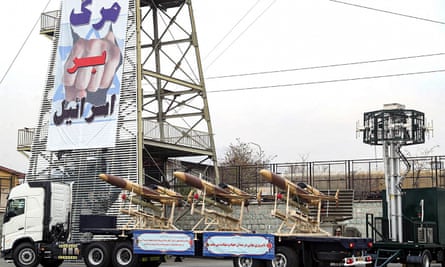
Iranian Karrar drones are displayed at an inauguration ceremony on 10 December in Tehran next to a banner which reads ‘Death to Israel’Iranian Karrar drones are displayed at an inauguration ceremony on 10 December in Tehran next to a banner that reads ‘Death to Israel’. Iran has also been providing shells, drones and missiles to Russia. Photograph: Iranian army office/AFP/Getty Images

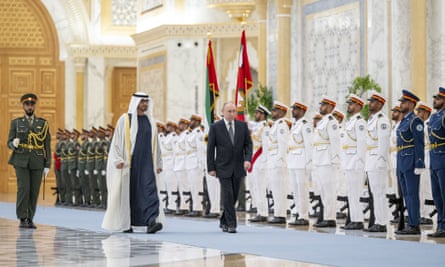
In a rare, one-day trip that underlined his warming relationship with key players in the Middle East, Putin earlier in December visited the United Arab Emirates and Saudi Arabia, where he received a grand welcome, despite his status in the west as a wanted man sought by the international criminal court for war crimes.

“Putin’s visit to the Middle East confirmed the empty noise in the words about the isolation of the Russian Federation,” Izvestia, a pro-Kremlin daily, triumphantly wrote after Putin’s trip.

Kozhanov said the Israel-Hamas war also provided Moscow with a rare opportunity to court the broader global south, which has accused the west’s rules-based order of hypocrisy over Palestinian deaths. In the process, the Kremlin was eager to claim the moral high ground, despite its own devastating record of human rights abuses during wars in Chechnya, Syria and, most recently, Ukraine.

“Putin’s Russia is very pragmatic,” said Kozhanov. “Moscow sensed that the events in Gaza are driving the global south away from the west and could make its attitudes more sympathetic to Moscow.”

Mohamed bin Zayed Al Nahyan welcomes Vladimir Putin with an official ceremony at Qasr Al Watan in Abu Dhabi – they are both walking on a blue carpet in a grand reception room in front of a line of men in military uniforms, standing to attentionVladimir Putin, seen here in Abu Dhabi with the president of the UAE, Mohamed bin Zayed Al Nahyan, was welcomed on his visit to the emirates and Saudi Arabia earlier in December. Photograph: UAE presidential court/Anadolu/Getty Images

For two decades under Putin, Russia and Israel pursued a delicate balance.

While the two countries often found themselves on opposite sides of the geopolitical spectrum, Israel sought contact with Russia in Syria and was careful not to antagonise Moscow, given its ties to Israel’s arch-rival, Iran.

Putin also courted the large Jewish population in Moscow and saw in Israel an ally in keeping the memory of the second world war alive, the monumental historical event around which the Russian leader has sought to build his presidency.

“It was never an alliance, but there was always a strategic understanding. Both countries needed each other,” said Michlin-Shapir.

But Russia’s invasion of Ukraine, which made Putin a pariah in much of the west, placed Israel in a bind.

Many in Israel were left deeply uncomfortable with Russia’s framing of its invasion, with Moscow falsely comparing Ukraine’s government to Nazi Germany to justify its war, said Pinchas Goldschmidt, the former chief rabbi in Moscow.

In spring 2022, these tensions first spilled over into the public when Russian officials accused Israel of supporting the “neo-Nazi regime” in Kyiv. The spat was ignited after Russia’s foreign minister, Sergei Lavrov, recycled an antisemitic conspiracy theory claiming that Adolf Hitler “had Jewish blood” – comments that Israel described as “unforgivable and outrageous”.

“On 7 October, Israel woke up and found Russia on the opposite side of the war. But the foundations for the split were already laid when Putin invaded Ukraine,” said Michlin-Shapir.

skip past newsletter promotion

Sign up to This is Europe

The most pressing stories and debates for Europeans – from identity to economics to the environment

Privacy Notice: Newsletters may contain info about charities, online ads, and content funded by outside parties. For more information see our Privacy Policy. We use Google reCaptcha to protect our website and the Google Privacy Policy and Terms of Service apply.

after newsletter promotion

Alexander Gabuev, the director of the Carnegie Russia Eurasia Center, said it was only logical that Moscow opted to support the Iran-sponsored Hamas, as it was the option most beneficial for its war efforts in Ukraine.

The war in Ukraine has become “the raison d’être for the entire machinery of Putinism”, Gabuev wrote in a recent op-ed, pointing to Iran’s indispensable military support.

“This is why the Kremlin’s muted reaction to the 7 October terrorist attacks by Hamas and ensuing full-throated criticism of Israel’s war in Gaza would once have been unimaginable but is hardly surprising in 2023,” he said.

As the Hamas attack unfolded, Russian officials and state-controlled media quickly took up a pro-Palestinian position, cheering Israeli military and intelligence blunders, which were presented as a testament to western weakness.

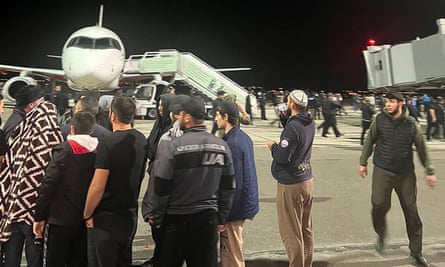
The state rhetoric, which often had nods toward antisemitism, has partly been attributed to the anti-Jewish storming of an airport in the Russian region of Dagestan, during which a violent mob looked for Jewish passengers arriving from Israel.

People in a crowd on the airfield shout antisemitic slogansA crowd of people stormed on to the airfield and shouted antisemitic slogans at the airport in Makhachkala, Dagestan, on 30 October, protesting against the arrival of a plane from Tel Aviv. Photograph: AP

The Israel-Hamas war has already proved to be a win for Putin by helping take the west’s focus off the war in Ukraine, with the US and the EU struggling to push through two critical aid packages that are deemed vital for Kyiv’s long-term survival.

“Russia now has an interest in prolonging this conflict in the Middle East,” said a senior European diplomat in Moscow, speaking on conditions of anonymity. He said he feared an all-out Israel-Hezbollah war would further derail any help for Ukraine.

The hard pro-Israeli position of the Ukrainian president, Volodymyr Zelenskiy, on the Gaza conflict, in which he sought to compare Hamas to Russia, has in the meantime alienated some of the countries in the global south. This, insiders say, could undo months of diplomatic efforts by the west and Ukraine to paint Moscow as a global pariah in the global south for breaching international law.

“It seemed a bit too easy and too fast for Zelenskiy to go full pro-Israel,” said a senior European official in Kyiv in November. Pointing to countries such as South Africa, Brazil, Indonesia and Turkey, the official said it could now be harder for Ukraine to make inroads after sustained diplomatic progress.

In an interview in Kyiv, Zelenskiy’s adviser Mykhailo Podolyak admitted there would be a “chill in relations” with non-western countries, but said once Ukraine would “be able to explain why this is happening and the role of Russia in it … we will be able to revive all our dialogues”.

For now, Ukraine appears to have little to show in return for supporting Israel. Before 7 October, Netanyahu had announced a nonaligned approach to the war in Ukraine, refusing to provide lethal weapons or much-desired air defence systems to Kyiv, an approach that is unlikely to change with the fighting in Gaza. Netanyahu has also reportedly rejected repeated requests by Zelenskiy to make a solidarity visit to Israel after the Hamas attack.

In contrast, Michlin-Shapir said the Hamas-Israeli war provided Putin with a new opportunity to impose himself on the global order.

The former Israeli official compared the current diplomatic efforts to Russia’s intervention in Syria in 2015, which brought Moscow back to the international table after it annexed Crimea a year before. “They managed to get out of isolation then. The Middle East always provides new opportunities for Russia,” she said.

Shaun Walker contributed from Kyiv

Categories
Saved Web Pages - Audio Posts

Ukraine war maps: Zelensky confronted with “territorial sacrifices”

The war started by Vladimir Putin should end only with Ukraine strong enough to defeat any future aggression from Moscow, the Institute for the Study of War (ISW) says, with its maps comparing the latest situation on the ground with territory held before Russia’s 2022 invasion.

In an analysis published New Year’s Eve, the Washington, D.C., think tank addressed suggestions that Kyiv should consider ceding territory to end the war, which has killed hundreds of thousands and displaced millions.

The U.S. is the biggest donor of military aid to Ukraine, but further assistance from Washington has been held up by Republican lawmakers who question the ongoing financial commitment that Ukraine wants.

Ukrainian soldier

A Ukrainian army scout is pictured on December 23 in Avdiivka, Ukraine. The Institute for the Study of War, a U.S. think tank, says that Ukraine must be given the resources to defeat Russia and prevent future aggression from Moscow.
Kostya Liberov/Getty Images

The GOP-controlled House has not approved President Joe Biden‘s funding request for $106 billion, which includes $61 billion in additional aid for Ukraine and funds for Israel and U.S. border security.

GOP Senator J.D. Vance told CNN‘s State of the Union that it was in the U.S.’s “best interest” to accept that Ukraine would give up some territory to Russia because it was unlikely Kyiv’s forces could force Russian troops back behind the borders in place before they invaded in February 2022.

But the ISW said that the only outcome the U.S. and its allies should accept is a Ukraine that can “deter and defeat” any future aggression by Moscow while maintaining “an economy strong enough to prosper without large amounts of foreign aid.”

Newsweek has emailed the Russian Defense Ministry for comment.

Amid discussions about pressing Ukraine to trade land that the Russians now occupy for a ceasefire or armistice are rumors of the Kremlin’s interest in negotiations of some sort, the ISW said. These discussions largely focus on the supposed intransigence of Ukrainian President Volodymyr Zelensky.

But that argument ignores “the military, economic, and financial consequences that these territorial sacrifices would have for Ukraine’s long-term security and economic viability,” according to the ISW.

It also ignores “the future financial burden they would impose on the supporters of an independent Ukraine.” Furthermore, there are military and economic reasons for Ukraine to try to liberate all of the territory Russia now occupies.

“The current lines cannot be the basis for any settlement remotely acceptable to Ukraine or the West,” the ISW said, adding that “trusting Russian promises of good behavior would be foolish.”

The ISW’s latest maps reveal that Ukraine’s borders, and the line of contact between Ukraine and Russia before the 2022 invasion, were about 2,000 miles and included large defendable areas, especially in the northeast.

Institute for the Study of war map

This map from the Institute for the Study of War shows Russian-occupied Ukraine before Vladimir Putin’s 2022 invasion.
Institute for the Study of War

Another map, dated December 31, shows how Russia’s territorial gains would become a staging area for a future invasion and that Ukraine must liberate the Kherson and Zaporizhzhia regions to avoid this.

Institute for the Study of war map

This Institute for the Study of War map, dated December 31, shows what the ISW considers to be the regions that Ukraine must liberate to prevent a future Russian invasion.
Institute for the Study of War

The ISW said that Russia will not abandon its maximalist aims now or in the future and that “the most advantageous lines Ukraine could hold militarily and economically are its internationally recognized 1991 boundaries.”

This means that freezing the war’s gains now “enormously advantages Russia and increases the risks and costs to Ukraine and the West of deterring, let alone defeating, a future Russian attempt to fulfill Putin’s aims by force.”

Newsweek is committed to challenging conventional wisdom and finding connections in the search for common ground.

Newsweek is committed to challenging conventional wisdom and finding connections in the search for common ground.

Categories
Saved Web Pages - Audio Posts

Israel’s Supreme Court overturns a key component of Netanyahu’s polarizing judicial overhaul

?url=https%3A%2F%2Fassets.apnews.com%2F3

JERUSALEM (AP) — Israel’s Supreme Court on Monday struck down a key component of Prime Minister Benjamin Netanyahu’s contentious judicial overhaul, delivering a landmark decision that threatens to reopen the fissures in Israeli society that preceded the country’s ongoing war against Hamas.

The planned overhaul sparked months of mass protests, threatened to trigger a constitutional crisis between the judicial and legislative branches of government and rattled the cohesion of the powerful military.

Those divisions were largely put aside after Hamas militants carried out a bloody cross-border attack in southern Israel on Oct. 7, triggering a war that has raged in Gaza for nearly three months. But Monday’s court decision could reignite those tensions, even while the country remains at war.

Justice Minister Yariv Levin, a Netanyahu ally and the architect of the overhaul, lambasted the court’s decision, saying it demonstrated “the opposite of the spirit of unity required these days for the success of our soldiers on the front.”

The ruling “will not discourage us,” Levin said without indicating whether the government would try to revive his plan in the short term. “As the campaigns are continuing on different fronts, we will continue to act with restraint and responsibility,” he said.

In Monday’s decision, the court narrowly voted to overturn a law passed in July that prevents judges from striking down government decisions they deem “unreasonable.” Opponents had argued that Netanyahu’s efforts to remove the standard of reasonability opens the door to corruption and improper appointments of unqualified cronies to important positions.

The law was the first in a planned overhaul of the Israeli justice system. The overhaul was put on hold after Hamas militants carried out their Oct. 7 attack, killing some 1,200 people and kidnapping 240 others. Israel immediately declared war, and is pressing forward with an offensive that Palestinian health officials say has killed nearly 22,000 people in Gaza.

In an 8-7 decision, the Supreme Court justices struck down the law because of the “severe and unprecedented harm to the core character of the State of Israel as a democratic country.”

The justices also voted 12-3 that they had the authority to overturn so-called “Basic Laws,” major pieces of legislation that serve as a sort of constitution for Israel.

It was a significant blow to Netanyahu and his hard-line allies, who claimed the national legislature, not the high court, should have the final word over the legality of legislation and other key decisions. The justices said the Knesset, or parliament, does not have “omnipotent” power.

Netanyahu’s government could seek to ignore Monday’s ruling, setting the stage for a constitutional crisis over who has ultimate authority.

Netanyahu and his allies announced their sweeping overhaul plan shortly after taking office a year ago. It calls for curbing the power of the judges, including by limiting the Supreme Court’s ability to review parliamentary decisions and changing the way judges are appointed.

Supporters said the changes aim to strengthen democracy by circumscribing the authority of unelected judges and turning over more powers to elected officials. But opponents see the overhaul as a power grab by Netanyahu, who is on trial for corruption charges, and an assault on a key watchdog.

The Movement for Quality Government in Israel, a good-government group that opposed the legislation, called the Supreme Court’s ruling “a tremendous public victory for those who seek democracy.”

“Only an unreasonable government, one that acts unreasonably, that makes unreasonable moves, abolishes the reasonablility standard,” the group’s chairman, Eliad Shraga, said.

Before the Israel-Hamas war, hundreds of thousands of Israelis took to the streets in weekly protests against the government. Among the demonstrators were military reservists, including fighter pilots and members of other elite units, who said they would stop reporting for duty if the overhaul was passed. Reservists make up the backbone of the Israeli military.

While the reservists quickly returned to duty after the Oct. 7 attacks in a show of unity, it remains unclear what would happen if the overhaul efforts were revived. A resumption of the protests could undermine national unity and affect the military’s readiness if soldiers refused to report for duty.

Under the Israeli system, the prime minister governs through a majority coalition in parliament — in effect, giving him control over the executive and legislative branches of government.

As a result, the Supreme Court plays a critical oversight role. Critics say that by seeking to weaken the judiciary, Netanyahu and his allies are trying to erode the country’s checks and balances and consolidate power over the third, independent branch of government.

Netanyahu’s allies include an array of ultranationalist and religious parties with a list of grievances against the court.

His allies have called for increased West Bank settlement construction, annexation of the occupied territory, perpetuating military draft exemptions for ultra-Orthodox men, and limiting the rights of LGBTQ+ people and Palestinians.

The U.S. had previously urged Netanyahu to put the plans on hold and seek a broad consensus across the political spectrum.

The court issued its decision because its outgoing president, Esther Hayut, is retiring and Monday was her last day on the job.

Categories
Saved Web Pages - Audio Posts

Live updates | Fighting in southern Gaza city as Israel widens its offensive

?url=https%3A%2F%2Fassets.apnews.com%2F6

The center of Gaza’s second-largest city has seen fighting amid Israel’s widening air and ground offensive in the southern part of the territory that has displaced tens of thousands more Palestinians and worsened dire humanitarian conditions. Distribution of food, water and medicine have been prevented outside a sliver of southern Gaza, and new military evacuation orders are squeezing people into ever-smaller areas.

The United Nations said 1.87 million people — more than 80% of Gaza’s population — have been driven from their homes since the start of the Israel-Hamas war, triggered by the deadly Oct. 7 Hamas assault on southern Israel. The U.N. also says that all telecom services have been shut down due to cuts in the main fiber routes. On Wednesday, the United Nations chief urged the U.N. Security Council to use its clout to avert “a humanitarian catastrophe” in Gaza.

Around 1,200 people have died on the Israeli side, mainly civilians killed during Hamas’ Oct. 7 attack. The Health Ministry in Hamas-run Gaza said the death toll in the territory has surpassed 16,200, with more than 42,000 wounded. The ministry does not differentiate between civilian and combatant deaths, but said 70% of the dead were women and children.

Currently:

— U.N. chief uses rare power to warn Security Council of impending ‘humanitarian catastrophe’ in Gaza

— Senior U.N. official denounces ‘blatant disregard’ in Israel-Hamas war after many U.N. sites are hit.

— Hanukkah message of light in darkness feels uniquely relevant to U.S. Jews amid war and antisemitism.

— Generation after generation, Israeli prison marks a rite of passage for Palestinian boys.

— Find more of AP’s coverage at https://apnews.com/hub/israel-hamas-war.

Here’s what’s happening in the war:

ISRAEL FOREIGN MINISTER CRITICAL OF U.N. CHIEF

JERUSALEM — Israeli Foreign Minister Eli Cohen is sharply criticizing the U.N. secretary-general after he issued a dire warning over the situation in the Gaza Strip, calling Antonio Guterres’ tenure at the world body “a danger to world peace.”

Guterres wrote to the 15-member Security Council on Wednesday urging it to use its influence to avert “a humanitarian catastrophe” in Gaza. He also reiterated an urgent call for a humanitarian cease-fire and warned that Israel’s bombardment will soon lead to a complete breakdown of public order.

Posting on the social media platform X, Cohen said Guterres’ call for a cease-fire and request to activate Article 99 of the U.N. Charter “constitutes support of the Hamas terrorist organization and an endorsement of the murder of the elderly, the abduction of babies and the rape of women.”

“Anyone who supports world peace must support the liberation of Gaza from Hamas,” Cohen concluded.

It was the first time since Guterres took the helm of the United Nations in 2017 that he has written to the Security Council under Article 99, which lets him bring to the council’s attention any matter he believes threatens international peace and security.

ISRAEL’S SECURITY CABINET APPROVES FUEL DELIVERIES TO GAZA

JERUSALEM — Israeli Prime Minister Benjamin Netanyahu says his Security Cabinet has approved small deliveries of fuel into the Gaza Strip to prevent a humanitarian crisis and the spread of disease in the crowded southern part of the besieged territory.

Netanyahu says the “minimal amount” of fuel will be set by the three-member authority in charge of managing the war against Hamas.

Israel has greatly restricted fuel shipments into Gaza, saying that Hamas diverts it for military purposes. Humanitarian officials say the fuel shortages have crippled the health care system and hindered deliveries of basic humanitarian supplies.

Netanyahu’s office said shipments would be approved “from time to time” for the southern Gaza Strip, where the vast majority of Gaza’s population is concentrated.

The decision comes as Israel faces mounting pressure from the United States to ramp up aid to Gaza to avoid mass civilian casualties.

ISRAELI MILITARY SAYS HAMAS LEADER IS HIDING UNDERGROUND

JERUSALEM — An Israeli army spokesman says Hamas leader Yehya Sinwar is hiding underground and it is the mission of the Israeli military to “find Sinwar and kill him.”

Israeli forces have pushed deeper into Sinwar’s hometown of Khan Younis over the past two days, heightening the focus on the Hamas leader seen as the mastermind of the deadly Oct. 7 Hamas attack on southern Israel.

Sinwar grew up in the refugee camp of Khan Younis which over the decades evolved into a crowded neighborhood of the city. Mohammed Deif, the shadowy military leader of Hamas, is from the camp as well.

Earlier Wednesday, Israeli Prime Minister Benjamin Netanyahu announced that troops “are encircling Sinwar’s house,” adding that “he can escape, but it’s only a matter of time before we get him.”

Asked later whether this meant troops were closing in on the Sinwar home, as some media had reported, Israeli army spokesman, Rear Adm. Daniel Hagari said: “The house of Sinwar is the area of Khan Younis.”

“Sinwar is not above ground; he is underground,” Hagari said. “I don’t want to elaborate where and how and what we know in terms of intelligence. This is not the place to talk about such things in the media. Our job is to find Sinwar and kill him.”

ISRAELI MILITARY SAYS IT FOUND STASH OF WEAPONS

JERUSALEM — The Israeli military said Wednesday that it found a large stash of weapons, including long-range rockets and explosives, near a clinic and school in northern Gaza.

The military released videos from inside Gaza of the weapons arranged neatly on the ground, and said they included hundreds of missiles and dozens of explosives, grenades and drones.

Israeli media reported that the weapons were found near Shati refugee camp, which Israeli forces gained control of during their offensive in the north of the strip.

ARAB NATIONS CALL FOR A CEASE-FIRE

UNITED NATIONS — Arab nations at the United Nations are fine-tuning a proposed U.N. Security Council resolution calling for a cease-fire in the two-month Israeli-Gaza war.

Riyad Mansour, the Palestinian U.N. ambassador, said Wednesday that it’s essential that the U.N.’s most powerful body demand a halt to the conflict following the resumption of bloodshed in Gaza after the end of a weeklong humanitarian truce on Dec. 1.

Surrounded by members of the 22-nation Arab Group, Mansour also told reporters that a ministerial delegation from Arab nations and the 57-member Organization of Islamic Cooperation headed by Saudi Arabia’s foreign minister will be in Washington on Thursday to meet with U.S. officials.

“On top of the agenda is this war has to stop,” he said. “A cease-fire has to take place and it has to take place immediately.”

Mansour said the national security adviser to U.S. Vice President Kamala Harris contacted Palestinian President Mahmoud Abbas Wednesday morning and that Abbas pressed for an immediate cease-fire and more humanitarian aid.

The United States, Israel’s closest ally, has veto power in the Security Council and has not supported a cease-fire.

On Tuesday, U.S. deputy ambassador Robert Wood told reporters that the role of the Security Council in the Israeli-Gaza war “is not to get in the way of this important diplomacy going on on the ground … because we have seen some results, although not as great results as we want to see.”

A Security Council resolution at this time, he said, “would not be useful.”

YAD VASHEM CALLS UNIVERSITIES’ RESPONSE TO ANTISEMITISM INADEQUATE

JERUSALEM — Israel’s Yad Vashem Holocaust memorial says it is alarmed by the congressional testimonies of the presidents of Harvard, the University of Pennsylvania and the Massachusetts Institute of Technology. The memorial claims the universities had an inadequate response to campus antisemitism that has flared during the Israel-Hamas war.

In a statement Wednesday, Yad Vashem accused the presidents of “minimizing” and “contextualizing” antisemitism.

“The positions taken by the three university presidents in their testimonies highlight a basic ignorance of history, including the fact that the Holocaust did not start with ghettos or gas chambers, but with hateful antisemitic rhetoric, decrees and actions by senior academics, among other leaders of society,” the statement said.

In recent weeks, the federal government has opened investigations into several universities, including Penn and Harvard, regarding antisemitism and Islamophobia on campus.

The university presidents told a House Committee on Tuesday that there is a fine line between protecting free speech and allowing protests, while also combatting antisemitism.

The academic leaders said they were taking steps to combat antisemitism on campus, including increasing security and providing additional counseling and mental health support.

U.N. CHIEF WARNS OF POSSIBLE HUMANITARIAN CATASTROPHE IN GAZA

UNITED NATIONS — The United Nations chief is urging the U.N. Security Council to use its clout to avert “a humanitarian catastrophe” in Gaza.

Secretary-General Antonio Guterres said Wednesday that the fast-deteriorating humanitarian system now risks a total collapse.

He reiterated his urgent call for a humanitarian cease-fire. He warned that Israel’s bombardment of Palestinians in Gaza, who have no shelter or essentials to survive, will soon lead to a complete breakdown of public order.

Guterres wrote to the 15-member Security Council on Wednesday under Article 99 of the U.N. Charter for the first time since he took the helm of the 193-member world body in 2017. It allows the secretary-general to bring to the council’s attention any matter that he believes threatens international peace and security.

Guterres said the desperate conditions in Gaza and the breakdown of public order will make humanitarian assistance impossible. He warned that “an even worse situation could unfold, including epidemic diseases and increased pressure for mass displacement into neighboring countries.”

“The international community has a responsibility to use all its influence to prevent further escalation and end this crisis,” Guterres said.

LEAFLETS IN KHAN YOUNIS

KHAN YOUNIS, Gaza Strip — Residents of Khan Younis, the largest city in southern Gaza and the latest focus of the Israeli military’s ground offensive, say the army has showered the area with leaflets quoting a verse in the Quran.

Palestinians deciding whether to flee Khan Younis as Israeli tanks draw closer viewed the quoted verse, “The flood overtook them as they were wrongdoers,” as an ominous portent.

The Israeli military had no immediate comment when asked about the leaflet drop.

Journalist Aamer Tabsh in Khan Younis said he saw Israeli planes drop thousands of the fliers.

Tabsh said residents are convinced the reference to the epic flood of Noah in the Quran and Bible “means that something much worse is coming.”

Some are linking it to Hamas’ name for its Oct. 7 attack against Israel, Al Aqsa Flood Battle. Others pointed to recent reports that the Israeli military was considering flooding Hamas’ subterranean tunnel network with seawater to force out the militants.

JERUSALEM MARCH PLANNED FOR THURSDAY

JERUSALEM — Ultranationalist Jews plan to march through the Muslim Quarter of Jerusalem’s Old City on Thursday in a demonstration that risks igniting new violence in the holy city.

Israeli police on Wednesday confirmed that they gave permission for a march of 200 people to pass through the Muslim Quarter and the Old City to the Western Wall, the holiest site where Jews can pray. The march coincides with the start of the Jewish holiday of Hanukkah.

Ultranationalist activists have called on supporters to honor the memory of fallen soldiers who died in the latest Gaza war and to push for expanded Jewish access to Jerusalem’s most sensitive holy site.

Jews call the site the Temple Mount, the spot where the biblical Temples once stood. Muslims call it the Noble Sanctuary, home to the Al-Aqsa Mosque and the golden Dome of the Rock.

Police said Thursday’s march will not enter the compound.

Former Jerusalem police Chief Yair Yitzhaki told Army Radio he couldn’t understand why police approved the march. He added that the route through the Muslim Quarter was “an attempt to anger and inflame the area.”

Jerusalem has been the site of multiple Palestinian stabbing and shooting attacks since Israel’s war with Hamas began on Oct. 7.

A similar march in 2021 boiled over into an 11-day Gaza war.

Categories
Saved Web Pages - Audio Posts

Biden urges Congress to pass Ukraine funding now: “This cannot wait”

By Kathryn Watson

Updated on: December 6, 2023 / 1:38 PM EST / CBS News

President Biden on Wednesday reiterated his plea to Congress to pass a national security funding request that includes money for Ukraine, as the White House warns Ukraine funding will dry up by the end of the month. 

The president directed his message to Republicans in particular, as the Democratic-controlled Senate prepares to vote on Mr. Biden’s request for $106 billion in funding for national security-related matters. Many Republicans insist funding for border security must be included in any such package. 

“Make no mistake — today’s vote is going to be long remembered,” he said. “And history is going to judge harshly those who turn their back on freedom’s cause. We can’t let Putin win.” 

The president warned Republicans they’d be siding with Russian President Vladimir Putin if they don’t pass more aid for Ukraine soon. 

“This cannot wait,” the president said. “Congress needs to pass supplemental funding for Ukraine before they break for the holiday recess, simple as that. Frankly, I think it’s stunning that we’ve gotten to this point in the first place. Congress—Republicans in Congress are willing to give Putin the greatest gift he could hope for and abandon our global leadership, not just Ukraine, but beyond that.”

Mr. Biden said Russians have captured “thousands” of Ukrainian children, keeping them in Russia and decimating Ukrainian families. 

“Russian forces are committing war crimes,” the president continued. “It’s as simple as that. It’s stunning. Who is prepared to walk away from holding Putin accountable for this behavior? Who among us is really prepared to do that?”

Mr. Biden’s remarks come on the heels of Attorney General Merrick Garland’s announcement that the U.S. has charged four Russian soldiers with war crimes for allegedly abducting and torturing an American citizen in Ukraine. 

The Office of Management and Budget sent a letter to Congress on Monday urging the House and Senate to approve more funding for Ukraine — both to support the country in its battle against Russian aggression and to replenish U.S. military stockpiles. 

“I want to be clear: without congressional action, by the end of the year we will run out of resources to procure more weapons and equipment for Ukraine and to provide equipment from U.S. military stocks,” OMB Director Shalanda Young wrote to Congress. “There is no magical point of funding available to meet this moment. We are out of money — and nearly out of time.”

Mr. Biden’s address came shortly after former House Speaker Kevin McCarthy announced in a Wall Street Journal op-ed that he would be leaving Congress at the end of the month, before his term ends. 

The current speaker, Rep. Mike Johnson, says Ukraine aid won’t pass without funding for border security. The president addressed the “broken immigration system” Wednesday. 

“In terms of changes of policy and providing resources that we need at the border, I’m willing to change policy as well,” Mr. Biden said. “I’ve asked for billions of dollars for more border agents, more immigration judges, more asylum officers. Republicans have to decide if they want a political issue or if they want a solution at the border.” 

More

Kathryn Watson

Kathryn Watson is a politics reporter for CBS News Digital based in Washington, D.C.

First published on December 6, 2023 / 12:03 PM EST

© 2023 CBS Interactive Inc. All Rights Reserved.

Categories
Featured Posts Saved Web Pages - Audio Posts

Zelensky explains why he won’t negotiate with Putin

20240101_FLP001.jpg

As 2024 begins President Volodymyr Zelensky speaks to The Economist’s Editor-in-chief, Zanny Minton Beddoes, about his political and military goals for the coming year and why he won’t compromise with Vladimir Putin.