An unwillingness to decentralize decision making authority and a failure to communicate accurate information are the most consequential weaknesses at the state level that have contributed to the Russian military’s subpar performance to date in the war with Ukraine. These characteristics are exacerbated by other historic factors found throughout Russian society, which also permeate the military as a reflection of that society. They include an imperialist national identity, endemic corruption, and societal brutality. To these systemic problems must be added the inherent difficulties of what the Russian military was supposed to achieve in its first major peer conflict since World War Two and elements of simple military incompetence.
The unwillingness to decentralize decision making authority is symptomatic of over five centuries of Russian autocracy. It is why Russia lacks an effective noncommissioned officer (NCO) corps and has a top-down command-and-control system, which is slow to provide timely direction to forces at the front. This is exacerbated by a failure to communicate accurate information, especially at the strategic level, which results in decision making based on faulty information and reinforces bad decisions due to inaccurate feedback.
These two characteristics create a command, control, and communications system unsuited for modern warfare but congruent with a Russian way of war that has been influenced by a culture of imperialism, corruption, and brutality. Imperialism prevented Russian national security elites from seeing agency in other peoples, which led them to underestimate possible Ukrainian resistance and Western resolve. Corruption compounded personnel and supply challenges for the Russian military. A reliance on brutality to control its own soldiers and assert control over occupied populations exacerbated factors in the Russian military that are detrimental to good order, discipline, morale, and unit cohesion and provided additional motivation to Ukrainians to resist Russian aggression.
These are not really “weaknesses” of the Russian system but consequences of that system. Furthermore, despite their detrimental impact on military effectiveness, these factors have sometimes “worked” for Russia and provided, counterintuitively, advantages such as the political will to conduct attrition warfare at a cost that no Western society would accept.
This is significant because all the above factors are endemic to Russian social and political culture and will continue, barring a major social revolution in Russia of the scale of 1917. This means there will be no permanent solution to the war in Ukraine even if a peace treaty is signed. These cultural factors will eventually drive Russia to regain its military capacity and renew its aggression against Ukraine and hostility to the West. As long as Russia is autocratic with a propensity for self-deception and imperialism, it will try again to assert hegemony over Ukraine and other portions of its former empire. That future war will likely resemble the war in Ukraine, a high-intensity war of attrition where Moscow is willing to make brutal sacrifices to outlast its foes. This is not a case of predicting that history will repeat itself, but that Russia’s basic political nature will. Only if Russia overcomes its history and changes internally, will it ever behave differently externally.
Introduction
This essay will address the question, “What systemic weaknesses at the state level have contributed to Russia’s underperformance in the war with Ukraine?” It will show how Russia’s military performance in the war in Ukraine reflects historic Russian societal and political factors by examining the following questions:
- Why cannot the Russian military decentralize decision making authority?
- Why cannot the Russian government honestly communicate with itself and its military?
- How has an imperialist ideology impacted Russian planning and decision making?
- What effect has corruption had on military capabilities?
- Why is brutality an aspect of Russian military service and what are its effects?
This essay will also examine the inherent difficulties of what the Russian military was supposed to achieve in its first major peer conflict since World War Two and how military incompetence complicated its efforts. It will conclude with a caveat that while cultural factors negatively affected Russian military performance in Ukraine, they also sometimes generated strengths for reasons that are counterintuitive for Western observers.

Participants attend an annual meeting of the Defence Ministry Board in Moscow, Russia, December 21, 2022. Sputnik/Mikhail Klimentyev/Kremlin via REUTERS
Why cannot the Russian military decentralize decision making authority?
The Russian military reflects a society whose government, with rare exceptions, has never been based on the consent of the governed. Russia’s default form of government is autocracy, where absolute power over a state is concentrated in the hands of one person, whose decisions are subject neither to external legal restraints nor to regularized mechanisms of popular control.[1] Autocracy creates a military that adheres to orders, as the militaries of democratic societies do, but also one where decentralization, honest communication, and individual rights are not only incompatible with the ethos of the state but also threaten it. An autocracy cannot survive if its military’s culture is in opposition to itself. Hence, over centuries, the Russian military developed to protect the state by defeating its enemies while having a system compatible with autocracy, so as not to undermine it.
This is why the Russian military has never empowered NCOs, expected them to show initiative, or trained them to serve as a bridge between officers and enlisted men to mentor the former and teach the later. In the pre-industrial age this was not a serious drawback since the Russian army, like others of that era, was based on long-service peasant conscripts who were trained by rote to conduct simple maneuvers and fire their weapons. The hardiness of Russian soldiers and the size of Russia’s population produced armies able to defeat even Napoleon.
Industrial Age warfare created a need for soldiers with specialized skills and leadership abilities, i.e., NCOs. While industrialized nations developed small unit leaders from working class foremen and artisans, predominately peasant Russia could not due to its small working class and the unwillingness of aristocratic Russian officers to treat NCOs better than serfs, which they were till 1861. In 1903, the Imperial Russian army had only 12,109 long-service soldiers, which averaged about two senior NCOs per company whereas German units of this era would have twelve.[2] As a result, as late as 1912, the Russian General Staff Academy taught only two maneuvers – advance and retreat – and tactical formations were constructed on an understanding that more complex maneuvers could cause panic and confusion. The men were simply gathered in thick masses, and set to charge the enemy line, regardless of their vulnerability to artillery.[3]
When the Bolsheviks in 1917 needed an army to defend their revolution, they eschewed creating an empowered NCO corps. Instead, they formed the Red Army as a reflection of the top-heavy, officer-centric, Imperial Army using former Tsarist officers to train and lead the force.[4] This continued throughout the Soviet era. There were few senior NCOs in the Soviet army, which had a one percent reenlistment rate, so junior officers fulfilled those duties. Soldiers who held junior NCO ranks were conscripts who attended a six-month course and then served as sergeants for their final eighteen months of service. Ironically, by one estimate, most junior NCOs were Ukrainians.[5] Reports that the post-Soviet army had developed an NCO corps proved to be overly optimistic.[6] Some Russian soldiers may wear chevrons, but they do not fulfill the functions normally associated with NCOs.
Russian army junior officers, as in Soviet times, bear the burden of their own responsibilities plus those normally handled in Western armies by senior NCOs. This increases their span of control, the number of personnel and functions a leader must supervise, beyond what young leaders can properly handle, especially in combat. This contributes to a heavy casualty rate for junior officers in a military that already had problems retaining them.[7] It then cascades into a high casualty rate for field grade officers who must be forward to ensure missions are accomplished. This reinforces historic tendencies for top-down direction and an unwillingness to delegate authority. Heavy officer casualties also inhibit Russian military efforts to regenerate itself. Basic and advanced training in Russia’s army is done at the individual unit level, but most officers deployed with their units to Ukraine.[8] This left limited cadres at home bases to instruct new conscripts. Fewer officers left alive means fewer who can pass on their combat experience to conscripts, which results in fewer well-trained replacements. Evidence of this is clear among Russia’s newly mobilized cadres in Ukraine.
Because of this centralization and the historic lack of an NCO corps, Russia’s military has depended on rote training of conscripts to conduct simple battle drills and strict adherence to orders by field officers. Plans were developed at the most senior level available. In this system, initiative was harmful because it might undermine a commander’s overall plan. The decision-making process, sometimes known as the Observe-Orient-Decide-Act (OODA) loop, in the Russian army has been slow because of the time it takes for information from the front to reach headquarters, the senior-most leader to make a decision, transmit the order to the front, and then have it executed. This has often put the Russian army at a disadvantage because, per the OODA loop concept, the party that completes the cycle faster gains an advantage as the cycle continues, to the point when its enemy is overcome by events.[9]
The OODA loop concept was developed in the late 1970s, yet at the turn of the 20th century, Russian Minister of War, General Aleksey Kuropatkin, recognized that the slowness of the army’s information gathering and decision-making processes put it at a disadvantage with modern foes. Kuropatkin tried to institute numerous reforms including the conduct of free play exercises. In 1902, he led approximately 100,000 men on maneuvers near Kursk to test the army’s ability to quickly move from the defense to the offense under realistic conditions. Unfortunately for Russia, his reforms, including the concept of free play exercises, were opposed by many senior officers and never took hold. Even in the Kursk maneuvers, free play had its limits, as the entire exercise was mapped out and published in detail before a single soldier had marched onto the field. Each day’s activities were carefully planned right down to allotting time for officers to recall their daily activities in personal diaries.[10]
The traditions of the Imperial Russian army continued to the Soviet Red Army where adherence to orders was paramount over initiative or even common sense. This is seen in the message traffic between two headquarters on June 22, 1941 when Nazi Germany attacked. “We are being fired upon. WHAT SHOULD WE DO?!” reported one front line commander. “You must be insane. And why is your signal not in code?” came the reply from higher headquarters.[11] While this could be an example of peacetime lethargy not yet leaving the system, it also reflected that Stalin had ordered his military not to fire at German forces because he feared giving them a pretext for war. Even self-preservation could not overcome the necessity to fulfill all orders exactly as given and not show initiative.
Despite the experience of World War Two, the Soviet army continued to centralize planning, discourage initiative, and conduct staged maneuvers. During the 1967 maneuvers to celebrate the 50th anniversary of Communist rule, enlisted tank crews were replaced with newly commissioned second lieutenants and the bottom of the Dnieper River was lined with steel and concrete to facilitate a tank fording demonstration.[12] When the Soviet army fought in Afghanistan, it found itself hobbled by age-old problems. One critique by two senior Soviet officers of the army’s performance in Afghanistan noted:
The failure of officers to demonstrate decisiveness and initiative in accomplishing combat tasks when fighting, waiting for prompting and advice from seniors. They tried to act by rote without taking into consideration the nature of the terrain and the situation at hand. They displayed indecisiveness in maneuvering their forces.[13]
One wonders why these officials were surprised. How could officers show initiative when it was never expected of them, and planning and decision making were usually conducted at the highest level of command?
In this historical context, the initial invasion of Ukraine was consistent with Russia’s military past. To our best knowledge, the plan was drawn up independent of those who would implement it. When events did not go according to plan, commanders at all levels were unable to adjust to a situation that defied their expectations. Rather than improvise, units near Kyiv were withdrawn and transferred to Donbas to implement yet another plan drafted from above. Once in Donbas, they had only one strategy – attrition warfare by frontal attacks, for which minimal training was necessary. Donbas became akin to the battles of Sevastopol (1854), Mukden (1905), and Tannenberg (1914), but with drones.
Another factor, already alluded to, is that staged, centralized maneuvers misled not only foreign observers but Russian leaders themselves regarding the combat readiness of the army.[14] Impressions gathered from carefully rehearsed demonstrations often have no relation to a military’s true capacity to deal with the violence, friction, and logistics of modern warfare. To know its true status, the military should have tested its ability to fight by exercising against an unpredictable opposing force. Possibly the last Kremlin leader with the combat experience to realize this was Premier Nikita Khrushchev whose memoirs record his being appalled by unrealistic Soviet naval exercises and the lack of professional knowledge of the officers leading them.[15] His decision making during the Cuban Missile Crisis may have reflected this experience.
President Putin does not have a military background or combat experience. Neither does Sergei Shoigu, a former civil engineer and minor Communist Party apparatchik, who has been the Minister of Defense for over a decade. Both have attended numerous military demonstrations but probably never realized that choreographed events cannot provide an army with the training and experience necessary to deal with the inherent friction of war. Apparently, many Russian generals made the same mistake, and as one critic observed, they found themselves most at home sitting safely in viewing stands watching their troops in the military equivalent of a dance recital.[16] At least Kuropatkin tried.
The historic Russian phobia toward decentralized decision making has manifested itself for centuries in the lack of a functioning NCO corps, an officer corps unable to act without higher direction, and a military system focused on presenting the illusion of combat capability vice learning from trial and error. These consequences of the Russian state system are unlikely to change barring wholesale cultural changes in the Russian state and society. Change would require an honest discussion of problems and possible solutions – the first step in any reform movement. However, reform is unlikely as long as the Russian government fears honest feedback and communications both up and down the chain-of-command.

Russian service members march past an honour guard during a military parade on Victory Day, which marks the 77th anniversary of the victory over Nazi Germany in World War Two, in Red Square in central Moscow, Russia May 9, 2022. REUTERS/Shamil Zhumatov
Why cannot the Russian government honestly communicate with itself and its military?
Military reform, to include decentralizing decision-making authority, creating an empowered NCO corps, and changing training from demonstrations to trial-and-error exercises is impossible as long the Kremlin fears honest communication within society. As noted earlier, the military’s culture cannot be allowed to undermine the state. Kremlin rule depends not on the will of the people but on being able to control them. A lack of control would end autocratic rule. Therefore, the Kremlin has depends on high levels of propaganda and coercion to stay in power.[17]
High-coercion systems are low-information systems. Information flows in one direction: from the top down. Unwelcome information is seen as disruptive at best, treasonous at worst. In the Kremlin, people are not rewarded for speaking truth to power. Instead, people lie to power to protect themselves, because for centuries the truth can literally be lethal.
As we will examine in the next section, the decision to invade Ukraine was influenced by an imperial mindset. It was reinforced by inaccurate information, primarily from the Federal Security Service (FSB).[18] However, FSB reporting fit into a Kremlin culture of conformity, censorship, and self-censorship, which led to self-deception. These features are deeply rooted in Russia’s political culture.
In Russia, communications must conform to the viewpoints of the ruler. Famed Russian historian Vasily Kliuchevsky observed this as early as the reign of Ivan IV when he wrote, “the people had no right to a will of their own, but were obliged to think in accordance to the will of the authorities that represented them.”[19] This was later echoed by Trotsky when he proclaimed, “you cannot be right against the Party.” The will of the authorities, called democratic centralism under Communism, meant Kremlin decisions were binding on all and beyond discussion or criticism. The February 22, 2022 national security meeting demonstrated this as sycophantic Russian security elites, most of whom had private reservations about war with Ukraine, publicly acquiesced to Putin.[20] Two who showed the slightest signs of doubt or independent thinking, deputy Kremlin chief of staff Dmitry Kozak and foreign intelligence chief Sergey Naryshkin, were interrupted and humiliated by Putin on national television.[21]
Conformity is antithetical to honest intelligence collection and analysis, which is why Russia has never had an apolitical intelligence service. Intelligence that contradicts Kremlin beliefs must be adjusted.[22] When this has not happened, the Kremlin often ignores it or worse. Of the Soviet intelligence chiefs who served Stalin before the German invasion in 1941, the only one shot was the one who argued most forcefully that Germany would attack.[23] Inaccurate FSB reports to Putin regarding Ukraine’s society and army were just the latest episode of a long tradition of conforming to Kremlin perceptions for career advancement and survival.[24]
Censorship maintains public conformity. Self-censorship protects officials’ positions. The closing of remaining independent media outlets since the war began has decreased not only public knowledge of events, but official knowledge as well. Even if he wanted to, Putin could rarely find a Russian TV report or newspaper article with an opinion or information different than what was voiced at a Kremlin meeting. This and Putin’s self-imposed isolation make him a prisoner of the very system he controls. However, even if accurate information reached the Kremlin, it would have to pass through an ideological lens as old as Russian autocracy.
How has an imperialist ideology impacted Russian planning and decision making?
Centralization of authority and a failure to honestly communicate information are the most consequential weaknesses at the state level that have contributed to the Russian military’s subpar performance in the war with Ukraine. Other cultural factors exacerbate these problems. Russian imperialism, i.e., the messianic belief that Russia has a universalist mission in the Orthodox and Slavic worlds, is one of those features.[25] During Soviet times, a similar messianic impulse – international socialism with the slogan, “Proletarians of all countries, unite!” – justified Moscow’s similar imperial actions. Imperialism strengthened the logic of autocracy. As an empire, Moscow could never decentralize political control or allow individual freedoms because this could risk leading its various peoples to secede. If conquered ethnic groups could leave the empire, then what was to prevent nobles from leaving the Tsar or the proletariat from leaving the Party? Tsars and Commissars faced the same conundrum. Both decided to keep the empire and autocratic rule.
Russian imperialism also prevents Kremlin elites from seeing agency, the ability to make one’s own decisions, in others. The inability to acknowledge agency in individuals and nations reinforces a culture of autocracy internally and imperialism externally as it denies the equality of individuals and sovereignty of neighboring countries. Imperialism is the faulty lens through which equally faulty information is filtered to inform, or more accurately misinform, Russian national security policy. What is its history and consequences vis-a-vis Ukraine?
The Russian state was formed as both an autocracy and empire beginning with the reigns of Tsars Ivan III (the Great) (1462-1505) and Ivan IV (the Terrible) (1533-1584). Their rules were no more sanguine than that of Western contemporaries, but the dual development of autocracy and empire put Russia on a path different from other European states. Whereas England developed as a nation before it became an empire, Russian national identity was imperialistic from its very beginning.
When Ivan IV seized the Tatar territories of Kazan and Astrakhan, Russia became an empire with a vast area lacking distinct geographic boundaries to define or protect it. Therefore, continued expansion became both self-protection and self-aggrandizement. The empire rested on the possession of its western borderlands, particularly Ukraine, to satisfy the messianic self-image of Moscow being the “Third Rome” after the fall of Constantinople (1453) as the successor of both Byzantium and the earlier Slav empire of Kievan Rus. It was Russia’s incorporation of Ukraine following the Pereyaslav Accords (1654) that fused its national identity with an imperial one, where the entire legitimization of the Russian state rested on the possession of the western borderlands.[26] Russian historians would take the position that possession of Ukraine, the heart of the lands of Rus, was a vital ingredient in legitimizing the Russian empire. To sustain this national myth, these historians have consistently denied the existence of a separate Ukrainian national identity, claiming instead the inhabitants of what is present-day Ukraine were actually Russians.[27]
A polity’s national identity is the result of how it interprets its history.[28] Post-1991, Russia had two alternative ways to interpret its history and national identity. Either establish a postimperial identity such as Great Britain and France have, or focus on irredentism and attempt to “regather the Russian lands.” The latter was urged by Russians thinkers as diverse as Alexander Solzhenitsyn and Alexander Dugin, who wished to recreate a supranational Russian state.[29] Putin chose this course, used history and symbolism to reaffirm Russia’s imperial identity, and ignored neighbors’ different interpretations of the past. However, an imperial national identity for Russia was impossible if Ukraine had its own national identity. Putin is using war to deny Ukraine’s nationhood. Ukrainians are defending themselves to affirm it.
This imperial ideological blinder – Ukraine is Russian, Ukrainians are Russians, we will be liberators – started the war with the misconception that Ukrainians had no agency, no ability to make their own decisions, no right to exist, and therefore no will to resist. This mindset was reinforced by the earlier experience of the near bloodless annexation of Crimea. It also provided the strategic thinking to start the war with a coup de main (although we will see this was also a time-honored Russian approach). Since there would be no opposition, the war would be short and not require Russia’s society or industry to mobilize. A short war meant that Western intervention or aid to Ukraine would be impossible or pointless. These assumptions and their cascading effects came from a mindset reinforced by poor information; it was a downward spiraling policy making process for a reality that did not exist. However, it was consistent with the “advice” offered to Putin by a trio who Foreign Minister Sergey Lavrov says are his primary advisors: Ivan the Terrible, Peter the Great, and Catherine the Great.[30]
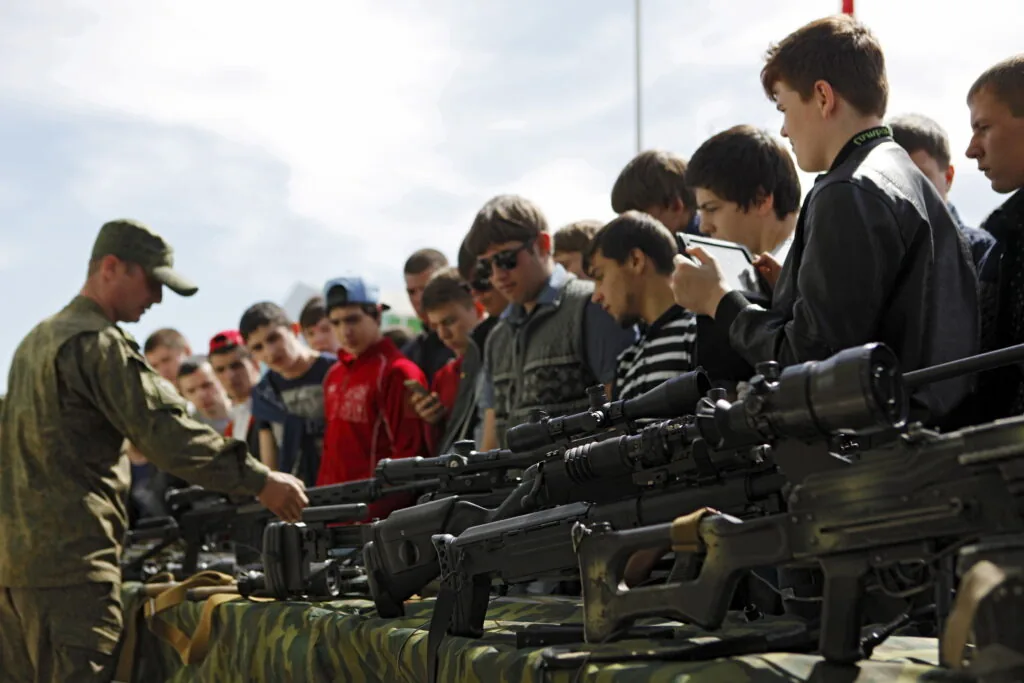
High school students, who are potential conscripts, look at firearms during an open army day at a military base in Stavropol, Russia, April 15, 2016. REUTERS/Eduard Korniyenko
What effect has corruption had on military capabilities?
Corruption, the use of public power for private gain, is found in all societies, but is exceptionally prevalent in Russia. Today, Russia occupies 137th place out of 180 countries on Transparency International’s Corruption Perceptions Index (Ukraine is ranked 116th, the United States 24th).[31] This is consistent with Russian and Soviet history. Under the Tsars, autocracy and centralization led to serfdom for the peasants and obligatory state service for the nobles. Practically everything belonged to the Tsars, both the land and the people. Under Communism, everything belonged to the Party. In either case, since the state owned everything, if someone wanted something beyond what the state allotted, personal gain had to come from state resources instead of from one’s own labor or inventiveness.
A feature of Russian autocracy that helped create a pervasive bureaucracy and culture of corruption was that Tsarist officials were put above the law (this tradition continued centuries later with Communist Party officials) and allowed to extort payments for favors and services (in Russian – kormleniia or feeding). The practice was so well entrenched that in the 17th century, Moscow set formal tariffs on the loot that governors could bring home upon retirement, confiscating any excess.[32]
In the Soviet Union, the inefficiencies and inadequacies of the planned economy created a black market or Second Economy in which all participated.[33] It was an integral part of the Soviet system encompassing everything from petty bribery, black marketeering, and wholesale theft from the state, to underground private manufacturing. This became so extensive that in 1961, Soviet authorities reinstituted the death penalty for economic crimes. In 1966, the Soviet press reported that one-fourth of all crimes in the country involved the misappropriation of state property.[34] For example, reportedly one-third of all Soviet cars drove on fuel stolen from the state.[35]
When the Soviet era ended, corruption and the centralized Communist bureaucracy not only hindered its transition to a market economy but grew with that transition. New leaders committed to democratic reforms found themselves hemmed in by the continuing power of a sprawling and self-perpetuating state bureaucracy. The Soviet bureaucracy was the culmination of a long Russian tradition of petty officialdom that did nothing well except protect privilege and prevent change. Far from driving out the crime and corruption that came with the growth of freedom, the bureaucrats tended to incorporate these sordid practices into their own way of life.[36] Observers who lived in both the Soviet Union and today’s Russia comment that corruption is worse now than ever before partly due to the lack of Soviet-era controls and partly due to a lack of confidence in the future. Individuals and businesses hesitate to invest since the economic future is so uncertain. Hence, theft and embezzlement are incentivized to get all one can out of the present.[37]
This includes the Russian military. Graft and corruption skyrocketed after 1991. During the First Chechen War (1994-1996), Russian soldiers and officers sold weapons, ammunition, and sometimes armored vehicles to Chechen rebels.[38] Russian peacekeepers in the Balkans resold fuel from United Nations stocks and engaged in other types of graft.[39] In one case, when a Russian airborne battalion finished its tour of duty, its soldiers flew home on a military transport while its officers drove to Russia in a convoy of over 120 stolen vehicles.[40] It is no wonder that in 1998 Russian General Prosecutor Yuri Skuratov declared the Russian military as the most corrupt government structure in Russia.[41]
Russian military corruption continued under Putin. In January 2004, Russian Audit Chamber chairman, Sergei Stepashin, claimed that ten percent of the maintenance portion of the defense budget had been misappropriated.[42] The Russian military procuracy added that in 2004 theft in the armed forces had grown 21% over the previous year.[43] Today, the military procuracy reports that over eighty percent of defense construction contracts have not been executed despite being funded, while criminal cases related to the embezzlement of defense construction funds have almost doubled (from 66 to 107) since the war began.[44] An independent media investigation into Rosreserv, the government agency tasked with procuring everything from food to manufacturing equipment during emergencies or war, and whose leadership has close Putin ties, discovered it cannot fulfill many requirements due to years of corrupt contracts and diversions of reserves.[45]
On the battlefield, corruption is reflected by the theft of equipment and supplies and the embezzlement of soldiers’ salaries. Russian tanks have gone into combat without explosive reactive armor, making them more vulnerable to anti-tank weapons.[46] Destroyed armored vehicles cannot be quickly replaced because only one out of ten tanks in reserve can function due to the theft of vital optics and electronics for their precious metals. In some cases, even entire tank engines were stolen.[47] Russian soldiers advance into battle without protective vests or with inferior older models since newer vests were stolen from warehouses and sold. Medical kits lack everything from bandages to tourniquets. Russian soldiers in Ukraine eat expired field rations and there is a lack of fuel for everything from vehicles to cooking stoves.[48] This is partly the result of poor logistics but also because even before the war, Russian officers were seen selling fuel on local black markets.[49] Every category of equipment needed for modern warfare from radios to night vision goggles is in short supply despite the money allocated to upgrade the Russian military after the 2008 war in Georgia. Theft of funds to maintain vehicles and purchase combat equipment for individual soldiers weakened the Russian military’s ability to arm and equip itself. It also impacted on personnel readiness and morale.
When the war began, portions of the army were undermanned despite their reported personnel status. In an echo of the Russian literary classic Dead Souls, Gogol’s novel about a scheme to defraud the government by counting dead serfs still on their landlords’ accounts, some Russian commanders claimed more soldiers in their units than were present for duty to collect their pay. This explains why some armored vehicles went into battle crewed by only one or two soldiers. Even worse for morale than embezzling pay for nonexistent soldiers has been the theft of pay for actual soldiers. There are numerous cases of soldiers not being paid for months, nor receiving their promised combat bonuses.[50] This is not unique to the war in Ukraine. During the First Chechen War, officers “borrowed” their men’s pay to invest in trade deals and profit from high interest rates. If the embezzlement of funds for ghost soldiers recalls the theme of Gogol’s Dead Souls, this practice was described to the letter in Dostoevsky’s The Brothers Karamazov in which a lieutenant colonel does the same with his soldiers’ wages.[51] Such examples seem to be military life imitating Russian art, or more accurately art reflecting an immutable aspect of Russian military culture. The culture of corruption formed under the Tsars, continued during the utopianism of Communism, and through the presidencies of Yeltsin and Putin. It seems to grow even stronger with the passing of each era. The price that the Russian army has paid for systemic corruption is a high one in combat capability, measured in equipment and personnel readiness. It also pays a price in terms of unit cohesion, as corruption contributes to the brutality that the average Russian soldier faces on and off the battlefield.

Members of Pokrov youth military club take part in a training session in the village of Beryozovka, near Krasnoyarsk, Siberia, Russia, March 6, 2016. The club was founded in 2008 by Andrei Krapitus, a former sergeant in the airborne troops, for children and youth to learn skills they can use to prepare for army service. Picture taken March 6, 2016. REUTERS/Ilya Naymushin
Why is brutality an aspect of Russian military service and what are its effects?
Autocracy requires political violence to maintain control. In Russia this begat a legacy of brutality by state institutions against its people by forces such as Ivan IV’s oprichnina, Peter the Great’s Preobrazhensky Prikaz, and various secret chancelleries under other Tsars culminating with the Okhrana under Alexander III. These institutions paled in comparison with the instrument of Communist control, the Cheka, and its litany of successors: GPU, OGPU, NKVD, MGB, and KGB. To control Russia, Communist leaders instituted the Red Terror, fought the Russian civil war, suppressed rebellions from Kronstadt to Tambov, crushed the peasantry (especially in Ukraine) through starvation, and atomized their own society with the Great Terror, which cut a swath through Soviet society including the military. The Gulag system of labor camps started with Lenin and continued till the end of the Soviet Union. An estimated 61 million people died in the Soviet Union between 1917-1991 due to state murders, man-made famines, mass deportations, and the gulag system.[52] Today, Putin maintains control through similar means including political incarceration and state murders. Russia’s brutal past and present is reflected both in how the Russian military conducts its operations and treats its soldiers.
After World War Two, the army supported Soviet secret police operations to pacify resistance in Eastern Europe and provided advisory assistance to socialist militaries at war in Egypt, Yemen, Vietnam, Angola, Ethiopia, and other places.[53] Its only major war was in Afghanistan, where it conducted a brutal counterinsurgency campaign. Soviet counterinsurgency strategy in Afghanistan, coercing the population to accept government rule, contrasted sharply with the Western “hearts and minds” approach, emphasizing winning the population over to the government via security and government services. The Soviet approach in Afghanistan killed approximately a million and a half civilians and made six million more refugees.[54]
Five years after the Afghan war, the nascent Russian army sent an armored force directly into Grozny to conduct a coup de main and end Chechnya’s de facto independence. The force was decimated and the First Chechen War began. After a stalemate and peace agreement, the Second Chechen War (1999-2000) brought the breakaway republic back under Moscow’s control. In both wars, the Russian army repeated its Afghan strategy of targeting a population to coerce it to accept government rule. In the Second Chechen War, Moscow used huge financial subsidies to coopt the Kadyrov clan to “Chechenize” the war and forced other clans to submit to Moscow. The destruction of Grozny and the torture and rapes in “filtration camps” terrorized the population, Russian citizens all, into acquiescence and set the stage for Russia’s intervention in Syria.[55]
In Syria, Russia committed artillery and air support assets to prevent the fall of the Asad regime to a mixed group of Islamist rebels. The rebels possessed neither effective counter-air nor counter-battery capabilities. Therefore, Russian forces were able to conduct stand-off attacks, deliberately targeting the civilian population to force them to surrender to the Asad regime. Civilians and relief workers, as well as hospitals, bakeries, schools, and other urban infrastructure, were targeted.[56] This strategy of targeting civilians to remove support for guerrilla forces is also used by the Russian paramilitary Wagner Group in various African nations.[57] This Russian way of war developed over decades and has often achieved Moscow’s political aims. It is therefore not surprising it is being used in Ukraine.
It is also not surprising that a military, which targets civilians, treats its own soldiers brutally. The primary example is dedovshchina – a system of bullying, beatings, extortion, hazing, humiliation, and sometimes the murder of junior enlisted men by senior ones.[58] No system like this could exist if the officer corps wanted it to stop. It does not because in the absence of a functioning NCO corps, this enforces a hierarchical system in the enlisted ranks. Russian officers tolerate dedovshchina because they see it as an effective means of maintaining discipline.[59]
The brutality exhibited towards its own soldiers is not just limited to a regime of barracks brutality. As noted, corruption is always at the expense of Russian soldiers who suffer from having insufficient rations, warm clothing, properly fitting gear, etc. The average Russian soldier also suffers from a total lack of concern about his safety. One example is the design of Russian armor. Russian tanks have their ammunition stored around the interior of the tank turret, instead of in a compartment protected by a blast door as in Western tanks. When the tank is hit, the ammunition in the turret explodes and leaves the crew little chance of survival.[60] Another example is the repeated frontal assaults against heavily defended Ukrainian positions. Many newly formed units, trained in other specialties such as artillery, have been redesignated as infantry forces and sent into battle despite protests about their lack of proper training. A final example is not only the execution of Wagner Group deserters by sledgehammer blows, but the way such executions have been videotaped and accepted or even celebrated in some circles of Russian society.
The brutal treatment of Russian soldiers impacts on intangible factors of combat effectiveness such as unit cohesion and morale. In his classic study of these intangibles, Fighting Power, Martin van Creveld explained that the reason for German military effectiveness at the individual-level during World War Two was because the average soldier, “felt himself a member of a well-integrated, well-led team whose structure, administration, and functioning were perceived to be, on the whole, equitable and just.”[61] Per van Creveld, elements responsible for creating that belief included how well soldiers were indoctrinated and trained, leave and unit rotation policies, availability of medical services including psychiatric care, fairness in pay, leave, decorations, military justice, and in dealing with soldiers’ complaints, and visible NCO and officer leadership, all of which are lacking in Russia’s military. The average Russian soldier in Ukraine does not consider himself to be part of a team that is well-integrated, well-led, equitable, and just. This is reflected in innumerable social media postings, videos sent to officials complaining about combat conditions, and numerous combat refusals including by company-sized formations.
It is also reflected in how Russian soldiers treat Ukrainians civilians. If they themselves are brutalized, why care if they brutalize someone in a weaker position? The war crimes against Ukrainian civilians and captured soldiers reflect both the brutal approach of the Russian military towards war and towards its own soldiers. The effect has been to increase Ukrainian resolve and fighting spirit, motivating not just Ukrainian soldiers but also the entire civilian population to resist this invasion. Ukrainian willingness to resist an enemy larger than itself has been a major contributing factor to Russia’s underperformance in the war with Ukraine.
What was the Russian army supposed to do in February 2022 and what prevented it from doing so?
Any study of this war must recognize that even without these factors, what the Russian military was expected to do on February 24, 2022 was a daunting task. Per the plan, a force of approximately 190,000 men and tens of thousands of vehicles were to move along multiple axes of advance ranging in distance from 150 to 200 miles and in 72 hours seize Kyiv and other major urban areas in the dead of winter with limited daylight or good flying weather for air support. This would have been one of the fastest movements in military history. Even Guderian’s panzers and Patton’s tanks only averaged 20 miles per day during their famed advances. Command and control would have to have been flawless to coordinate multiple unit movements along icy roads to prevent traffic jams, as well as to coordinate air support, airmobile, and naval operations along a 1,000-mile front. Logistical columns had to travel along these same roads bringing supplies and fuel from railheads that grew further from the front lines the farther the army advanced. This would have been difficult to achieve even if not one round had been fired.[62]
The fact this was even tried indicates that besides the factors discussed above, the Russian military was also a prisoner of its own heritage. The initial attack plan for Ukraine resembled almost every invasion conducted by the Soviet or Russian army since World War One. The plan for mobile columns to penetrate far into an enemy’s rear was consistent with the heritage of “deep operations” espoused by Marshall Tukhachevskii before World War Two, attempted in the first phase of the Winter War with Finland in 1940, and successfully conducted in Manchuria in 1945.[63] In Hungary in 1956, the Soviet army advanced against resistance on multiple axes to seize a capital. It did so again in 1968 in Czechoslovakia without resistance. In 1979, the Soviets conducted a bold and deep penetration from its borders into Kabul and other cities in Afghanistan, which met little initial opposition. As noted, the coup de main plan for Kyiv was similar to the 1994 attempt to seize Grozny, an event the Russian military did not learn from.
While some hold Kremlin leadership responsible for initial setbacks due to the difficulty of the plan, the false assumptions underlying it, and its deviation from military doctrine, the Russian military writ large cannot be excused for violating basic tactics and techniques as well as for clear deficiencies in combat readiness. A short examination of the critique that the initial subpar performance of the Russian army was due mainly to political factors will show that the military still bears responsibility for many actions or inactions. Deviation from doctrine may have been the least of its problems.
One critique is that per Russian military doctrine, there should have been weeks of preparatory fires before a ground assault to degrade Ukraine’s military and civilian infrastructure. Multiple axes of advance overstretched logistics and prevented the formation of reserve forces. Training before the attack was inadequate and prepositioning equipment near the Ukrainian border further degraded training opportunities. The inability to achieve air superiority was due to the need to provide close air support and other factors (e.g., combat over Syria did not prepare Russia’s air force for fighting over large forested areas or for attacking targets protected by air defenses).[64]
Much of that is true. However, first we should consider if a doctrinally correct approach would not have had its own drawbacks. Second, we should not exonerate the Russian military from responsibility for inherently military functions that political decisions did not affect.
Ukrainian defenses and infrastructure may have received greater damaged from weeks of preparatory fires but, with surprise lost, Ukraine would have had time before the ground invasion to better prepare defenses, train and equip territorial forces, destroy bridges, mobilize reserves, etc. One criticism of President Zelensky is that Ukraine recognized the threat too late, which led to the capture of key terrain in Kherson and elsewhere. A weeks-long air and missile bombardment prior to the invasion may have been doctrinally correct but would have given Ukraine more time to prepare for the ground attack and the West more time to ship weapons.
Attacking Ukraine via multiple, dispersed axes of advance did complicate Russian logistics. A concentrated blow aimed at Kyiv with reserve forces in echelon may have made the fight for the capital a different story; or maybe not. Russian logistics become complicated anytime they move away from railheads. A single force of 190,000 men advancing towards Kyiv might have overwhelmed Ukrainian defenders, but would have had to travel over the same roads as the smaller force did and the traffic jams that resulted may have become even more gargantuan. Even if the force entered Kyiv, how would it have fared in urban combat in the seventh most populous city in Europe with 3.5 million people occupying 324 square miles? A Russian advance against only one objective would have allowed other Ukrainian units to redeploy, reinforce Kyiv, or strike at Russian flanks. The multiple-axes advance issue essentially relitigates the World War Two debate over a narrow-front versus a broad-front advance, with Eisenhower’s preference for the later over Bradley’s, Patton’s, and Montgomery’s insistence on the former. History has shown that Eisenhower was probably right.[65] One strategic success Russia has gained to date is seizure of the fresh water canal to Crimea, essential for maintaining control of the peninsula. This would not have happened without a multiple-axes strategy.
The fact that Russian forces were unprepared and ill-trained cannot be solely a political responsibility. The penchant for demonstrations vice exercises or even productive small unit training is more the fault of Russia’s military leadership than its civilian leadership. The same with poor command and control capabilities that led to massive traffic jams, numerous friendly fire incidents, and poor combined arms coordination. The critique that the Russian air force was unable to gain air superiority over Ukraine partly because pilots had no experience fighting over a larger, forested country and against an adversary with layers of air defenses is not the fault of the political leadership but the air force command. An air force that is supposed to defend Russian from NATO should have prioritized training for the suppression of enemy air defenses. Only a small part of Russia’s air force was ever in Syria at one time and there are plenty of areas in Russia where its pilots can train over large forests. While many criticisms ring true, when considering the reasons for subpar military performance at the state level, not only culture and political interference should be considered, but also senior military incompetence and an assignment that would have been daunting to execute for any military, from any culture, using whatever doctrine.

Children play ball in front of the Tchaikovsky State Opera and Ballet Theatre, with a “Z” symbol on the wall in support of the Russian armed forces involved in the military conflict in Ukraine, in the city of Izhevsk, Russia August 18, 2022. REUTERS/Alexey Malgavko
Caveats
This essay argues that Russia’s subpar performance in Ukraine is the consequence of traits deeply embedded in Russian society and politics. Yet, disadvantages inherent to these traits have not prevented Russia from seizing 20 percent of Ukraine’s territory. Russia can also still rely on its historic practice of using mass as a substitute for quality and its modern practice of threatening to use nuclear weapons. Furthermore, Russian cultural factors, which have had negative consequences, can also provide advantages, however counterintuitive to Western audiences. Consideration should be paid to the following:
- Russia has always lacked an empowered NCO corps, but that did not prevent the Soviet army in World War Two from defeating an enemy with possibly the world’s best NCO corps.
- Imperialism distorts reality for elites, but it also generates intangibles such as patriotism and even chauvinism to help rally a nation and motivate troops in combat.
- Corruption degrades combat efficiency and morale, but for centuries Russians have adapted to it. Even World War Two saw corruption and incompetence in the Soviet arms industry. T-34 tanks often came off the production lines with cracked hulls and defective engines. One Soviet officer estimated that during an engagement at Stalingrad, only one quarter of his tanks could operate due to such defects.[66] As Stephen Kotkin has argued, the Soviet Union during World War Two was a paradox of pathologies and functioning institutions, but it won.[67]
- Finally, with regards to brutality, repeated frontal assaults by Wagner Group and the Russian army in Donbas have resulted in horrific casualties, but have regained battlefield initiative and may have prevented a Ukrainian winter offensive. Few other societies could have demanded such sacrificial frontal assaults and probably few other armies would have carried them out. As the old Russian saying goes, “our souls are God’s; our bodies the Tsar’s.” In the end, soldiers have human limits but they may not be known until reached. In Russian society, these limits may differ from those in Western society.
These caveats are not meant to negate the essay’s research and conclusion but to warn that as the Russians say, “there is the other side to the medal.” Traits that cause weakness at the state level in Russian culture can also lead to adaptation and compensatory strengths.
Conclusion
On the steppes of Eastern Europe, two post-Soviet armies are locked in combat. Each is outwardly similar in language, history, culture (including the culture of corruption), and military equipment. What differentiates the two in this war is that Russia is stuck in its history, Ukraine is moving away from it.
Today may be the Information Age but Russia is mired in the Misinformation Age. For the Kremlin, allowing open political speech is impossible if autocracy is to be maintained. It therefore stumbles into traps and bad decisions that it could be warned about. No one is willing to speak truth to power; but no one in the Kremlin is listening for it either.
Flawed information passed through an equally flawed filter of imperial ideology and led to a defective decision-making process, which caused the Kremlin to underestimate Ukraine and the West. Imperialist aggression combined with brutality have further united Ukraine and strengthened its national identity and will to resist. Corruption has tied one hand beyond the Russian military’s back by denying it the resources it expected to have in war. Corruption also mistreats the Russian soldier as much as any barracks hazing. This mistreatment is detrimental to unit cohesion, an intangible difficult to measure but clear when it breaks down.
The Russian soldier has endured trials like this before. Since these social and political factors have always been a part of his life, he is likely to continue to endure and adapt to them, until he no longer can or wishes to. Trading tens of thousands of lives for less than a hundred square miles of Donbas territory has not brought Russia victory, but at least it has staved off defeat. The Kremlin’s strategy is for its will to outlast Ukraine’s and Western willingness to support Kyiv, just as the equally ruthless Taliban outlasted the West in Afghanistan. In any event, Russia’s future operations and decisions will continue to be shaped by its past experiences.
The factors at the state level that have contributed to the Russian military’s subpar performance to date in the war all have their roots in Russian history and tradition. They are consequences endemic to Russia’s political and social culture and are unlikely to change without major social upheaval and domestic reforms, which could take decades and generations to permeate into Russian military culture. If the centuries old traditions of autocracy and imperialism do not change, then Russia’s conflict with Ukraine and the West will continue. Even if there is an armistice lasting years or decades, the same forces of history and culture that have created the current war will generate a new one against Ukraine, the Baltics, Georgia, or other former Russian lands to “gather them back in” to Moscow’s control. If Ukraine is any benchmark, Russia’s next war will again by a high-intensity war attrition with Moscow willing to sacrifice much to achieve its goals by outlasting its foes. Centuries of traditions, prejudices, and shibboleths do not disappear on command, if they disappear at all. Of all the burdens Russia has had to bear, the heaviest and most relentless of all may be the weight of her past.[68]
The author would like to thank Ambassadors William Courtney and Allan Mustard; Professor Roman Szporluk, Emeritus Director of Harvard’s Ukrainian Research Institute; and retired Russian Foreign Area Officers Colonels R. Taft Blackburn, Dr. Dan Burghart, and Barry Huggins USA, and Colonel James Howcroft USMC for their insights, which helped form the arguments for this paper, as well as the helpful comments of several other experienced Russia hands who prefer to remain anonymous. Thanks are also in order for Foreign Policy Research Institute intern Scott Buchholtz for his assistance in researching this paper. Any mistakes in this work are the fault of the author alone.
[1] Johnson, Paul M., Autocracy: A Glossary of Political Economy Terms, Auburn.edu.
[2] Stone, Norman, The Eastern Front: 1914-1917, Charles Scribner’s Sons, New York, 1998, p.167.
[3] Stone, Norman, p.45.
[4] Figes, Orlando, A People’s Tragedy: The Russian Revolution 1891-1924, Penguin Books, New York, 1996, p.591.
[5] See Suvorov, Viktor, Inside the Soviet Army, Macmillan Publishing Company, New York, 1982, p. 259-260 and Cockburn, Andrew, The Threat: Inside the Soviet War Machine, Random House, New York, 1983, p. 41.
[6] See Bartles, Major Charles K., Russian Armed Forces Enlisted Professionals, Foreign Military Studies Office, Fort Leavenworth, Kansas, March 11, 2019.
[7] Yelizaveta Mayetnaya, “Military Do Russian Officers Have a Morale Problem? Some Say Yes.” Radio Free Europe/Radio Liberty, December 16, 2021.
[8] Michael Kofman and Robert Lee, “Not Built for Purpose: The Russian Military’s Ill-Fated Force Design,” War on the Rocks, June 2, 2022.
[9] Marine Corps Doctrinal Publication 1, Warfighting, 1989.
[10] Steinberg, John, All the Tsar’s Men: Russia’s General Staff and the Fate of Empire, 1898-1914, Woodrow Wilson Center Press, Washington D.C., 2010, p. 95-104.
[11] Moynahan, Brian, The Claws of the Bear: A History of the Soviet Army from 1917 to the Present, Hutchinson Press, London, 1989, p. 93.
[12] Suvorov, Viktor, The Liberators: My Life in the Soviet Army, W.W. Norton and Company, New York, 1981, p. 61-70.
[13] Sarin, Major General Oleg and Dvoretsky, Colonel Lev, The Afghan Syndrome: The Soviet Union’s Vietnam, Presido Press, Novato, California, 1993, p. 94.
[14] See Kofman, Michael, Zapad 2021: What We Learned From Russia’s Massive Military Drills, Moscow Times, September 23, 2021.
[15] Khrushchev, Nikita, Khrushchev Remembers: The Last Testament, Little, Brown, and Company, Boston, 1974, p. 21-29.
[16] Connable, Ben, Russia’s ‘Demonstration Army’ Is a Red Flag for U.S. Security Force Assistance, Lawfare, June 26, 2022.
[17] See Arendt, Hannah, The Origins of Totalitarianism, Houghton, Mifflin, Harcourt, New York, 1951.
[18] Eckel, Mike, Russian Officials Predicted a Quick Triumph in Ukraine. Did Bad Intelligence Skew Kremlin Decision-Making?, Radio Free Europe/Radio Liberty, March 11, 2022.
[19] Szamuely, Tibor, The Russian Tradition, McGraw-Hill, New York, 1974, p. 35.
[20] Anin, Roman, Как Путин принял решение о войне (How Putin decided on war), istories.media, May 16, 2022 regarding doubts of Putin’s inner circle towards war with Ukraine.
[21] Galeotti, Mark, The Personal Politics of Putin’s Security Council Meeting, Moscow Times, February 22, 2022.
[22] Riehle, Kevin, Russian Intelligence: A Case-Based Study of Russian Services and Missions Past and Present, National Intelligence Press, 2022, p. 130.
[23] Murphy, David, What Stalin Knew: The Enigma of Barbarossa, Yale University Press, New Haven, 2005.
[24] Miller, Greg and Belton, Catherine, Russia’s Spies Misread Ukraine and Misled Kremlin as War Loomed, The Washington Post, August 19, 2022.
[25] Prizel, Ilya, National Identity and Foreign Policy, Cambridge University Press, Cambridge, 1998, p. 155.
[26] It is interesting that this cementing of Russian imperial identity in 1654 happened so close to the adoption of the social charter of Russian absolutism, the Sobornoe Ulozhenie in 1649, which enserfed the peasants. For more on this see Van Herpen, Marcel, Putin’s Wars: The Rise of Russia’s New Imperialism, Rowman & Littlefield, Lanham, MD, 2014, p. 18.
[27] Prizel, p. 157-158.
[28] Prizel, p. 14.
[29] See Solzhenitsyn, Alexander, The Russian Question at the End of the Twentieth Century, Farrar, Straus, and Giroux, New York, 1995, p. 93.; and Clover, Charles, Black Wind, White Snow: The Rise of Russia’s New Nationalism, Yale University Press, New Haven, 2016, p. 238. Solzhenitsyn desired a union of three Slavic states (Belarus, Russia, Ukraine) and Kazakhstan. Dugin proposes not only a return of most Soviet and Russian imperial territories to Moscow’s control but also that Slavic Serbia, Romania, Bulgaria, and Greece join Russia as an Orthodox “Third Rome” or Russian South.
[30] Seddon, Max et al, How Putin Blundered into Ukraine-Then Doubled Down, Financial Times, February 23, 2023.
[31] Transparency International, Corruption Perceptions Index for 2022.
[32] Pipes, Richard, Survival Is Not Enough: Soviet Realities and America’s Future, Simon and Schuster, New York, 1984, p. 152; and Pipes, Richard, Russia, Under the Old Regime. The History of Civilization, Scribner, New York, 1974, p. 95-96 and 282-283.
[33] Grossman, Gregory, The Second Economy in the USSR, Problems of Communism, 26, 5, September/October 1977.
[34] Smith, Hedrick, The Russians, Ballantine Books, New York, 1976, p. 113-114.
[35] Moynahan, p. 348.
[36] Govorunkhin, Stanislav, Velikaia kriminal’naia revoliutsiia (The Great Criminal Revolution), Moscow, 1993.
[37] Interview with retired ambassador Allan Mustard, January 2023.
[38] Smith, Sebastian, Allah’s Mountains: Politics and War in the Russian Caucasus, I.B Tauris & Company, London, 1998, p. 186/
[39] Pomfret, John, Planners of NATO-Led Bosnia Force Wary of Graft Among Russians, The Washington Post, November 6, 1995.
[40] Author’s personal experience in Bosnia, 1996.
[41] Galeotti, Mark, Russia’s grafting generals, Janes’ Intelligence Review, no. 4, April 1, 1998.
[42] Mukhin, Vladimir, Просчитали прослезились (They counted and started to cry), Nezavisimaya Gazeta, January 23, 2004.
[43] Strugovets, Vitalii, Постоянная полуготовность (Eternal half-readiness), Russkii kurer, November 18, 2004.
[44] Telegram Channel Cheka-OGPU, Telegram: Contact @vchkogpu, downloaded March 2, 2023.
[45] Titov, Sergey, Нетрудовыее резеры. Расследование о том как кланы из окружения Владимира Путина поделили стратегический запас родины (Laborless reserves. An investigation into how clans in Vladimir Putin’s circle divided the country’s strategic reserve), Proekt.media, January 23, 2023.
[46] Shinkman, Paul, How Russian Corruption Is Foiling Putin’s Army in Ukraine, U.S. News and World Report, August 31, 2022.
[47] Starr, Michael, Corruption hinders Russia’s attempts to replace losses with old vehicles – Ukraine, The Jerusalem Post, March 27, 2022.
[48] Cranny-Evans, Steve and Ivshina, Dr. Olga, Corruption in the Russian Armed Forces, Royal United Services Institute, May 12, 2022; Zakharov, Andrei, The shocking scale of theft in the Russian army, BBC News Russia, October 20, 2022.
[49] Radio Free Europe/Radio Liberty Belarus Service, ‘They Drink A Lot, Sell Their Fuel’: Belarussians Give Low Marks To Russian Troops Deployed For Drills, February 19, 2022.
[50] Ankel, Sophia, 100 drafted Russian soldiers went on strike, refusing to fight in Ukraine after not getting paid, report says, Business Insider, November 3, 2022; Kaonga, Gerrard, Russia Failing to Properly Pay, Feed Military Recruits in Ukraine – Report, Newsweek, August 15, 2022. See also the translation from the Russian Telegram channel Veterans Notes of a February 19, 2023 message about soldiers not paid for six months.
[51] Lieven, Anatol, Chechnya: Tombstone of Russian Power, Yale University Press, New Haven, 1998, p. 284.
[52] Rummel, R.J., Death By Government, Transaction Publishers, New Brunswick, 1994.
[53] See Applebaum, Anne, Iron Curtain: The Crushing of Eastern Europe, 1944-1956, Doubleday, New York, 2012; and see Jones, Seth, Ukrainian Innovation in a War of Attrition, Center for Strategic and International Studies, February 2023, for a listing of Soviet and Russian army military operations and losses since World War Two.
[54] Britannica, Afghan War: 1978-1992. Accessed March 3, 2023.
[55] See Gall, Carlotta and De Waal, Thomas, Chechnya: A Small Victorious War, Pan Books, London, 1997 for the best description of these tactics and the overall course of the First Chechen War; and see Schaefer, Robert, The Insurgency in Chechnya and the North Caucasus: From Gazavat to Jihad, Praeger, Santa Barbara, 2011 for an overview of both wars and especially Russia’s strategy of “Chechenization”.
[56] Human Rights Watch, Russia/Syria: War Crimes in Month of Bombing Aleppo, December 1, 2016; Russia/Syria: Strategy Targeted Civilian Infrastructure, October 15, 2020; and Knight, Ben, Syrian Archive finds ‘overwhelming’ Russian atrocities, March 28, 2017.
[57] Walsh, Declan, Russian Mercenaries Are Driving War Crimes in Africa, U.N. says, The New York Times, June 27, 2021; and Peltier, Elian, Wagner Group May Have Committed War Crimes in Mali, U.N. Experts Say, The New York Times, January 31, 2023.
[58] Human Rights Watch, The Wrongs of Passage: Inhuman and Degrading Treatment of New Recruits in the Russian Armed Forces, October 19, 2004; and Tyson, David, Bullying in the Soviet Army, How They Fight, U.S. Army Intelligence Agency, Intelligence and Threat Analysis Center, October-December 1989, ATC-WP-2600-191-88.
[59] Human Rights Watch, Russia: Systemic ‘Hazing’ a Serious Abuse: Officers’ Corps and Government Fail to Act, October 19, 2004.
[60] Lendon, Brad, Russia’s tanks in Ukraine have a ‘jack-in-the-box’ design flaw, CNN, April 28, 2022.
[61] Martin van Creveld, Fighting Power: German and U.S. Army Performance, 1939-1945, Greenwood Press, Westport, Connecticut, 1982, p. 163-164.
[62] These factors and others were discussed before the war in Jones, Seth and Wasielewski, Philip, Russia’s Possible Invasion of Ukraine, Center for Strategic and International Studies, January 13, 2022.
[63] See Simpkin, Richard, Deep Battle: The Brainchild of Marshal Tukhachevskii, Potomac Books, 1987; Gady, Franz-Stefan, Breaking the Mannerheim Line: Soviet Strategic and Tactical Adaptation in the Finnish-Soviet War, War on the Rocks, February 8, 2023, which describes how the deep battle strategy influenced the initial attack against Finland; and Glantz, David, August Storm: Soviet Tactical and Operational Combat in Manchuria, 1945, Leavenworth Papers (#7), Combat Studies Institute, Fort Leavenworth, KS, 1983.
[64] Massicot, Dara, What Russia Got Wrong: Can Moscow Learn From Its Failures in Ukraine?, Foreign Affairs, February 8, 2023.
[65] See Mosier, John, The Blitzkrieg Myth: How Hitler and the Allies Misread the Strategic Realities of World War II, Harper Collins Books, New York, 2003, p. 246-247.
[66] Markevich, Andrei and Harrison, Mark, Quality, Experience, and Monopoly: The Soviet Market for Weapons under Stalin, The Economic History Review 59:1 (2006), pp. 113-142.
[67] Kotkin, Stephen, Stalin at War, Institute for Advanced Study, Princeton, April 9, 2019.
[68] Szamuely, p. 9.


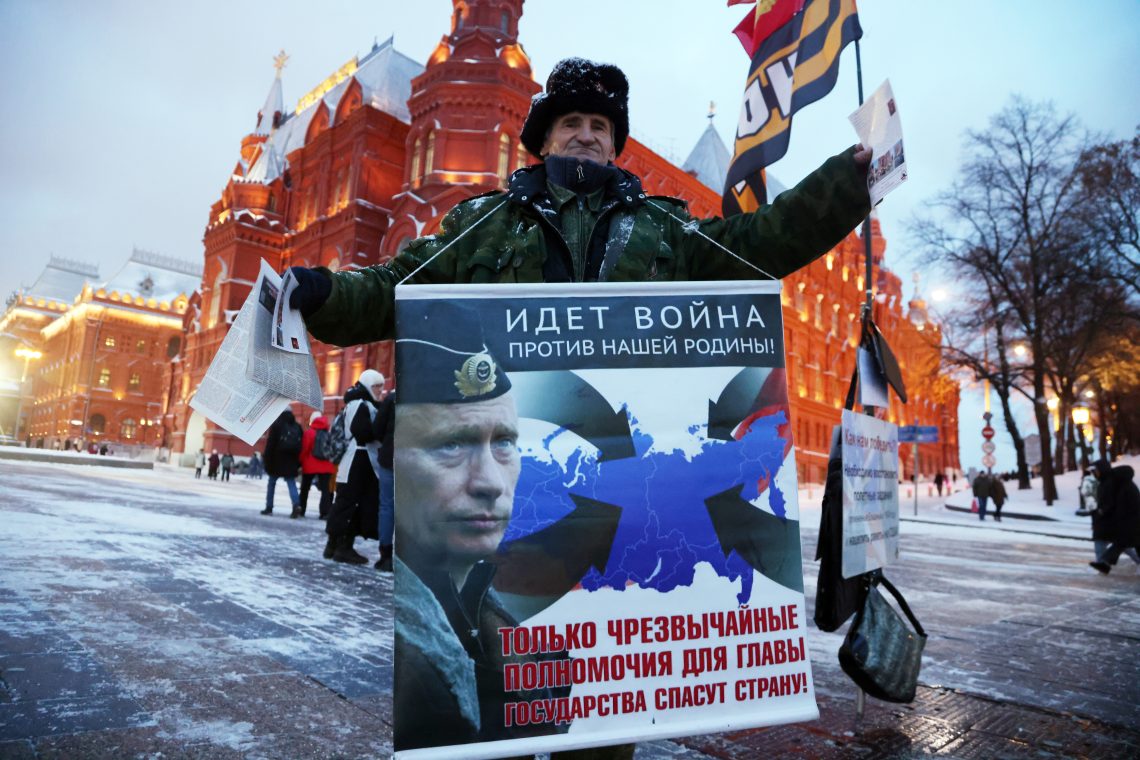 Moscow: A nationalist protester depicts Vladimir Putin, twenty years younger, in a Russian Navy cap: “There is a war against our homeland! Only emergency powers for the head of state will save the country!”
 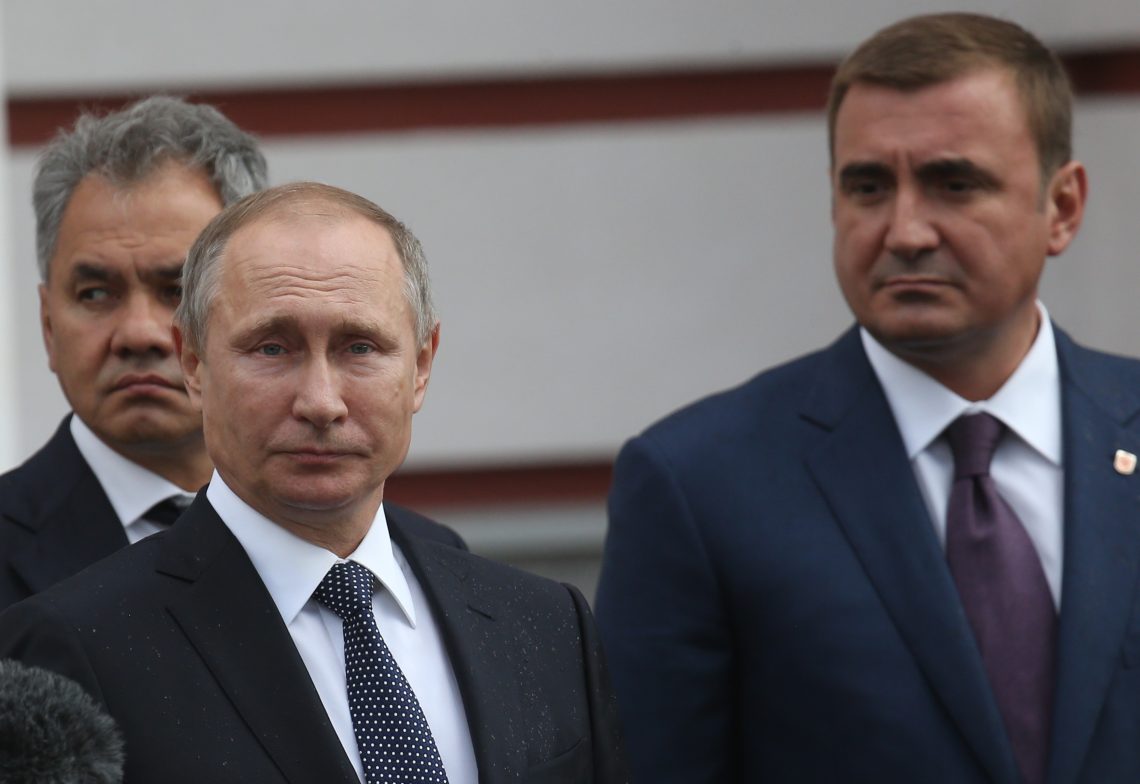 Vladimir Putin has no true deputy or natural heir. Those today rumored to be candidates for succession, like Tula Oblast Governor Alexey Dyumin (R), can quickly become disfavored, as Defense Minister Sergei Shoigu (L) purportedly was after the invasion of Ukraine.