
Category: Saved Web Pages – Audio Posts
Category Added in a WPeMatico Campaign


Victor Muller was a popular student at the highly regarded Johns Hopkins School of Advanced International Studies in Washington, D.C.
The “Brazilian” was described to CNN by fellow students as gregarious and smart. He was lively in class, open-minded, and often seen on campus carrying around his motorbike helmet.
One student said he was the last person they would ever suspect of being a spy.
But in March Muller’s true identity was revealed. Prosecutors in the Netherlands said that Muller was, in reality, Sergey Vladimirovich Cherkasov, a Russian military operative who under a fake identity sought an internship at the International Criminal Court in The Hague to steal intelligence.
Not long after, four individuals with Bulgarian identities were arrested in the UK. British prosecutors said they were in fact Russian intelligence agents, living under false identities to gather information on key parts of the UK infrastructure.
The cases, experts told Business Insider, show that as tensions with the West increase Russia is gearing up its famed program of “illegals”, or spies who live under fake identities, to infiltrate foreign countries.
It’s a method Russia has relied on since the earliest days of the Soviet Union, with its “deep cover” operatives depicted in movies, books, and TV dramas.
But with changing times experts believe that Russia has evolved new techniques for creating the “legends,” or fake identities for its illegals.
Spies deployed abroad fall into two broad categories. Most are “legals,” sent to foreign embassies to apparently take up diplomatic jobs while secretly gathering intelligence. There are also so-called “deep cover” agents, or “illegals,” who live under fake identities, sometimes for decades.
Russia’s famed ability to train “deep cover” agents goes back to the earliest years of the Soviet Union when Western countries refused to recognize the legitimacy of the Communist government and barred its diplomatic representatives.
To gather intelligence about Russia’s many foreign enemies, the KGB’s precursor, the NKVD, began sending agents abroad under fake aliases. Often, they spent years living apparently mundane lives, while secretly developing sources and gathering intelligence.
The Russian invasion of Ukraine has seen relations between the West and Russia sink to their lowest point since the Cold War, and diplomatic relations have again collapsed.
Western governments have expelled 700 Russian diplomats they’ve accused of being “legals” working for Russian intelligence agencies.
Kevin Riehle, a former FBI counterintelligence officer, said this means that Russia is falling back on old methods, and deploying “deep cover” agents under false identities to infiltrate the West.
“Because they don’t look Russian, they don’t operate out of the embassy, they can move around without the scrutiny that a Russian diplomatic officer gets,” he said.
Since the mass expulsion of Russian diplomats, “illegals are what’s left basically so they become very important,” he added.
Russian President Vladimir Putin, himself a former KGB foreign intelligence officer, has long celebrated the exploits of Russia’s spies. In a speech at the headquarters of Russia’s foreign intelligence agency, the SVR, in 2020, he praised Russia’s “courageous” spies.
Putin has portrayed becoming an “illegal” as an “act of self-sacrifice and heroism of these people to go and you know, subsume themselves from society on behalf of the motherland,” said Trevor Barnes, whose book, “Dead Doubles,” explores one of the most famous Russian deep-cover spy rings.
In 2014, 10 Russian “deep cover” agents had their covers blown in the US. One of the spies, Anna Chapman, became a tabloid celebrity, and on her return to Russia took up a lucrative position on the board of a bank.
How Russia creates ‘legends’ for its spies
Under Putin, Russia has evolved the methods it uses to create sophisticated cover identities for its spies, or “legends” as they’re known in the business.
During the Cold War, Canada became a hub for the illicit creation of identities for Russian spies. The country had less stringent rules for creating passports and identity papers than other Western nations, said Barnes.
Some Russian foreign embassy officials were assigned to a ghoulish role, he said, combing newspapers for notices of child deaths whose identities would then be used to obtain passports for agents. But in the wake of 9/11 new technology, such as biometric passports, made it more difficult to use fake identity papers.
Barnes said that there are “swings and roundabouts” in the use of new technology for registering identity, and AI and other new technologies made the production of convincing fakes easier.
New technology, he said, “puts great pressure on border agencies.”
Russia has also turned to a new part of the world to obtain fake identities for its agents: South America. There, corruption is rife and the Kremlin can count on the support of decades-old allies.
“It’s a little easier to find a cooperative individual in a registration office or in a driver’s license office or whatever it is, whom you can recruit, or you can pay and who is willing to maybe overlook a minor anomaly in the application,” said Riehle.
“Russia goes where it’s easiest. And just as with any operational activity, you go for where the less risk is, so I suspect they’re going there because the risk is lower,” said Riehle.
In recent months, several alleged Russian agents living under South American identities have been uncovered.
In Slovenia, a couple living with their two children were arrested in March and accused of living under false Argentine identities while spying for Russia. An academic living under a Brazilian identity was arrested in Norway in 2022, accused of spying for Russia.
Russia may also be turning back to methods it innovated decades ago, during a brutal conflict on European soil decades before Ukraine: The Spanish Civil War.
During the war, the Soviet Union’s agents stole passports from foreigners who enlisted to fight for the socialist Republicans against Francisco Franco’s fascists. They used them to create “deep cover” identities for spies, some of whom were only unmasked decades after the war ended.
It’s possible, Riehle said, that Russia is using the same tactics now. Thousands of foreign fighters from Central Asia, the Middle East, and elsewhere are believed to have signed up to fight for Russian mercenary groups in Ukraine.
“I think it’s possible the Russian services could use a similar method today. Particularly as there are foreign fighters from multiple countries traveling to Ukraine to fight on Russia’s side, not just the Ukraine side,” said Riehle.
Russian ‘illegals’ lead ordinary lives
But the world of Russia’s deep cover agents is not always as glamorous as its depicted as being in films and novels. Often, said Barnes, deep cover agents lead anonymous lives quietly seeking to infiltrate their targets.
Soviet spies Morris Cohen and his wife Lona lived in the 1950s in the London suburb of Ruislip under the identities of antiquarian booksellers Peter and Helen Kroger while sending intelligence to Moscow.
The alleged agents recently arrested in the UK lived ordinary lives, working as network engineers, hospital drivers, and lab assistants. It’s a world away from the casinos and international intrigue of James Bond movies.
In the fallout from Russia’s invasion of Ukraine, the world of espionage has become even more dangerous, said Barnes. The invasion prompted a wave of defections to the West, he said, and fears of brutal retaliation from the Kremlin.
He said it’s likely the unmasking of a number of Russian illegals in the West in recent months is the result of intelligence passed on by a defector.
John Sipher, formerly deputy director of the CIA’s Russia operations, told The Guardian he believed a source inside Russia had likely passed information to US or Western intelligence enabling illegals to be uncovered.
“It’s almost impossible for counterintelligence services to uncover illegals, except some of these GRU illegals who seem to have had sequential passport numbers. It is almost always a human source,” said Sipher.
As a result, the “illegals” program is now shrouded under even deeper layers of fear and security.
“There have been lots of defections in the last couple of years behind the scenes and none of that’s been made public yet,” said Barnes. “Security Services have given them much, much higher levels of protection.”
It’s impossible to know, said Riehle, how many deep cover agents Russia has deployed to the West. Traditionally, agents placed in deep cover roles train for around six years, an expensive and detailed process designed to iron out any mistakes or inconsistencies that may expose them as living under an assumed identity. The number may be as low as 30, said Riehle.
But one detail, he said is almost impossible to eliminate despite years of training: Accents.
It’s one of the details that led students to suspect that things were not all they seemed with alleged Russian spy Cherkasov.
“Looking back, it was a red flag,” the former classmate told CNN, speaking on the condition of anonymity, of Cherkasov’s accent. “I remember thinking at the time it didn’t really make sense.”
NOW WATCH: Popular Videos from Insider Inc.
Vladimir Egorov, an ally of Russian President Vladimir Putin, was found dead on Wednesday, according to Russian state media.
Tobolsk City Duma deputy Egorov, 46, a member of Putin’s ruling United Russia party, fell from the third floor window of a house on Kedrovaya Street in Tobolsk in the Tyumen Oblast, Russian Telegram channel Baza, which has links to Russian security services, reported.
Russian daily newspaper Izvestia also cited a source as saying that Egorov could have fallen out of a third floor window.
Newsweek couldn’t immediately verify the cause of Egorov’s death and has contacted Russia’s Foreign Ministry via email for comment.
Someone upset #Putin?
A councillor from the Tsar’s “United Russia” party for some reason decided to “fall out of a window” in #Tobolsk.
Vladimir Egorov was just 46. His body was discovered earlier today. pic.twitter.com/svslsk5p7b
— Tim White (@TWMCLtd) December 27, 2023
The press service of the Investigative Directorate for the Tyumen region told Russia’s state-run news agency RIA Novosti that investigators are “establishing all the circumstances of the incident.”
Last year, Egorov became one of the richest deputies of Tobolsk, with his income amounting to 9.1 million rubles (about $100,500), Russian news outlet RBC reported on Thursday.
This is a developing story and it will be updated when further information becomes available.
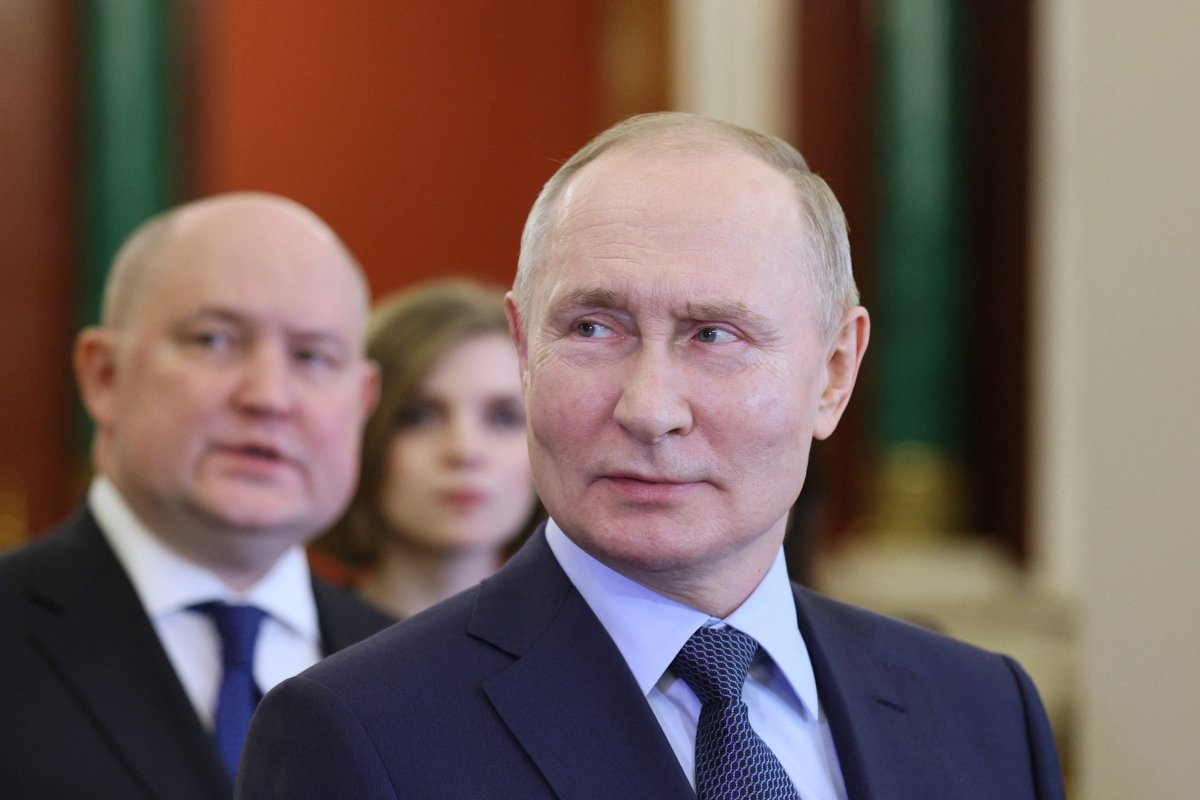
In this pool photograph distributed by Russian state agency Sputnik, Russia’s President Vladimir Putin visits an exhibition in the Grand Kremlin Palace in Moscow on December 27, 2023. Vladimir Egorov, an ally of Putin, was found dead on Wednesday, according to Russian state media.
GAVRIIL GRIGOROV/POOL/AFP/Getty Images
Newsweek is committed to challenging conventional wisdom and finding connections in the search for common ground.
Newsweek is committed to challenging conventional wisdom and finding connections in the search for common ground.
Isabel van Brugen is a Newsweek Reporter based in Kuala Lumpur. Her current focus is on the Russia-Ukraine war, and she has covered human rights issues in previous roles. Isabel joined Newsweek in 2021 and had previously worked with news outlets including the Daily Express, The Times, Harper’s BAZAAR, and Grazia. She has an MA in Newspaper Journalism at City, University of London, and a BA in Russian language at QMUL. Languages: English, Russian
You can get in touch with Isabel by emailing i.vanbrugen@newsweek.com
Twitter handle: @isabelvanbrugen
Isabel van Brugen is a Newsweek Reporter based in Kuala Lumpur. Her current focus is on the Russia-Ukraine war, and …
Read more
To read how Newsweek uses AI as a newsroom tool, Click here.
In April 2023, a prominent Russian national with suspected ties to Russian intelligence pulled off an impressive escape from Italian authorities. Artem Uss, a Russian businessman and the son of a former Russian governor, had been detained in Milan a few months earlier on charges of smuggling sensitive U.S. military technology to Russia. According to an indictment issued by a federal court in Brooklyn, New York, in October 2022, Uss had illegally trafficked in the semiconductors needed to build ballistic missiles and a variety of other weapons, some of which were being used in the war in Ukraine. But while Uss was awaiting extradition to the United States, he was exfiltrated from Italy with the help of a Serbian criminal gang and returned to Russia.
The escape, which was reported in The Wall Street Journal last spring, was only one of a series of recent incidents suggesting how much Russia’s intelligence forces have regrouped since the start of the war in Ukraine. Back in the spring of 2022, in the months after Russian President Vladimir Putin launched his invasion, the Russian intelligence agencies had seemed disoriented and confused. One by one, European countries had kicked out Russia’s diplomats; according to one British estimate, some 600 Russian officials were expelled from Europe, of which perhaps 400 were believed to be spies. The FSB, Russia’s internal security service, had also badly misjudged the kind of resistance that Russian forces would face in Ukraine, assuming that Russia could quickly take Kyiv. This contributed to Russia’s humiliating performance.
Now, Russia’s foreign intelligence network appears to be back with a vengeance. And it is becoming more inventive, increasingly relying on foreign nationals—such as the Serbian gang that assisted Uss, for instance—to help it get around restrictions on Russians. Before the war, Western intelligence agencies mostly dealt with Russian operations being carried out by Russian nationals. That is no longer the case. Today, Russian intelligence activities draw on a range of foreign nationals, and that includes not only spying on the West and tracking arms shipments to Ukraine but also applying growing pressure on Russian exiles and opponents of the Putin regime who have fled abroad since the war started. Evidence of such activity is turning up everywhere from Georgia and Serbia to NATO countries such as Bulgaria and Poland. In early 2023, for example, British officials arrested five Bulgarians who were accused of spying for Russia, including in an effort to keep tabs on Russian exiles in London.
At the same time, Russia’s spy agencies also appear to have shifted their orientation. Before the war, there was a division of labor among the three principal intelligence services—the SVR (foreign intelligence), the GRU (military intelligence), and the FSB (domestic security). In the past, it was generally understood that the SVR mostly focused on political and industrial espionage and the GRU on military issues, while the FSB was primarily focused on Russia itself, using its foreign branch mainly to conduct operations against Russians abroad and to keep friendly regimes in neighboring countries in power. Now, these distinctions are no longer so clear: all three agencies are deeply involved in the war in Ukraine, and all three have been actively recruiting new assets among Russia’s most recent exiles abroad.
The return of Moscow’s spying apparatus has significant implications for the West in its efforts to counter Russian meddling and Russian intelligence operations. If recent indications are correct, Russian intelligence activities in Europe and elsewhere may pose a significantly greater threat than had been assumed in the early stages of the war. At the same time, these changes offer insight into Putin’s own wartime regime and the extent to which it is increasingly rebuilding Russia’s spy agencies according to earlier models from the Soviet decades. Putin is not only attempting to make up for the Soviet KGB’s failure in its confrontation with the West in the late twentieth century. He is also trying to restore the glory of Stalin’s formidable secret service, which had considerable success against the West in the decades from the Bolshevik Revolution to World War II.
THE HUNDRED YEARS’ WAR
Before Russia began its full-scale war in Ukraine in 2022, the country’s intelligence services looked fairly weak. They had long suffered from interagency infighting and turf wars, as well as from a breakdown in trust between the generals and the rank and file, which led to significant delays and failures in getting information from the ground to the top level. Russian intelligence operations, meanwhile, increasingly became known chiefly for their sloppiness, as in the cases of the botched poisonings of the former Russian military officer Sergei Skripal in the United Kingdom in 2018 and the opposition leader Alexei Navalny in 2020. In short, the Russian spy services seemed to have lost much of their former luster, a problem that burst into the open with the embarrassing misreading of Ukraine in the planning for Russia’s invasion.
But as the war in Ukraine entered its second year, the Russian intelligence agencies regrouped and found a new sense of purpose. Instead of dwelling on their mistakes and questioning why they had so utterly failed to anticipate Ukrainian resistance in the initial invasion, the agencies moved on, taking new strength from the fact that they were withstanding a confrontation with the entire West. They have not only increased their activities in Europe and in neighboring countries; the FSB has also stepped up its efforts to fight back Ukrainian ops on Russian soil. That Putin did not make any radical changes in the security services despite the catastrophe of 2022 has been seen as a virtue: since the tumultuous 1990s, there has been a widely shared view both among the intelligence leadership and the rank and file that any attempt to overhaul the agencies will weaken their capabilities.
Underlying this new activity, however, has also been a larger goal: revitalizing Russia’s overall intelligence war against the West. This is a war that for the main Russian agencies goes back to the earliest years of the Soviet era. As Russian intelligence officials see it, the war in Ukraine has launched the third round of a great spy war that has been playing out since 1917.
Putin is trying to restore the glory of Stalin’s formidable secret service.
The first round of this struggle, in which early Soviet operatives faced off primarily against their British counterparts, started soon after the Bolshevik Revolution. In that original conflict, Soviet agents successfully compromised any chance of fomenting resistance to the Bolshevik regime from abroad. They did this by conducting a massive and very successful false-flag operation, code-named Trust, in which they lured politically active Russian émigrés, as well as British spies, to the Soviet Union to help a fake anti-Bolshevik organization. These anti-Soviet activists were in this way identified and killed. The conflict reached its peak during World War II, when Russian spies successfully penetrated British intelligence and, in the United States, got access to the Manhattan Project and stole the secrets of the atomic bomb. Overall, Soviet officials believed they won this first round with the West.
The second round of the intelligence war, however, did not end so well for Moscow. During the Cold War, the KGB failed to save the Soviet regime it swore to protect. Then, in the early 1990s, the agency was nearly destroyed after being split apart and dismembered. The collapse left lasting scars on Putin, who witnessed it firsthand, and his security elite, as they struggled to rebuild a Russian state that had lost its former power. (Putin ultimately built the FSB on the KGB’s former foundations.)
Now, with the onset of a new grand conflict with the West, Russia’s intelligence agencies are seeking to reverse the setbacks that unfolded at the end of the Cold War. And they sense a new opportunity, seeing the war in Ukraine as the opening salvo in the third round of the intelligence war. The sense of continuity with their Soviet predecessors has even taken visible form in Russia: in September, Sergei Naryshkin, Russia’s head of foreign intelligence, inaugurated a new statue to the founder of the Soviet secret police in the courtyard of the SVR’s Moscow headquarters. And in November, the FSB reinforced that message by celebrating the 100th anniversary of the OGPU, the Soviet secret police, and stressing the role of the OGPU in crushing political émigré organizations.
But the continuity goes well beyond celebrating early Soviet exploits. In the run-up to the war and since, Putin has made notable use of former KGB generals who share his eagerness to avenge the humiliation of the Soviet collapse. Nikolai Gribin, who in the 1980s served as deputy head of foreign disinformation operations at the KGB’s foreign intelligence branch, has a lead role in a new Russian think tank launched in 2021, the National Research Institute for the Development of Communications, which seeks to shape pro-Kremlin opinion in countries near Russia, with a particular focus on Belarus. (Gribin himself has written several research reports on public opinion in Belarus.) In the 1980s, Alexander Mikhailov served in the KGB’s infamous Fifth Directorate—the branch given the task of rooting out ideological subversion, including dissidents, musicians, and church leaders—and ran disinformation operations for the FSB in the 1990s. Since the fall of 2021, a few months before the invasion, Mikhailov has been the FSB’s unofficial mouthpiece for the Russian media, promoting the agency’s view of events in Ukraine. As Russian intelligence portrays it, the war pits the United States and Europe against Russia, with the Ukrainians serving merely as the puppets of their Western spymasters.
Putin giving a speech near the FSB’s headquarters in Moscow, June 2022
Aleksey Nikolskyi / Sputnik / Kremlin / ReutersAlong with Putin, Russia’s spy agencies have also drawn some important lessons from the earlier Soviet intelligence wars. Because it pitted Russia directly against the West, the war in Ukraine has prompted the Kremlin and its spy agencies to rethink several major national security questions that had not been closely studied since 1991. For example, there was the question of Russia’s borders and whether to close them. The Kremlin decided against doing so, and that has benefited the intelligence services, which can use the new exodus of Russian nationals to Europe and other neighboring countries to help make up for the expulsions of Russian diplomats from European capitals. Putin has clearly set out to avoid the mistakes made during the Cold War, when the Soviets significantly restrained the cross-border movement of people, hampering Soviet intelligence.
But there was another pressing problem for the Kremlin: how to enforce discipline within the ranks. Putin could have followed Stalin’s approach, embarking on large-scale purges and mass repressions. But he seems to have learned that those measures ultimately backfired for the Soviets. Putin understands that instilling fear is a useful tool but that outright purges would hurt the agencies—as they did in the 1930s when the Soviets’ foreign intelligence lost its most talented agents. Thus, the head of the FSB’s foreign intelligence branch, Sergei Beseda, was initially detained and held incommunicado after the first disastrous days of the Ukraine invasion. But after several weeks, he was reinstated, and the broader purges in military intelligence and the FSB that many expected after Yevgeny Prigozhin, the head of the Wagner paramilitary company, led a mutiny in June 2023 never materialized.
Overall, Putin has taken a flexible, pragmatic approach to his intelligence services, playing between the ever-present fear of purges and encouraging the agencies to be more innovative at regaining ground in the West. One result seems to have been a noticeable rise in more ambitious foreign operations over the past year, including alleged sabotage operations, as well as the exfiltration of the Russian operative in Italy and stepped up recruitment efforts in several NATO countries, as is apparent in the case of a member of Germany’s BND intelligence agency who was arrested in December 2022 on charges of allegedly transferring highly classified information to the Russian government, and is now on trial for treason.
SPIES LIKE US
In staging their comeback, Russia’s spy agencies have also internalized another important lesson from the Soviet years: the strategic use of ideology. In the 1930s, Moscow was able to win over many Westerners to the Soviet cause by aiming its arguments at Western deficiencies rather than promoting Marxist doctrine. At the time, Soviet agents learned that they did not really need to sell a full-fledged communist ideology; instead, they could portray the Soviet Union as an alternative to Western imperialism, emphasizing the West’s double standards and hypocrisy and offering in contrast a leader who stood up against global powers. These ideas are exactly what Russian agencies can now pedal to potential allies and recruits in Russia’s new intelligence war with the West.
As Russia prepares to enter a third year of war, its intelligence agencies know that the Kremlin supports them and shares their paranoia and prejudices. This reality suggests that the spy services can count on the Kremlin’s protection. But it does not mean that Putin himself is more secure in power.
For much of the past 20 years, Putin has struggled with the challenge of how to control his vast security and intelligence community, spread over an enormous country and abroad. In the early 2000s, he destroyed former President Boris Yeltsin’s concept of competing spy services, making the FSB the top agency. After Russia’s annexation of Crimea in 2014, Putin tried to bring his intelligence forces to heel by sending several middle-rank officers to jail on corruption charges. But this did not result in tighter Kremlin control of the agencies. Now, with the war in Ukraine, Putin has tried to avoid the mistakes of the past and keep his intelligence forces loyal. He has also succeeded in making them stronger, for the time being, than at any previous point in the war.
But it is unclear if any of this has improved his control over them. And so far, Putin has done nothing to fix the problem: he is unwilling to repeat Stalin’s mistakes of purging his agencies on an industrial scale, but he also understands that unlike during the Soviet years, when the Communist Party controlled the KGB, he has few other ways to rein them in. If things began to go badly for Russia in the war, this one-sided dynamic could mean that Putin’s spies might be in no rush to save him.
Loading…

FBI whistleblower Kyle Seraphin revealed in February he existence of a memorandum within the FBI’s field office in Richmond, Virginia, that labeled Catholics as potential domestic terrorists. Last Monday, almost a full year after Seraphin’s disclosure, the House Judiciary Committee released a report on it.
The House committee’s report, titled “The FBI’s Breach of Religious Freedom: The Weaponization of Law Enforcement Against Catholic Americans,” details how the FBI “abused its counterterrorism tools” to target Catholics. But there are some key issues that Capitol Hill—and most media—missed completely.
The FBI stigmatized a vast number of United States citizens as potential “radical traditional Catholic” terrorists based upon the existence of one criminal case involving a man who self-described as such a Catholic. The FBI’s version of the facts, detailed in an “intelligence note,” describes a man who likely suffers from mental illness—hardly a cross section of the Catholic population.
The most shocking aspect of this, one that largely escaped public attention, is that the FBI memo states the subject wasn’t even Catholic. He was taking catechism lessons in the hopes of becoming a baptized Catholic, but he was neither baptized nor confirmed.
The FBI never explained what “threat” the agency sought to “mitigate” by targeting Catholics. The intelligence note offers no history or example of political violence associated with conservative Catholics who prefer the Latin Mass. It simply asserts, baselessly, that they pose a threat as potentially violent domestic terrorists.
Moreover, the FBI’s denigration of Catholics is not limited to Latin Mass worshippers. Rather, the bureau appears to have issues with the Catholic faith in general. The “intelligence note” laments a purported “intelligence gap” when seeking to identify factors leading to violence, “which may include increased religiosity and/or adherence to extreme religious teachings.”
Hence, the FBI literally claims that increasing one’s religiosity makes one a greater domestic terrorist threat.
The FBI never bothered to explain precisely what tenets of Catholicism or “extreme religious teachings” of the Catholic Church lead to political violence because, of course, there are none. Adherents of the faith who embrace extreme Catholic religiosity tend to become nuns in the streets of Calcutta.
The House Judiciary Committee also fails to address the most fundamental issue posed by the FBI’s abuse of Catholics’ civil liberties. The FBI labeled an amorphous and impossibly ill-defined faith community as potential terrorists without pointing to a single historical or current example of a “radical-traditionalist Catholic” associated with any form of political violence, the preeminent and unnegotiable element required by the domestic terrorism statute (18 U.S.C. § 2331).
No political violence = no domestic terrorism. Contrast this to the Black Lives Matter riots that engulfed the United States in the summer of 2020. The Heritage Foundation’s Oversight Project filed a federal lawsuit to force the FBI to provide evidence that the government conducted any investigation of BLM during that season of political violence and domestic terrorism. To date, the bureau has produced no such evidence.
In the pre-woke FBI, it took more than simply labeling a U.S. citizen as a potential domestic terrorist to open an investigation. Back then, the bureau was required first to show that an individual sought to engage in criminally violent or life-threatening acts to intimidate or coerce a civilian population or government.
Today’s FBI, however, blissfully bypasses the most fundamental elements of the domestic terrorism violation when it comes to labeling large swaths of peaceful, law-abiding citizens (non-Catholics as well as Catholics) as potential terrorists. According to the Judiciary Committee report, the FBI’s targets are Americans who dare hold such disfavored political viewpoints as “pro-life, pro-family” and “support the biological basis for sex and gender distinction.”
Perhaps the clearest indication that the FBI itself knows it has ventured into constitutionally impermissible territory is its flippant use of a “First Amendment caveat.” The wordy exercise in psychological projection is worth reading in full, especially as this caveat is relied upon in similar exercises elsewhere:
Potential criminality exhibited by certain members of a group referenced herein does not negate nor is it a comment on the constitutional rights of the group itself or its members to exercise their rights under the First Amendment to the U.S. Constitution. The FBI does not investigate, collect, or maintain information on U.S. persons solely for the purpose of monitoring activities protected by the First Amendment.
Obviously, the First Amendment implications of labeling an entire mainstream religious group are top of mind for in-house FBI lawyers. That should have been a cause for pause as opposed to further activity and laughable legalese.
Also, notice the looseness of the term “potential criminality.” The bureau now needs not rely on actual evidence of past criminality to determine threat levels. The standard now appears to be speech alone.
As the FBI continues to invent a new alphabet soup of terminological groupings, such as Radical Traditional Catholics and Racially Motivated Violent Extremist, and to open investigations for activities such as sporting Gadsden or Betsy Ross flags, the agency has reached apex weaponization as an ideological entity as opposed to a crime-fighting one.
Today’s FBI routinely opens domestic terrorism investigations targeting Americans who never have demonstrated any propensity toward political violence.
These civil liberty violations occur not merely because of inept or corrupt FBI leadership. Ideologically weaponized FBI employees at all levels gravitate toward FBI units, such as domestic terrorism squads, that allow them to indulge their political ideology. Working drugs or health care fraud apparently lacks that satisfying special sauce that working politically charged violations bring for the ideological agent. To such weaponized employees, political dissent in and of itself constitutes a threat to their preferred social order.
This is why virtually all FACE Act prosecutions target pro-lifers, while countless attacks on pro-life pregnancy centers and Catholic churches go uninvestigated.
This is why the FBI pointed long arms at pro-life activist Mark Houck’s terrified children.
This is why geriatric grandmothers who committed misdemeanor trespass at the Capitol on Jan. 6, 2021, have taken FBI investigative priority over child predators and spies.
This is why a Republican internet prankster was sentenced to seven months in prison (the case is now on appeal) for posting a social media meme joking that Democrat votes might be texted while a Democrat who posted the identical meme suggesting Republican votes might be texted never was bothered by law enforcement.
Even in cases that don’t result in criminal prosecution, the FBI’s legally questionable activities can have a punitive effect on law-abiding Americans.
Keep in mind that the FBI’s anti-Catholic intelligence note was uploaded to the FBI’s databases under domestic terrorism file number 266H-RH-2893090. Anyone mentioned in this context case could fall prey to financial ruin in legal fees and soul-crushing anxiety as a result of this baseless domestic terrorism case. Even if they are spared financial and emotional devastation, being falsely labeled as a terrorist in the FBI databases is a grotesque abuse of federal authority—with malicious negative consequences.
When a person noted under that domestic terrorism file number is the subject of a background check in seeking federal employment or to purchase a firearm, or seeks any other form of public benefit that requires an FBI check, it will be noted that his or her identity has been identified in a domestic terrorism case.
This will require additional scrutiny, potentially extended bureaucratic delays, and possible denial of entitled government benefits. The person’s business may be denied contracts without explanation or subjected to unending IRS audits, and may even find himself and employees subject to law enforcement screenings at airports.
One of the first questions that comes to mind is why it took almost a year for a report from Congress to largely rearticulate what already had been known.
The purpose of congressional oversight is to inform legislation and fix problems that have been identified. Now that the House Judiciary Committee has finished its investigation and released its report, what meaningful accountability measures are being taken to address these abuses? Who has been held accountable? What has changed at the FBI as a result?
Lawmakers don’t seem to understand the urgency. A constitutional republic cannot stand without an even-handed rule of law. If lawmakers fail to deweaponize the FBI, the republic may not survive our generation.
Congress should embrace its oversight responsibilities and force an immediate audit of the genesis of all current FBI domestic terrorism cases. What percentage of cases target conservatives? How many cases involve the targeting of persons who never have demonstrated any propensity to engage in political violence?
Most importantly, who in the FBI is responsible for the bureau’s stomping on the civil liberties of peaceful political dissidents (in violation of 18 U.S.C. § 241), and when will he, she, or they be held accountable?
At the beginning of the year, this and much more was what Americans were promised. They were promised a full-scope investigation into the FBI and other weaponized agencies that would stop the weaponization. This effort, to be funded at the same levels as the House’s select committee on Jan. 6, was to be supported by a committee modeled after the Church committee of the 1970s, a massive undertaking that examined abuses across the intelligence community.
In launching that committee, Judiciary Chairman Jim Jordan, R-Ohio, said:
We want to focus on that because we want it all to stop. We want the double standard to stop. This idea that if you’re a pro-life activist, you’re gonna get your door kicked in, you’re gonna get arrested and handcuffed in front of your seven kids and your spouse for simply praying in front of an abortion clinic and telling the guy who was harassing your son to knock it off.
You’re gonna have the FBI raid your home, but the protests that went on at Supreme Court justices’ homes in the aftermath of the leak of the [Supreme Court’s] Dobbs opinion, oh, no problem there. Americans are sick and tired of it. And what we want, we don’t want to go after anyone. We just want it to stop. And we want to respect the First Amendment to the Constitution that the greatest country in the world has.
That’s what this committee is all about. And that’s what we’re going to focus on. That’s what we’re going to do.
I agreed then, and I agree now. The weaponization of federal law enforcement for partisan purposes is an existential threat to freedom. It needs to stop if we hope to pass along any semblance of America to the next generation.
But vague standards and constant cable news appearances aren’t an adequate measure of success. The only real standard is whether Congress actually deweaponizes the FBI and the other intelligence agencies. And so far, the agencies have skated this entire Congress without any real investigations.
The truth is, this job always has been too big for one existing committee or person. That’s why no real reform efforts are underway, and the FBI continues apace, fully funded and with no accountability. Indeed, the bureau is being rewarded with a massive new headquarters the size of the Pentagon.
Lawmakers have wasted enough time failing to prioritize deweaponization. Americans can’t afford to let them waste more time by failing to unite and make changes. And change is certainly what voters expected in 2022 when they flipped control of the House to the GOP.
Congress already has the information it needs to begin deweaponization efforts immediately. History will judge this Congress by that simple measure, not by its analysis and rhetoric regarding the problem.
This commentary originally was published by RealClear Politics
Have an opinion about this article? To sound off, please email letters@DailySignal.com, and we’ll consider publishing your edited remarks in our regular “We Hear You” feature. Remember to include the URL or headline of the article plus your name and town and/or state.
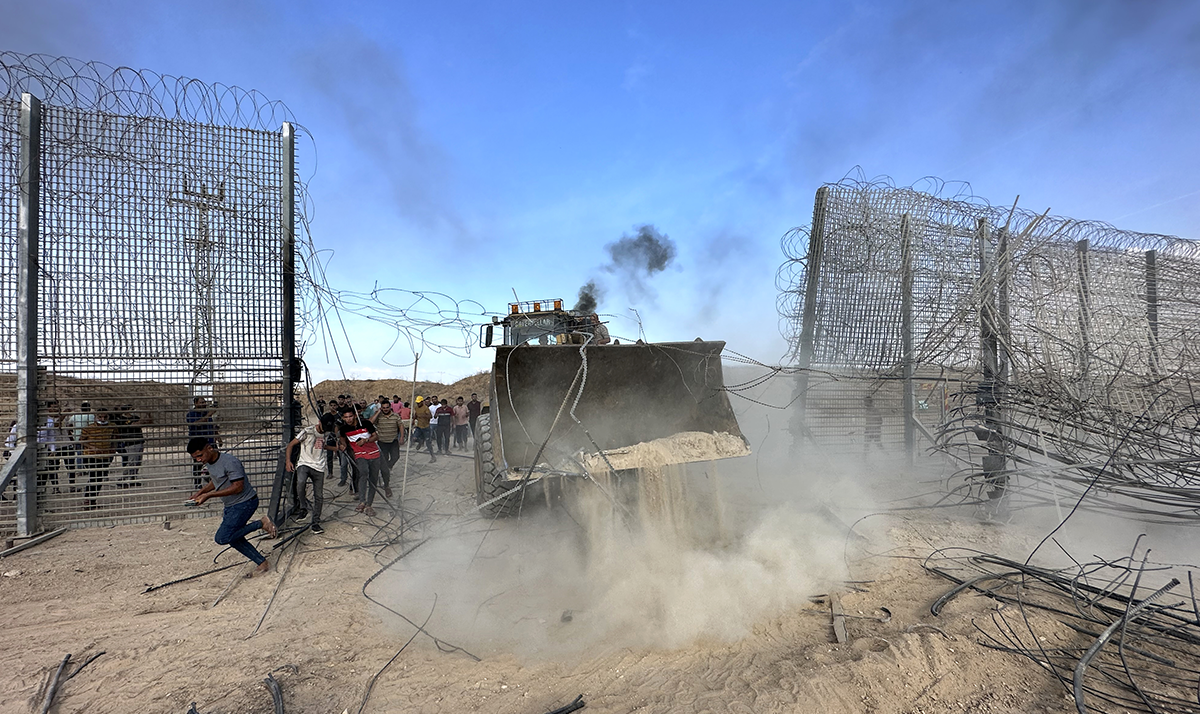
Did the Israel Defense Forces (IDF) rely too heavily on advanced technologies in its effort to secure and fortify Israel’s border with Gaza?
That is one of many questions that have arisen in the days since Hamas’ Oct. 7 incursion into Israel and attacks on Israeli forces and civilians. The absence of early warnings from data collected via sensors, cameras, and surveillance drones along the border’s “smart fence,” as well as the penetration of the Iron Dome missile defense system, has led to a sense that Israel experienced a tragic “high-tech failure.” An “overreliance on border surveillance equipment” has emerged as one factor plausibly contributing to Hamas’ ability to overrun the border defenses.
The IDF’s overreliance on technology seems to have played a significant role in the attack’s success. However, this is not adequately described as a “high-tech failure” or a catastrophic failure of the technologies themselves. Rather, the role of technology in the IDF’s fortification of the border with Gaza — and its failure to prevent and mitigate Hamas’ attack — reflects human strategic error.
It would thus be a mistake to prematurely undervalue the use of advanced and emerging technologies in defense as a result of Hamas’ breaching of the border fence and incursion into Israel. The necessity before Israeli officials when they investigate this attack — and for analysts and practitioners elsewhere — is to instead pinpoint the origin of overreliance on advanced and emerging technologies and how the appropriate uses of technological innovation in defense remains a matter of indispensable human judgment and strategic thought.
What is critical, then, is to highlight the intrinsic dependence of the technologies employed in Israel’s defense on human personnel. This applies as much to vaunted emerging technologies like artificial intelligence (AI) as it does to traditional software and more familiar technologies, like cellular communication. Recognizing this allows us to distinguish between catastrophic technological failures and the effectiveness — or lack thereof — of human choices that must grapple with pernicious assumptions and inevitable strategic considerations in defense.
The attack in perspective
The attack started at roughly 6:30 a.m., local time on Oct. 7. The initial phase began with a coordinated effort to disrupt the IDF’s surveillance and communications. It has been reported, based in part on footage released by the al-Qassam Brigades, that Hamas used uncrewed drones to drop explosive munitions into the generators of communications towers along the border — presumably to limit surveillance and communications by and between IDF personnel — as well as into some remote-controlled machine gun turrets (in a fashion similar to tactics employed in Ukraine). In addition, communications out of the IDF’s southern Gaza headquarters were jammed to prevent the issuing of an alert to other personnel as the attack began. Also during the initial stages of the attack, Hamas sniper fire concentrated on surveillance cameras as well as exposed machine gun ammunition boxes.
As the assault proceeded, Hamas fired approximately 3,000 rockets into Israel within a 20-minute window, exceeding the capacity of the Iron Dome missile defense system — with 10 batteries distributed across Israel — to respond effectively. As Hamas’ rocket barrage provided cover, bulldozers, motorbikes, pickup trucks, explosives, and paragliders were each used to breach the border fence while communications remained partially disrupted. Hamas may have, as the International Institute for Strategic Studies’ Ben Barry observes, identified the weakest and most vulnerable points along the border and selected “breaching points” among them through which they would overwhelm Israeli soldiers by sheer force of numbers (200 attackers in the first wave, and then, later, 1,800).
The result of the coordinated assault combined with an ill-prepared IDF was hours of Israeli military confusion and dysfunction as Hamas fighters stormed through over 20 Israeli towns.
Why did the attack succeed?
The success of Hamas’ forces in breaching the barrier between Gaza and Israel while facing shockingly little military resistance (for a time) thereafter is a result of several, converging factors. As we will see, a picture emerges not of catastrophic technological failure but of human strategic error that failed to appropriately value the technologies employed in Israel’s defense (and the “low” technologies deployed against it) relative to the ongoing indispensable value of human presence and judgment in military affairs.
The data and footage collected by sensors and cameras along the border are monitored by IDF personnel remotely. Early information indicates, though, that members of Hamas did not move along the border in a manner that would arouse immediate suspicion by humans monitoring the data on the Israeli side, particularly given the dramatic and abrupt nature of the attack. Furthermore, Hamas flipped the value of these technologies’ ability to operate without directly relying on and risking human lives on its head: the use of uncrewed drones to sabotage communications and surveillance systems meant that, just as the machine guns could be operated remotely, they could be destroyed remotely, as well. As Ronen Bergman and Patrick Kingsley report, IDF soldiers monitoring the border from behind were blinded by a lack of cellular signals and alarms that may have proved vitally useful as the attack began.
As for the evasion of sensors by paragliders, retired Marine Col. J.D. Williams observes that the paragliders remained low except when going over border fencing, noting that air and missile defense systems are not optimized to detect slow-moving, low-flying objects. Jeff Schogol suggests this is analogous to the “gaps” in NORAD’s warning systems, which are dependent on sensors and radars not geared toward identifying objects like the Chinese surveillance balloon detected over the United States earlier this year.
The movement of Hamas’ ground troops at specific points along the border fence, furthermore, critically benefitted from the shortage of military personnel along the border on the Israeli side to quell the onslaught. As a result of the IDF prioritizing the West Bank — and distributing personnel accordingly — there was “minimal” staffing of the border with Gaza. In the face of Hamas’ rapid, methodically planned, and brute force border incursion, Israeli forces were unable to mount a sufficiently rapid response as Hamas fighters poured through breached sections of the fence.
Finally, the Iron Dome system appears to have been simply overwhelmed by the massive number of missiles fired by Hamas. The system is designed, technically speaking, to carry out three core functions: detect, identify, and track missiles according to their estimated threat of impact, determine where to fire its own (limited quantity of) interceptor missiles and how many, and use heat-seeking sensors to self-destruct in close proximity to the incoming missile. It does not appear that any of these core functions collapsed in the moment (the interception rate of the Iron Dome has been given high marks in recent years, hovering at and above 90% over the period of a given conflict).
Instead, Hamas had tested the quantitative limits of Iron Dome’s capacity prior to the Oct. 7 barrage. The Oct. 7 attack was a marked departure from past rates of rocket launches into Israel. As the Modern War Institute’s Patrick Sullivan and John Amble observe, Hamas “dramatically” increased its missile barrage from a maximum of 470 rounds in one day to “several thousand in a fraction of an hour.” The result was decreased missile defense and increased cover for Hamas’ troops breaching the border fence. This limitation of the Iron Dome was predicted with foreboding undertones since at least the 2021 Israel-Palestine crisis.
Of course, a full explanation for this attack’s success includes factors that go beyond the technological domain and the distribution of personnel on Oct. 7. These include intelligence failures, incorrect assumptions held by some Israeli officials about the continuity of deterrence over time, misjudgment on Oct. 6 about suspicious Hamas activity, and a possible lack of political will to act on internal or external warnings, among others. The role of technology does present its own, distinctive level of analysis in assessing the success of this attack, but the deployment of technology in defense necessarily relates to factors beyond its immediate nature. Indeed, reporting in recent days indicates not only that the attack was heavily planned and coordinated, but that Hamas knew, upon infiltrating Israeli border bases, “exactly where the communications servers were and destroyed them.”
A failure of human judgment
How do we account, then, for the technological picture painted above?
The first, and perhaps most obvious, implication of the above facts is that it is not clear that the Oct. 7 attack is best characterized as a technological (or “high-tech”) failure. More specifically, the failure does not appear to resemble the oft-feared “catastrophic failures” of emerging technologies deployed in adversarial conditions. In the context of, for example, AI-enabled or enhanced systems operating in real-world, adversarial circumstances, a catastrophic failure typically refers to such systems encountering out-of-context data (than what they were trained on) and subsequently experiencing a sharp drop in performance (this is, in the jargon, known as a “distributional shift”).
Catastrophic failure, in this sense, does not adequately capture the failure of Israeli defenses. The methods employed by Hamas soldiers, instead, circumvented the functions and scope of the technologies undergirding Israeli defenses, exploiting a lack of redundancies in the latter’s border security. The uses of snipers to destroy surveillance cameras, uncrewed quadcopter drones to sabotage communication towers, communication jamming to prevent early warnings, brute-force civilian equipment like bulldozers, a missile barrage of unprecedented scale, and low-flying paragliders all share one thing in common: They are the result of the identification of weaknesses, vulnerabilities, and opportunities by Hamas. None of them indicates that the technologies undergirding the data-collecting sensors, surveillance drones, the Iron Dome’s specialized missile detection, tracking, and interception systems, or even more familiar technologies like cellular communication failed to execute their core functions. This is, instead, a failure of strategizing and planning; of carefully matching capabilities with objectives, and understanding that technology is, for the foreseeable future, a means to these ends.
This all illustrates the difference between a technology failing to execute its functions at the level of performance for which it was designed and misunderstanding or underappreciating the appropriate scope of application of the technology’s functions.
Some have, nonetheless, emphasized an “overreliance” on technology and the need to begin a discussion on what this means for technology and defense. In this vein, though, the Middle East Institute’s Bilal Y. Saab is correct to note that, “Over reliance on tech always has its drawbacks. But the problem here wasn’t tech. There was a failure of imagination, first and foremost, and total disrespect of the opponent.” To be sure, this in no way neglects a vitally important discussion on the relationship between emerging and advanced technologies and defense, but instead forces us to ask a more specific question: What is the origin of overreliance on such technologies?
The IDF believed that its human presence along the border with Gaza could be scaled back due to the increased presence of technologically advanced systems, including an extensive network of surveillance drones, sensors, and cameras, remote-controlled machine guns, and the geographically distributed Iron Dome system, among others.
This belief can, in part, be traced to enthusiasm about the applications of emerging technologies like AI, with the IDF incorporating the idea that the mass collection and transformation of data will be vital to winning future conflicts into its AI strategy. The murkiness of answering our question comes into play when considering the broader threat landscape perceived by Israel, especially those perceived threats emanating from the West Bank.
Whether the IDF’s belief in the relative human-independence of technologies deployed in the defense of its border with Gaza was primarily a result of needing to re-prioritize according to perceived threats or primarily a result of belief in the efficacy of the technologies themselves is a complicated matter (and it could easily be both with, say, the latter stimulating the former). It is one that should be investigated as this discussion of technology and defense proceeds.
More decisively, this crisis serves as a potent reminder that framing adversarial dynamics as “low-tech” vs. “high-tech” has a way of neglecting the true nature of technological innovation in warfare. Not only does this ignore the increasing number of pathways for less-resourced actors to “create fairly advanced technological means to go up against high-tech nations,” as the Carnegie Mellon Institute for Security and Technology’s Audrey Kurth Cronin observes, but potentially misguides regional and other governments as they seek to adopt emerging technologies for defense purposes.
In this way, it reminds analysts and practitioners alike that “disruptive innovation” in military affairs has always been a more complicated subject, with a more mixed record, than current headlines about the integration of emerging technologies in defense systems and organizations suggest. The inflation or deflation of technological systems’ capabilities — and subsequent overreliance on them — results, at least in part, from non-technological assumptions.
Technological adoption and integration by militaries must be located within a broader strategic framework that links capabilities with desired, overarching goals. The over- or under-estimation of any given technology reflects human choices and the presence of human judgment remains essential even in the age of AI: Overestimate the capabilities of any one technologically advanced system relative to human personnel and the consequences can be severe. The same is true for the converse as well: Underestimating the potential uses of a seemingly-limited technology can take one’s forces by surprise. Israel appears, tragically, to have done both vis-à-vis its own defense technologies and Hamas’ offensive capabilities (without locating, by any stretch, the fault for this attack entirely within the technological domain). Care must now be taken by governments and militaries to ensure that advanced and emerging technologies are not suddenly undervalued; instead, they should properly assess the role of technology in this crisis and how human design choices impact its utility.
Vincent J. Carchidi is a Non-Resident Scholar with the Middle East Institute’s Strategic Technologies and Cyber Security Program. His work focuses on the intersection of emerging technologies, defense, and international affairs.
Photo by Ashraf Amra/Anadolu Agency via Getty Images
The Middle East Institute (MEI) is an independent, non-partisan, non-for-profit, educational organization. It does not engage in advocacy and its scholars’ opinions are their own. MEI welcomes financial donations, but retains sole editorial control over its work and its publications reflect only the authors’ views. For a listing of MEI donors, please click here.
/cloudfront-us-east-2.images.arcpublishing.com/reuters/OHFKGCVG6FJWZJZAAJ34IWMMPM.jpg)
Oct 9 (Reuters) – A careful campaign of deception ensured Israel was caught off guard when the Palestinian Islamist group Hamas launched its devastating attack, enabling a force using bulldozers, hang gliders and motorbikes to take on the Middle East’s most powerful army.
Saturday’s assault, the worst breach in Israel’s defences since Arab armies waged war in 1973, followed two years of subterfuge by Hamas that involved keeping its military plans under wraps and convincing Israel it did not want a fight.
While Israel was led to believe it was containing a war-weary Hamas by providing economic incentives to Gazan workers, the group’s fighters were being trained and drilled, often in plain sight, a source close to Hamas said.
This source provided many of the details for the account of the attack and its buildup that has been pieced together by Reuters. Three sources within Israel’s security establishment, who like others asked not to be identified, also contributed to this account.
“Hamas gave Israel the impression that it was not ready for a fight,” said the source close to Hamas, describing plans for the most startling assault since the Yom Kippur War 50 years ago when Egypt and Syria surprised Israel and made it fight for its survival.
“Hamas used an unprecedented intelligence tactic to mislead Israel over the last months, by giving a public impression that it was not willing to go into a fight or confrontation with Israel while preparing for this massive operation,” the source said.
Israel concedes it was caught off guard by an attack timed to coincide with the Jewish Sabbath and a religious holiday. Hamas fighters stormed into Israeli towns, killing 700 Israelis and abducting dozens. Israel has killed more than 400 Palestinians in its retaliation on Gaza since then.
“This is our 9/11,” said Major Nir Dinar, spokesperson for the Israeli Defence Forces. “They got us.”
“They surprised us and they came fast from many spots – both from the air and the ground and the sea.”
Osama Hamdan, the Hamas representative in Lebanon, told Reuters the attack showed Palestinians had the will to achieve their goals “regardless of Israel’s military power and capabilities.”
‘THEY RAN RIOT’
In one of the most striking elements of their preparations, Hamas constructed a mock Israeli settlement in Gaza where they practiced a military landing and trained to storm it, the source close to Hamas said, adding they even made videos of the manoeuvres.
“Israel surely saw them but they were convinced that Hamas wasn’t keen on getting into a confrontation,” the source said.
Meanwhile, Hamas sought to convince Israel it cared more about ensuring that workers in Gaza, a narrow strip of land with more than two million residents, had access to jobs across the border and had no interest in starting a new war.
“Hamas was able to build a whole image that it was not ready for a military adventure against Israel,” the source said.
Since a 2021 war with Hamas, Israel has sought to provide a basic level of economic stability in Gaza by offering incentives including thousands of permits so Gazans can work in Israel or the West Bank, where salaries in construction, agriculture or service jobs can be 10 times the level of pay in Gaza.
“We believed that the fact that they were coming in to work and bringing money into Gaza would create a certain level of calm. We were wrong,” another Israeli army spokesperson said.
An Israeli security source acknowledged Israel’s security services were duped by Hamas. “They caused us to think they wanted money,” the source said. “And all the time they were involved in exercises/drills until they ran riot.”
As part of its subterfuge in the past two years, Hamas refrained from military operations against Israel, even as another Gaza-based Islamist armed group known as Islamic Jihad launched a series of its own assaults or rocket attacks.
NO INKLING
A rocket is fired from Gaza toward Israel, in Gaza, October 7, 2023. REUTERS/Ibraheem Abu Mustafa/File Photo Acquire Licensing Rights
The restraint shown by Hamas drew public criticism from some supporters, again aimed at building an impression that Hamas had economic concerns not a new war on its mind, the source said.
In the West Bank, controlled by Palestinian President Mahmoud Abbas and his Fatah group, there were those who mocked Hamas for going quiet. In one Fatah statement published in June 2022, the group accused Hamas leaders of fleeing to Arab capitals to live in “luxurious hotels and villas” leaving their people to poverty in Gaza.
A second Israeli security source said there was a period when Israel believed the movement’s leader in Gaza, Yahya Al-Sinwar, was preoccupied with managing Gaza “rather than killing Jews”. At the same time, Israel turned its focus away from Hamas as it pushed for a deal to normalise relations with Saudi Arabia, he added.
Israel has long prided itself on its ability to infiltrate and monitor Islamist groups. As a consequence, the source close to Hamas said, a crucial part of the plan was to avoid leaks.
Many Hamas leaders were unaware of the plans and, while training, the 1,000 fighters deployed in the assault had no inkling of the exact purpose of the exercises, the source added.
When the day came, the operation was divided into four parts, the Hamas source said, describing the various elements.
The first move was a barrage of 3,000 rockets fired from Gaza that coincided with incursions by fighters who flew hang gliders, or motorised paragliders, over the border, the source said. Israel has previously said 2,500 rockets were fired at first.
Once the fighters on hang-gliders were on the ground, they secured the terrain so an elite commando unit could storm the fortified electronic and cement wall built by Israel to prevent infiltration.
The fighters used explosives to breach the barriers and then sped across on motorbikes. Bulldozers widened the gaps and more fighters entered in four-wheel drives, scenes that witnesses described.
‘HUGE FAILURE’
A commando unit attacked the Israeli army’s southern Gaza headquarters and jammed its communications, preventing personnel from calling commanders or each other, the source said.
The final part involved moving hostages to Gaza, mostly achieved early in the attack, the source close to Hamas said.
In one well-publicised hostage taking, fighters abducted party-goers fleeing a rave near the kibbutz of Re’im near Gaza. Social media footage showed dozens of people running through fields and on a road as gunshots were heard.
“How could this party happen this close (to Gaza)?” the Israeli security source said.
The Israeli security source said Israeli troops were below full strength in the south near Gaza because some had been redeployed to the West Bank to protect Israeli settlers following a surge of violence between them and Palestinian militants.
“They (Hamas) exploited that,” the source said.
Dennis Ross, a former Middle East negotiator who is now at the Washington Institute for Near East Policy, said Israel had been distracted by violence in the West Bank, leading to a “thin, under-prepared presence in the south.”
“Hamas probably succeeded beyond their expectation. Now they will have to deal with an Israel determined to decimate them,” he said.
Retired General Yaakov Amidror, a former national security adviser to Prime Minister Benjamin Netanyahu, told reporters on Sunday the assault represented “a huge failure of the intelligence system and the military apparatus in the south.”
Amidror, chairman of the National Security Council from April 2011-November 2013 and now senior fellow with the Jerusalem Institute for Strategy and Security, said some of Israel’s allies had been saying that Hamas had acquired “more responsibility”.
“We stupidly began to believe that it was true,” he said. “So, we made a mistake. We are not going to make this mistake again and we will destroy Hamas, slowly but surely.”
Reporting by Samia Nakhoul in Dubai and Jonathan Saul in London; Additional reporting by Ali Sawafta in the West Bank and Matt Spetalnick in Washington, Writing by William Maclean; Editing by Edmund Blair
Our Standards: The Thomson Reuters Trust Principles.

Save
KISSUFIM, Israel — When Hamas militants arrived in the tiny kibbutz of Kissufim, less than a mile from the border with the Gaza Strip, they attacked a carefully picked first target: the white and red metal communication towers on its outskirts.
They made a beeline for the small fenced compound that housed the critical equipment, shooting at it and using a ladder to scale a barbed wire fence to get inside, videos obtained by The Washington Post show.
“They knew exactly what they were doing,” said Shai Asher, 50, a member of the armed kibbutz security squad that battled Hamas gunmen that day, struggling to communicate with each other and unable to call for backup.
“The phone network doesn’t work, WhatsApp doesn’t work, everything is broken down, our radio doesn’t work, all the channels of command are missing,” he recalled. “They had a flawless battle plan that they executed flawlessly.”
For hours, volunteers such as Asher were left to fend for themselves, outnumbered and outgunned. The soldiers that were supposed to protect them were blind to the unfolding disaster, or had been killed or kidnapped.
In a simultaneous wave of attacks on at least seven military posts across the border, Hamas sought to systematically disable key detection, communications and warning systems, using snipers and commercial drones armed with explosives. The strategy allowed its gunmen to advance deep into Israeli territory with little resistance and scrambled the subsequent military response.
The Washington Post spoke to more than a dozen current and former Israeli intelligence and security officials and studied footage from Hamas body cameras to build a picture of how militants were able to overwhelm Israeli military installations and rampage through more than 20 residential communities.
“There weren’t enough soldiers; there weren’t enough capabilities,” said Eyal Hulata, the head of the country’s National Security Council from 2021 to 2023. “The first line of defense became the last line of defense, and this should never happen. Israel knows that.”
The attack, in which more than 1,400 people were killed and 229 others taken hostage, exposed the vulnerabilities of Israel’s border security system, long believed to be one of the most advanced and indomitable in the world. At least 309 Israeli soldiers are among the dead.
Israeli Prime Minister Benjamin Netanyahu had boasted for years of multimillion-dollar investments in an expansive “smart wall,” running the length of the enclave above ground and extending deep into the ground.
Claiming in recent years that Hamas had been successfully contained in Gaza, Netanyahu oversaw the gradual withdrawal of troops from the south. Forces left behind at the military and intelligence bases were trained to rely on sophisticated cameras and sensors to monitor for border infiltrations, and to alert forces on the ground in case of unusual events.
But in the early hours of Oct. 7, at least 1,500 Hamas and Islamic Jihad militants broke through some 30 points along the border barrier. They overran some bases so rapidly that soldiers were killed in their bunks, and the militants took out communication networks so efficiently that the area became a blind spot for the military.
“They coordinated it, in sync, to get the maximum impact,” Hulata said. “The fact we failed doesn’t mean the IDF isn’t prepared to respond,” he added.
The assault came on a Saturday morning, on the Jewish holiday of Simchat Torah — the end of a two-week string of holidays — ravaging a sleeping nation that had been assured repeatedly by its top security officials that Hamas posed no immediate threat.
“Despite a series of actions that we carried out, unfortunately on Saturday we were unable to generate a sufficient warning that would have thwarted the attack,” said Ronen Bar, the head of the Shin Bet internal security service, in a letter to his employees and their families.
Asked for comment by The Post, the Israeli military replied: “Currently the IDF is focused on the ongoing war, we will get to questions of your kind later on.” The prime minister’s office did not respond to a request for comment.
The coordinated attack began with rocket fire from Gaza — a regular occurrence that caused no particular alarm among soldiers and civilians. As the air raid sirens sounded just before 6:30 a.m., Israeli officers stayed below their lookouts.
Then came the familiar booms from the Iron Dome antimissile defense system, drowning out the gunfire from snipers, who shot at a string of cameras dotting the border, and the explosions from more than 100 remotely operated drones that took out watchtowers, according to security experts who analyzed the footage — most of it posted in real time by the militants.
The towers were outfitted with machine guns and cameras, both connected to the border’s thermal imaging sensors and to optical and radar detection systems. They relied partly on automation, partly on remote control.
Once the systems were disabled, fighters from the Nukhba, Hamas’s special operations unit, were able to breach the border with relative ease, videos show, using bulldozers, trucks and motorcycles. From there, it was less than a mile’s drive to the first military installations, which were mostly unguarded outside.
Front-line observation troops were caught off guard when the militants stormed their bases, navigating confidently through facilities and barracks, security officials familiar with the situation told The Post.
Soldiers managed to kill some Hamas gunmen with remotely controlled guns but, within minutes, hundreds more had taken their place. They killed soldiers in their safe rooms and took others hostage while ransacking weapons caches, loading up trucks and motorbikes already laden with AK-47s, grenades and other weaponry.
Only at 8:06 a.m. — an hour and a half after the start of the assault — did the Israel Defense Forces report a “combined attack.” At 8:25, with a large number of Israelis already dead, it declared “a state of alert for war.”
Placing key command centers so close to the border was a key mistake, said a former senior Israeli intelligence officer, who spoke to The Post on the condition of anonymity because of the sensitivity of the subject.
“That’s what happens when you suffer a catastrophic systemic failure,” he said, “and military headquarters and other installations are so close to the border. That’s what happens when you forget that all defense lines can eventually be breached and have been historically. That’s what happens when you underestimate your enemy.”
The Israeli military’s regional command-and-control center, near Kibbutz Re’im, suffered a “complete destruction” of “communications systems, their antennas, even the systems that activated the sensors on the fence itself,” said Lt. Col. Alon Eviatar, a member of the reserves and an expert in Palestinian militancy as well as being a former officer in 8200, Israel’s elite intelligence unit.
In parallel, according to footage reviewed by security analysts, a separate Hamas unit stormed an 8200 installation near Urim, about 10 miles inside Israeli territory, detonating an explosive at the entrance to an underground bunker that housed an expansive intelligence apparatus — synthesizing data from Israel, the Palestinian territories and around the world.
“It is the largest and most significant intelligence base in Israel, one of the country’s greatest assets,” said Eviatar. “It was a top priority for them.”
Hamas fighters battled with Israeli forces outside the bunker, Eviatar said. It is still unclear whether any of the militants survived the battle or managed to take espionage documents or equipment back to Gaza, which he said could be “extremely valuable to Hamas leadership and to Iran.”
Forty-five miles to the north, in Zikim, troops at a training base for the Israeli military’s search-and-rescue brigade were among the few units not affected by the disabling of communication systems. They belonged to a separate command center that was spared the blackout that affected most of the other installations.
When a rocket struck the base, the duty officer was able to report the attack to Col. Elad Edri, the brigade’s commander, who sped to the scene.
“We managed to speak to each other by radio, by phone. It was clear, it was okay,” he told The Post. “The bombs didn’t influence my unit. They obviously influenced the units that were there to defend the fence.”
Edri lost seven soldiers but managed to repel the attack and maintain control of the base.
The breadth and speed of the assault points to deep planning by Hamas. Asher, the security guard in Kissufim, estimates that the militants were at his kibbutz just a few minutes after 6:30 a.m., shortly after the first rocket barrage.
At 6:45 a.m., he got a voice note in the kibbutz’s security group on WhatsApp. “This is real action, real action, a real situation,” a member of the team said, as gunfire sounded and sirens wailed in the background.
“Do you have any connection with the IDF?” Asher asked, as squad members tried in vain to call in military reinforcements. The internet would cut out soon after. Asher didn’t know until 10 p.m. that his wife and two children, barricaded in their safe room at home, had survived.
“It was a nightmare,” he said.
After entering the kibbutz, the militants went straight to the house of the community’s head of security, who was forced to retreat to a safe room with his family. He could not join the fight, but he survived.
It was a pattern repeated in other communities, Asher said, citing conversations with residents.
“Their success wasn’t tech; it was preparation,” said Miri Eisin, a former senior intelligence officer in the IDF. They “used military tactics to carry out a terror attack.”
As the hours wore on and the death toll climbed, the rare messages that did make it back to Israel’s main military headquarters in Tel Aviv were interpreted with “a lot of question marks,” said Michael Milshtein, a former senior adviser to COGAT, the Israeli military agency in charge of the Palestinian territories. “After so many years of discounting Hamas,” he said, military leaders struggled to grapple with the scale of the unfolding calamity.
Initially, the IDF sent in special operations units, trained to respond to infiltrations from Gaza. But none of their war games resembled what confronted them on Oct. 7.
“[Hamas] knew exactly where they were going, what they were doing, even though it was their first time there,” said Milshtein, who said that Shin Bet has been trying to crack down on espionage networks from Gaza over the past two years.
Israeli forces that were able to fight their way into communities under attack struggled to manage the situation, lacking higher-altitude assessments of a vast and chaotic battlefield.
“Without an overall picture, we had to make a lot of quick decisions,” said Maj. Palmach, one of the Israeli reservists who, without waiting to be called up, put on their uniforms and jumped in their cars that Saturday, speeding south to fight alongside the special operations forces. He shared his story on the condition that he be identified only by his last name because of IDF ground rules.
Palmach battled Hamas gunmen at the entrance to Alumim, preventing them from entering. He then joined an improvised convoy to Be’eri, one of the hardest-hit kibbutzim. Guided by word of mouth and frantic WhatsApp messages, Palmach rescued people from their safe rooms, many as their houses were burning. Militants lit tires on fire and wheeled them into homes to smoke out families that were in hiding, according to other officers who arrived at the scene that day.
Israel’s southern border region is a military zone now. Its tightknit towns are charred and abandoned. Bodies are still being found. Many survivors feel betrayed by a government that promised them safety even as it withdrew protection.
In December 2021, Netanyahu tweeted that the installation of an “underground barrier that stops Hamas’s tunnel weapons” amounted to a “historic” day. He had completed the project, he said, despite “great opposition” from other politicians and the defense establishment.
Amir Tibon, a journalist from the Israeli newspaper Haaretz, moved to Nahal Oz in 2014. At least 14 of his neighbors were killed there Oct 7.
When he began living there, combat units were stationed in every community. In recent years, they were redeployed to the West Bank to protect Jewish settlements and to counter new Palestinian militant groups.
“After that fancy underground obstacle that Netanyahu was so proud of, it was decided that the forces weren’t needed anymore,” Tibon said in a recent Haaretz podcast. “If in every community on that dark Saturday there were forces of 20 people, everything would have looked differently.”
Some Israeli soldiers stationed along the border now say they feared a Hamas incursion was imminent and tried to sound the alarm.
“It was clear that something would happen. It was only a matter of time,” Maya Dasiatnik, an observation officer in the Nahal Oz base, said an interview with the Kan public broadcaster on Wednesday.
She said that she and dozens of fellow soldiers had repeatedly reported suspicious activity: people approaching the fence with maps, appearing to study it for its weak spots, getting closer every week. There also were tractors and large groups of armed men, carrying out exercises that looked like military drills.
Roni Eshel, who served alongside Dasiatnik, is believed to be among the hostages held in Gaza.
“She reported all kinds of breakdowns along the border,” Eyal, her father, told The Post. His last contact with Roni was a text message at 9:27 a.m., three hours after her base was raided. The beds, the safe rooms and the central war room were torched.
“It could have been prevented,” he said, “if someone in the army had opened their eyes and ears.”

In Iran, Iraq, Jordan, Lebanon, Syria, Turkey, and elsewhere in the Middle East, protests have erupted following the October 7 attack in solidarity with the Palestinians, in opposition of Israel and its supporters, and, in some cases, in explicit support for Hamas. In major cities throughout Africa, protestors have expressed solidarity with Palestinians and denounced Israel’s actions. Asian states such as Bangladesh, India, Indonesia, Japan, Malaysia, and the Philippines have seen pro-Palestinian protests. In Europe, North America, and South America, countries such as France, Germany, Norway, Romania, Spain, the United Kingdom, Canada, the United States, Brazil, Argentina, and Uruguay have experienced both pro-Israel and pro-Palestinian protests. Some countries, such as France, Germany, and India, have tried to implement prohibitions on protests in support of Palestinians, citing concerns related to public order and anti-Semitic incidents, though several large pro-Palestinian demonstrations have still taken place in all three countries.
Figure 10: Protest in London in Response Violence in Gaza