Russian opposition politician Alexei Navalny is seen on a screen via a video link during a court hearing to consider his claims against the administration of a penal colony, where he serves a sentence after being found guilty of parole violations, fraud and contempt of court charges, in the town of Kovrov, Russia October 7, 2022…. Acquire Licensing RightsRead more
MOSCOW, Dec 25 (Reuters) – Jailed Russian opposition politician Alexei Navalny has been moved to a penal colony in an Arctic region of northern Russia, his spokeswoman said on Monday after supporters lost touch with him for more than two weeks.
Navalny was tracked down to the IK-3 penal colony in Kharp in the Yamal-Nenets region, about 1,900 km (1200 miles) north east of Moscow, spokeswoman Kira Yarmysh said.
Navalny’s lawyer managed to see him on Monday, Yarmysh said.
Navalny’s allies, who had been preparing for his expected transfer to a “special regime” colony, the harshest grade in Russia’s prison system, said he has not been seen by his lawyers since Dec. 6 and raised the alarm about his fate.
“Many thanks to our supporters, activists, journalists and the media who are concerned about Alexei’s fate and who do not get tired of writing about the situation,” Navalny lawyer Ivan Zhdanov said.
Zhdanov said his supporters sent 618 requests for information about the location of Navalny, who had been held at a penal colony 235 km (145 miles) east of Moscow.
Reporting by Reuters; Editing by Guy Faulconbridge
Since Russia launched its full-scale invasion on Feb. 24, 2022, I have spent a good deal of time in Ukraine filming three documentaries. And for the past 50 years, I have covered most of Israel’s wars. I was last there in the hours that followed the pogrom of Oct. 7.
The situations differ, of course. The number of civilian deaths in Gaza caused by Israel’s response has no equivalent in Russia, since Ukraine has not extended its response into enemy territory.
And I can see how, if one were to judge by images alone, the opposite comparison might come to mind: Israeli Prime Minister Benjamin Netanyahu striking in the same manner as Russian President Vladimir Putin, with the ruins in Gaza looking hardly different from those in Mariupol.
The reality, however, is that Ukraine and Israel are both victims of aggression. Their aggressors share a strategy — that of intentionally striking civilian targets.
The two are indirectly linked: Iran, which supplies Putin with the Shahed drones that I saw barely miss the car carrying Artem Bogomolov, Ukraine’s commander in the Bakhmut zone; the same Iran that made its training camps, its instructors and, perhaps, its strategies available to Hamas in Lebanon.
Even worse, the two aggressors, Putin and Hamas, share a direct link: Moscow is the only major capital in which the Palestinian terrorists were welcomed both before (Sept. 10) and after (Oct. 26) the attack of Oct. 7.
Add to this Turkish Prime Minister Erdogan’s ambiguous game of multiplying his gestures of friendship toward Putin and describing the Hamas killers as “liberators.” Add China’s refusal to condemn Hamas while not missing the chance to affirm its “deep friendship” with Russia, which, moreover, enjoys its “confidence.”
If you take seriously the art of seeing the world as “a single city” — a view that the ancient Greeks called “geopolitics” — the situation is clear.
On one side we have in Israel and Ukraine two imperfect democracies — but democracies all the same — that emerged from wars of decolonization, one against the British Empire, the other against the Soviet, later Russian, Empire.
On the other side stands an alliance against democrats domestic and foreign, an alliance that joins Russia, with its Eurasian ambitions; the Islamic International, from the Taliban to Qatar, with a direct line through Hamas; neo-Ottoman Turkey; an Iran suddenly nostalgic for the great days of the Persian Empire; and a neo-imperial China that never stops counting points, monitoring America’s will to come to the aid of its allies in Europe and the Near East and biding its time before deciding whether or not to open a third front in Taiwan.
This is not a war of civilizations.
No, it’s a political and ideological war of global scope between the adherents and the adversaries of liberty and law — and by global I do mean the entire world, encompassing the global South as well as the West. Israel and Ukraine, the first targets in the early phases of this globalized war, know what’s at stake.
In “Glory to the Heroes,” I filmed Ukrainian soldiers whose model is the Israel Defense Forces, and I filmed IDF solders fighting in the ranks of the Ukrainian army.
I have spent time in the Jewish communities of Odesa and Dnipro, where residents pray with one voice for Ukraine’s victory and for Israel’s. And I know Israel well enough to know that its civil society took the side of invaded Ukraine very early on.
I know that Netanyahu was late in understanding this common destiny. But I also know — because he told me, in his Jerusalem office in the days after Oct. 7 — that Israeli President Isaac Herzog believes that his country’s place is alongside that of the only post-Soviet nation to have so deeply confronted its antisemitic past, and to have extended the process of grieving and redemption, to the point of electing a president, Volodymyr Zelensky, who makes no secret of his Judaism.
No one is unaware of the fact that this heroic president, a descendant of a family of Holocaust survivors who stood up to the invader of his country, like Judas Maccabeus against the Seleucids or David against Goliath, did not wait a minute to condemn the aggression of Hamas, to express his support for the Jewish state and to float the idea of a visit to Israel.
Terrorism is a family affair. The same barbarism is at work when one deports children from Mariupol as when one takes hostages from the kibbutz of Kfar Aza. The same savagery is at work when one slaughters and massacres like monsters in Bucha or at the kibbutz Be’eri.
Against this international of the worst there stands what the Czech philosopher Jan Patočka called the “solidarity of the shaken.”
Israel and Ukraine are in the same fight.
The outcome of this new Great Game will be decided on both of these frontlines. And in the balance is the rise or fall of liberal values.
It would be perilous indeed to give in to the temptation to put our emergencies in rank order, to prioritize our compassion and to cut Ukraine’s aid in favor of Israel — or vice versa.
Bernard-Henri Lévy is a philosopher, filmmaker and the author of more than 45 books. His third and latest film from the frontlines on the war against Ukraine, “Glory to the Heroes,” was just released nationwide in the U.S. and follows two prior documentary film, “Slava Ukraini” and “Why Ukraine.”
Copyright 2023 Nexstar Media Inc. All rights reserved. This material may not be published, broadcast, rewritten, or redistributed.
Illustration. Bedouin soldiers of the IDF’s desert reconnaissance unit. Photo: Israel Defense Forces
We continue to bring you some of the amazing stories of heroism on that accursed Shabbat morning, October 7, 2023, when Hamas invaded and brutalized the people of Israel.
This story is of the heroic bravery of two Bedouin Arab soldiers who are members of the IDF’s desert trackers unit.
They were at the Re’im base where the Gaza Division is headquartered when the attack began. Re’im base was specifically targeted by Hamas, and its defenders were briefly overcome. The base is also not far from where the Nova music festival was attacked and over 260 young Israelis massacred.
During the surprise assault, these two Bedouin troops put everything on the line to protect their Jewish and Arab comrades. And they did so with shocking efficiency.
The younger of the two soldiers took off the top part of his IDF uniform so he’d look more like the Hamas invaders, who were also decked out in military gear (though not IDF uniforms). He then began calling out assertively in Arabic to the Hamas invaders: “Come… over here…”
He continued, and gained their confidence just enough to trick a number of Hamas terrorists out of hiding and to move toward his position.
That’s when his commanding officer, Lt.-Col. M, began picking off the exposed terrorists from close range.
The two Bedouin soldiers managed to kill many Hamas invaders, and no doubt played a major role the IDF’s efforts to reassert control over the base. More importantly, they saved many Israeli lives.
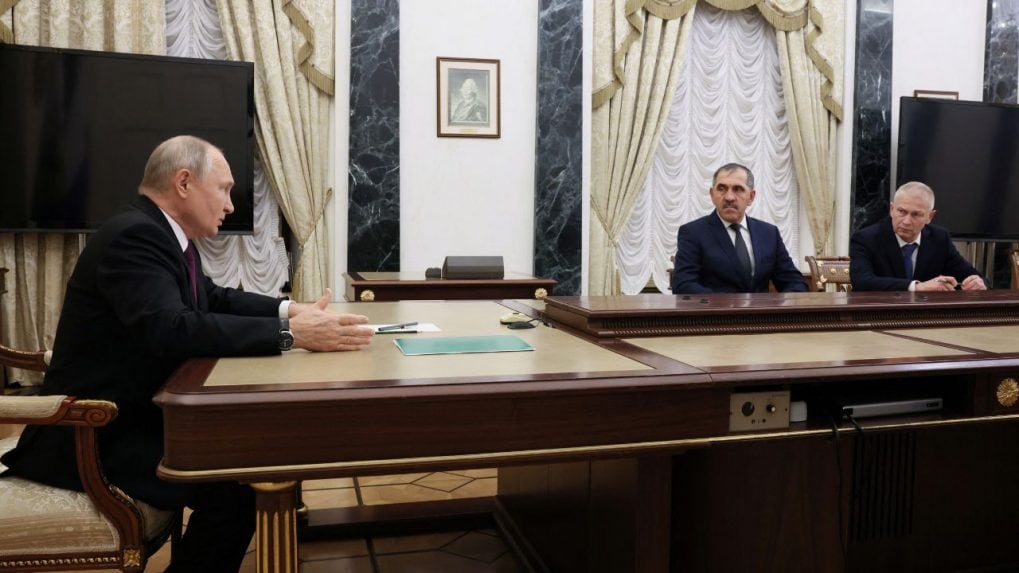
Russian President Vladimir Putin was on Friday shown meeting one of the most senior former commanders of the Wagner mercenary group and discussing how best to use “volunteer units” in the Ukraine war.
The meeting underscored the Kremlin’s attempt to show that the state had now gained control over the mercenary group after a failed June mutiny by its boss Yevgeny Prigozhin, who was then killed with other senior commanders in a plane crash in August.
Putin was shown on state television meeting at the Kremlin with Andrei Troshev, a former Wagner commander known by his nom de guerre “Sedoi” – or “grey hair”.
The Kremlin said the meeting took place late on Thursday. Deputy Defence Minister Yunus-Bek Yevkurov, who has travelled over recent months to several countries where Wagner mercenaries have worked, was also present, sitting closest to Putin.
Addressing Troshev, Putin said that they had spoken about how “volunteer units that can perform various combat tasks, above all, of course, in the zone of the special military operation.”
“You yourself have been fighting in such a unit for more than a year,” Putin said. “You know what it is, how it is done, you know about the issues that need to be resolved in advance so that the combat work goes in the best and most successful way.”
Putin also said he wanted to speak about social support for those involved in the fighting.
Troshev was shown listening to Putin, leaning forward and nodding, pencil in hand. His remarks were not shown.
Kremlin spokesman Dmitry Peskov told the RIA news agency that Troshev now worked at the defence ministry.
The fate of Wagner has been unclear since Prigozhin’s failed June 23 mutiny and his death on August 23, after which Putin ordered Wagner fighters to sign an oath of allegiance to the Russian state, which Prigozhin and many of his men had opposed.
Russia’s Kommersant newspaper has reported that just days after the Wagner mutiny Putin had suggested that Troshev take over from Prigozhin.
The Putin meeting in the Kremlin appears to indicate that what remains of Wagner will now be overseen by Troshev and Yevkurov.
Wagner, which once had tens of thousands of men, became best known for its May capture of the Ukrainian city of Bakhmut in the bloodiest battle of the war. After Bakhmut’s fall, Wagner units withdrew from Ukraine.
Some of the Wagner fighters have signed up for service with the formal Russian army while many others have moved into different private military companies (PMCs), Russian sources have told Reuters.
British military intelligence said that up to hundreds of fighters formerly associated with Wagner have likely started to redeploy to Ukraine as part of a variety of different units.
“The exact status of the redeploying personnel is unclear, but it is likely individuals have transferred to parts of the official Russian Ministry of Defence forces and other PMCs,” British military intelligence said.
Troshev, a decorated veteran of Russia’s wars in Afghanistan and Chechnya and a former commander in the SOBR interior ministry rapid reaction force, is from St Petersburg, Putin’s home town, and has been pictured with the president.
He was awarded Russia’s highest medal, Hero of Russia, in 2016 for the storming of Palmyra in Syria against Islamic State militants.
A former veteran chief of American’s Central Intelligence Agency has declared Vladimir Putin’s days are numbered, predicting the Russian president will be overthrown in a ‘Black Swan’ palace coup.
And the ousting of one of modern history’s most divisive and ruthless leaders is only a matter of time.
Jack Devine served for three decades with the US spy agency and told The Sun newspaper in an exclusive interview that he wouldn’t be surprised if Putin “disappeared tomorrow.”
Speculation about the future of Russia’s leadership has been festering for some time, with the country’s bruising performance in its war with Ukraine intensifying talk.
So too have endless reports about Putin’s ill health, with rumours emerging from inside the Kremlin that he has at various points been close to death.
Then he faced an armed uprising led by warlord Yevgeny Prigozhin, who rallied his Wagner Group mercenaries in a bizarre and short-lived plot.
Prigozhin died for his disloyalty.
But Devine, 83, who led thousands of spies on covert and classified missions across the globe for 32 years, believes Putin’s demise will be at the hands of those closest to him.
Vladimir Putin’s days are numbered, a former CIA chief has predicted. ZUMAPRESS.com
“Putin could disappear tomorrow, and I wouldn’t be surprised if some element in the government had decided they were going to take executive action,” Devine told The Sun.
Devine believes Putin has become increasingly unpredictable and dangerous – and his invasion of Ukraine has “sowed his political demise”.
The Russian president is continuing to throw his troops into meat-grinder assaults to try to secure a winter victory.
The devastated city of Avdiivka – the gateway to the major city of Donetsk that lies 12 miles to the east – has become the deadliest flashpoint of the war as Putin attempts to break a painful stalemate.
Devine believes the tyrant’s popularity will continue to drop as the war goes on – but it won’t stop his gruesome grind.
Vladimir Putin’s grip on power is increasingly weak. via REUTERS
The Russian leader will plough on with his fight “no matter what it takes”, Devine said.
“The more losses and the more violence that is visible to the Russian citizens, the less people want to be involved,” he explained.
“He will have a hard time recruiting, but it is Russia after all. He will find a way to strong arm, entice.
“He will come up with the army at the end of the day, but the war will become increasingly less popular.”
The “standstill” in Ukraine will likely see Putin toppled in a ‘Black Swan’ palace coup, particularly if it looks as though Russia’s efforts are resulting in a “permanent stalemate”.
“It’ll be a surprise. There’s always what we call a ‘Black Swan’ that appears from nowhere.
“But failing a ‘Black Swan’ I believe his troubles begin when there’s a stalemate and that’s right now. I don’t think it’ll be an uprising. I think it’ll be a what we might call a palace coup.”
A growing number of military analysts agree Putin’s power cannot last much longer and the end of his reign is near, whether by coup, assassination, regime collapse or his failing health.
Devine said Putin’s behaviour in recent times suggests the president has become increasingly unpredictable and dangerous, and he likely realises that he has “sowed his political demise” with the Ukraine war.
Russia continues to send countless troops into battle, facing severe casualties and embarrassing military defeats.
As the war goes on and the country’s humiliation worsens, Devine believes Putin’s popularity will tank.
Ukraine remains determined to defeat Russia’s attempts at invasion and continues to rally strong support from the West.
On top of that, the European Union’s efforts to sign up Ukraine, which would offer it NATO protection, represent a significant strategic loss for Putin.
Local resident Tetiana inspects her ruined flat at the site of a drone attack on a residential building in Kyiv (Kiev), Ukraine, amid the Russian invasion. Oleg Petrasyuk/EPA-EFE/Shutterstock
Devine fears it’s not going to “get any better” any time soon, with both sides unwilling to flinch despite the mounting costs.
“The Ukrainians aren’t going to give them territory. Putin’s not going to withdraw.
“But you can take the temperature down. They have to wind down, when everybody realises there’s no hope for Putin to win.
“He’s not going to lose in the technical sense. He’s not going to be driven back into Russia. Anybody waiting for that has false hopes.
“But I don’t think it’s too far off. I think next year we’ll see almost a permanent stalemate.”
Whatever happens to Putin, Devine said the person who replaces him is unlikely to be dramatically different.
And that makes keeping an eye on the so-called ‘Axis of Evil’ of China, Iran and Russia even more important.
“They are trying to pull their allies into an alliance and an axis,” he said.
“And I think we can see it being demonstrated with the Hamas attack in Israel and how Russia is playing that.
“The expansionist abilities of Putin are psychological and political right now, and I think it’s in the non-European world where he’s making some progress.”
When Israeli prime minister Benjamin Netanyahu held a 50-minute phone call with Russian president Vladimir Putin last weekend, it was only the second time the two leaders had spoken since the war against Hamas started on 7 October. The two leaders were once close allies, but no longer: relations between Putin and Netanyahu have now fractured, perhaps beyond repair.
In a statement released immediately after the call, Netanyahu criticised Russia’s close alliance with Iran. The Kremlin blamed Israel for ‘the catastrophic humanitarian situation in Gaza’ – repeating a position expressed by Putin in the past, including in a meeting with his ally and staunch Israel critic, Turkish president Recep Tayyip Erdogan, back in October.
If Russia has gone cold on Israel, it appears to be warming to Hamas
The breakdown of Putin and Netanyahu’s relationship is no surprise. Russia’s ambassador to the UN, Vasily Nebenzya, has announced that, because Israel is an ‘occupying state’, it didn’t have the right to defend itself against Hamas – an organisation which, of course, killed, raped and tortured some 1,200 Israelis and abducted dozens of women and children. Nebenzya also blamed Israel for committing ‘crimes against humanity’ in Gaza. What’s more, Russia – which started an illegal war in which tens of thousands of people have died – has supported ceasefire resolutions in the United Nations security council and general assembly.
If Russia has gone cold on Israel, it appears to be warming to Hamas. A Hamas delegation has been warmly welcomed in Moscow and Putin is rumoured to have promised them military aid. Hamas, which receives much of its funding, weapons and training from Iran and Qatar, is also still not recognised by Russia as a terror organisation.
Before the war in Ukraine, Israel and Russia enjoyed positive strategic relations. The bond and trust between Putin and Netanyahu had allowed Israel to operate against Hezbollah and Iranian targets within Syria and Iran, actions that necessitated quiet consent from Russia.
The foul truth about wood-burners
Relations between the two countries have, however, deteriorated since Israel decided to stand by Ukraine. Israel’s support of Kyiv, under the short-lived centrist coalition government of Naftali Bennett and Yair Lapid, was limited and hesitant due to Russia’s influence in the Middle East. But this was still enough to damage relations between the two countries.
When Netanyahu returned to power almost a year ago exactly, he sought to restore relations with Putin. He worried that a strained relationship might push Russia closer to Iran. Netanyahu’s assessment has been proven correct: the strategic alliance between the two pariah states has gone from strength to strength. But even if Israel’s position on Ukraine was different, Russia and Iran would still have grown closer. Increasingly isolated following the invasion of Ukraine, and under strict international sanctions, Russia has grown reliant on Iran for supplying weapons and drones while it struggles militarily.
Israelis used to believe that Putin had a soft spot for Israel, primarily because of the large population of Russian Jews living in the country. However, Putin’s support only lasted as long as Israel served Russian interests.
The war in Gaza has accentuated the division between the global democratic west and authoritarian east. The eastern bloc is headed up by Russia and includes Iran, Syria and Hamas, while Israel has been embraced by the US and other western allies since the start of the war. In Putin’s dichotomous worldview, Israel has now been pushed even further away from Russia and into the arms of those he considers his enemies. As such, the Middle East has become the latest theatre of the 21st century’s cold war.
The war in Gaza has served Putin by drawing the world’s attention away from Ukraine and from the atrocities committed by Russian forces. Putin also hopes that the aid given by the Americans to Israel will eat into the aid that Washington provides Ukraine. This is incentivising Putin to inflame the war in Gaza, along with his ally Iran, which, as well as supporting terror organisations in the West Bank, has been guiding Hezbollah’s attacks against Israel from Lebanon.
In an effort to establish the image of Russia as a champion of human rights and supporter of a peaceful solution to the war, the Kremlin has launched a campaign of disinformation and conspiracy theories. Putin claimed, for example, that ‘ruling elites’ in the US are responsible for the killing of Palestinians, as well as for other events across the Middle East and in Ukraine. He argues that the US benefits from global instability. This is, of course, somewhat ironic: despite pointing the finger at the US as being responsible for violence and instability, it’s Putin himself who has acted as an agent of chaos in the region. He has cosied up to terrorists and supported Iranian militarisation efforts for years now.
After the phone call between Netanyahu and Putin, Russia’s foreign minister Sergei Lavrov has, for the first time, condemned Hamas’s attack, recognising it as an act of terrorism. At the same time, Lavrov also accused Israel of indiscriminately shelling Gaza.
Despite this condemnation, though, Russia’s position is unlikely to change. The Russian state has also called on Hamas to release the remaining Israeli hostages still held in Gaza. This isn’t a sudden show of support for Israel. Instead, it’s meant to help Russia establish itself as a relevant and powerful actor in the Middle East.
Jerusalem (AFP) – Among the nations condemning Israel’s war in Gaza, one has stood out — Russia had built a growing friendship with Israel, but that dalliance is over, analysts said, erased by the shifting sands of Middle East geopolitics.
Just under two years ago, the picture had been very different.
When Russia invaded Ukraine in February 2022, Israel didn’t join the West in sanctioning Moscow, a demonstration of the alliance of convenience between the two governments.
Now, Russia’s President Vladimir Putin is among Israel’s loudest critics and has refused to denounce Hamas’s bloody October 7 attack.
Instead, his war against Ukraine has driven Russia into a different coupling, this time with Israel’s sworn enemy Iran.
Russia has officially backed calls for an immediate ceasefire in Gaza at the UN, while early in the war Putin accused Israel of contemplating tactics comparable to Nazi Germany’s brutal siege of what is now Saint Petersburg during World War II.
The health ministry in Hamas-run Gaza says Israel’s offensive, aimed at destroying Hamas, has killed more than 19,600 people, mostly women and children.
In late October, Moscow went as far as to host envoys from the Palestinian militant group and Iran, which the Russian government said included talks on releasing foreign hostages. Israel called the meeting “a reprehensible step that gives support to terrorism”.
This month, Iranian President Ebrahim Raisi visited Moscow for talks with Putin, while on Wednesday Russia made a joint demand alongside the Arab League for a UN Security Council ceasefire resolution.
In Israel, the mood is one of shock and anger. Putin’s decision not to criticise Hamas, even with Russian citizens among the roughly 1,140 people killed by the militants on October 7, was “a foul betrayal”, said Israeli historian Semion Goldin.
Russia has come down squarely “on the side of the aggressor, not at all on our side”, said Golding, a researcher in Russian studies at the Hebrew University of Jerusalem.
‘Israel deluded itself’
It’s all a far cry from where Israeli-Russian relations were as recently as last year.
During much of the Cold War, Soviet-Israeli relations were frosty. The Kremlin prevented many Jews from emigrating to Israel, while the Soviet Union propagated anti-Zionist propaganda and provided military aid to Arab states, in particular during the 1973 Yom Kippur War.
However, following the Soviet Union’s collapse in 1991, the newly re-emerged Russia established much closer ties with Israel, that saw increased tourism and a massive wave of Russian Jewish migration to Israel.
Today, there are more than a million Russian-speakers from the former Soviet Union in Israel, forming a substantial political bloc.
Under Prime Minister Benjamin Netanyahu, the relationship appeared to grow even closer.
Following Moscow’s intervention in the Syrian civil war, Israel worked closely with the Kremlin as it mounted its own air campaign in Syria targeting Iranian-backed forces, said former Israeli ambassador to Russia, Arkady Milman, now a researcher at the Institute for National Security Studies in Tel Aviv.
Russia controlled Syria’s airspace and was, in effect, authorising Israel’s raids, he said.
With eyes on the military situation in Syria, the large Jewish populations in Ukraine and Russia, and its own sizeable Russian and Ukrainian communities, Israel opted against slapping sanctions on Russia for its invasion of Ukraine.
That position held through three Israeli prime ministers.
Raised hackles
As Putin’s war in Ukraine has dragged on and his international isolation deepened, he has turned against Israel’s quiet friendship.
Instead, the Russian president has forged a new alliance with Iran, with Tehran delivering drones to Moscow and the pair cooperating in evading Western sanctions.
That inevitably raised hackles in Israel, which fears Iran joining it as a nuclear-armed state.
Moreover, Iran would like Russia “to neutralise Israel in Syria”, said Edward Waysband, an associate researcher at New Europe College, a prospect “that is unacceptable for Israel”.
Israeli linguistics professor Cyril Aslanov said Moscow’s reaction to the Israel-Hamas war had revealed that the “so-called rapprochement” between Israel and Russia since the fall of the Soviet Union “was profoundly illusory”.
Aslanov once travelled back and forth to Russia, visiting universities to spread Jewish culture, but he said that appeared a bygone era, with anti-Semitic incidents in Russia and warnings against travel to some regions.
Now, Israel finds itself denouncing its erstwhile partner. Netanyahu criticised “the dangerous cooperation between Russia and Iran” in a phone call with Putin in early December and expressed his dissatisfaction with the Kremlin’s stance at the United Nations.
Iran aside, the Kremlin has chosen to use the Israel-Hamas war as a chance to denounce the United States and its allies while positioning itself as a champion of the Global South and “Orthodox Christians in the Holy Land”, said Waysband.
With Moscow prioritising anti-Western rhetoric and Israel a close ally of Washington, it “finds itself de facto facing this alliance against the West”, said Milman.
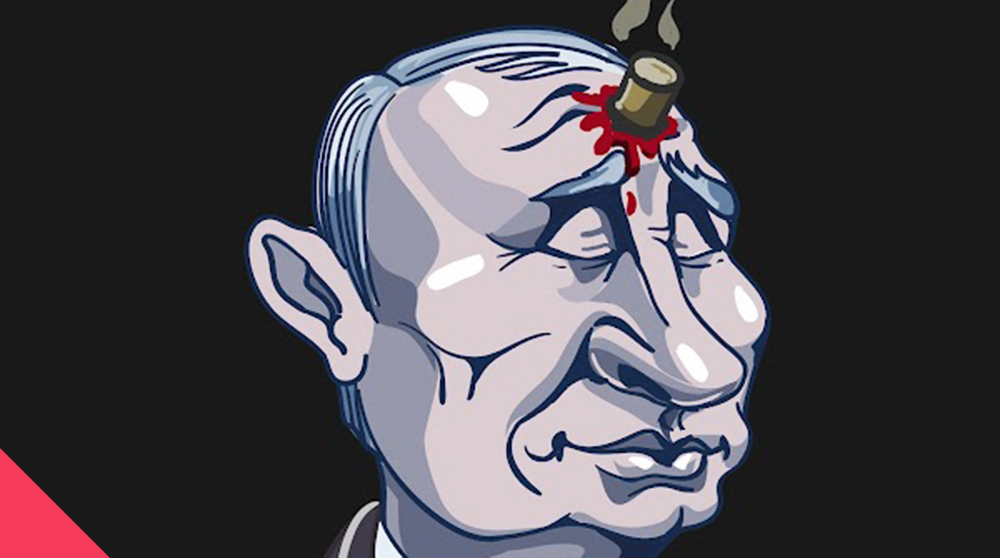
An NFT collection with different scenarios of Russian president Vladimir Putin’s death was posted on OpenSea. A Putin Huilo collection features 18 cartoons, which portray the dictator’s death by a grenade or a bullet, by hanging or electrocution.
The cartoons were created by independent illustrators from Ukraine and Belarus, who condemn Russian and Belarusian aggression against Ukraine. All the money raised from NFT sales will go to support the Ukrainian army, medical and humanitarian assistance to the Ukrainians affected by the war.
With 10,000 copies in each edition, the price for one illustration ranges between $25 and $1000. In case of selling out the collection, illustrators plan to raise $1.5 millions. The final sum will be shared among various charity funds.
WASHINGTON (TND) — FBI director Christopher Wray urged lawmakers to renew a law that allows the agency to conduct warrantless surveillance outside the U.S. amid bipartisan calls for reform due to concerns about privacy violations of U.S. citizens.
Wray appeared before the Senate Judiciary Committee on Tuesday for the top law enforcement agency’s regular oversight hearing. His appearance comes as Congress has a series of issues connected to the FBI before it and limited time or partisan divisions presenting obstacles to finding a solution.
Along with renewing the authorization of the surveillance tool, Section 702 of the Foreign Intelligence Surveillance Act, some Republican lawmakers have also called for cutting the agency’s funding, blocking the construction of a new headquarters to replace its dilapidated Washington location amid complaints about the handling of the investigation into the Jan. 6 riot at the Capitol and investigation of President Joe Biden’s son Hunter.
Tuesday’s hearing also comes as the U.S. is facing a heightened level of threats at home and abroad amid the wars in Ukraine and Gaza. Wray told a separate Senate committee last month that the threat of international terrorism targeting the U.S. has spiked since the Oct. 7 attack on Israel.
“What I would say that is unique about the environment that we’re in right now in my career is that while there may have been times over the years where individual threats could have been higher here or there than where they may be right now, I’ve never seen a time where all the threats or so many of the threats are all elevated, all at exactly the same time,” Wray said.
One of the most pressing issues facing lawmakers in a busy finish to the year is deciding whether to renew Section 702, which will expire on Dec. 31 without congressional action.
Wray told lawmakers that allowing it to lapse would be dangerous to national security and would be “devastating” to its ability to counter threats.
“Blinding ourselves through either allowing 702 to lapse or amending it in a way that guts its effectiveness would be reckless at best and dangerous and irresponsible at worst,” Wray said. “The reality is the whole reason we have 702 focused on foreign threats from overseas is to protect America from those threats. It’s not to admire foreign threats from afar and study them and think about them. It’s to know what they are and to make sure they don’t hurt Americans here.”
There are several bills with potential reforms up for debate in the House and Senate, some of which include a new requirement for agents to obtain a warrant before running a search on digital communications for information on U.S. citizens. National security officials in support of renewing Section 702 argue that a warrant requirement would make the powerful surveillance tool much less useful and effective.
“What if there were a terrorist attack that we had a shot to prevent, but couldn’t take it, because the FBI was deprived of the ability under 702 to look at key information already sitting in our holdings?” Wray said during Tuesday’s hearing.
Lawmakers on both sides of the aisle said they supported the FBI’s ability to combat terrorism by using information obtained from Section 702, but still had concerns about innocent Americans getting wrapped up in the searches.
Also at issue for Wray was accusations the FBI and broader justice system has been politicized against conservative Americans and former President Donald Trump, who is facing multiple federal indictments.
“You’re simply sitting blindly by while career partisans in your agency allow it to be weaponized, and you are damaging the FBI and you are damaging the Department of Justice,” Cruz said.
Other Republicans at the hearing also asked Wray about the bureau’s involvement in an investigation into Hunter Biden, a yearslong affair that dates back to the Trump administration. A pair of IRS whistleblowers have alleged that the probe into his overseas business dealings and tax violations was slow-walked due to political influence.
Wray declined to directly answer most questions about Hunter Biden or Trump because both investigations remain ongoing, a longstanding DOJ policy. He did say that his agency was directed to follow the facts in any investigation regardless of the subject or political consequences.
“My instructions to our people on this and on every other investigation are that we’re to follow the facts wherever they lead, no matter who likes it, no matter what political influence,” he said.

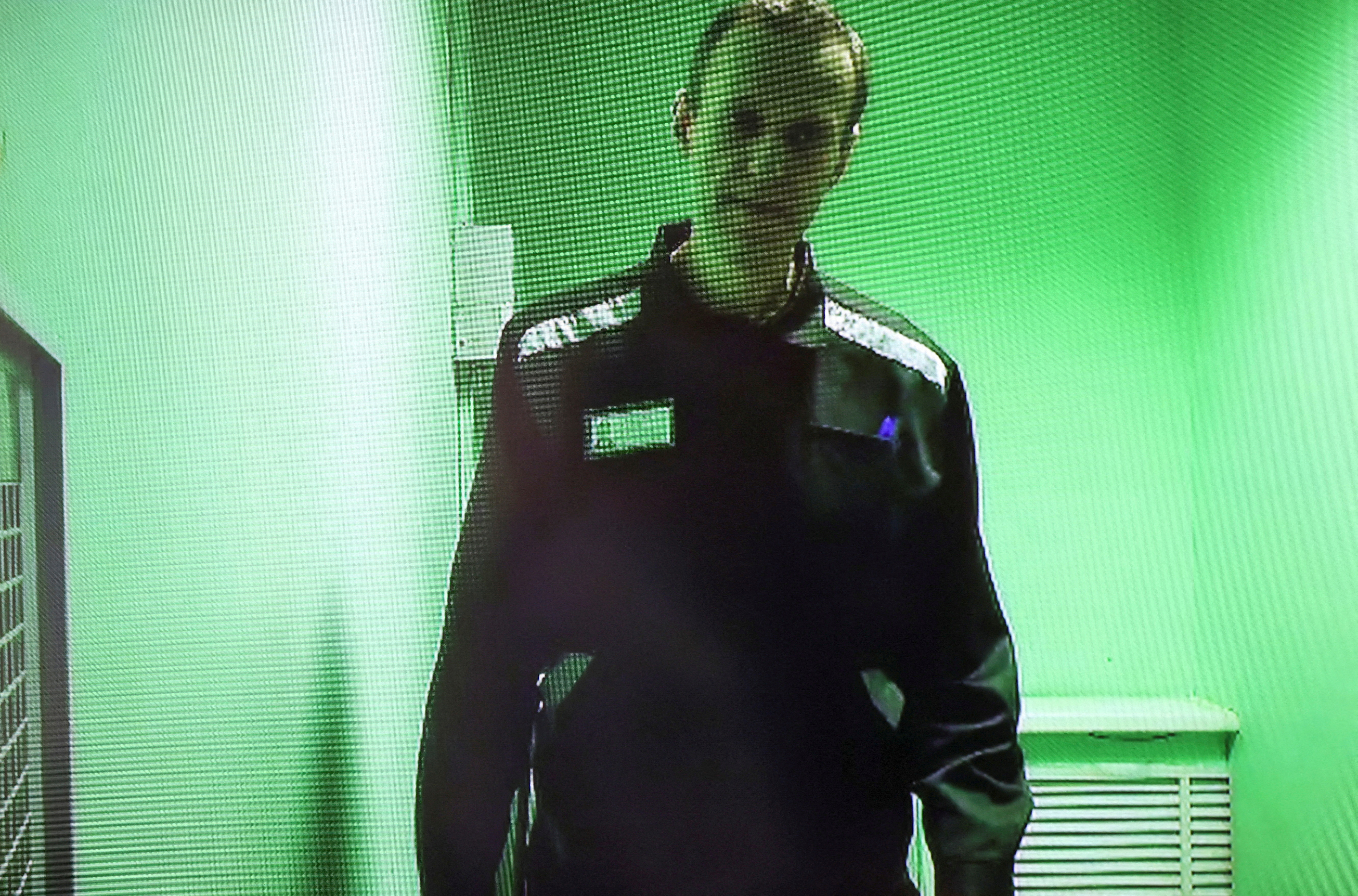

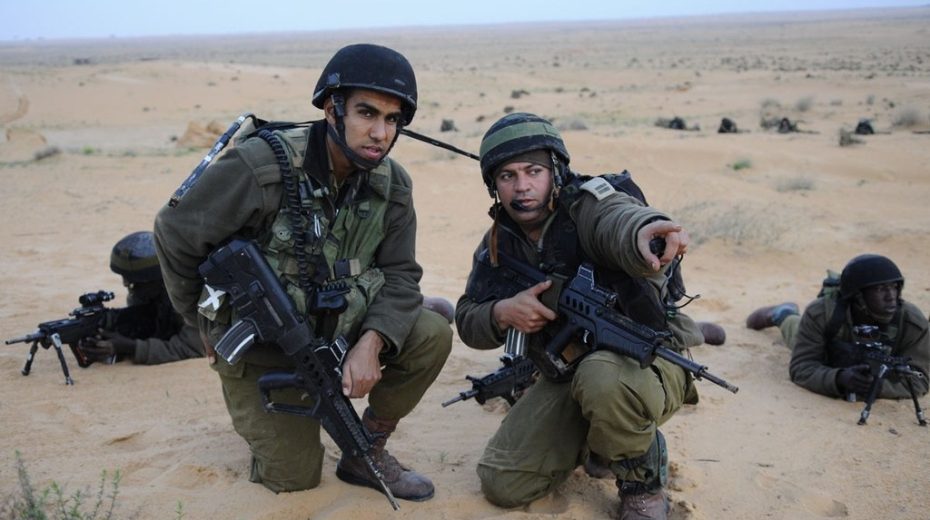 Illustration. Bedouin soldiers of the IDF’s desert reconnaissance unit. Photo: Israel Defense Forces