Oops! We didn’t find anything on that query, try again with a different query!
This content has been removed. Get more news at Philanthropy News Digest.”
 The News And Times Review - NewsAndTimes.org
Category Added in a WPeMatico Campaign
Oops! We didn’t find anything on that query, try again with a different query!
This content has been removed. Get more news at Philanthropy News Digest.”
COVID vaccines could be partly to blame for a rise in “unprecedented” excess deaths in the US and other Western countries in the three years since the pandemic took hold, a new study suggests.
Analyzing mortality data from 47 Western countries, scientists from the Netherlands’ Vrije Universiteit found that excess mortality has “remained high” since 2020 — despite the widespread rollout of COVID vaccines and various containment measures.
The researchers said the trend “raised serious concerns” as they urged government leaders and policymakers to “thoroughly investigate the underlying causes of persistent excess mortality,” according to the study published in BMJ Public Health.
Vrije Universiteit ranks 150th out of more than 20,000 universities globally, according to the Center for World University Rankings.
 COVID vaccines could possibly be to blame, in part, for a rise in “unprecedented” excess deaths in the US and other Western countries, a study from the Netherlands’ Vrije Universiteit found. AP
“Although COVID-19 vaccines were provided to guard civilians from suffering morbidity and mortality by the COVID-19 virus, suspected adverse events have been documented as well,” the researchers wrote.

“Both medical professionals and citizens have reported serious injuries and deaths following vaccination to various official databases in the Western World.”
“During the pandemic, it was emphasized by politicians and the media on a daily basis that every Covid-19 death mattered and every life deserved protection through containment measures and Covid-19 vaccines. In the aftermath of the pandemic, the same moral should apply,” they added.
The study found there had been more than 3 million excess deaths across the US, Europe and Australia since 2020.
Of those excess deaths, more than 1 million occurred in 2020 at the height of the pandemic, according to the study.
Those figures, however, remained high in the following years, with 1.2 million in 2021 and 800,000 in 2022, researchers added.
The death toll figures include fatalities directly linked to the virus, as well as “indirect effects of the health strategies to address the virus spread and infection,” the study notes.
 The study found there had been more than 3 million excess deaths across the US, Europe and Australia since the pandemic took told in 2020. BMJ Public Health
The researchers added that serious side effects of the vaccines had been documented, including ischemic strokes, acute coronary syndromes and brain hemorrhages.
“This commonality hinders clinical suspicion and consequently its detection as adverse vaccine reactions,” the study stated.
More than 1.1 million Americans have died from COVID since the pandemic broke out, according to the US Centers for Disease Control and Prevention.

Exactly 25 years ago, the man widely regarded as President Vladimir Putin’s political instructor was hiding in Paris from the Russian police. Anatoly Sobchak, the former mayor of St. Petersburg, was suspected of corruption and was helped to leave Russia on a Finnish private jet by KGB lieutenant colonel Vladimir Putin, who had just been appointed director of Russia’s FSB.
When I interviewed him on my program “Top Secret”, Sobchak seemed a bit confused and unable to imagine the future. But that evening in the lobby of the Hôtel Ambassadeur we talked about the future. As we were leaving, Sobchak said to me, “I understand why Yeltsin chose Putin as his successor — he would never betray you. But I also understand that once he has power, Putin will never give it back to anyone.”
The meaning of these words was then understood by very few people, but Sobchak did not hope to be heard.
A quarter of a century later, Vladimir Putin’s supporters and critics understand exactly what Sobchak meant. Putin has only one successor — himself. The transition of power, about which so many political scientists both in Russia and abroad have speculated, ended in the elections this March.
If Putin still holds power in 2036 — which the sham 2020 referendum enabled him to do — he will surpass Josef Stalin and Catherine the Great to become the longest-ruling leader of Russia. After the outbreak of war with Ukraine, when Russian Foreign Minister Sergei Lavrov was asked whether Putin consulted with him, he replied, “Putin has three advisers — Ivan the Terrible, Peter the Great and Catherine the Great.”
Having placed himself on the level of the tsars, Putin remembers that power changed only after the monarch’s death. To continue this political tradition, however, two conditions must be met. The tsar must be reliably protected from assassination and must never give up the throne himself.
When Putin became president in the spring of 2000, at a closed board meeting of the Russian FSB, he said from the podium: “The KGB’s task of infiltrating the Russian government has been accomplished.” It is unclear whether he was joking or serious.
But from that moment on, the influence of the FSB on all the processes taking place in the country grew every year. Until May of this year, the only state institution that was not subject to the FSB’s influence was the army. Putin considered the military to be the most important pillar of power, but he never trusted it 100%.
When Putin approached Sergei Shoigu in November 2012 to take over as defense minister, Shoigu set one condition: that there be no FSB officers around him in the army leadership. Putin agreed, receiving in return a military leadership personally loyal to him. But to balance controlled conflicts within the Defense Ministry, Putin appointed General Valery Gerasimov, considered a close ally of Shoigu, to the post of Chief of the General Staff in the same fall of 2012. The time of the security services, for whom control over the army and its budgets was a cherished dream, had not yet arrived. It was to come later.
Until February 2022, there was a conditional truce between the influential clans in the Russian government. But two years ago, the FSB, whose reports (as well as those of the military) had convinced Putin that victory in Ukraine would be easy, opened its own personal front — an internal one. The FSB’s task was to take control of all spheres of life in Russia, to destroy the opposition and its leaders, to introduce censorship, to subjugate the industrial sector, financial institutions, culture and, of course, the military.
After Putin’s victory in the heavily corrupt presidential election, the Chekists went on the offensive. As journalists at Agenstvo calculated, 21 criminal cases were opened against officials and heads of state companies between March and April alone. Not only was Deputy Defense Minister Timur Ivanov arrested, but also Gennady Sakharov, an executive at the state Rosatom corporation, and Igor Andreev, vice president of Rossiya Bank. The truce among the elites is over.
But despite what the Kremlin says, this is not a fight against corruption. It is a fight for power.
By the beginning of Putin’s fifth term, the FSB had won. Officials from the Culture Ministry can tell you that all films are reviewed by two plainclothes officers before a rental certificate is issued. Raw materials businessmen will tell you how the new board of directors includes undercover FSB officers. The work of the presidential administration is controlled by the FSB’s Second Service (that combats terrorism and “protects the constitutional order”), and the Security Council is staffed only by security officers. To paraphrase Putin’s quote from 2000, Lubyanka has infiltrated the country’s hierarchy of power more successfully than at any other point in history.
Therefore, it was not difficult for the FSB to lobby for its employees to be exempt from military service, remaining to guard the political comfort of the regime in the rear. This decision caused serious irritation among the Defense Ministry and other institutions of power. But Putin sided with his former colleagues from the FSB, whom the historian of special services Andrei Soldatov once called “the new nobility.”
Historically, the Russian nobility was a military class. During the War of 1812, when the Russian army was defending its country rather than attacking a neighbor, representatives of the nobility led the fight. Now, the elites from the FSB, Interior Ministry, Federal Penitentiary Service, and special services remain at the rear.
Their real task in the conditions of the military-political “special operation” is not to protect the people, but to secure the regime. But in fulfilling this task, there is an inevitable temptation for the aforementioned elites to become an integral part of the state, and in the long run — to lead it.
However, this battle of the bulldogs in Moscow may deal the Kremlin a blow far more severe than the drones and missiles coming from Ukraine. The Russian system of political power is now organized in such a way that any bias in the direction of one of the clans can lead to the collapse of the pyramid or a coup by the siloviki.
And it is not by chance that today. Mikhail Khodorkovsky wrote that in 1996 Russia did not face a choice between Yeltsin and Gennady Zyuganov, the Communist Party candidate. The choice was between electing Yeltsin and declaring a state of emergency. The FSB and FSO were in favor of a state of emergency that would have turned Yeltsin into a puppet of the security services. “By defending the rejection of the state of emergency, we postponed the FSB’s rise to power for 8-12 years.”
Putin’s new term is just beginning. It will take place under the full control of the FSB, whose presence in government at all levels is growing constantly. Data suggests that in the last years of the Soviet Union, only 3% of officials in top government positions were representatives of special services. During Yeltsin’s rule, the figure was over 30% and has risen to 70-80% today.
Putin’s regime has become a dictatorship of the security services, which will try to ensure the sustainability of this model of government for as long as possible. But that will only be the case until the rising clan of young siloviki sees the 72-year-old president as a weak link in the chain of power.
… we have a small favor to ask. As you may have heard, The Moscow Times, an independent news source for over 30 years, has been unjustly branded as a “foreign agent” by the Russian government. This blatant attempt to silence our voice is a direct assault on the integrity of journalism and the values we hold dear.
We, the journalists of The Moscow Times, refuse to be silenced. Our commitment to providing accurate and unbiased reporting on Russia remains unshaken. But we need your help to continue our critical mission.
Your support, no matter how small, makes a world of difference. If you can, please support us monthly starting from just $2. It’s quick to set up, and you can be confident that you’re making a significant impact every month by supporting open, independent journalism. Thank you.

When COVID-19 hit in 2020, I jotted down a makeshift “will” for my four kids under 12. It wasn’t official, just a set of instructions for my children and other immediate family members in case anything happened to me. Bank accounts, passwords, and access to other valuable information the family might need were included.
It was the beginning of the pandemic and we had no idea just how serious things would get.
As a single parent, I worried that if I suddenly caught it and died, my children would languish. The virus was rampant, and the risk of dying seemed high and very real. Fear and anxiety took hold.
COVID-19 deaths weren’t exactly uncommon. The pandemic killed more than a million Americans, and there have been about 104 million confirmed cases in the United States alone. A lot of decisions were rooted in fear and brought with them life-changing consequences. Statewide lockdowns, shuttered businesses, school closings: All were based initially on the social distancing rule of the Centers for Disease Control and Prevention.
We’re now getting answers to questions those decisions raised.
In his testimony to the House Oversight and Accountability Committee on Monday, Dr. Anthony Fauci, former director of the National Institute of Allergy and Infectious Diseases and former chief medical adviser to President Donald Trump, said the 6-foot social distancing rule, which the CDC originally recommended, had not been backed by a clinical trial. This is despite constant claims that COVID-19 protocols were based on science.
These disclosures are damning and maddening for all of us who had structured our lives around these rules for years. As a result, millions of people suffered needlessly.
On Monday, Fauci was also asked to clarify his comments during the two-day congressional testimony he gave in January. The transcript of that testimony was recently released.
He specifically responded on Monday to questions about the 6-foot rule: “It had little to do with me since I didn’t make the recommendation and my saying ‘there was no science behind it’ meant there was no clinical trial behind that.”
In January, Fauci told staff and members of the Select Subcommittee on the Coronavirus Pandemic that “there was no science behind” the 6-foot social distancing rule that state and local governments repeated for months if not years.
What about the next pandemic: The world desperately needs a pandemic agreement. Will we come together to save lives?
“You know, I don’t recall. It sort of just appeared. I don’t recall, like, a discussion of whether it should be 5 or 6 or whatever,” Fauci said in January’s testimony.
He also admitted in the January interview that there was little science that backed requiring children to wear masks in public and at schools for almost two years.
“Do you recall reviewing any studies or data supporting masking for children?” a staffer asked Fauci.
“You know, I might have,” he answered, “but I don’t recall specifically that I did. I might have.”
These revelations are infuriating. Fauci repeated CDC-based COVID-19 protocols as the mouthpiece of President Trump’s administration. Desperate for guidance, states, local governments, businesses, churches and schools instituted them.
The real effect of social distancing − which Fauci basically admitted Monday and in January’s testimony was just an educated guess on how to deter COVID-19 − devastated America’s economy, small businesses and families. It interrupted the fabric of American life. For what?
The CDC’s now-infamous three weeks to “flatten the curve” turned into months for students and families living with the consequences. Here are some.
Closing schools was devastating to kids, especially poor or otherwise disadvantaged children. Remote learning wasn’t as effective as in-person learning, especially in the first year, as teachers had no time to prepare. Kids fell behind their grade levels. Pandemic closings resulted in two decades of learning loss.
Operation Warp Speed: Trump has to disavow his COVID vaccine to keep voters from RFK Jr. and his anti-vax clout
Anxiety and depression skyrocketed, especially among adolescents and teens. Kids with learning disabilities were completely left behind.
Non-urgent but still important medical diagnoses and exams were halted altogether. (This went for adults, too.) When schools did reconvene, masks were treated as sacrosanct, and kids were forced to eat lunch several feet apart.
Children learning to read and write at the beginning of the pandemic are still behind even now. Never mind that kids rarely showed any adverse effects of COVID-19, let alone died from it.
This is not a matter of hindsight being 20/20, either. People, including myself, were calling for schools to open in the fall months after the pandemic began, predicting it would continue to be harmful.
The entire medical profession, well beyond Fauci’s purview, seemed to struggle to understand how to mitigate the virus while continuing to provide medical care to those in need. While most providers pushed everyone to get vaccinated, screenings and routine care were pushed off for fear of COVID-19, even though they themselves were vaccinated.
At one point during the first year of COVID-19, one of my daughters became extremely ill. I phoned our pediatrician. Even though the staff was vaccinated, they would only see newborns. Her pediatrician refused to examine my daughter in person, and we tested negative for COVID-19 three times. She lost weight and refused to eat, sleeping all day.
After about 10 days, she eventually recovered. We still have no idea what illness she had, but her pediatrician’s treatment, based on COVID-19 guidelines, made no sense.
Hundreds of providers endangered patients based on ideas that had no basis in research. We’re only now learning just how much delaying cancer treatments out of the fear of spreading COVID-19 will cost people.
Schools were just one example. The economic data, representing millions of families, is no more comforting.
In the second quarter of 2020, 1.2 million jobs were destroyed. In June 2021, 6.2 million people did not work at all or worked fewer hours because their employers closed or lost business. Family-owned businesses were lost, savings wiped, all for rules that had no real scientific basis.
Elderly loved ones, the most susceptible to COVID-19, died alone in hospital beds, with no one holding their hands and whispering last prayers. If funerals were held at all, expressions of affection was banned.
On Monday, Fauci did concede that some COVID-19 preventative measures may have gone too far and led to harmful outcomes. He said it is “very, very clear” that public health officials in the future should consider “the potential collateral negative effects” of controversial ideas like requiring masks and ask “how we can do better next time.”
Still, even this seems too little too late.
While COVID-19 measures were set in place immediately, as hundreds, if not thousands, were at risk of dying from the disease, it became clear within months that the disease disproportionately targeted elderly people and hardly affected kids at all.
An adaptable administration led by Fauci, the CDC and the National Institutes of Health would have observed such shifts and lifted strict lockdowns of schools and businesses. A healthy society quarantines the sick, not the young. A robust economy never shuts down its economy and hopes it will thrive.
Because we live in Texas, which remained largely open save for a couple of months, my kids and I watched as friends and family struggled through the pandemic with shuttered businesses and schools. The contrast between living in a state where responsible freedom was encouraged compared with places where local governments kept businesses and schools closed was obvious and remains cemented in my mind.
COVID-19 was four years ago now, but as time marches on, we must never forget its valuable lessons so we don’t repeat those mistakes again.
Nicole Russell is an opinion columnist with USA TODAY. She lives in Texas with her four kids.

NEW YORK, June 3 (Reuters) – A prominent 91-year-old psychiatrist who was once close friends with Jeffrey Epstein was sued on Monday by a onetime model who said he enabled the late financier’s sex trafficking, and turned her into his “modern-day sex slave.”
In a complaint filed in Manhattan federal court, the plaintiff, using a pseudonym Jane Doe 11, said Henry Jarecki raped her repeatedly starting in 2011, after Epstein referred her for mental health treatment following his own sexual abuses.
Doe also said Jarecki was Epstein’s “go-to” doctor for treating young women experiencing depression, shared victims’ confidential medical information with Epstein, and shielded Epstein from law enforcement.
“The allegations will be shown to be entirely false and baseless,” said Sarita Kedia, a lawyer for Jarecki. “Dr. Jarecki never engaged in any abusive conduct with the complainant or any other person.”
Doe’s civil lawsuit seeks unspecified compensatory and punitive damages for sexual battery, emotional distress, and violating the federal Trafficking Victims Protection Act.
Epstein killed himself in a Manhattan jail cell in August 2019 at age 66 while awaiting trial on sex trafficking charges.
Jarecki, of Rye, New York, is the latest of many people sued over their ties to the registered sex offender.
Jarecki also became wealthy trading commodities, and from selling MovieFone, which he co-founded with his son, to America Online for about $388 million in stock in 1999.
While Jarecki was in Epstein’s public address book, Monday’s lawsuit appears to be the first over their relationship.
Monday’s complaint said Doe came to the United States in 2010, seeking a visa to work a model, when another model told her that Epstein could help her career.
She said Epstein sent her to Jarecki after she became depressed, calling him “the best doctor in New York City.”
But instead of helping, Jarecki allegedly promised to “save” Doe from Epstein, pushing her to move into an apartment he could monitor from his own bedroom around the corner in Manhattan’s Gramercy Park neighborhood.
Doe said Jarecki, then in his late 70s, began using the apartment to force her into sex, threatening her work status or to return her to Epstein if she failed to comply.
She also said Jarecki ordered her to go to bed at 10 p.m., calling her to demand she sleep if he saw the light on at 10:15, and expressed displeasure when she didn’t smile enough.
The complaint accused Jarecki of “raping Jane Doe 11 by force on dozens of occasions in New York,” and trafficking her to his private Caribbean island where he sexually abused her.
Brad Edwards, a lawyer for Doe and more than 200 other Epstein accusers, declined to elaborate on Monday’s lawsuit but said “we want other survivors to know that it is safe to come forward.”
The case is Doe v Jarecki, U.S. District Court, Southern District of New York, No. 24-04208.
Sign up here.
Reporting by Jonathan Stempel in New York
Editing by Nick Zieminski
Our Standards: The Thomson Reuters Trust Principles., opens new tab
:quality(70)/cloudfront-us-east-1.images.arcpublishing.com/archetype/KBLXIZ3BJZCEZKDWO26CGV473Q.jpg)
NATO plans to offer Ukraine a security package when the alliance convenes its annual summit this summer in Washington, though it’s expected to stop short of accepting the nation’s long-standing request for membership amid Russia’s invasion.
In addition to unveiling the package in July, an estimated 32 countries are finalizing a series of bilateral agreements to support Ukraine ahead of the summit, with 13 finalized so far, according to Julianne Smith, the U.S. ambassador to NATO.
“Allies will be putting forward a whole package of deliverables that will serve as a bridge to their membership inside the alliance,” Smith said at a Defense Writers Group roundtable on Monday. “Part of the package will be the language we use to describe Ukraine’s membership aspirations in the declaration itself.”
“Part of it will be an institutionalization of some of the bilateral support that’s currently being provided [to] Ukraine, and tucking it under NATO command. Part of it will be working to identify new resources for our friends in Ukraine, and ensuring that we send a signal to Moscow that the NATO alliance isn’t going anywhere,” Smith added.
Ukrainian President Volodymyr Zelenskyy asked for fast-tracked accession into the alliance shortly after Russia’s full-scale invasion in 2022 — a request NATO rebuffed at last year’s summit in Lithuania. Instead, NATO offered Ukraine a multiyear assistance package meant to bolster its defenses and help it transition away from Soviet-era equipment.
Ukrainian entry into NATO would allow Kyiv to invoke the alliance’s collective defense clause, potentially triggering a broader regional conflict with Russia. U.S. President Joe Biden said last year that the war with Russia would have to end before Ukraine enters the alliance.
Still, during an April visit to Kyiv, NATO Secretary General Jens Stoltenberg vowed that “Ukraine will become a member of NATO.”
“The work we are undertaking now puts you on an irreversible path towards NATO membership, so that when the time is right, Ukraine can become a NATO member straightaway,” Stoltenberg said.
Some defense companies from the NATO bloc have expressed interest in co-producing certain military capabilities like unmanned systems. The U.S. in May announced a $2 billion Foreign Military Financing package largely geared toward helping Ukraine grow its defense-industrial base.
“This is coming from, in large part, European or Canadian or American companies that are looking at co-production opportunities,” Smith told Defense News.
Smith noted the July summit, which marks NATO’s 75th anniversary, will also focus on the regional defense and deterrence plans for northern, central and southern Europe, which the alliance formally agreed to during last year’s summit.
“It’s going to mean a major shift across the alliance in how countries invest, procure, work together to implement and execute those regional plans,” the diplomat said.
The plans are partially aimed at guiding NATO members when they make military procurement decisions to ensure they’re buying the right capabilities. For instance, a country could be responsible for three core tasks within a regional plan and would be expected to make procurement decisions accordingly.
“It’s ultimately up to them on how to spend the resources, but they have to answer to the regional plans,” Smith said.
She argued that the regional plans will also help reassure defense manufacturers that NATO intends to keep procuring larger amounts of ammunition and other materiel over the long term, encouraging them to ramp up production.
“It’s not a signed contract, but helping them see what the requirements will be across the alliance that’s tagged to these regional plans will certainly assure them that the demand signals will not just be over the next 12 months, but the demand signals to industry will be for the better part of a decade,” she said.
The summit will also focus on burden-sharing. Smith expects that slightly more than 20 countries will spend at least 2% of their respective gross domestic product on defense — a goal set by the alliance.
“We have to make sure that we keep pushing and get every member of the alliance to lay out a plan to get to the 2% within the next few years,” Smith said. “And I think 99% of the allies have a plan in place.”
Bryant Harris is the Congress reporter for Defense News. He has covered U.S. foreign policy, national security, international affairs and politics in Washington since 2014. He has also written for Foreign Policy, Al-Monitor, Al Jazeera English and IPS News.
The American Civil Liberties Union said it planned to challenge the executive action in court.

Tuesday’s decision is a stark turnaround for President Biden, who came into office attacking Donald J. Trump for his efforts as president to restrict asylum.Credit…Anna Rose Layden for The New York Times


By Zolan Kanno-Youngs and Hamed Aleaziz
President Biden issued an executive order on Tuesday that prevents migrants from seeking asylum at the U.S.-Mexico border when crossings surge, a dramatic election-year move to ease pressure on the immigration system and address a major concern among voters.
The order is the most restrictive border policy instituted by Mr. Biden, or any other modern Democrat, and echoes an effort in 2018 by President Donald J. Trump to cut off migration that was blocked in federal court.
The restrictions kick in once the seven-day average for daily crossings hits 2,500. Daily totals already exceed that number, which means that Mr. Biden’s executive order could go into effect right away, allowing border officers to return migrants across the border into Mexico or to their home countries within hours or days.
The border would reopen to asylum seekers only when the number of crossings falls significantly. The figure would have to stay below a daily average of 1,500 for seven days in a row. The border would reopen to migrants two weeks after that.
The American Civil Liberties Union said it planned to challenge the executive action in court.
“The administration has left us little choice but to sue,” said Lee Gelernt, a lawyer at the A.C.L.U. who led the challenge against many of Mr. Trump’s policies. “It was unlawful under Trump and is no less illegal now.”
Mr. Biden’s move shows how drastically immigration politics have shifted in the United States. Polls suggest there is support in both parties for border measures once denounced by Democrats and championed by Mr. Trump as the number of people crossing into the country has reached record levels in recent years.
There would be limited exceptions, including for minors who cross the border alone, victims of human trafficking and those who use a Customs and Border Protection app to schedule an appointment with a border officer to request asylum.
But for the most part, the order suspends longtime guarantees that give anyone who steps onto U.S. soil the right to seek a safe haven. Typically, migrants claiming asylum are released into the United States to wait for court appearances, where they can plead their cases. A huge backlog means those cases can take years to come up.
The executive action mirrors a bipartisan bill that had some of the most significant border security restrictions Congress had considered in years. But Republicans thwarted the bill in February, saying it was not strong enough. Many of them, egged on by Mr. Trump, were loath to give Mr. Biden a legislative victory in an election year.
“Donald Trump begged them to vote ‘no’ because he was worried that more border enforcement would hurt him politically,” Andrew Bates, a White House spokesman, said in a statement on Tuesday. He added: “The American people want bipartisan solutions to border security — not cynical politics.”
The American Civil Liberties Union led the charge against the Trump administration’s attempt to block asylum in 2018, which resulted in the policy being stopped by federal courts. The group has signaled that it is ready to challenge any order that limits asylum at the border.
Immigration advocates and some progressive Democrats have expressed concern that Mr. Biden was abandoning his promise to rebuild the asylum system.
“By reviving Trump’s asylum ban, President Biden has undermined American values and abandoned our nation’s obligations to provide people fleeing persecution, violence, and authoritarianism with an opportunity to seek refuge in the U.S.,” said Senator Alex Padilla, Democrat of California.
Tuesday’s decision is a stark turnaround for Mr. Biden, who came into office attacking Mr. Trump for his efforts to restrict asylum. During a 2019 debate, Mr. Biden, then a candidate running against Mr. Trump for the first time, excoriated his rival’s policies.
“This is the first president in the history of the United States of America that anybody seeking asylum has to do it in another country,” Mr. Biden said at the time.
Mr. Trump tried several times to close the U.S. border to asylum seekers, succeeding only in 2020 when he used a Covid-era emergency rule to seal the border to most migrants.
In a call with reporters, Biden administration officials bristled the idea that the president’s executive order is comparable to Mr. Trump’s actions. They emphasized that Mr. Biden’s administration would only turn away asylum seekers during periods of surging crossings.
Immigration has proved to be a huge political vulnerability for Mr. Biden, reaching a crisis in December, when about 10,000 people a day were making their way into the United States.
Biden administration officials, panicked over those numbers, pressed Mexico to do more to curb migration. Mexican officials have since used charter flights and buses to move migrants deeper south and away from the United States.
The number of people crossing has plunged since then, though the numbers are still historically high. On Sunday, more than 3,500 people crossed without authorization, in line with the trends of recent weeks, according to a person with knowledge of the data.
Even with the executive order in place, migrants could still apply for other protections designed for those who can prove they will be tortured in their home country. But that screening has a much higher bar than asylum and as a result, administration officials said they do not expect many migrants to be screened into the United States.
People who cross illegally and do not qualify for those other protections would be subject to a five-year bar for entering the United States.
White House officials believe the order provides Mr. Biden an opportunity to take Republicans to task for dooming the bipartisan bill. That legislation also would have provided billions to the Department of Homeland Security for more border officers and immigration judges.
Mr. Biden cannot provide those resources through executive action. White House officials for weeks said they preferred legislation over presidential proclamation because it would more lasting and less exposed to a court challenge.
The order also comes with some political risks. Republicans have questioned why Mr. Biden did not take unilateral action at the border sooner. In January, he told reporters that he had “done all I can do” at the border and that he needed help from Congress.
“It’s window dressing. Everybody knows it,” Speaker Mike Johnson, Republican of Louisiana, said of the president’s order at a news conference Tuesday morning. “If he was concerned about the border, he would have done this a long time ago.”
As Mr. Biden considered whether to take executive action in recent months, his administration has taken smaller steps to try to control those backlogs.
In May, the administration proposed a rule change that would allow officers to quickly identify people who are ineligible for asylum, such as those who have been convicted of serious crimes. Currently, they may be allowed to enter the country and wait months, or often years, for asylum proceedings. The proposal must go through a 30-day public comment period.
The U.S. Citizenship and Immigration Services also issued a new policy in May instructing asylum officers to consider whether applicants could find refuge in their own countries before coming to the United States.

Former White House chief medical adviser Anthony Fauci said the “levels of vitriol” in the county and in Congress, particularly Tuesday’s incident with Rep. Marjorie Taylor Greene (R-Ga.), is “really quite unfortunate.”
Facui joined CNN’s Kaitlan Collins to discuss his Monday testimony before the House Oversight and Accountability Select Subcommittee on the Coronavirus Pandemic. He was the face of the Trump administration’s COVID-19 response while leading the National Institute of Allergy and Infectious Diseases.
“I have testified literally hundreds of times over the last 40 years over Congress, and there’s always been differences of opinion, differences of ideology, criticisms and things like that,” Fauci said.
“But the level of vitriol that we see now, just in the country in general, but actually played out during this hearing, was really quite unfortunate. Because the purpose of hearings [is] to try and figure out how we can do better so that next time, if and when we are faced with a pandemic, we’d be better prepared and we could benefit,” he continued.
Fauci testified before the committee Monday for the first time since retiring. He said his goal is to help leaders identify mistakes that were made during the COVID-19 pandemic and correct them for the future.
“That’s not what we saw today, as shown by the clip you showed with Marjorie Taylor Greene,” Fauci said. “I mean, that was nothing about trying to do better, unfortunately.”
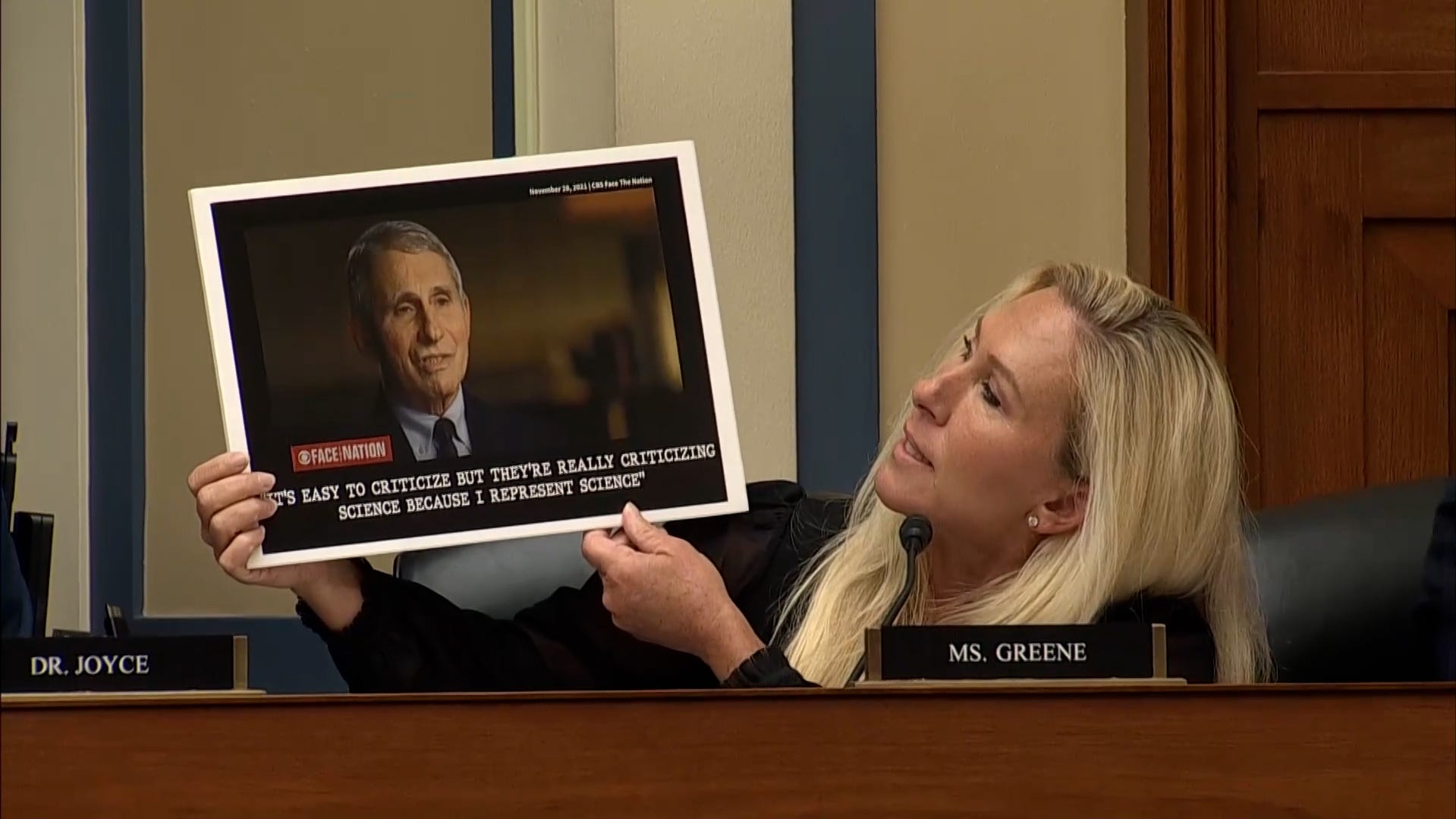
During the hearing, Greene refused to recognize him as a doctor, referring to him instead as “Mr. Fauci.” She questioned Fauci on why the American people “deserve to be abused” by him and said, “You’re not ‘Dr.,” you’re ‘Mr. Fauci’ in my few minutes.”
Fauci told the committee and Collins that he and his family still receive death threats for his role in the nation’s response to the pandemic. He said there’s a pattern with the threats, whether it’s Fox News or “somebody in the Congress” that alleges he is responsible for widespread death from COVID-19.
“So, that’s the reason why I’m still getting death threats, when you have performances like that unusual performance by Marjorie Taylor Greene in today’s hearing,” he said. “Those are the kinds of things that drive up the death threats, because there are a segment of the population out there that believe that kind of nonsense.”
Tags Anthony Fauci COVID COVID-19 pandemic House Oversight and Accountability Select Subcommittee on the Coronavirus Pandemic Kaitlan Collins Marjorie Taylor Greene
Copyright 2024 Nexstar Media Inc. All rights reserved. This material may not be published, broadcast, rewritten, or redistributed.
On June 6, 1944, the British found themselves suddenly and irrevocably overtaken by their former colony.
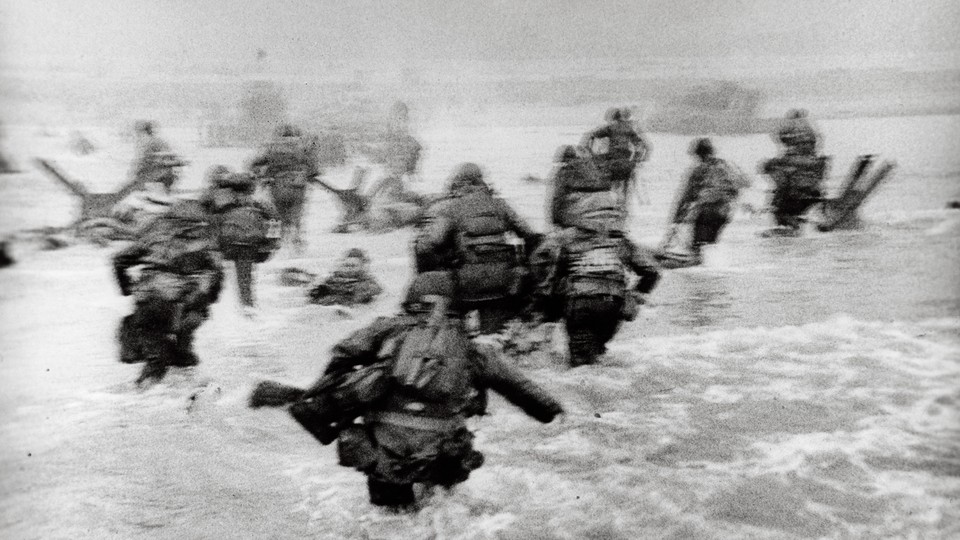
Robert Capa / Magnum

Listen to this article
Produced by ElevenLabs and News Over Audio (NOA) using AI narration.
For most Americans, D-Day remains the most famous battle of World War II. It was not the end of the war against Nazism. At most, it was the beginning of the end. Yet it continues to resonate 80 years later, and not just because it led to Hitler’s defeat. It also signaled the collapse of the European empires and the birth of an American superpower that promised to dedicate its foreign policy to decolonization, democracy, and human rights, rather than its own imperial prestige.
It is easy to forget what a radical break this was. The term superpower was coined in 1944 to describe the anticipated world order that would emerge after the war. Only the British empire was expected to survive as the standard-bearer of imperialism, alongside two very different superpower peers: the Soviet Union and the United States. Within weeks of D-Day, however, the British found themselves suddenly and irrevocably overruled by their former colony.
That result was hardly inevitable. When the British and the Americans formally allied in December 1941, the British empire was unquestionably the senior partner in the relationship. It covered a fifth of the world’s landmass and claimed a quarter of its people. It dominated the air, sea, and financial channels on which most global commerce depended. And the Royal Navy maintained its preeminence, with ports of call on every continent, including Antarctica.
The United States, by contrast, was more of a common market than a nation-state. Its tendency toward isolationism has always been overstated. But its major foreign-policy initiatives had been largely confined to the Western Hemisphere and an almost random collection of colonies (carefully called “territories”), whose strategic significance was—at best—a point of national ambivalence.
In the two years after Pearl Harbor, the British largely dictated the alliance’s strategic direction. In Europe, American proposals to take the fight directly to Germany by invading France were tabled in favor of British initiatives, which had the not-incidental benefit of expanding Britain’s imperial reach across the Mediterranean and containing the Soviet Union (while always ensuring that the Russians had enough support to keep three-quarters of Germany’s army engaged on the Eastern Front).
Things changed, however, in November 1943, when Winston Churchill and Franklin D. Roosevelt held a summit in Cairo. The British again sought to postpone the invasion of France in favor of further operations in the Mediterranean. The debate quickly grew acrimonious. At one point, Churchill refused to concede on his empire’s desire to capture the Italian island of Rhodes. George Marshall, the usually stoic U.S. Army chief of staff, shouted at the prime minister, “Not one American is going to die on that goddamned beach!” Another session was forced to end abruptly after Marshall and his British counterpart, Sir Alan Brooke, nearly came to blows.
With the fate of the free world hanging in the balance, a roomful of 60-year-old men nearly broke out into a brawl because by November 1943, America had changed. It was producing more than twice as many planes and seven times as many ships as the whole British empire. British debt, meanwhile, had ballooned to nearly twice the size of its economy. Most of that debt was owed to the United States, which leveraged its position as Britain’s largest creditor to gain access to outposts across the British empire, from which it built an extraordinary global logistics network of its own.
From the April 2023 issue: The age of American naval dominance is over
Having methodically made their country into at least an equal partner, the Americans insisted on the invasion of France, code-named “Operation Overlord.” The result was a compromise, under which the Allies divided their forces in Europe. The Americans would lead an invasion of France, and the British would take command of the Mediterranean.
Six months later, on June 6, 1944, with the D-Day invasion under way, the British empire verged on collapse. Its economic woes were exacerbated by the 1.5 million Americans, and 6 million tons of American equipment, that had been imported into the British Isles to launch Operation Overlord. Its ports were jammed. Inflation was rampant. Its supply chains and its politics were in shambles. By the end of June 1944, two of Churchill’s ministers were declaring the empire “broke.”
The British continued to wield considerable influence on world affairs, as they do today. But after D-Day, on the battlefields of Europe and in international conference rooms, instead of setting the agenda, the British found themselves having to go along with it.
In July 1944, at the Bretton Woods Conference, the British expectation that global finance would remain headquartered in London and transacted at least partially in pounds was frustrated when the International Monetary Fund and what would become the World Bank were headquartered in Washington and the dollar became the currency of international trade. In August 1944, America succeeded in dashing British designs on the eastern Mediterranean for good in favor of a second invasion of France from the south. In September 1944, the more and more notional British command of Allied ground forces in Europe was formally abandoned. In February 1945, at a summit in Yalta, Churchill had little choice but to acquiesce as the United States and the Soviet Union dictated the core terms of Germany’s surrender, the division of postwar Europe, and the creation of a United Nations organization with a mandate for decolonization.
How did this happen so quickly? Some of the great political historians of the 20th century, such as David Reynolds, Richard Overy, and Paul Kennedy, have chronicled the many political, cultural, and economic reasons World War II would always have sounded the death knell of the European imperial system. Some British historians have more pointedly blamed the Americans for destabilizing the British empire by fomenting the forces of anti-colonialism (what D. Cameron Watt called America’s “moral imperialism”).
Absent from many such accounts is why Britain did not even try to counterbalance America’s rise or use the extraordinary leverage it had before D-Day to win concessions that might have better stabilized its empire. The French did precisely that with far less bargaining power at their disposal, and preserved the major constituents of their own empire for a generation longer than the British did. The warning signs were all there. In 1941, Germany’s leading economics journal predicted the rise of a “Pax Americana” at Britain’s expense. “England will lose its empire,” the article gloatingly predicted, “to its partner across the Atlantic.”
The American defense-policy scholar and Atlantic contributing writer Kori Schake recently made a persuasive case that Britain came to accept the role of junior partner in the Atlantic alliance, rather than seek to balance American power, because the two countries had become socially, politically, and economically alike in all the ways that mattered. Britain, in other words, had more to lose by confrontation. And so it chose friendship.
The argument makes sense to a point, especially given how close the United Kingdom and the United States are today. But the remembered warmth of the “special relationship” in the 1940s is largely a product of nostalgia. British contempt for American racism and conformist consumerism seethed especially hot with the arrival in the U.K. of 1.5 million Americans. And American contempt for the British class system and its reputation for violent imperialism equally made any U.S. investment in the war against Germany—as opposed to Japan—a political liability for Roosevelt.
The British elite had every intention of preserving the British empire and European colonialism more generally. In November 1942, as Anglo-American operations began in North Africa, Churchill assured France that its colonies would be returned and assured his countrymen, “I have not become the King’s First Minister in order to preside over the liquidation of the British Empire.”
The British assumed that America’s rise was compatible with that goal because they grossly miscalculated American intentions. This was on stark display in March 1944, just over two months before D-Day, when Britain’s Foreign Office circulated a memorandum setting out the empire’s “American policy.” Given how naive the Americans were about the ways of the world, it said, Britain should expect them to “follow our lead rather than that we follow theirs.” It was therefore in Britain’s interest to foster America’s rise so that its power could be put to Britain’s use. “They have enormous power, but it is the power of the reservoir behind the dam,” the memo continued. “It must be our purpose not to balance our power against that of America, but to make use of American power for purposes which we regard as good” and to “use the power of the United States to preserve the Commonwealth and the Empire, and, if possible, to support the pacification of Europe.”
It is easy to see why members of Britain’s foreign-policy elite, still warmed by a Victorian afterglow, might discount Americans’ prattling on about decolonization and democracy as empty wartime rhetoric. If anything, they thought, Americans’ pestering insistence on such ideals proved how naive they were. Churchill often grumbled with disdain about Americans’ sentimental affection for—as he put it—the “chinks” and “pigtails” fighting against Japan in China, scornful of the American belief that they could be trusted to govern themselves.
And the face America presented to London might have compounded the misapprehension. Roosevelt was expected to choose George Marshall to be the American commander of Operation Overlord, a position that would create the American equivalent of a Roman proconsul in London. Instead, he picked Dwight Eisenhower.
Roosevelt’s reasons for choosing Eisenhower remain difficult to pin down. The president gave different explanations to different people at different times. But Eisenhower was the ideal choice for America’s proconsul in London and Europe more generally, if the goal was to make a rising American superpower seem benign.
Eisenhower had a bit of cowboy to him, just like in the movies. He was also an Anglophile and took to wearing a British officer’s coat when visiting British troops in the field. He had a natural politician’s instinct for leaving the impression that he agreed with everyone. And he offered the incongruous public image of a four-star general who smiled like he was selling Coca-Cola.
He was also genuinely committed to multilateralism. Eisenhower had studied World War I closely and grew convinced that its many disasters—in both its fighting and its peace—were caused by the Allies’ inability to put aside their own imperial prestige to achieve their common goals. Eisenhower’s commitment to Allied “teamwork,” as he would say with his hokey Kansas geniality, broke radically from the past and seemed hopelessly naive, yet was essential to the success of operations as high-risk and complex as the D-Day invasion.
Eisenhower, for his part, was often quite deft in handling the political nature of his position. He knew that to be effective, to foster that teamwork, he could never be seen as relishing the terrifying economic and military power at his disposal, or the United States’ willingness to use it. “Hell, I don’t have to go around jutting out my chin to show the world how tough I am,” he said privately.
On D-Day, Eisenhower announced the invasion without mentioning the United States once. Instead, he said, the landings were part of the “United Nations’ plan for the liberation of Europe, made in conjunction with our great Russian allies.” While the invasion was under way, Eisenhower scolded subordinates who issued reports on the extent of French territory “captured.” The territory, he chided them, had been “liberated.”
The strategy worked. That fall, with Paris liberated, only 29 percent of French citizens polled felt the United States had “contributed most in the defeat of Germany,” with 61 percent giving credit to the Soviet Union. Yet, when asked where they would like to visit after the war, only 13 percent were eager to celebrate the Soviet Union’s contributions in Russia itself. Forty-three percent said the United States, a country whose Air Force had contributed to the deaths of tens of thousands of French civilians in bombing raids.
In rhetoric and often in reality, the United States has continued to project its power, not as an empire, but on behalf of the “United Nations,” “NATO,” “the free world,” or “mankind.” The interests it claims to vindicate as a superpower have also generally not been its imperial ambition to make America great, but the shared ideals enshrined soon after the war in the UN Charter and the Universal Declaration of Human Rights.
Had the D-Day invasion failed, those ideals would have been discredited. Unable to open the Western Front in France, the Allies would have had no choice but to commit to Britain’s strategy in the Mediterranean. The U.S. military, and by extension the United States, would have lost all credibility. The Soviets would have been the only meaningful rival to German power on the European continent. And there would have been no reason for the international politics of national prestige and imperial interest to become outmoded.
Instead, on D-Day, American soldiers joined by British soldiers and allies from nearly a dozen countries embarked on a treacherous voyage from the seat of the British empire to the shores of the French empire on a crusade that succeeded in liberating the Old World from tyranny. It was a victory for an alliance built around the promise, at least, of broadly shared ideals rather than narrow national interests. That was a radical idea at the time, and it is becoming a contested one today. D-Day continues to resonate as much as it does because, like the battles of Lexington and Concord, it is an almost-too-perfect allegory for a decisive turning point in America’s national story: the moment when it came into its own as a new kind of superpower, one that was willing and able to fight for a freer world.
World News – 2024 – Video Playlist | Video Playlists | Sites: | newsandtimes.org | links-newsandtimes.com | worldwebtimes.com | southcaucasusnews.com | russianworld.net | jossica.com | octobersurprise2016.org | bklyntimes.com | oceanavenuenews.com | fbireform.com | bloggersunite.net | octobersurprise-2024.org | Trump-News.org | Audio-Posts.com | Bklyn-NY.com | Posts Review – newsandtimes.org | Capitol-Riot.com |
The News And Times Review – NewsAndTimes.org