Categories
Saved Web Pages - Audio Posts

Can America’s spy services survive a second Trump presidency?

Donald Trump could turn America’s spy services into weapons of “retribution” against domestic political opponents, skew intelligence findings in favor of authoritarian leaders and undermine information sharing with U.S. allies if he wins a second term, more than a dozen former intelligence officers, Western officials and lawmakers tell NBC News.

Given Trump’s track record during and after his first term, including his public remarks lambasting the intelligence services, his alleged mishandling of classified information, his vows to seek vengeance against his political opponents, and plans by his allies to purge large numbers of career civil servants deemed to be members of a “deep state” cabal, former intelligence officers worry that the spy agencies could suffer irreparable damage.

“I’m very concerned. And I think almost every one of my former colleagues and current colleagues in the intelligence community is very concerned,” said a former national security official who served under Trump. “I haven’t talked to a single senior person who said, ‘Oh, it’s overblown. Don’t worry, he’ll be fine.’”

This article is based on interviews with more than a dozen former intelligence officers — many of whom worked in the Trump administration and had face-to-face meetings with the then-president — as well as Western officials and members of Congress.

There are few legal parameters defining the president’s power over the intelligence agencies, and Trump would have tremendous leeway if he chose to expand the number of political appointees at the Office of the Director of National Intelligence, the CIA and other agencies, according to Glenn Gerstell, who worked as general counsel for the National Security Agency from 2015 to 2020.

When it comes to the president’s authority over the intelligence community, “the law allows for a hell of a lot of discretion” and Trump would have “a pretty free hand,” he said.

“If a determined president, supported by a group of senior aides who will both support and enable him and not object, wishes to do his bidding throughout the entire executive branch, there are few practical limits on his ability to do so, unless Congress has the political will to step in,” Gerstell said. “The law is going to be pushed pretty far before it’s actually going to produce a counterreaction.”

Supporters of Trump say dire warnings about the future of the intelligence community in a possible second term are hysterical and overblown, and that his record at the White House shows that he strengthened the spy agencies.

Brian Hughes, senior adviser to the Trump presidential campaign, said it was President Joe Biden and his administration that had injected partisan politics into the intelligence agencies, not Trump.

“There is rich irony in hearing some of the deepest, deep-state voices sudden concern for the institution of legitimate national security intelligence,” Hughes said in an email. “These are some of the same people who routinely worked to undermine American democracy and push the ‘Russia hoax’ to disrupt an American election. Now to hear them criticize a meaningful discussion focused on ensuring a Constitutionally-based national security pathway, and yet again push patently political lies for the corrupt administration they serve is outrageous.”

The biggest question looming over a possible second Trump administration is whether the president or his team would attempt to turn the intelligence agencies against his domestic political opponents, which would violate laws that expressly forbid using the spy services against Americans.

Perhaps the most notorious example of a president crossing that line is Richard Nixon, whose administration had the CIA gather intelligence on domestic protesters against the Vietnam War. Nixon also tried unsuccessfully to enlist the help of the CIA to quash an FBI investigation into the burglary of the Democratic National Committee headquarters at the Watergate Hotel.

Trump and some of his former deputies have fueled speculation about drastic actions with talk of vengeance against those who they say pose a threat to America’s democracy. Trump said at a rally last year that “for those who have been wronged and betrayed, I am your retribution.” And the former president also has pledged to name a special prosecutor to “go after” Biden and his family.
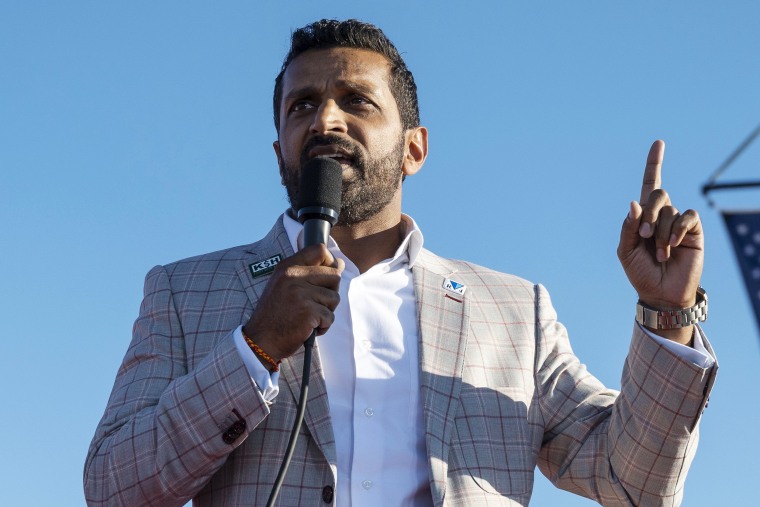
Patel said Tuesday, Dec. 5, 2023, that if the former president is elected again, his administration will retaliate against people in the media "criminally or civilly."Kash Patel speaks at a rally in Nevada on Oct. 8, 2022.José Luis Villegas / AP file

Kash Patel, who worked at the Justice and Defense departments during the Trump administration and who at one point was considered for the post of deputy director of the CIA, said in December that a second Trump administration would “go out and find the conspirators not just in government, but in the media” over the 2020 election. Trump lost the election to Biden, but Patel and Trump insist without evidence that the election was “stolen.”

Trump’s campaign has distanced itself from Patel’s remarks.

Fears among allies

Foreign allies, anxious about keeping their intelligence sources safe, already are worried about the implications of a second Trump term and could discreetly scale back how much information they share with their U.S. counterparts about intelligence gathering methods, former officials and lawmakers said.

The cooperation and trust between the U.S. and allied intelligence agencies have been forged over decades. Washington relies heavily on its foreign intelligence partners to help track terrorist threats, navigate international crises and prepare for possible conflicts. But Trump’s return to the White House could jeopardize those relationships, former officials said.

“I think some of our allies may withhold intelligence information on subjects such as Russia,” said a former career CIA officer who oversaw clandestine operations in Europe. “And they would do it very carefully. They would ratchet it back so it doesn’t look so obvious, for fear of retribution.”

Trump has been accused of having a cavalier attitude to sensitive or secret information, and is facing federal charges that he mishandled classified documents he kept after leaving the White House and then allegedly obstructed the government’s attempt to reclaim them. Prosecutors say Trump took more than 300 classified files to his Mar-a-Lago estate in Florida. The former president has vehemently denied any wrongdoing and called the case an attempt to undermine his re-election bid.

This image, contained in the indictment against former President Donald Trump, shows boxes of records stored in a bathroom and shower in the Lake Room at Trump's Mar-a-Lago estate in Palm Beach, Fla. Trump is facing 37 felony charges related to the mishandling of classified documents according to an indictment unsealed Friday, June 9, 2023. (Justice Department via AP)Boxes of records stored in a bathroom and shower at Trump’s Mar-a-Lago estate in Florida in an image in the federal indictment against former President Donald Trump.Justice Dept. via AP

The allegations about Trump’s mishandling of classified information, and his consistent praise and refusal to condemn Russian President Vladimir Putin, would cause U.S. partners to think twice about relaying intelligence related to Russia, former officials said.

Protecting sources is a bedrock principle for all intelligence work, and no government would be ready to jeopardize that, the former CIA officer said.

“The one thing any intelligence community cares about most is source protection,“ the former officer said. “No ally is ever going to come out and say we’re going to turn off intel sharing, but a friendly service would be remiss if such source protection concerns are not of paramount concern, given Trump’s affinity for Putin.”

James Clapper, former director of national intelligence and former director of the Defense Intelligence Agency, said U.S. allies will be “apprehensive about sharing intelligence revelatory of their sources and methods, particularly if you have somebody that’s obviously pretty careless about protecting security information.”

No more ‘adults’

When Trump entered office in 2017, he arrived without having served in the military or any branch of government.

“As a result, he had no experience handling classified information or working with military, diplomatic, or intelligence programs and operations. Trump had traveled abroad but, by his own account, did not often read,” reads a history of presidential briefings published by the CIA’s Center for the Study of Intelligence.

Having publicly disparaged the intelligence agencies even before he was sworn in, Trump’s relations with the spy services have always been difficult. At times, intelligence officials who delivered analyses that did not fit the White House’s agenda were berated by angry aides, according to two former intelligence officers.

But during Trump’s time at the White House, senior figures in his Cabinet, military and in the intelligence community — dubbed the “adults in the room” — managed to steer him away from what they believed were ill-informed or risky ideas, sometimes by persuading him otherwise or delaying decisions.
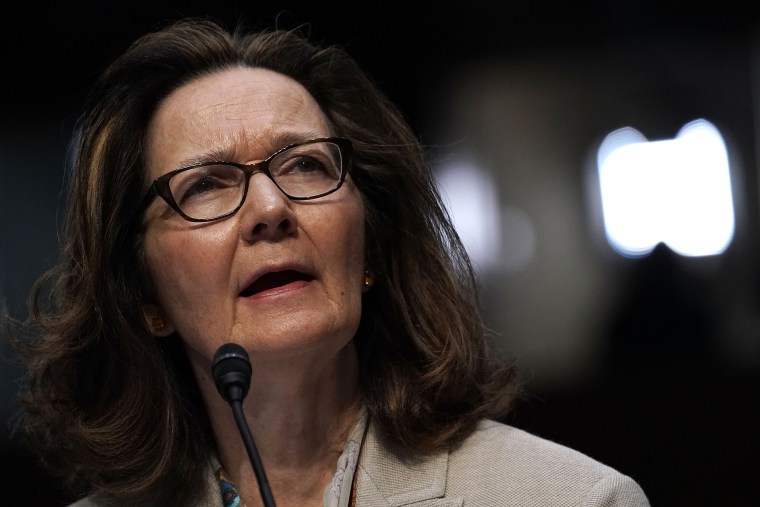
Image: CIA Director Nominee Gina Haspel Testifies At Senate Confirmation HearingGina Haspel speaks during her 2018 confirmation hearing to be CIA director.Alex Wong / Getty Images file

One of them was Gina Haspel, a career intelligence officer who served as CIA director in the tumultuous second half of Trump’s presidential term, from 2018-2021. She helped insulate the spy agency’s workforce from political pressure, according to former intelligence officials.

“She knew how to manage Trump, how to flatter him and how to call in her chips when the moment called for it,” said one former colleague.

Clapper called Haspel “one of the most impactful directors in the history of the agency simply because of how she protected it.”

But a career intelligence officer will likely not get the nod for the director’s job at the CIA in a second Trump presidential term, as Trump has signaled he wants deputies who have demonstrated strong political allegiance to him.
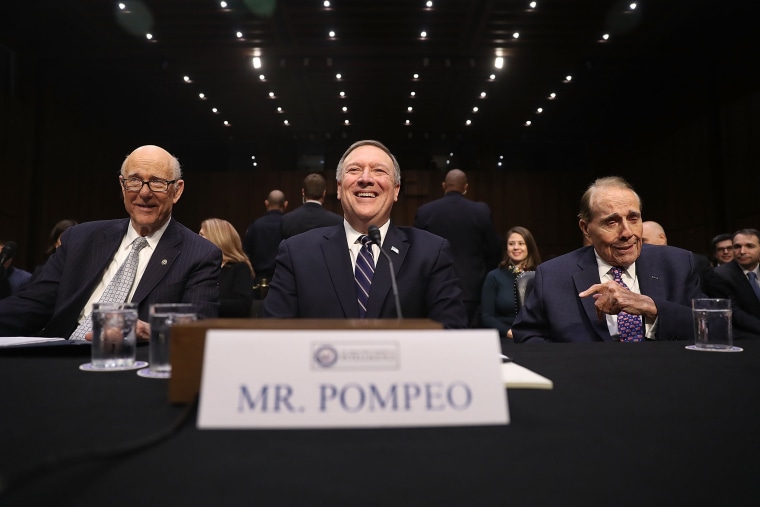
Senate Committee Holds Confirmation Hearing For Rep. Mike Pompeo To Become Director Of C.I.A.Sen. Pat Roberts, R-Kan., Rep. Mike Pompeo, R-Kan., and former Sen. Bob Dole, R-Kan., take their seats during Pompeo’s confirmation hearing to head the CIA in January 2017.Joe Raedle / Getty Images file

Trump’s supporters at the Heritage Foundation think tank and elsewhere are advocating that he shake up the federal bureaucracy by replacing tens of thousands of civil servants with political appointees in government agencies, which would include the 18 federal intelligence agencies. In the closing months of the Trump administration, the White House attempted such an effort with a new executive order but the Biden administration quickly reversed it.

“I think there will be more political appointees, but I don’t know how many more,” said one former official who served in the Trump administration and who is in close contact with Trump’s team.

The former official said it would be reasonable for Trump to assert control over the intelligence community in a second term through political appointees, to ensure the intelligence agencies carry out the president’s policies without bureaucratic subterfuge.

“No matter what side you’re on politically, you should want political control because we don’t want this country to become a security state,” the former official said.

The Heritage Foundation’s proposed outline for action if Trump is elected, titled “Project 2025,” calls for the president-elect to promptly choose a deputy director of the CIA, who would not need Senate confirmation, and could “immediately begin to implement the President’s agenda.”

“Additional appointees should be placed within the agency as needed to assist the Director in supervising its functioning,” the report states.

The document also calls for breaking “the cabal of bureaucrats in D.C.” by moving some directorates in the CIA outside of northern Virginia, where the headquarters is located.

Robert Litt, who served as general counsel for the Office of the Director of National Intelligence from 2009 to 2017, said inserting political appointees into the management of the spy agencies in unprecedented numbers could distort the way intelligence is analyzed and lead to illegal or ill-advised decisions.

“I think it would be a very, very bad thing for the intelligence community and for the nation if the intelligence community was dominated by a group of political loyalists,” he said.

“One is the risk that intelligence analysis will not be called down the middle,” Litt said. “And the other is the risk that the intelligence agencies will be directed to do things that are either unlawful or inappropriate.”

Worst-case scenarios

In a second Trump White House, China would remain the top priority for the intelligence agencies, as it was for the last Trump administration and the current Biden administration, said the former official close to Trump’s team. A mission center at the CIA dedicated to Iran likely would be restored, and a Trump White House would look to cut back on in-house analytical teams within ODNI, the former official said.

The Heritage document, echoing an argument often employed by Trump and his supporters, asserts that former intelligence officials have injected politics into the work of the spy agencies in an attempt to promote the idea that Trump’s campaign in 2016 allegedly colluded with Russia and to play down allegations of possible corruption against Biden’s son Hunter Biden.

The Heritage policy blueprint calls for security clearances to be revoked for any former intelligence officials who “discuss their work in the press or on social media without prior clearance” from the director of national intelligence. It also calls for an “audit” of all cases of “past politicization and abuses of intelligence information.”

Former intelligence officials are divided over whether a worst-case scenario — with the spy services targeting domestic political opponents — could take place, and if it did, how the intelligence workforce and courts would respond. Much will depend on whom Trump names as the leaders of the intelligence agencies and the Justice Department. Former Republican Rep. Devin Nunes, a staunch supporter of Trump who was an outspoken critic of the investigation into possible ties between the Trump campaign and Russia, is seen as a possible candidate for CIA director. John Ratcliffe, the former Texas congressman who served as director of national intelligence under Trump, could be asked to return to the DNI’s job.

One former senior intelligence official said for all its shortcomings, the intelligence community would not be easily converted into a domestic spying service, and that many of the career officers would refuse to follow unlawful orders.

“They would be pretty resistant to turning it on the American people,” the ex-official said.

A more likely scenario could be a steady degradation of the intelligence agencies, in which experienced staff resign or are sacked and morale declines, with unpredictable consequences for intelligence gathering and the country’s national security, the former official said.

Other former officials say Trump has never respected the norms and guardrails meant to safeguard America’s democracy, and that there is no guarantee he won’t venture into Nixonian territory.

“I would not say anything is off the table when it comes to Donald Trump, including the most potentially damaging and egregious violations of practice, if not law itself,” said John Brennan, who served as CIA director under President Barack Obama and is an outspoken critic of Trump.
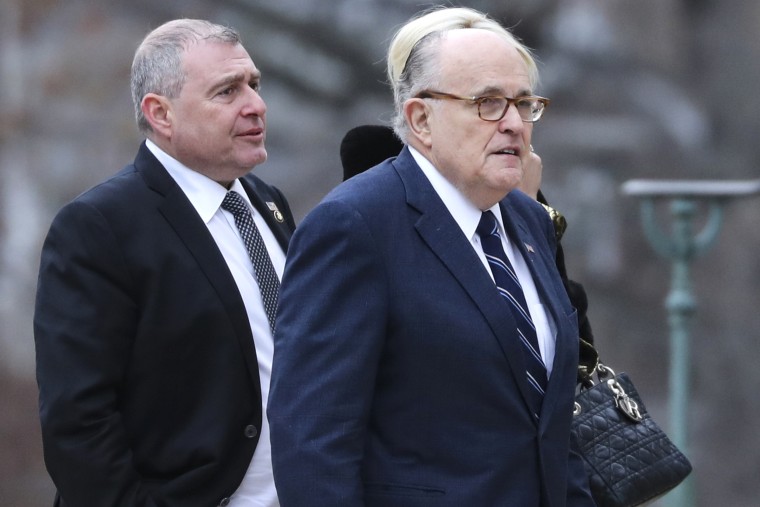
Image: Lev parnas, Rudy GiulianiRudy Giuliani, right, and businessman Lev Parnas, who was Giuliani’s fixer in Ukraine, pictured in Washington, D.C., in 2018.Alex Edelman / AFP via Getty Images file

Former officials point out that Trump sent his personal lawyer, Rudy Giuliani, to Ukraine in a bid to dig up dirt on Biden, his political opponent. Next time, the former officials said, perhaps a similar mission would be handed to the CIA, though presented under the guise of legitimate intelligence gathering.

Miles Taylor, who worked as a senior official at the Department of Homeland Security during the Trump administration, said the secrecy that underpins intelligence work could also enable an administration to hide the true purpose of a particular order and make it extremely difficult for an employee to blow the whistle if they deem it inappropriate.

“A number of people at senior levels are very concerned that they will get asked to do things they consider unethical but not illegal,” Taylor said.

But unlike other parts of the government, there would be “few remedies to sound the alarm” because so much relevant information is classified, said Taylor, who has warned publicly of the risks of a second Trump presidency.

Contemplating a possible second Trump term, many intelligence officers are looking at securing assignments abroad or leaving for the private sector, Taylor said.

“A lot of them are thinking if Trump wins, it’s a really good time to move on,” he said.

Categories
Saved Web Pages - Audio Posts

AI employees warn of technology’s dangers, call for sweeping company changes

4CVDCEZVYSOG5DKYDV57L355RI_size-normaliz

A handful of current and former employees at OpenAI and other prominent artificial intelligence companies warned that the technology poses grave risks to humanity in a Tuesday letter, calling on companies to implement sweeping changes to ensure transparency and foster a culture of public debate.

The letter, signed by 13 people including current and former employees at Anthropic and Google’s DeepMind, said AI can exacerbate inequality, increase misinformation and allow AI systems to become autonomous and cause significant death. Though these risks could be mitigated, corporations in control of the software have “strong financial incentives” to limit oversight, they said.

Because AI is only loosely regulated, accountability rests on company insiders, the employees wrote, calling on corporations to lift nondisclosure agreements and give workers protections that allow them to anonymously raise concerns.

The move comes as OpenAI faces a staff exodus. Many critics have seen prominent departures — including OpenAI co-founder Ilya Sutskever and senior researcher Jan Leike — as a rebuke of company leaders, who some employees argue chase profit at the expense of making OpenAI’s technologies safer.

Daniel Kokotajlo, a former employee at OpenAI, said he left the start-up because of the company’s disregard for the risks of artificial intelligence.

“I lost hope that they would act responsibly, particularly as they pursue artificial general intelligence,” he said in a statement, referencing a hotly contested term referring to computers matching the power of human brains.

“They and others have bought into the ‘move fast and break things’ approach, and that is the opposite of what is needed for technology this powerful and this poorly understood.”

Liz Bourgeois, a spokesperson at OpenAI, said the company agrees that “rigorous debate is crucial given the significance of this technology.” Representatives from Anthropic and Google did not immediately reply to a request for comment.

The employees said that absent government oversight, AI workers are the “few people” who can hold corporations accountable. They noted that they are hamstrung by “broad confidentiality agreements” and that ordinary whistleblower protections are “insufficient” because they focus on illegal activity, and the risks that they are warning about are not yet regulated.

The letter called for AI companies to commit to four principles to allow for greater transparency and whistleblower protections. Those principles include a commitment to not enter into or enforce agreements that prohibit criticism of risks; a call to establish an anonymous process for current and former employees to raise concerns; supporting a culture of criticism; and a promise to not retaliate against current and former employees who share confidential information to raise alarms “after other processes have failed.”

The Washington Post in December reported that senior leaders at OpenAI raised fears about retaliation from CEO Sam Altman — warnings that preceded the chief’s temporary ousting. In a recent podcast interview, former OpenAI board member Helen Toner said part of the nonprofit’s decision to remove Altman as CEO late last year was his lack of candid communication about safety.

“He gave us inaccurate information about the small number of formal safety processes that the company did have in place, meaning that it was basically just impossible for the board to know how well those safety processes were working,” she told “The TED AI Show” in May.

The letter was endorsed by AI luminaries including Yoshua Bengio and Geoffrey Hinton, who are considered “godfathers” of AI, and renowned computer scientist Stuart Russell.

Categories
Saved Web Pages - Audio Posts

OpenAI Insiders Warn of a ‘Reckless’ Race for Dominance

Daniel Kokotajlo, wearing a cap, stands outside with his arms crossed.

Daniel Kokotajlo, a former researcher in OpenAI’s governance division, is an organizer of a group of former and current employees who say the company has a reckless culture.Credit…Jason Andrew for The New York Times

The Shift

A group of current and former employees are calling for sweeping changes to the artificial intelligence industry, including greater transparency and protections for whistle-blowers.

Daniel Kokotajlo, a former researcher in OpenAI’s governance division, is an organizer of a group of former and current employees who say the company has a reckless culture.Credit…Jason Andrew for The New York Times

Listen to this article · 10:10 min Learn more

A group of OpenAI insiders is blowing the whistle on what they say is a culture of recklessness and secrecy at the San Francisco artificial intelligence company, which is racing to build the most powerful A.I. systems ever created.

The group, which includes nine current and former OpenAI employees, has rallied in recent days around shared concerns that the company has not done enough to prevent its A.I. systems from becoming dangerous.

The members say OpenAI, which started as a nonprofit research lab and burst into public view with the 2022 release of ChatGPT, is putting a priority on profits and growth as it tries to build artificial general intelligence, or A.G.I., the industry term for a computer program capable of doing anything a human can.

They also claim that OpenAI has used hardball tactics to prevent workers from voicing their concerns about the technology, including restrictive nondisparagement agreements that departing employees were asked to sign.

“OpenAI is really excited about building A.G.I., and they are recklessly racing to be the first there,” said Daniel Kokotajlo, a former researcher in OpenAI’s governance division and one of the group’s organizers.

The group published an open letter on Tuesday calling for leading A.I. companies, including OpenAI, to establish greater transparency and more protections for whistle-blowers.

Other members include William Saunders, a research engineer who left OpenAI in February, and three other former OpenAI employees: Carroll Wainwright, Jacob Hilton and Daniel Ziegler. Several current OpenAI employees endorsed the letter anonymously because they feared retaliation from the company, Mr. Kokotajlo said. One current and one former employee of Google DeepMind, Google’s central A.I. lab, also signed.

A spokeswoman for OpenAI, Lindsey Held, said in a statement: “We’re proud of our track record providing the most capable and safest A.I. systems and believe in our scientific approach to addressing risk. We agree that rigorous debate is crucial given the significance of this technology, and we’ll continue to engage with governments, civil society and other communities around the world.”

A Google spokesman declined to comment.

The campaign comes at a rough moment for OpenAI. It is still recovering from an attempted coup last year, when members of the company’s board voted to fire Sam Altman, the chief executive, over concerns about his candor. Mr. Altman was brought back days later, and the board was remade with new members.

The company also faces legal battles with content creators who have accused it of stealing copyrighted works to train its models. (The New York Times sued OpenAI and its partner, Microsoft, for copyright infringement last year.) And its recent unveiling of a hyper-realistic voice assistant was marred by a public spat with the Hollywood actress Scarlett Johansson, who claimed that OpenAI had imitated her voice without permission.

But nothing has stuck like the charge that OpenAI has been too cavalier about safety.

Last month, two senior A.I. researchers — Ilya Sutskever and Jan Leike — left OpenAI under a cloud. Dr. Sutskever, who had been on OpenAI’s board and voted to fire Mr. Altman, had raised alarms about the potential risks of powerful A.I. systems. His departure was seen by some safety-minded employees as a setback.

So was the departure of Dr. Leike, who along with Dr. Sutskever had led OpenAI’s “superalignment” team, which focused on managing the risks of powerful A.I. models. In a series of public posts announcing his departure, Dr. Leike said he believed that “safety culture and processes have taken a back seat to shiny products.”

Neither Dr. Sutskever nor Dr. Leike signed the open letter written by former employees. But their exits galvanized other former OpenAI employees to speak out.

“When I signed up for OpenAI, I did not sign up for this attitude of ‘Let’s put things out into the world and see what happens and fix them afterward,’” Mr. Saunders said.

Some of the former employees have ties to effective altruism, a utilitarian-inspired movement that has become concerned in recent years with preventing existential threats from A.I. Critics have accused the movement of promoting doomsday scenarios about the technology, such as the notion that an out-of-control A.I. system could take over and wipe out humanity.

ImageIlya Sutskever, wearing a blue V-neck T-shirt, sits on a padded bench with his hands folded in his lap.

Ilya Sutskever, an OpenAI founder and former chief scientist, recently left the company. He had been on the company’s board and had voted to oust Sam Altman, the chief executive, last year.Credit…Jim Wilson/The New York Times

Mr. Kokotajlo, 31, joined OpenAI in 2022 as a governance researcher and was asked to forecast A.I. progress. He was not, to put it mildly, optimistic.

In his previous job at an A.I. safety organization, he predicted that A.G.I. might arrive in 2050. But after seeing how quickly A.I. was improving, he shortened his timelines. Now he believes there is a 50 percent chance that A.G.I. will arrive by 2027 — in just three years.

He also believes that the probability that advanced A.I. will destroy or catastrophically harm humanity — a grim statistic often shortened to “p(doom)” in A.I. circles — is 70 percent.

At OpenAI, Mr. Kokotajlo saw that even though the company had safety protocols in place — including a joint effort with Microsoft known as the “deployment safety board,” which was supposed to review new models for major risks before they were publicly released — they rarely seemed to slow anything down.

For example, he said, in 2022 Microsoft began quietly testing in India a new version of its Bing search engine that some OpenAI employees believed contained a then-unreleased version of GPT-4, OpenAI’s state-of-the-art large language model. Mr. Kokotajlo said he was told that Microsoft had not gotten the safety board’s approval before testing the new model, and after the board learned of the tests — via a series of reports that Bing was acting strangely toward users — it did nothing to stop Microsoft from rolling it out more broadly.

A Microsoft spokesman, Frank Shaw, disputed those claims. He said the India tests hadn’t used GPT-4 or any OpenAI models. The first time Microsoft released technology based on GPT-4 was in early 2023, he said, and it was reviewed and approved by a predecessor to the safety board.

Eventually, Mr. Kokotajlo said, he became so worried that, last year, he told Mr. Altman that the company should “pivot to safety” and spend more time and resources guarding against A.I.’s risks rather than charging ahead to improve its models. He said that Mr. Altman had claimed to agree with him, but that nothing much changed.

In April, he quit. In an email to his team, he said he was leaving because he had “lost confidence that OpenAI will behave responsibly” as its systems approach human-level intelligence.

“The world isn’t ready, and we aren’t ready,” Mr. Kokotajlo wrote. “And I’m concerned we are rushing forward regardless and rationalizing our actions.”

OpenAI said last week that it had begun training a new flagship A.I. model, and that it was forming a new safety and security committee to explore the risks associated with the new model and other future technologies.

On his way out, Mr. Kokotajlo refused to sign OpenAI’s standard paperwork for departing employees, which included a strict nondisparagement clause barring them from saying negative things about the company, or else risk having their vested equity taken away.

Many employees could lose out on millions of dollars if they refused to sign. Mr. Kokotajlo’s vested equity was worth roughly $1.7 million, he said, which amounted to the vast majority of his net worth, and he was prepared to forfeit all of it.

(A minor firestorm ensued last month after Vox reported news of these agreements. In response, OpenAI claimed that it had never clawed back vested equity from former employees, and would not do so. Mr. Altman said he was “genuinely embarrassed” not to have known about the agreements, and the company said it would remove nondisparagement clauses from its standard paperwork and release former employees from their agreements.)

In their open letter, Mr. Kokotajlo and the other former OpenAI employees call for an end to using nondisparagement and nondisclosure agreements at OpenAI and other A.I. companies.

“Broad confidentiality agreements block us from voicing our concerns, except to the very companies that may be failing to address these issues,” they write.

They also call for A.I. companies to “support a culture of open criticism” and establish a reporting process for employees to anonymously raise safety-related concerns.

They have retained a pro bono lawyer, Lawrence Lessig, the prominent legal scholar and activist. Mr. Lessig also advised Frances Haugen, a former Facebook employee who became a whistle-blower and accused that company of putting profits ahead of safety.

In an interview, Mr. Lessig said that while traditional whistle-blower protections typically applied to reports of illegal activity, it was important for employees of A.I. companies to be able to discuss risks and potential harms freely, given the technology’s importance.

“Employees are an important line of safety defense, and if they can’t speak freely without retribution, that channel’s going to be shut down,” he said.

Ms. Held, the OpenAI spokeswoman, said the company had “avenues for employees to express their concerns,” including an anonymous integrity hotline.

Mr. Kokotajlo and his group are skeptical that self-regulation alone will be enough to prepare for a world with more powerful A.I. systems. So they are calling for lawmakers to regulate the industry, too.

“There needs to be some sort of democratically accountable, transparent governance structure in charge of this process,” Mr. Kokotajlo said. “Instead of just a couple of different private companies racing with each other, and keeping it all secret.”

Categories
Saved Web Pages - Audio Posts

Biden expected to unveil immigration order severely limiting asylum-seeker crossings

gettyimages-2126142079.jpg?c=16x9&q=w_80

President Joe Biden is expected to announce an executive order as early as Tuesday that would effectively shut down the US-Mexico border to asylum-seekers crossing illegally when a daily threshold of crossings is exceeded – a sweeping and controversial proposal that is likely to receive fierce pushback from progressives and immigration advocates.

The executive action, described to CNN by multiple people briefed on the order, would mark a significant attempt by Biden to address head on one of his biggest political vulnerabilities, just weeks before the first presidential debate with former President Donald Trump. Trump has made hard-line immigration policies a cornerstone of his campaign.

The executive order uses an authority known as “212(f)” – a regulation used under the Trump administration and widely denounced at the time by Democrats.

The executive action, which has been in the works for months, would severely restrict migrants from seeking asylum at the US southern border if they crossed the border unlawfully once daily encounters between ports of entry reached 2,500, meaning that the measure is likely to almost immediately take effect. Migrants could still request an appointment to present their asylum claim at a port of entry.

Unaccompanied children would be exempt – a key piece of the executive order that would worry immigration advocates who have said such an exemption could encourage some families to send children to the border on their own.

The executive action would allow authorities to turn away migrants while in effect either to Mexico or their origin country. The US previously worked with Mexico when a Covid-19-era border restriction, known as Title 42, also resulted in certain migrants being returned to Mexico.

Sources who described the order to CNN cautioned that changes could still be made to the text before it was expected to be publicly unveiled this week.

The action would mark a significant policy shift for the Biden administration, which has taken a more aggressive approach to border security after years of grappling with border crises fueled by record migration as it has attempted to blunt Republican attacks during a heated election year.

Trump campaign spokeswoman Karoline Leavitt slammed Biden’s expected order on Tuesday, saying the president is “controlled by radical left Democrats.” Trump sought to use a similar authority to clamp down on border crossings while in office, but was ultimately blocked by a federal appeals court.

Border authorities have recently been apprehending just under 4,000 migrants unlawfully crossing the border, according to a Homeland Security official, and there have been roughly 1,500 appointments per day through the US Customs and Border Protection mobile app.

Under the executive order, the border would reopen once daily illegal crossings drop, according to one of the sources.

Senior White House officials, including chief of staff Jeff Zients, have been calling lawmakers and other stakeholders over the weekend to brief them on the plans, according to two sources familiar with the discussions.

CNN first reported that the White House began outreach to border mayors to have them attend the announcement.

Edinburg Mayor Ramiro Garza confirmed to CNN that the administration contacted him on Saturday to attend a Tuesday event at the White House. Brownsville Mayor John Cowen said he was invited as well and will attend. Harlingen Mayor Norma Sepulveda and Laredo Mayor Dr. Victor D. Trevino have also confirmed that they are expected to attend the event. McAllen Mayor Javier Villalobos also said he was invited but will be unable to attend.

CNN’s Camila DeChalus contributed to this report.

Categories
Saved Web Pages - Audio Posts

New study tallies excess physician deaths during early pandemic

2018-11-19-GENERICSOCIAL.jpg

When the COVID-19 pandemic began, the world was caught off guard and left unprepared with how to handle this novel infection. As a result, it exacted a toll many would never have imagined possible. COVID-19 has killed nearly 1.1 million people in the U.S., according to the Centers for Disease Control and Prevention’s data tracker. Yet despite the essential role of physicians in the pandemic response, little has been known about excess mortality among doctors, according to a research letter published in JAMA Internal Medicine.

For the study, “Excess Mortality Among Physicians During The COVID-19 Pandemic,” researchers from Stanford University School of Medicine and the University of Southern California, Los Angeles used data from the AMA Masterfile and the corresponding Deceased Physician File to calculate excess deaths from March 2020 through December 2021 among U.S. physicians 45–84 years old.

All told, 4,511 physicians died during this early phase of COVID-19—622 more deaths than would have occurred had the pandemic not happened.

Excess physician deaths peaked at 70 in December 2020 among all active physicians, followed by a rapid drop in 2021 when safe and effective vaccines became available. No excess deaths among physicians occurred after April 2021, which coincided with the widespread availability of COVID-19 vaccines, meaning that nearly 50 U.S. doctors more than expected died each month during this phase of the pandemic.

“Measuring excess mortality allows us a partial view of the collateral damage caused by the pandemic,” said Lindsey Carlasare, research and policy manager for the AMA and an author on the research letter along with Kirsten Bibbins-Domingo, MD, PhD, MAS, editor-in-chief of JAMA® and JAMA Network..

“Beyond the deaths directly attributable to the virus, we see the extended impact by quantifying the number of physicians deceased beyond what would have been expected under normal circumstances,” Carlasare said.

Physicians who provided direct patient care during the pandemic had excess deaths per 100,000 person-years of 10 in the youngest group and 182 in the oldest group. Nonactive physicians had the highest excess death per 100,000 person-years compared with doctors who provided direct and nondirect patient care. This was still a substantially lower excess mortality rate than what was experienced in the general population.  

“The huge rate of excess mortality among the general population compared to physicians—even ones who are not actively practicing and therefore not at a higher risk of being exposed to SARS-CoV-2—shows how much better we could have done in our response during the pandemic,” said Mathew Kiang, ScD, MPH, lead author and assistant professor in the Department of Epidemiology and Population Health at Stanford University School of Medicine.

Yet, Kiang noted, “despite higher workplace protections, there were still excess deaths among physicians, and we need to think about how we can protect front line workers in the future.”

Subscribe for insights and real-world solutions delivered straight to your inbox.

Active physicians had lower excess death rates than nonactive doctors and the general population despite having higher risk for contracting SARS-CoV-2 infection throughout the pandemic.

What this suggests is that personal protective equipment (PPE) use along with vaccine requirements, infection-prevention protocols and other workplace-based protective measures were vital for preventing excess mortality among physicians.

“Our findings demonstrate not only the tragedy that is the hundreds of physicians deceased due to COVID-19, but it also adds to the body of evidence showing that reasonable measures, such as providing adequate access to PPE, infection-prevention protocols and better staffing are integral in preventing excess mortality,” Carlasare said.

Younger physicians were excluded from the study because they experienced fewer than five deaths a month during the study period. Of the excess physician deaths, 65.3% were men and 34.7% were women, the study says. While excess mortality among physicians was lower than in the general population, doctors still faced another battle. During the first year of the pandemic, physicians in the U.S. saw a rise in workplace stress while trying to make sense of COVID-19. They also experienced higher rates of burnout.

Categories
Saved Web Pages - Audio Posts

California’s Chilling Attempt To Muzzle Physician Speech

istock-1215063159.jpg?itok=Ao94rPuC

Last fall, Gavin Newsom signed into law a bizarre and disturbing requirement that would charge California physicians with professional misconduct and possible loss of their license if they were to question the medical community’s consensus opinions regarding COVID-19. The motivation for this law was the assertion that healthcare providers were some of the most dangerous propagators of “misinformation” and “disinformation” about COVID. No source other than “major news outlets” was credited for the impetus for creating a new law that effectively muzzled physicians from expressing any opinion that didn’t parrot back what government wanted them to say.

But like so many California laws, AB 2098 is vague, poorly written, and represents gross government overreach. Just how badly was it written? The law requires that physicians disseminate no information outside of “contemporary scientific consensus.” However, the law provides no definition for this term, which in any case is almost indefinable during a rapidly evolving health crisis when research findings, interpretations, and opinions change quickly and significantly.

This suggests that the law violates the due process rights of physicians, because it does not provide a specific standard that physicians can reference when trying to abide by the law. And the fact that the law conflates physicians’ speech with their conduct suggests it also violates their First Amendment rights. As it is written, there is nothing within the law to prevent the California state government from initiating a professional misconduct case against any physician if it doesn’t like what the physician is alleged to have said or written about COVID.

But the harm of this law goes beyond its chilling constitutional infringements on physicians. Questioning the status quo is the foundation of all scientific inquiry, and muzzling that effort would substantially retard medical progress and leave in place potentially harmful medical orthodoxy. Consider the long-standing consensus regarding heart disease and diet. For decades, the American medical community recommended a low-fat diet to combat a supposed new epidemic of heart disease, basing its advise on research conducted by Ancel Keys, an epidemiologist at the University of Minnesota. Keys studied data from seven countries in the 1950s and 1960s and concluded that such a dietary change would significantly reduce heart disease.

This diet recommendation was accepted as consensus scientific knowledge and was widely recommended to Americans. But the diet was flawed; clinical trials continued to provide no evidence in support of low-fat diets. It took years of research effort and pushback to overturn a diet dogma that was, according to some researchers, actually contributing to mortality and declining health. The first clue was that the incidence of coronary disease, and coronary disease deaths, in the US actually rose in the wake of this diet consensus. Subsequent research has found a range of factors for understanding coronary disease risk, including obesity, high blood pressure, rising consumption of refined sugar and other processed foods, the importance of aerobic exercise, and a more nuanced interpretation of blood cholesterol levels.  

The recommendation for the original diet—one that became consensus—was premature. Keys included only six countries in his original study out of a possible 22 countries that could have been studied. France, a country where people consume a diet high in saturated fat but have a relatively low incidence of heart disease, was excluded, and some researchers believe it was omitted because data from France would not have supported Keys’s hypothesis.

It wasn’t until after one of Keys’s collaborators passed away, around 10 years ago, that unpublished research performed by the two men in the late 1960s and early 1970s was discovered in his home—research that in fact refuted their diet recommendation. Imagine the continued harmful effects—sometimes fatal—had medical professionals not felt able to question this “scientific contemporary consensus.”

Shortly after California’s law took effect last year, a lawsuit was filed by a few California physicians, and a district court judge issued a preliminary injunction against its implementation. Late last month, a motion for summary judgment was made to permanently block the law from taking effect.

Just two days after the motion for summary judgment was submitted, Gavin Newsom signed Assembly Bill 815, which reauthorizes California’s medical board. This is noteworthy because within AB 815 is a clause that eliminates AB 2098. Just like that, the people who wanted to muzzle California physicians eliminate the law once it becomes increasingly apparent they are going to lose in court. And no one—not Newsom, not State Senator Richard Roth, the author of AB 815, not anyone within government—has said anything about the mystery clause that deletes AB 2098.

Roth indicates he has no idea where the clause eliminating AB 2098 came from. He noted that it may have come through committee leadership or the governor’s office, but at the end of the day, it just seemed to have appeared in the new bill.

The stealth elimination of the AB 2098 is disturbing, because it means the government is unwilling to acknowledge that it was terrible legislation that would have trampled individual constitutional rights. To understand the danger of the legislation, note that the bill stated, “It shall constitute unprofessional conduct for a physician and surgeon to disseminate misinformation or disinformation related to COVID-19, including false or misleading information regarding the nature and risks of the virus, its prevention and treatment; and the development, safety, and effectiveness of COVID-19 vaccines.”

The statement is patently clear, but it seemed to mean something remarkably different to Gavin Newsom when he signed the original legislation in 2022, when he argued that it would “apply only to those egregious instances in which a licensee is acting with malicious intent or clearly deviating from the required standard of care while interacting directly with a patient under their care.”

I have no idea how one can interpret the bill’s language in the way that Newsom did, and we will never know, because as of now, it is as if AB 2098 never existed. If it weren’t for a handful of physicians who fought for their rights, AB 2098 would very much exist today. And it would be applied according to the text of the bill, not what Newsom advertised when he signed it.

Categories
Saved Web Pages - Audio Posts

Number of Russian spies in US remains ‘way too big,’ says FBI director

Skip to content

FBI Director Christopher Wray testifies before a House Committee on the Judiciary oversight hearing, Wednesday, July 12, 2023, on Capitol Hill in Washington. (AP Photo/Patrick Semansky)

FBI Director Christopher Wray said Thursday the number of Russian spies in the U.S. remains “way too big” despite recent efforts to root them out.

“The Russian traditional counterintelligence threat continues to loom large,” Wray said at an event at the International Spy Museum. 

“The Russian intelligence footprint — and by that, I mean Russian intelligence officers — is still way too big in the United States,” he added. “And it’s something that we’re constantly bumping up against and trying to block and prevent and disrupt in every way we can.”

While Wray emphasized the U.S. has made “very positive, significant strides” on the issue in recent years, he also said they remain mindful of Moscow’s “disproportionately large” footprint in the U.S., and the interests those individuals are advancing.

“If anybody needs a reminder of what Russia’s interests are, you can just look at what’s going on in Ukraine,” he said. “And so, we never lose sight of the fact that these are the same people that are involved in unconscionable activity and aggression in Ukraine.”

He noted Russia is also now using cut-outs, or individuals who act as intermediaries between agents, as part of its intelligence operations. Wray pointed to the case of Hector Alejandro Cabrera Fuentes, a Mexican national who was arrested by U.S. authorities in 2020 for spying on behalf of Moscow.

Tags Christopher Wray FBI russia Russian spies

Copyright 2024 Nexstar Media Inc. All rights reserved. This material may not be published, broadcast, rewritten, or redistributed.

Categories
Saved Web Pages - Audio Posts

Ukraine War Sparks US Intelligence Recruitment of Disgruntled Kremlin Insiders

Russia’s ongoing invasion of Ukraine has presented US intelligence services with a unique opportunity to target Kremlin insiders dissatisfied with the handling of the war for recruitment, as reported by CCN.

“Disaffection creates a once-in-a-generation opportunity for us. We’re very much open for business,” CIA Director Bill Burns said during a speech in the United Kingdom last year.

Follow our coverage of the war on the @Kyivpost_official.

David McCloskey, a former CIA officer, said, “That business is the exchange of information that the asset or agent would provide for something that they want.”

“We want people who have some sense of what [Russian] leaders’ priorities are – what they’re trying to accomplish,” he added.

According to CNN’s report, the recruitment effort is not a secret. The CIA has released Russian-language videos on social media, appealing to the patriotism of disaffected Russians with access to valuable information.

These posts include step-by-step instructions for potential informants on how to avoid detection by Russian security services using virtual private networks (VPNs) and the Tor web browser to contact the agency anonymously and securely on the Dark Web, the report disclosed.

The FBI has launched a similar initiative to recruit Russian government sources working in the US, including geographic targeted social media ads aimed at phones located near Russia’s embassy in Washington.

Moscow Minister Implies Peace Possible Only If Kremlin Keeps Invaded Territories

Kremlin Foreign Minister Sergey Lavrov’s statement reiterates Russian rhetoric that Moscow is open to peace talks but only under conditions Kyiv considers unacceptable.

“This direct appeal is an unusual approach, but one which could prove effective in reaching a Russian populace with few options to express their discontent,” said Douglas London, a former CIA station chief.

London suggested that Russians who are angry with the Kremlin’s state-sanctioned corruption and abuse and have no way to act openly, are left with few alternatives other than seeking external support.

Over 30 years after the dissolution of the Soviet Union, the world entered a new period of superpower conflict. CNN’s chief national security analyst, Jim Sciutto, describes it as “a definitive break between the post-Cold War era and an entirely new and uncertain one” in his latest book.

As during the Cold War era, espionage remains a vital tool for both sides. Tech-savvy US intelligence officers are openly attempting to recruit new assets, while Russian-linked operatives reportedly increase operations across Europe.

Russian spymasters bribed German politicians to make anti-Ukraine statements and to buy pro-Kremlin votes in the European Parliament, a major Prague news platform reported, citing intelligence from the Czech national intelligence agency BIS.

The Denik N newspaper revealed that Czech counterintelligence uncovered a network of Kremlin agents and local operatives paying anti-government politicians from at least six EU member states to influence European Parliament votes in favor of Russia.

The operation also funded a major pro-Russian news website, which produced content praising Moscow and spreading negative propaganda about Ukraine, marking one of the largest exposed Russian influence operations in recent years.

Hungarian news outlet VSquare reported that around 100 of the 252 Russian spies in Austria work as diplomats, with many more possibly using civilian cover. This information, shared by an unnamed intelligence chief from a Central European country, was revealed in a closed-door meeting with officials.

In February, it was reported that Ireland refused to renew visas for several Russian diplomats over espionage concerns.


Page 2

Kyiv Post

The Kyiv Post is Ukraine’s English-language newspaper and proud winner of the 2014 Missouri Honor Medal for Distinguished Service in Journalism. The newspaper’s first print edition came out on Oct. 18, 1995, and went online in 1997.

Categories
Saved Web Pages - Audio Posts

Russia’s nuclear threats are losing their power

https%3A%2F%2Fwww.ft.com%2F__origami%2Fs

Unlock the US Election Countdown newsletter for free

The stories that matter on money and politics in the race for the White House

Russia is once again waving around its nuclear weapons. Last week, Vladimir Putin warned Nato countries against allowing Ukraine to use western munitions to strike Russia. The Russian leader warned of “serious consequences” and said that Ukraine’s allies should be aware of the “small territory” and “dense population” of many European countries.

In case this was too vague, Dmitry Medvedev followed up with a more blood-curdling threat. Russia’s former president cited Putin’s words and added: “The use of tactical nuclear weapons can also be miscalculated. This would be a fatal mistake.”

Medvedev has a reputation as a man who is fond of strong drink. But Moscow has also taken actions recently to underline its threats, with Russian troops conducting nuclear drills near the border with Ukraine.

These moves have not deterred several Nato nations, including the US, from taking the latest step up the escalation ladder by approving the use of their weapons inside Russian borders.

This latest move by Nato nations reflects a mix of confidence and nervousness. On the positive side, the US and its European allies are now less concerned about the threat that Russia will go nuclear than they were 18 months ago.

On the negative side, they are also increasingly uneasy about the situation on the battlefield. The new willingness to allow Ukraine to strike back at enemy artillery positions and missile bases — even if they are inside Russia itself — reflects a concern that Ukraine is gradually losing the war. As a result, Kyiv’s western backers feel compelled to tolerate a greater level of risk to keep Ukraine in the fight.

The west’s willingness to take on this level of risk represents a dramatic shift in thinking since Russia’s full-scale invasion in February 2022. Back then, Nato countries were nervous about providing Ukraine with any offensive weapons.

The provision of each new significant capability to Kyiv — long-range missiles, tanks, fighter jets — has been accompanied by prolonged, sometimes agonised, debate in the west and by nuclear threats from Russia. But each time the Nato countries have crossed a threshold, the Kremlin has failed to make good on its nuclear threats. And that has made it easier for the western alliance to take the next step.

But the fact that the US and its allies are no longer quite so anxious about Russia’s nuclear posturing does not mean that they dismiss the threat completely. Indeed, there are some western officials who remain very uneasy about the potential for escalation involved in authorising the use of weapons, provided by the west, to strike Russian territory.

Their concern is that Russia will regard this latest step as the escalation of a proxy war by the west and could make what it regards as a symmetrical response — involving counterstrikes on Nato territory. That might lead Russia and Nato very close to the direct conflict that western leaders have always sought to avoid. Russian military doctrine is believed to assume that Moscow cannot prevail in a conventional war with the west, and so to envisage the early use of nuclear weapons.

Despite talk by Emmanuel Macron, France’s president, of eventually stationing French troops on Ukrainian soil, the western alliance is still trying to maintain its clear red line against direct involvement in a conflict with Russia.

When Iran recently loosed off a barrage of missiles at Israel, the US and its allies got directly involved in shooting them down. Ukraine has received no such support against Russian missile assaults on cities and infrastructure — partly because of the risk that western air forces might end up shooting directly at Russian forces.

Even now, the US has put significant restrictions on how far Ukraine can go in striking back against Russian forces with US-provided weapons. The new policy is that Ukraine is free to strike at Russian forces that are firing into Ukraine from just across the border. But strikes at targets deep inside Russian territory are still off the table.

Despite the concerns about Russia’s potential response to this latest move, US decision makers still think that the circumstances that could trigger a Russian nuclear response are fairly distant. The two situations that are most often mentioned are if the Russian army is about to be routed on the battlefield; or if Ukrainian ground forces threaten Crimea, which Russia formally annexed in 2014.

The closest that the world has come to a real nuclear crisis over Ukraine, so far, was in October 2022 — when Russia suffered a series of catastrophic setbacks in the war, including the loss of Kherson. There was one weekend when western officials became seriously concerned that Russia might be on the point of going nuclear.

But that crisis also created a new playbook for how to deal with Russian nuclear threats, when they look really serious. Step one is to talk to Russian counterparts and to threaten direct and massive western involvement in the conflict. Step two is to talk to other major powers — in particular, China and India — and to get them to warn Russia off, preferably in public.

For the moment, this playbook is back in the desk drawer. But it may have to be brought into operation once again before the war in Ukraine comes to an end — one way or another.

gideon.rachman@ft.com

Categories
Saved Web Pages - Audio Posts

Fauci pushes back partisan attacks in fiery House hearing over COVID origins and controversies

?url=https%3A%2F%2Fassets.apnews.com%2F8

Fauci testifies publicly before House panel on COVID origins, controversies

Photos

Updated [hour]:[minute] [AMPM] [timezone], [monthFull] [day], [year]  

WASHINGTON (AP) — Dr. Anthony Fauci, the top U.S. infectious disease expert until leaving the government in 2022, was back before Congress on Monday, calling “simply preposterous” Republican allegations that he’d tried to cover up origins of the COVID-19 pandemic.

A GOP-led subcommittee has spent over a year probing the nation’s response to the pandemic and whether U.S.-funded research in China may have played any role in how it started — yet found no evidence linking Fauci to wrongdoing.

He’d already been grilled behind closed doors, for 14 hours over two days in January. But Monday, Fauci testified voluntarily in public and on camera at a hearing that quickly deteriorated into partisan attacks.

Republicans repeated unproven accusations against the longtime National Institutes of Health scientist while Democrats apologized for Congress besmirching his name and bemoaned a missed opportunity to prepare for the next scary outbreak.

“He is not a comic book super villain,” said Rep. Jamie Raskin, D-Md., saying the Select Subcommittee on the Coronavirus Pandemic had failed to prove a list of damaging allegations.

Fauci was the public face of the government’s early COVID-19 response under then-President Donald Trump and later as an adviser to President Joe Biden. A trusted voice to millions, he also was the target of partisan anger and choked up Monday as he recalled death threats and other harassment of himself and his family, threats he said still continue. Police later escorted hecklers out of the hearing room.

The main issue: Many scientists believe the virus most likely emerged in nature and jumped from animals to people, probably at a wildlife market in Wuhan, the city in China where the outbreak began. There’s no new scientific information supporting that the virus might instead have leaked from a laboratory. A U.S. intelligence analysis says there’s insufficient evidence to prove either way — and a recent Associated Press investigation found the Chinese government froze critical efforts to trace the source of the virus in the first weeks of the outbreak.

Fauci has long said publicly that he was open to both theories but that there’s more evidence supporting COVID-19’s natural origins, the way other deadly viruses including coronavirus cousins SARS and MERS jumped into people. It was a position he repeated Monday as Republican lawmakers questioned if he worked behind-the-scenes to squelch the lab-leak theory or even tried to influence intelligence agencies.

“I have repeatedly stated that I have a completely open mind to either possibility and that if definitive evidence becomes available to validate or refute either theory, I will ready accept it,” Fauci said. He later invoked a fictional secret agent, decrying a conspiracy theory that “I was parachuting into the CIA like Jason Bourne and told the CIA that they should really not be talking about a lab leak.”

Republicans also have accused Fauci of lying to Congress in denying that his agency funded “gain of function” research – the practicing of enhancing a virus in a lab to study its potential real-world impact – at a lab in Wuhan.

NIH for years gave grants to a New York nonprofit called EcoHealth Alliance that used some of the funds to work with a Chinese lab studying coronaviruses commonly carried by bats. Last month, the government suspended EcoHealth’s federal funding, citing its failure to properly monitor some of those experiments.

The definition of “gain of function” covers both general research and especially risky experiments to “enhance” the ability of potentially pandemic pathogens to spread or cause severe disease in humans. Fauci stressed he was using the risky experiment definition, saying “it would be molecularly impossible” for the bat viruses studied with EcoHealth’s funds to be turned into the virus that caused the pandemic.

In an exchange with Rep. H. Morgan Griffith, R-Va., Fauci acknowledged that the lab leak is still an open question since it’s impossible to know if some other lab, not funded by NIH money, was doing risky research with coronaviruses.

Fauci did face a new set of questions about the credibility of NIH’s National Institute of Allergy and Infectious Diseases, which he led for 38 years. Last month, the House panel revealed emails from an NIAID colleague about ways to evade public records laws, including by not discussing controversial pandemic issues in government email.

Fauci denounced the actions of that colleague and insisted that “to the best of my knowledge I have never conducted official business via my personal email.”

The pandemic’s origins weren’t the only hot topic. The House panel also blasted some public health measures taken to slow spread of the virus before COVID-19 vaccines, spurred by NIAID research, helped allow a return to normalcy. Ordering people to stay 6 feet apart meant many businesses, schools and churches couldn’t stay open, and subcommittee chairman Rep. Brad Wenstrup, R-Ohio, called it a “burdensome” and arbitrary rule, noting that in his prior closed-door testimony Fauci had acknowledged it wasn’t scientifically backed.

Fauci responded Monday that the 6-feet distancing wasn’t his guideline but one created by the Centers for Disease Control and Prevention before scientists had learned that the new virus was airborne, not spread simply by droplets emitted a certain distance.

___

The Associated Press Health and Science Department receives support from the Howard Hughes Medical Institute’s Science and Educational Media Group. The AP is solely responsible for all content.